
Meta Platforms Inc. shares jumped on Friday after the business reported a record-breaking fourth quarter and declared a dividend. That raised the question of whether Meta may be considered a value stock.
Investors often view value stocks as mature corporations that are consistent performers, are likely to pay dividends to shareholders, and trade at relatively modest market valuations.
Meta’s META stock soared 20% on Friday after the firm revealed a 25% increase in revenue and a tripling of profit from the year-earlier quarter. Investors observed the desired growth and felt the shares were undervalued as of Thursday’s close.
Here’s coverage of a fantastic Friday for Meta and its CEO:
- Meta’s stock climbs towards record on first-ever dividend — but Zuckerberg sees ‘unpredictable and erratic’ Years ahead.
- Meta’s lethal stock rise adds $200 billion in market worth, an unprecedented haul.
- Zuckerberg rises to No. 4 on the billionaire list, courtesy to Meta’s leap.
So what are we to think of Meta’s stock now? Can Meta be considered a value stock, or a bargain? Let’s look ahead and then take a look back at how the company has grown, to answer that question.
What may be ahead for Meta
Let’s start with Meta’s forward price-to-earnings ratio, which is based on Friday’s closing price (following the 20% increase), as well as FactSet’s updated consensus projections for earnings per share over the next 12 months.
Meta is among the “Magnificent Seven,” a group of significant US corporations that led the S&P 500 surge in 2023.The other businesses in the group are Microsoft Corp. (MSFT), Apple Inc. (AAPL), Amazon.com Inc. (AMZN), Alphabet Inc. (GOOGL), Nvidia Corp. (NVDA), and Tesla Inc. (TSLA).
We may expand our list to include the top ten corporations in the S&P 500 by market capitalization. After sorting by market capitalization, below are forward P/E ratios with comparisons to rolling 5- and 10-year averages. Weighted aggregates for the entire index are at the bottom.
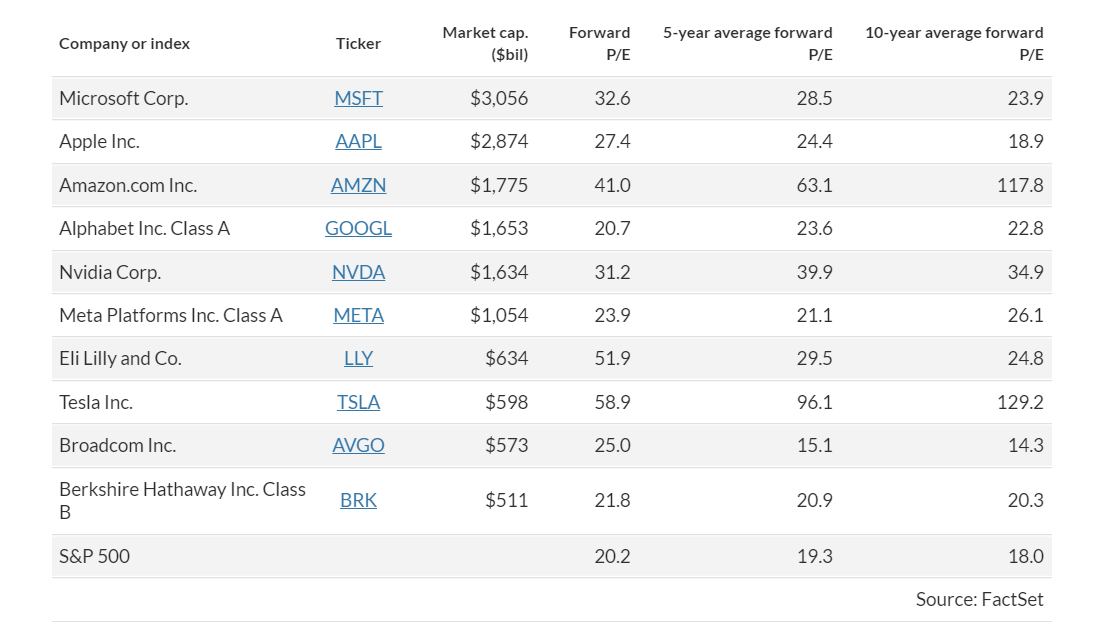
Among the top ten S&P 500 stocks, Meta is the second-cheapest in terms of forward P/E. The Magnificent Seven have a 29% portfolio allocation in the SPDR S&P 500 ETF Trust, while these 10 equities account for over 33% of the fund.
Meta’s forward P/E ratio of 24 is higher than the five-year average, but lower than the ten-year average. Six out of ten stocks trade above their five-year averages, and five trade above their ten-year averages. The index’s forward P/E is higher than both of its averages.
Leaving the group in the same order, let’s look at the predicted compound annual growth rates (CAGR) for sales, EPS, and free cash flow per share for the group and the index through 2025, based on FactSet’s consensus predictions of analysts. We utilise calendar year estimates because Microsoft, Nvidia, Apple, and Broadcom’s fiscal years do not coincide with the calendar.
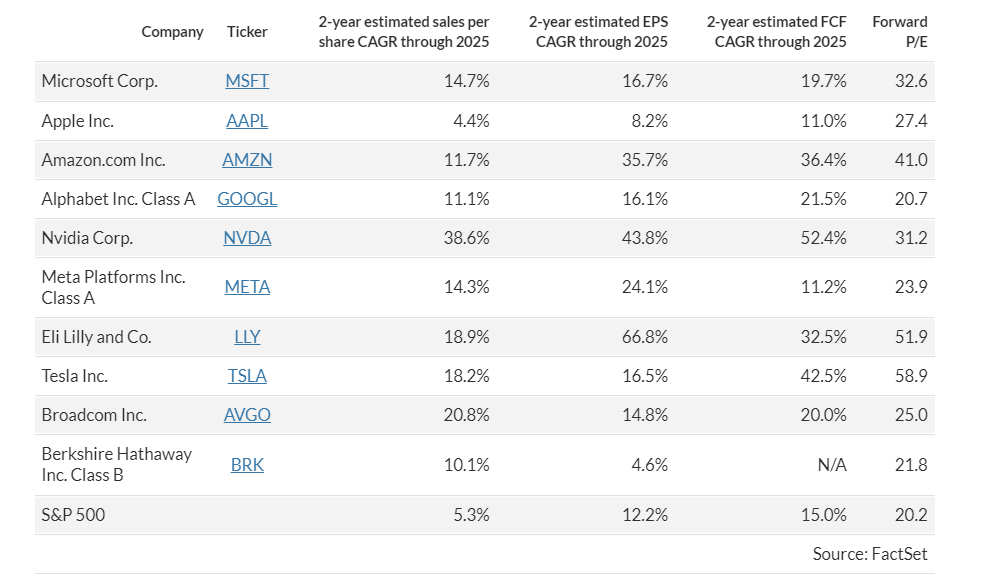
We put the forward P/E ratios on the right side of this table.
In contrast to Apple, Meta has a lower P/E ratio but a significantly greater predicted two-year CAGR for sales and earnings.
A company’s free cash flow (FCF) is the remaining cash flow after capital expenditures. This is money that can be utilised for expansion, dividend increases, share buybacks (which can reduce share count and enhance EPS), or other corporate goals. Meta’s relatively low anticipated FCF CAGR reflects the company’s ambitions to boost staffing and spending on a variety of initiatives, including hardware for artificial intelligence, data centres, and new product development.
Looking back
Here’s the group again, this time with five-year CAGRs for revenues, EPS, and FCF, as well as earnings until 2023, adjusted and estimated by FactSet for companies whose fiscal years do not correspond to the calendar:
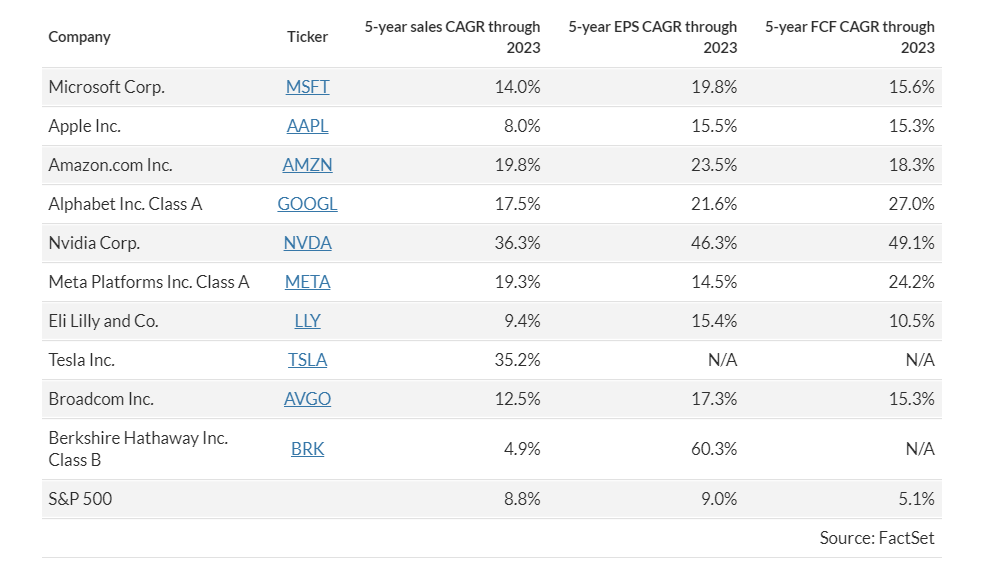
Meta has demonstrated strong growth during the last five years.
Let’s take a final look at these ten organisations, this time focusing on return on invested capital.
FactSet defines a company’s return on invested capital, or ROIC, as its earnings divided by the total carrying value of its common stock, preferred stock, long-term debt, and capitalised lease commitments.
ROIC is an annualised metric that shows how well a management team used the money invested to fund its operations. It is not an ideal tool for measuring performance, in part because various businesses require more capital than others.
It is important to note that a company’s carrying value may be significantly lower than its present market valuation. The corporation may have issued the majority of its shares many years ago at a significantly lower price than today’s. If a corporation issued a big number of newer shares lately or at a high price, its ROIC will be reduced. A company’s ROIC increases when it has less debt. If a corporation is obliged to increase borrowings, particularly when interest rates rise, its ROIC will decrease.
FactSet calculates ROIC across 12-month periods using companies’ most recently reported fiscal quarters. So we looked at the previous ten 12-month periods for the ten companies. Here’s the average, minimum, and maximum ROIC for five and ten years:
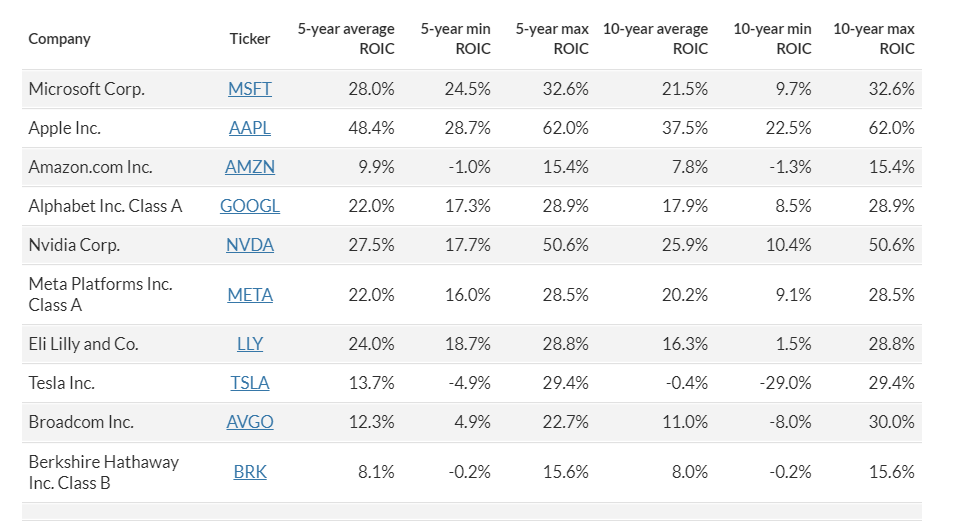
Meta is ranked sixth out of ten organisations in terms of average five-year ROIC and minimum ROIC throughout that period. For the past ten years, the company has ranked fourth.
Apple ranks first in both periods, showing many years of great success and free cash flow to fuel its expansion. However, Meta’s strong long-term track record, which includes the fourth-highest minimum ROIC over a 10-year period, provides support for its relatively low P/E value, particularly after the shares surged on Friday.
In conclusion, Meta can and should be referred to as a growth stock. However, it appears to be a solid value at these levels, based on predictions for significant growth in sales and earnings through 2025, historical data, and the S&P 500’s overall valuation.