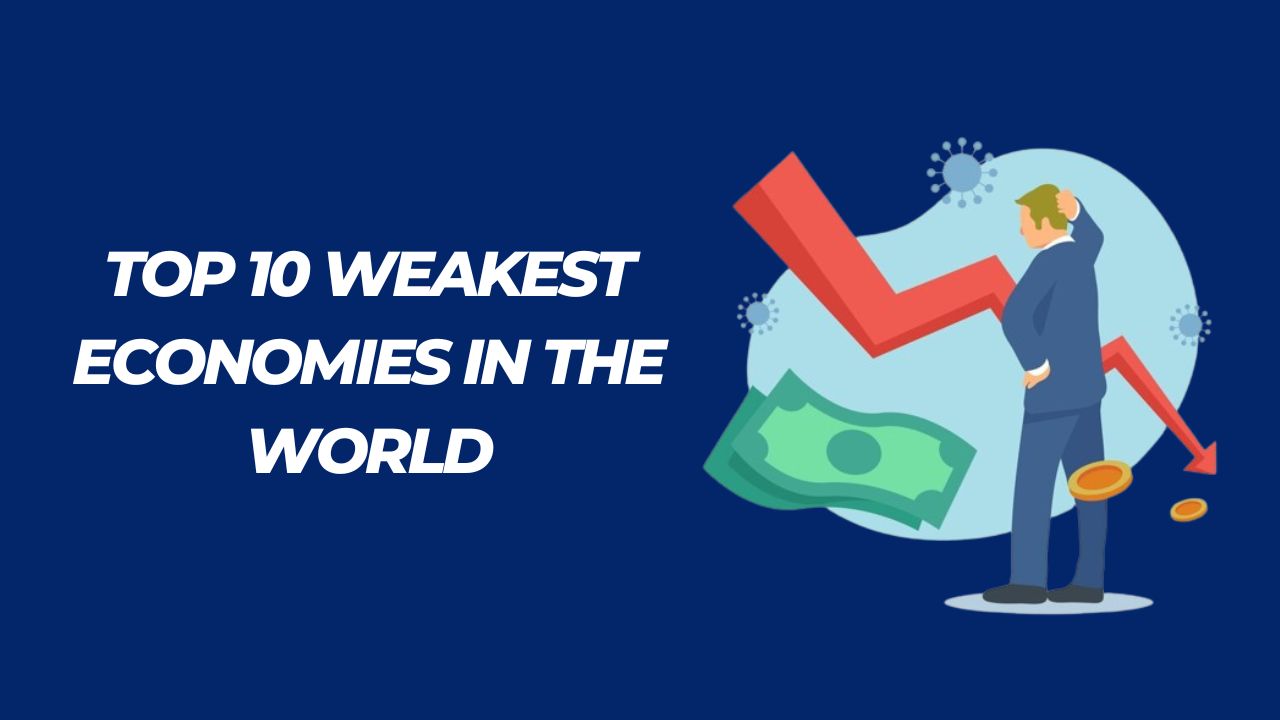
How many of the top economies in the world are you aware of? Yes, you should (it’s here). Conversely, we will talk about the world’s weakest economies. These are caused by the numerous reasons that continue to exist in the nations that fit this description. Even with several emergency fund initiatives and World Bank funding allocations, some nations are still struggling to recover from the economic conditions that are undermining them. Don’t ask me why; sometimes it can be difficult to determine why a nation would find itself in a protracted economic crisis.
A wealthy nation may fall into poverty as a result of incompetent leadership or official corruption. The world’s weakest economies have struggled with debt because it makes it increasingly difficult to pay for necessities like infrastructure, healthcare, and education as debt mounts.
The economy of the weakest nations suffer from a lack of resources, failing financial systems, and insufficient investment in areas that can spur economic expansion. I’ll go into great depth regarding the world’s weakest economies in this post, particularly what contributed to their precarious financial circumstances.
1. South Sudan
South Sudan is the world’s youngest nation, having gained independence on July 9, 2011. Political unrest, economic hardships, and conflicts have all impeded South Sudan’s progress. The civil conflict that started in December 2013 actually made matters worse because it severely damaged the nation for several years. The nation’s ability to conduct governance functions is reliant on international assistance. A barrier to real progress has been climate change and catastrophic calamities. There was a brief period of economic recovery after South Sudan assumed control of its oil deposits, but it was put to an end by the COVID-19 pandemic and flooding.
2. Burundi
Over 70% of Burundi’s labor force is employed in agriculture, making the country highly dependent on it. Soil erosion, civil unrest, and overpopulation all play a part in the nation’s economic downturn. Despite being self-sufficient in food production, Burundi still requires aid from outside sources. Burundi is classified as a least-developed nation by the UN. Meaningful investment has been hindered by a lack of security. Together, the World Bank and the IMF tried in vain to overhaul Burundi’s exports, coffee industry, and foreign exchange system in 1986.
3. The Central African Republic (CAR)
The core of the Central African Republic’s economy, agriculture, provides the majority of its income. Maize, plantains, millet, cassava, peanuts, and sorghum are the food crops cultivated. The nation is dependent on non-governmental organizations (NGOs) and foreign help. The nation’s economy has developed very slowly as a result of inadequate infrastructure, financial mismanagement, and a lack of investment. A workforce lacking in skills, a subpar transit system, and unfavorable macroeconomic policies are further problems.
4. The Democratic Republic of Congo (DRC)
Even though the Democratic Republic of the Congo is rich in natural resources, its economy has been in decline since the 1980s. The DRC’s economy was booming following its independence in 1960, particularly in the mining and agriculture sectors. However, political unrest, violence, and corruption prevented the country’s economy from expanding further. The 1996 hostilities in the Democratic Republic of the Congo resulted in lower government revenue, more foreign debt, and lower national productivity. The economy was weakened by this event, placing it among the weakest in the world.
5. Mozambique
Mozambique’s annual budget is mostly reliant on international assistance. The majority of workers in the nation engage in subsistence farming. Mozambique became a nation with extremely poor socioeconomic output by the end of 1992. The per capita GDP was 120 dollars in the 1980s and improved to 222 dollars in 2000. Mozambique suffered from debt, but a project known as “Heavily Indebted Poor Country” (HIPC) provided debt relief. The majority of state-owned small businesses have been privatized. Still, their economy is one of the poorest in the world, and they are having difficulties.
6. Malawi
The World Bank, individual donors, and the International Monetary Fund (IMF) provide financial support to Malawi’s economy. Malawi’s economy is among the poorest in the world because of ongoing macrofiscal imbalances and a lack of foreign money. It is anticipated that Malawi’s GDP will expand by 2.8% in 2024, thanks to macroeconomic changes.
7. Niger
Niger has a relatively low per capita income and has continuously been placed lowest on the Human Development Index. The nation is one of the most indebted nations. It has been challenging for Niger to address its economic problems due to its low resources and poverty. The Niger Republic’s economy is among the lowest in the world for a number of reasons, including this one.
8. Chad
Geographic isolation, political unrest, and a lack of infrastructure all hurt Chad’s economy. The World Bank and the African Development Bank (AFDB) provide financial assistance to the nation. Roughly 85% of people rely on agriculture for their subsistence. Chad’s GDP was rated 147th in the world in 2018. The economy is predicted to expand by at least 2.8 percent in 2024–2025. Chad has the tenth-largest oil reserves in Africa, but the country’s economy is still among the poorest in the world due to poverty, which is still a threat. Additionally, you can also read about- Bank of America Warns of Dollar Risk.
9. Liberia
Liberia’s economy has become one of the poorest in the world, largely due to the country’s two periods of civil conflict, which lasted from 1989 to 1996 and 1999 to 2003. The infrastructure and economy of Liberia were devastated by the civil war. Liberia is one of the world’s poorest and least developed nations, according to the UN. Liberia indeed has abundant natural resources, lush forests, and a thriving agricultural sector, but it lacks political stability and human capital.
10. Madagascar
Madagascar has been dealing with issues such as low physical and human capital, poor governance, and poverty. The issues were made worse by weak economic development and climate crises. By 2022, 75 percent of the population lived in poverty. It is projected that the economy will expand by 4.7% between 2024 and 2025. Madagascar has a market economy based on tourism, mining, agriculture, and textiles. A coup in Madagascar in 2009 impeded international investment and added to the country’s economic downturn.