

The moment to hire a business tax accountant is when a filing deadline carries a penalty you cannot absorb, not when revenue crosses a number. Payroll, contractors, inventory and multi-owner structures create those deadlines. Revenue on its own does not, which is why a six-figure sole proprietor with a simple income stream is often fine with a bookkeeper and a paid preparer at year end.
The harder question, once you decide when to hire a business tax accountant, is which tier to hire, and that answer depends on a fact
most pricing pages skip. The IRS reserves different powers to different credentials, and those powers matter on the day something goes
wrong.
The four situations that create a real need
The need is usually about deadlines, not revenue. Where no deadline bites, the pressure to hire is mostly self-imposed.
Payroll is the strongest trigger. Employer withholding, deposits and quarterly reporting run on short deadlines,
and lateness carries penalties that compound. A missed payroll deposit is not a bookkeeping inconvenience; it is a cost that grows daily.
Contractor payments are the second. Paying a contractor above the reporting threshold obliges you to issue an
information return, and the penalty for getting it wrong falls on the business, not the contractor.
Inventory and cost of goods is the third, because it decides whether a product is actually profitable. Without it you are
reading a revenue number and guessing at margin.
Multiple owners or outside investors is the fourth. A second party wants figures prepared to a standard they can trust, and
that changes what your output has to satisfy.
Revenue alone is not a trigger. A business earning well with one income stream, no employees and no inventory carries little reporting
burden, and paying a monthly retainer for it buys reassurance rather than work. The honest test is whether any of the four situations above
is present.
Representation rights decide more than the fee does
Buyers compare monthly fees. The IRS publishes a better comparison, and it is about who can stand in front of the agency for you.
Anyone with a preparer tax identification number can prepare a federal return for payment. The IRS states that plainly. But
practitioners fall into distinct tiers by credential, and the tiers differ in representation rights:
| Credential | Representation rights before the IRS |
|---|---|
| Enrolled agent, CPA, or attorney | Unlimited — any matter, including audits, collection issues and appeals |
| Annual Filing Season Program participant | Limited — only clients whose returns they prepared and signed, and not on appeals or collection |
| PTIN holder with no credential and no AFSP | None — may prepare returns, but no authority to represent clients |
That table is the reason the credential question outranks the price question. On a straightforward return the difference is invisible, because nothing goes wrong. If the IRS questions a filing, the preparer who charged less may be unable to represent you at all, and you then pay a second professional to do the work the first could not.
The IRS also lists what each credential requires, which is useful for judging claims. Enrolled agents are licensed by the IRS, pass a three-part Special Enrollment Examination covering federal tax planning, business return preparation and representation, and complete 72 hours of continuing education every three years. CPAs are licensed by state boards in 55 jurisdictions, have passed the Uniform CPA Examination, and must keep their license current with ongoing ethics and education requirements. Attorneys are licensed by state courts or bar authorities.
Annual cost by tier, and where the money actually goes
What you pay when you hire a business tax accountant varies widely by region and complexity, so the useful figure is the annual total rather than the monthly line. According to the published pricing bands collected for this article, adding twelve months of service to a business return changes the picture, and the tier-to-tier deltas show what the upgrade actually buys.
| Tier | Monthly | Annual, service plus business return | Year-on-year jump |
|---|---|---|---|
| Bookkeeper only, no tax filing | $300–950 | $3,600–11,400 | — |
| Accountant, monthly plus business return | $500–2,000 | $6,800–27,000 | $3,200–15,600 |
| CPA firm, monthly plus business return | $900–3,500 | $12,300–48,000 | $5,500–21,000 |
The spread widens as filing gets bundled, so a monthly quote understating the return is the most common way a cheap option turns out not to be. The wider jump sits between accountant and CPA firm rather than between bookkeeper and accountant, which means the middle tier is usually where the value sits.
Prices change, and these are ranges rather than quotes. A firm handling a multi-state payroll with inventory will sit at the top of a band, and a single-member service business with one income stream sits
near the bottom.
What to expect once you hire a business tax accountant
Knowing when to hire a business tax accountant is one decision; knowing what the engagement covers is the other. Beyond filing, the work
splits into four functions.
Recording. Every transaction reaches a ledger coded to the right account. This is the layer everything else rests on, and an error here does not surface until a filing or a lender asks about it.
Reporting. The ledger becomes a balance sheet, income statement and cash flow statement prepared to a recognized standard, which is what makes the numbers usable by anyone other than you.
Compliance. Federal and state returns, payroll filings, and information returns for contractors are prepared and submitted on legal deadlines.
Advisory. This covers what the numbers mean — whether a product line is profitable after overhead, whether a hire is affordable, how a purchase should be structured. It is the function owners underestimate before hiring and value most afterwards.
The year has a shape worth knowing, because the work is not evenly spread. Month end brings reconciliation and management figures. Quarter end brings estimated tax payments and recurring payroll and sales tax filings. Year end brings the annual statements, the entity return and contractor information returns. Ad hoc work sits outside the cycle, when a lender asks for statements or an ownership change is discussed.
How to verify one before you engage

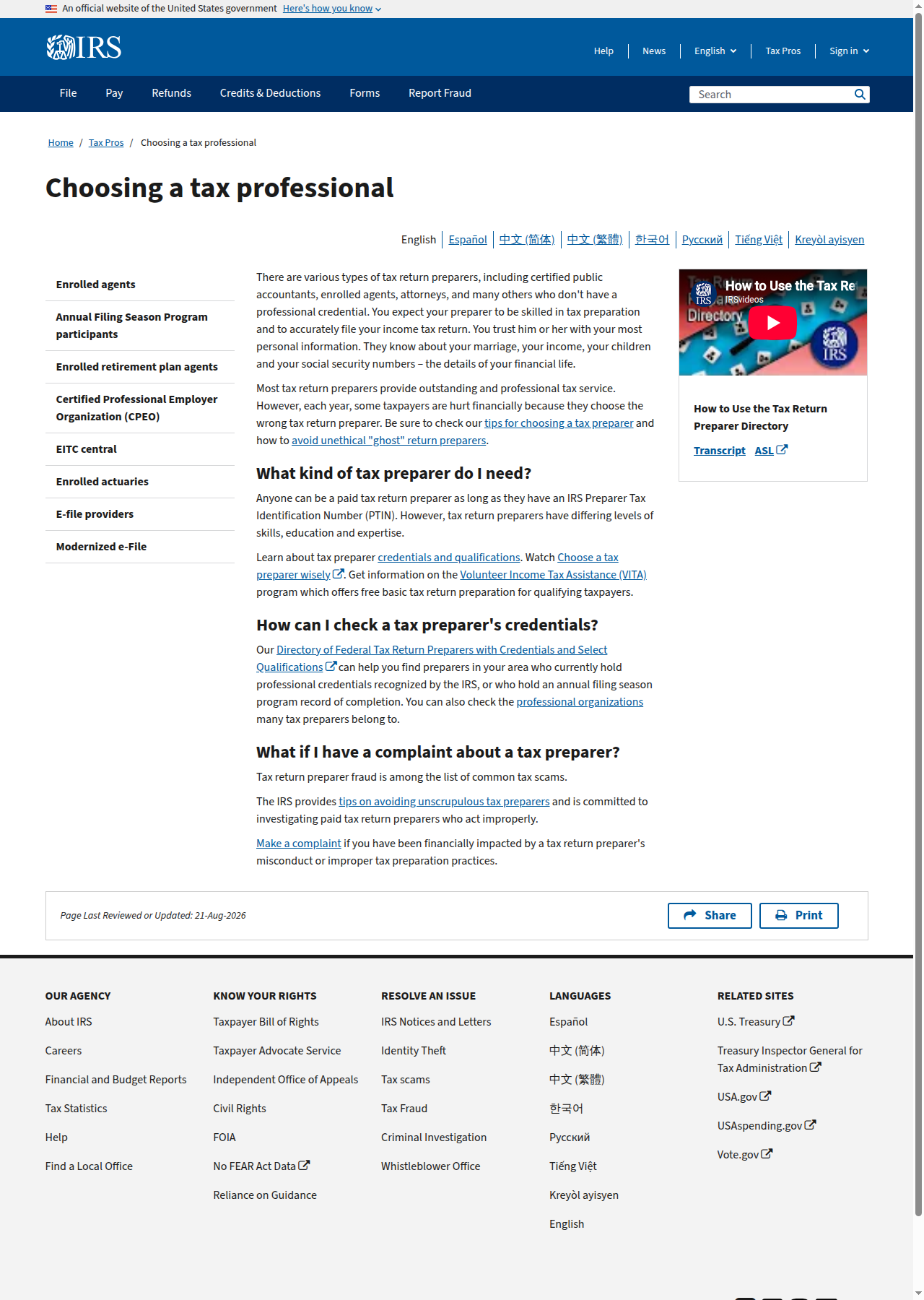
The IRS publishes a free, searchable directory of federal tax return preparers who hold credentials or a selected qualification. It lists preparers by name and location, covering attorneys, CPAs, enrolled agents and others with a current annual filing season record.
For a CPA specifically, confirm the license with the state board of accountancy in the state where the work will be delivered. Licensing is state-level across 55 jurisdictions, so a license held in one state does not automatically travel to another, and a business operating across state lines should check the state that governs the engagement.
For anyone charging for advice or return preparation, ask for the PTIN and confirm it. A PTIN alone proves eligibility to prepare, not expertise, and it is worth asking directly which credential the person holds and whether the firm or an individual will sign the return.
The IRS also publishes guidance on choosing a preparer and on so-called ghost preparers, who take payment and disappear without signing the return. A preparer unwilling to sign is the strongest single warning sign available.
The verdict: which tier your business actually needs
The decision to hire a business tax accountant follows business shape rather than revenue. Four profiles cover most cases.
Sole proprietor, simple income, no payroll, no inventory. A bookkeeper plus a preparer engaged at year end is the correct choice, not a compromise. There is no payroll deadline to miss and no third party relying on the output, so the representation tier you are paying for is unlikely to be tested. Spend the difference on a clean bookkeeping system.
Payroll, contractors, or inventory. Move to an accountant or enrolled agent on a monthly retainer. This is where the trigger fires, and it is where the cheap option fails, because a missed deposit or information return carries a penalty that exceeds the fee difference several times over. The enrolled agent is worth serious consideration here: IRS-licensed, examined on business tax and representation, and typically priced below a CPA firm.
Multiple owners, investors, a lender, or cross-border activity. A CPA. Not because the return is harder to prepare, but because the output has to be relied on by a bank, an investor or a co-owner — and the IRS reserves unlimited representation rights to CPAs, enrolled agents and attorneys precisely for the disputes that come with outside parties reviewing your numbers.
Unsure which you are. Start at the accountant tier with a written scope naming exactly what is included, and move up when a trigger fires. Moving up later is straightforward; moving down means rebuilding trust with your own records.
Why the cheaper option sometimes wins
The verdict above is not a license to spend. There are real cases where the lowest tier is correct.
A solo consultant with one client, no employees and a modest income genuinely does not need a monthly retainer. A business in its first year
with no revenue has nothing to reconcile. An owner who already keeps a clean ledger and understands their own numbers buys less value from the reporting layer than one who does not, and paying for work you have already done is the most avoidable cost in this decision.
The trap runs the other way too. Owners hire a business tax accountant with a CPA credential for a simple sole-proprietor return because it feels safer, and pay several thousand dollars a year for representation rights that never get used. The test is not which credential is most impressive; it is which one your business shape actually requires.
Scope, limits, and the questions this article leaves to a professional
This is general information about how US preparer credentials, representation rights and typical pricing bands work. It is not tax advice for your situation, and it does not tell you how to structure your entity or which firm to hire.
Scope limits worth naming. Everything here applies to United States federal practice; state filing requirements and deadlines differ, and
other countries license accountants quite differently. Pricing varies by region, industry and complexity, and the ranges above are published
bands rather than quotes for your business. A firm’s fee also depends on whether it signs the return, whether it handles notices, and what
happens if it makes an error, all of which belong in a written engagement letter before work starts.
If you are weighing when to hire a business tax accountant, the decision that affects real money and a real deadline belongs with a licensed professional in your jurisdiction who knows your full position.