

Have you ever looked at your sales numbers, felt great, and then checked your bank account and felt your stomach drop? You’re making money on paper. So why does it feel like there’s never enough cash to go around?
Suppliers want their payments. Employees need their paychecks. Bills keep arriving. And your customers? They’re taking their sweet time paying those invoices.
This squeeze has a name, and understanding it changes everything. So, what is working capital? It’s the money your business has available to cover short-term bills and keep things running. Think of it as your financial cushion.
Here’s the simple math: working capital is the difference between your current assets (cash and money customers owe you) and your current liabilities (bills you owe suppliers). A healthy working capital ratio sits between 1.0 and 2.0, meaning you have one to two dollars in current assets for every dollar you owe.
I’m going to walk you through what working capital means, why it matters, and the exact steps you can take to improve yours. Grab a coffee, and let’s go through it together.
What Is Working Capital?
Working capital is the money your business has available to pay bills and keep operations running smoothly. It’s the difference between what you own right now and what you owe right now.
Definition and Importance
Net working capital, or NWC, is your current assets minus your current liabilities. Current assets include cash, inventory, and money owed to you that you’ll collect within one year.
Current liabilities are the debts and obligations you must pay within that same timeframe. This simple math tells you something powerful: how much liquid money your business actually has to work with.
The formula looks like this:
Current Assets – Current Liabilities = Working Capital
This number reveals whether you can pay your bills and keep the lights on. But its importance goes beyond simple math.
Your working capital directly measures your short-term financial health and operational efficiency. A company can be profitable on paper yet still face bankruptcy if cash flow dries up.
And this problem is more common than you might think. According to the Federal Reserve Banks’ Small Business Credit Survey, covering 2025 and published in the 2026 reports, 94% of employer firms faced at least one financial challenge. More than half (56%) struggled to pay operating expenses, and 51% dealt with uneven cash flow. If cash feels tight at your business, you’re in very crowded company, which is exactly why tracking this number matters.
Profitability and liquidity are different animals. You need working capital to:
- Meet short-term obligations like rent and loan payments
- Pay employees on time, every time
- Purchase supplies and inventory
- Grab growth opportunities when they appear
The amount you need varies based on your industry, company size, and risk profile. Retail businesses need different working capital levels than service companies. Without enough of it, even successful businesses stumble and fail.
The Working Capital Formula
Working capital equals your total current assets minus your total current liabilities. Let’s look at some real numbers to make this concrete.
| Current Assets | Current Liabilities | Working Capital |
|---|---|---|
| $100,000 | $30,000 | $70,000 |
| $200,000 | $150,000 | $50,000 |
| $150 billion (major corporation) | $120 billion | $30 billion |
If your company has $100,000 in current assets and $30,000 in current liabilities, you have $70,000 in working capital. That’s your cash cushion. Even the largest corporations use this exact same formula.
The numbers change often, which makes tracking your current position tricky. But the formula never changes.
There’s a second calculation worth knowing: your working capital ratio, also called the current ratio. You get it by dividing your current assets by your current liabilities.
A ratio between 1.0 and 2.0 is generally considered healthy for most small businesses. Some small-business finance guides, such as Pursuit Lending’s working capital guide, suggest a slightly stricter floor of 1.2. And here’s a tip many owners miss: a ratio far above 2.0 isn’t automatically good. It can mean cash sitting idle or too much money tied up in inventory.
Both calculations work together to paint a complete picture of your cash flow and balance sheet strength. Track them regularly, and you’ll spot problems before they become serious.
Why Working Capital Matters for Small Businesses
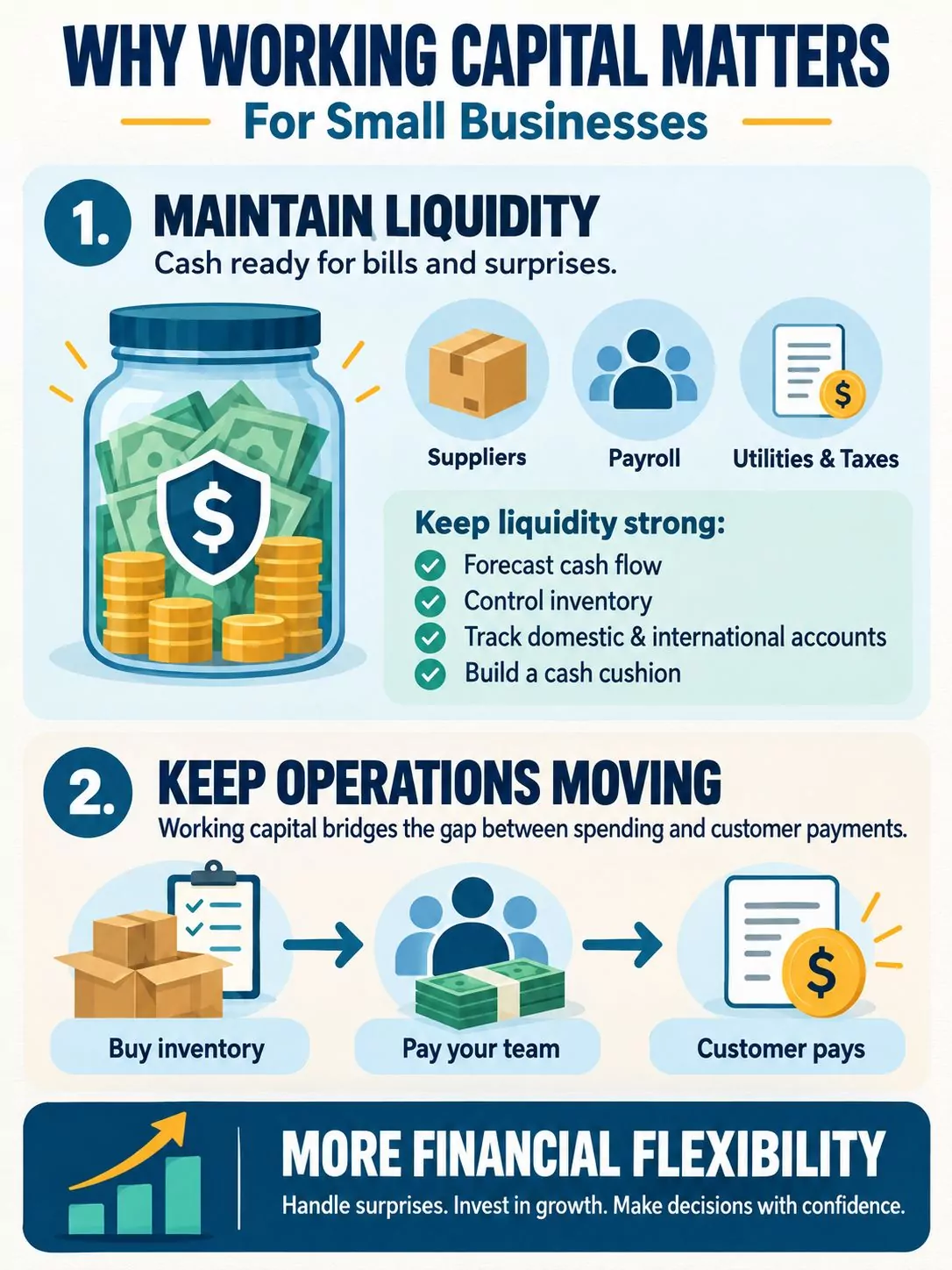
Working capital keeps your small business running smoothly, day after day. Without it, you’ll struggle to pay suppliers, cover payroll, and handle the surprise expenses that always seem to pop up.
Maintaining Liquidity
Liquidity management keeps your business breathing. It measures how fast you can turn assets into cash, and that speed matters when bills pile up.
Your suppliers need payment. Your employees expect their wages. Taxes come due, and utilities keep the lights on. Short-term liabilities hit constantly, and you need cash ready for all of them.
Cash and cash equivalents are your most liquid assets. They give you immediate money for expenses and investments. Higher liquidity means you handle unexpected costs without scrambling or borrowing.
So how do you keep liquidity strong? A few habits make the biggest difference:
- Accurate cash flow forecasts show you what money comes in and goes out each month
- Inventory control stops you from tying up cash in products sitting on shelves
- Full visibility of your bank accounts, both domestic and international, gives you real control
- A cash cushion lets you cover routine expenses without running to lenders
Financial flexibility becomes your superpower. You make decisions based on what’s best for your business, not what your bank account forces you to do. And your operational efficiency climbs because you’re not constantly firefighting cash shortages.
Supporting Day-to-Day Operations
Your company needs cash to buy inventory, pay employees, and settle supplier payments on time. Without liquid funds, operations grind to a halt.
Customers expect fast delivery. Your team expects paychecks. Suppliers want their money when promised. Working capital makes all of this happen without straining your cash flow.
Think of working capital as your business’s lifeblood. It covers the gap between what you spend and what you earn:
- Your inventory sits on shelves waiting to sell
- Your employees work before customers pay you
- Your suppliers deliver goods before invoices get paid
Working capital bridges these timing gaps. It also gives you a buffer against challenges like economic downturns or sudden drops in demand.
This cushion protects your business from risk, so you can handle surprises without panic. Revenue growth gets easier too, because you have the resources to invest in new equipment or expand your product lines when the moment is right.
Types of Working Capital Status
Your business lands in one of two camps: you either have money left over after paying your bills, or you don’t. Your working capital status tells you which camp you’re in, and that answer shapes every money decision you make next.
Positive Working Capital
Positive working capital happens when your current assets exceed your current liabilities. Your business has more money and resources available than it owes in the short term.
This signals good short-term financial health. For example, a company with $48,000 in positive working capital has enough short-term assets to cover all its liabilities. That breathing room lets you handle surprise expenses, pay suppliers on time, and keep operations running without stress.
Strong liquidity also opens doors for growth. A working capital ratio of 1.5 means you have $1.50 in current assets for every $1.00 of current liabilities, which points to solid financial stability.
With that kind of cushion, you can:
- Put money into short-term investments
- Purchase new equipment
- Hire talented staff without risking your solvency
- Expand when opportunity knocks, instead of scrambling for cash
Negative Working Capital
Negative working capital happens when short-term liabilities exceed short-term assets. It’s like having more bills due next month than cash in the bank to pay them.
This status signals potential financial distress and warns of cash flow trouble. Your business may struggle to meet short-term obligations without outside financing, and bankruptcy risk climbs if liabilities keep outpacing assets.
That said, negative working capital doesn’t always spell doom. Some companies in growth stages, or those that collect from customers faster than they pay suppliers, handle it just fine.
Here’s a real-world turnaround worth studying. One subscription business faced this exact challenge and flipped it in just two months:
| Metric | Before | After |
|---|---|---|
| Working capital ratio | 0.86 | 1.28 |
| Working capital | -$9,800 | +$16,300 |
| Net improvement | +$26,100 | |
How did they do it? The company negotiated extended supplier terms from net 15 to net 45 while speeding up customer billing to immediate payment. The owner said aligning supplier terms with customer billing turned a cash problem into a multi-week cushion almost overnight.
The lesson: working both sides of the equation at once can shift your status fast.
Still, most small business owners should treat negative working capital seriously. Tracking your status helps you spot cash flow problems before they become real headaches.
How to Improve Working Capital
You can boost your working capital in two ways: cut down on what you owe right now, and make your current assets work harder for you. Owners who take action on both fronts see real improvements in their cash flow and financial stability.
Reducing Current Liabilities
Reducing your current liabilities frees up cash your business needs right now. Here’s where to start:
- Skip short-term borrowing you don’t truly need. Fewer loans mean a lighter debt load.
- Negotiate longer payment terms with suppliers. Extended payables keep money in your account longer while you still meet obligations.
- Renegotiate existing vendor contracts to lower costs. Better terms save money and improve your cash position.
- Switch to electronic payments like ACH or wire transfers instead of paper checks. Digital payments cut the costs of printing, handling, and storing documents.
That last point deserves real numbers. One regional service contractor compared the cost of paper checks versus ACH for 60 vendor payments over three months. Paper checks cost roughly $4.20 per payment once printing, envelopes, postage, and reconciliation were counted, totaling $756. ACH ran about $0.35 per payment, just $63 total.
The $693 saved equaled roughly one week of operating payroll for that business. As the owner put it, moving supplier payments to ACH shaved nearly seven hundred dollars in three months and simplified reconciliation.
Independent data backs this up. According to the Association for Financial Professionals’ 2022 Payments Cost Benchmarking Survey, the median cost of issuing a paper check runs $2.01 to $4.00, while an ACH payment costs about $0.26 to $0.50. The contractor’s all-in check cost sat at the high end of that range, but even at the median, checks cost many times more than ACH.
A few more ways to shrink what you owe:
- Move accounts payable to electronic workflows. Cleaner processes reduce errors and help you track what you actually owe.
- Cut operating costs by improving internal processes, or outsource functions where quality stays strong.
- Plan for accrued liabilities, the expenses you’ve incurred but haven’t paid yet. Anticipating them prevents surprise payment demands.
- Trim unnecessary spending across the business. Good expense management keeps liabilities from growing out of control.
Making Current Assets Work Harder
Your current assets form the backbone of your business’s financial health. Smart management here directly improves your cash flow and liquidity.
- Build cash reserves by setting aside profits regularly. This gives you a safety net for surprises and opportunities.
- Speed up accounts receivable by offering early payment discounts, which encourages customers to pay invoices faster.
Why does speed matter so much? Because getting paid is taking longer across the board. According to 2026 US small business payment-timing reports, including Xero’s payment-time data and a July 2026 overdue-invoice survey, small businesses waited about 29 days on average to be paid in the second quarter, with payments arriving roughly 9 days late. The survey also found 59% of small businesses had invoices overdue by 30 days or more, up from 47% a year earlier. Among businesses with overdue invoices, 51% said cash flow was a problem, compared with 36% of those without.
Slow collections are getting worse, so anything that pulls cash in faster protects your working capital. One professional services firm proved how well a small discount can work. It offered a 2.5 percent early-payment discount on 30 invoices over one quarter:
- 18 of 30 invoices were paid within 7 days of the offer
- Average days sales outstanding fell from 42 to 19 days
- Earlier collections added an estimated $14,200 in available working capital that quarter
The owner explained that a modest 2.5 percent discount moved nearly 60 percent of invoices into the bank within a week, freeing cash that covered payroll that month. That’s a big liquidity boost with no complicated financing involved.
Keep the momentum going with these steps:
- Move your invoicing to electronic systems, which get payments to you quicker than paper methods.
- Encourage customers to pay electronically, cutting the time money sits in transit.
- Use demand forecasting tools to predict what customers will buy, so you stock the right amounts without tying up cash.
- Control inventory levels by avoiding over-ordering. Products sitting on shelves drag down your working capital ratio.
Inventory changes can free serious cash, too. A small retail shop ran a 12-week pilot using weekly demand forecasting and two-cycle inventory counts. Overstock days fell from 48 to 21, carrying cost estimates dropped by 28 percent, and working capital tied up in inventory shrank by $22,400 at quarter end.
The shop owner said weekly forecasts and tighter counts cut slow-moving stock nearly in half and released a meaningful chunk of cash. No expensive software required, just consistent attention to what you stock and how much you order.
Two final moves to round out your plan:
- Use inventory management tools to track stock in real time, preventing both stockouts and overstock.
- Prepay certain expenses when discounts are available, locking in savings that lower future costs.
Final Thoughts
Working capital management isn’t a one-time task. It’s an ongoing practice that shapes your business’s financial health. So, what is working capital really? It’s your financial backbone. Small business owners who track their current assets and current liabilities catch cash flow problems before they strike.
By trimming what you owe and making your assets work harder, you build the cushion needed to handle surprise costs and fund growth. Even profitable companies collapse without it.
Frequently Asked Questions (FAQs)
1. What is working capital?
Working capital is the money your small business has left after you subtract what you owe soon from what you own now. Think of it as the cash cushion that keeps the lights on, pays your team, and covers inventory between sales.
2. How do I calculate working capital?
Take your current assets, like cash, inventory, and unpaid customer invoices, and subtract your current liabilities, like bills and short-term loans. If the number is positive, you can breathe easy.
3. Why does working capital matter for a small business?
It shows whether you can cover daily costs without scrambling for cash. Even a profitable shop can sink if money is stuck in unsold stock or slow-paying customers. According to U.S. Bank research, 82% of small business failures are tied to cash flow problems.
4. How can I improve my working capital?
Collect customer payments faster, trim extra inventory, and ask vendors for longer payment terms. Small tweaks here add up, and your bank balance will thank you.