

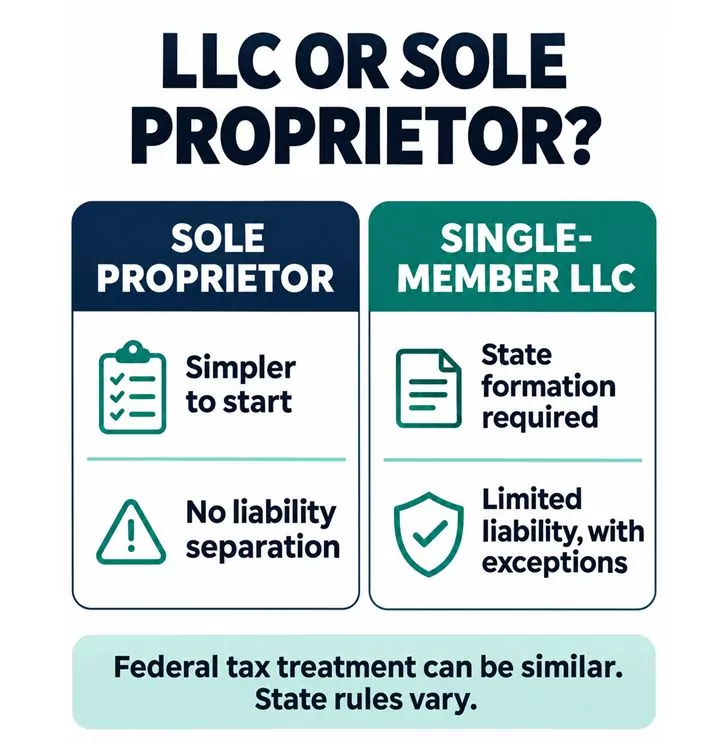
A sole proprietorship is usually the simplest way to begin a one-person business. A single-member LLC takes more work to form, but creates a legal entity that generally limits an owner’s personal liability for certain business debts. That protection has exceptions, and an LLC does not automatically reduce federal income or self-employment taxes.
Your decision should begin with the risks you take on, your state’s formation and ongoing costs, and the records you are prepared to maintain. This guide explains the tradeoffs and the questions to ask before choosing.
A founder perspective
I am Sukanta Kundu, Founder and CEO of Editorialge Media LLC. The company was formed on February 21, 2023. Choosing a business structure is a decision that connects the legal identity of a company with the practical responsibilities of operating it.
If you are weighing the options for your own business, look beyond the name on the formation document. Consider the contracts you may sign, your exposure to claims, the cost of maintaining an entity, and the records you will need to keep. The right choice will depend on your situation and the state where you operate.
LLC vs sole proprietorship at a glance
| Question | Sole proprietorship | Single-member LLC |
| Separate legal entity | No separate entity from the owner. | Generally a separate entity under state law. |
| Personal liability | Owner can be personally responsible for business obligations. | Generally limits owner liability for LLC debts, subject to exceptions. |
| How it starts | Generally arises when an individual conducts business without forming another entity. | Formed under state law through required filing. |
| Default federal income tax | Business income or loss generally reported on owner’s return. | Generally reported on owner’s return unless corporate treatment is elected. |
| Self-employment tax | Generally applies to eligible net self-employment earnings. | Generally applies to eligible trade or business earnings under default treatment. |
| Ongoing requirements | Fewer entity-formation formalities; permits may apply. | State formation and ongoing requirements vary. |
What is a sole proprietorship
A sole proprietorship is a business owned by one person that has not been formed as a separate entity. A freelancer or product seller who begins operating alone without forming an LLC or other entity may already be a sole proprietor.
You generally do not file LLC formation documents to start. Depending on the work and location, however, you may still need a business license, professional license, sales tax registration, or trade-name filing. A sole proprietorship does not create a separate business entity, so the owner may be personally liable for its debts and obligations.
What is a single member LLC
A single-member LLC is a limited liability company with one owner, known as a member. It is formed under state law, generally by filing formation documents and paying the required fee. The LLC is generally separate from its owner under state law, which can limit personal liability for certain business obligations.
The IRS often treats a domestic single-member LLC as a “disregarded entity” for federal income tax purposes unless it elects corporate treatment. This describes a tax classification; it does not mean the LLC ceases to exist as a separate state-law entity.
Liability is often the most important difference
As a sole proprietor, you and your business are not legally separate. Business debts or claims can expose your personal assets. The structure itself does not provide an LLC liability shield.
An LLC generally provides separation between company obligations and the owner, but it is not an absolute shield. Depending on state law and the facts, you may still face personal exposure if you sign a personal guarantee, commit a wrongful act yourself, personally assume an obligation, or a court does not respect the company’s separate status.
Maintain accurate records, use the LLC’s legal name on contracts, and keep personal and business finances separate. These habits are useful but do not guarantee protection. Discuss your actual contracts and exposure with a qualified attorney.
An LLC does not replace insurance
A business insurance policy may cover certain claims, defense costs or property losses, subject to policy terms, limits and exclusions. Depending on the work, an owner may need general liability, professional liability or product liability coverage. Ask an insurance professional what your actual policy covers.
Federal taxes are often similar by default
A sole proprietor generally reports business income and expenses on their personal federal tax return, commonly using Schedule C for a qualifying business. A domestic single-member LLC with an individual owner and no corporate election generally reports its activity on the owner’s return as well, often using Schedule C where applicable.
For an individual owner operating a trade or business, the IRS generally applies self-employment tax to eligible net earnings from a default-taxed single-member LLC in the same manner as a sole proprietorship. Forming an LLC does not automatically create a federal tax saving.
An illustrative example
Suppose a freelance editor has $80,000 in revenue and $20,000 in deductible business expenses. The resulting $60,000 is net business profit before the owner’s other tax calculations. Merely placing the same business in a default-taxed single-member LLC does not make that profit disappear or automatically create a special tax deduction. This is a simplified hypothetical; actual tax depends on the facts.
What about an S corporation election
An eligible LLC may elect S corporation tax treatment. This is a federal tax election, not the state-law act of forming an LLC. It can bring payroll, reporting and accounting requirements. The IRS requires reasonable compensation for shareholder-employees for services before non-wage distributions. Whether a particular election saves money depends on the facts and the cost of compliance.
Not every owner is eligible. The IRS does not permit nonresident alien shareholders in an S corporation. A founder outside the United States should seek cross-border advice before assuming the election is available.
Costs and paperwork to check before deciding
State requirements differ. Instead of relying on an average advertised LLC price, make a first-year and recurring-cost checklist for the state where you form and operate the business.
- State formation fees and filing method.
- Annual or periodic reports, franchise taxes and other recurring obligations, if applicable.
- Registered agent requirements and any cost of a service.
- Local licenses, professional permits, sales tax and trade-name or DBA registrations.
- Accounting, legal, bookkeeping and payroll costs that apply to your situation.
- Additional registration requirements if your business operates in another state.
Sole proprietors can also face registration, licensing and insurance costs. If you later close an LLC, check your state’s dissolution rules; stopping operations does not necessarily end filing and tax obligations
EIN and bank account considerations
An Employer Identification Number, or EIN, is a federal tax identification number. A single-member LLC does not always need its own EIN for federal income tax purposes, but it may obtain one for banking or state tax purposes. Different rules apply when an LLC has employees or certain excise obligations. Ask your bank what it requires.
Keeping a dedicated business account can make bookkeeping easier for a sole proprietor or an LLC. For an LLC it is a useful separation practice, but an account alone does not guarantee liability protection.
When a sole proprietorship may make sense
A sole proprietorship can be a practical starting point if you are testing an idea, have relatively limited exposure, and understand that business obligations can be personal obligations. Consider the type of work, client contracts, insurance coverage and licensing—not simply the fact that you work alone.
For example, a freelance editor with no employees, inventory or long-term lease might consider this route after assessing actual professional and contractual risks. This example is hypothetical; editing is not automatically risk-free.
When a single member LLC may make sense
An LLC may be worth the cost and administration if the business takes on significant contracts, inventory, a lease or other obligations, or if you value the legal separation it generally provides. Your decision still needs to account for personal guarantees, insurance exclusions, state law and how the company will be managed.
A one-person seller carrying physical inventory and signing supply contracts, for example, may want to discuss an LLC and product liability insurance with advisers. This example is illustrative, not a guarantee of protection.
Can you start as a sole proprietor and form an LLC later
Often, yes. But changing structure may require more than adding LLC to your website. Review state formation, business accounts, existing contracts, licenses, insurance, tax registrations and whether an EIN change is needed. The SBA notes that changing structure may involve restrictions or tax consequences.
A note for foreign owners of US LLCs
A foreign-owned US single-member LLC can have reporting obligations that are separate from its federal income tax classification. A foreign-owned US disregarded entity with reportable related-party transactions may need to file Form 5472 with a pro forma Form 1120. Whether a filing is required depends on the facts and IRS instructions. US and home-country tax obligations are separate questions.
Founders living outside the United States should have their structure, transactions and reporting reviewed by a qualified cross-border tax adviser.
Frequently asked questions
Is a single-member LLC the same as a sole proprietorship?
No. A single-member LLC is formed under state law as a separate entity. Its default federal income tax treatment can resemble that of a sole proprietor, but the structures are not identical under state law.
Does an LLC automatically lower self-employment tax?
No. Under default treatment, eligible self-employment earnings are generally treated similarly. A different tax election has separate conditions and costs.
Can a sole proprietor use a business name?
Yes. A sole proprietor can use a trade name, but state or local rules may require a DBA or fictitious-name registration. A trade name alone does not create a separate legal entity.
Can a one-person LLC hire employees?
Yes. Single-member describes the number of owners, not employees. Employer registration and employment-tax obligations can apply.
Do I need an LLC if I have insurance?
Not necessarily. Insurance and legal structure address different risks. Coverage depends on policy terms; liability protection depends on applicable law and facts. Discuss both with qualified advisers.
Which should you choose
A sole proprietorship may fit an owner who values simplicity and understands the personal exposure. A single-member LLC may be worth considering when business obligations make legal separation valuable enough to justify formation and ongoing compliance. Start with the actual risk, then check state costs and the tax consequences of any proposed election.