
Managing client retainers well means setting a clear scope, tracking hours or deliverables against a fixed fee, billing on a predictable schedule, and reviewing the agreement before renewal. Agencies that do this consistently protect their margin, avoid scope creep, and keep client trust intact over multiple renewal cycles.
Most agencies now treat retainers as their core revenue model rather than an afterthought. Learning how to manage client retainers: billing, tracking and renewals properly is the difference between a predictable monthly income stream and a constant cycle of renegotiation and unpaid overages.
What’s the Difference Between a Retainer and Project-Based Billing
A retainer is a recurring fee paid in advance for ongoing access to your time or deliverables, while project-based billing charges a fixed amount for a defined, one-time scope of work. The retainer model builds predictable monthly revenue; project billing ties payment to completion of a specific deliverable.
For agencies, consultants, and freelancers, this distinction affects cash flow, staffing, and client relationships directly. A project fee ends when the work ends. A retainer renews, which means the client relationship, and the trust behind it, has to be maintained continuously, not just delivered once.
Choose a retainer if the client needs ongoing work (SEO, content, paid media management, fractional leadership). Choose project billing if the scope is a single deliverable with a clear end date, like a website build or a one-time audit.
How Much Should I Charge for a Monthly Client Retainer
Monthly retainer pricing varies widely by service type and seniority, typically ranging from under $1,000 for advisory-only packages to $8,000,$13,000 for full-service or fractional leadership work. Pricing should reflect hours required, expertise level, and the value delivered, not just a flat industry average.
Recent market data on retention-focused agencies shows monthly retainers starting around $995 for lighter advisory packages and climbing to $8,995 per month for hands-on fractional team leadership, according to a 2026 cost review of retention agencies. Full-service retention marketing retainers run from roughly $4,000 to $4,500 at entry level up to $13,000 per month for top-tier lifecycle and subscription work, per industry shortlists tracking retention marketing agency pricing.
How Do I Track Hours and Billable Work Against a Retainer
Track hours against a retainer using time-tracking software tied directly to the retainer project, so every hour logged reduces the remaining balance in real time. This lets you see burn rate, remaining capacity, and profitability before the billing period closes, not after.
Even fixed-fee retainers benefit from internal time tracking. Without it, you have no documentation to support scope decisions, overage billing, or renewal pricing. Best practice:
- Log time against the specific retainer, not a general client account.
- Review burn rate weekly, not just at month-end.
- Flag any retainer that’s over 80% used with more than a week left in the period.
- Report usage to the client on a recurring cadence (weekly or biweekly) so there are no surprises.
When Should I Renew a Client Retainer Agreement
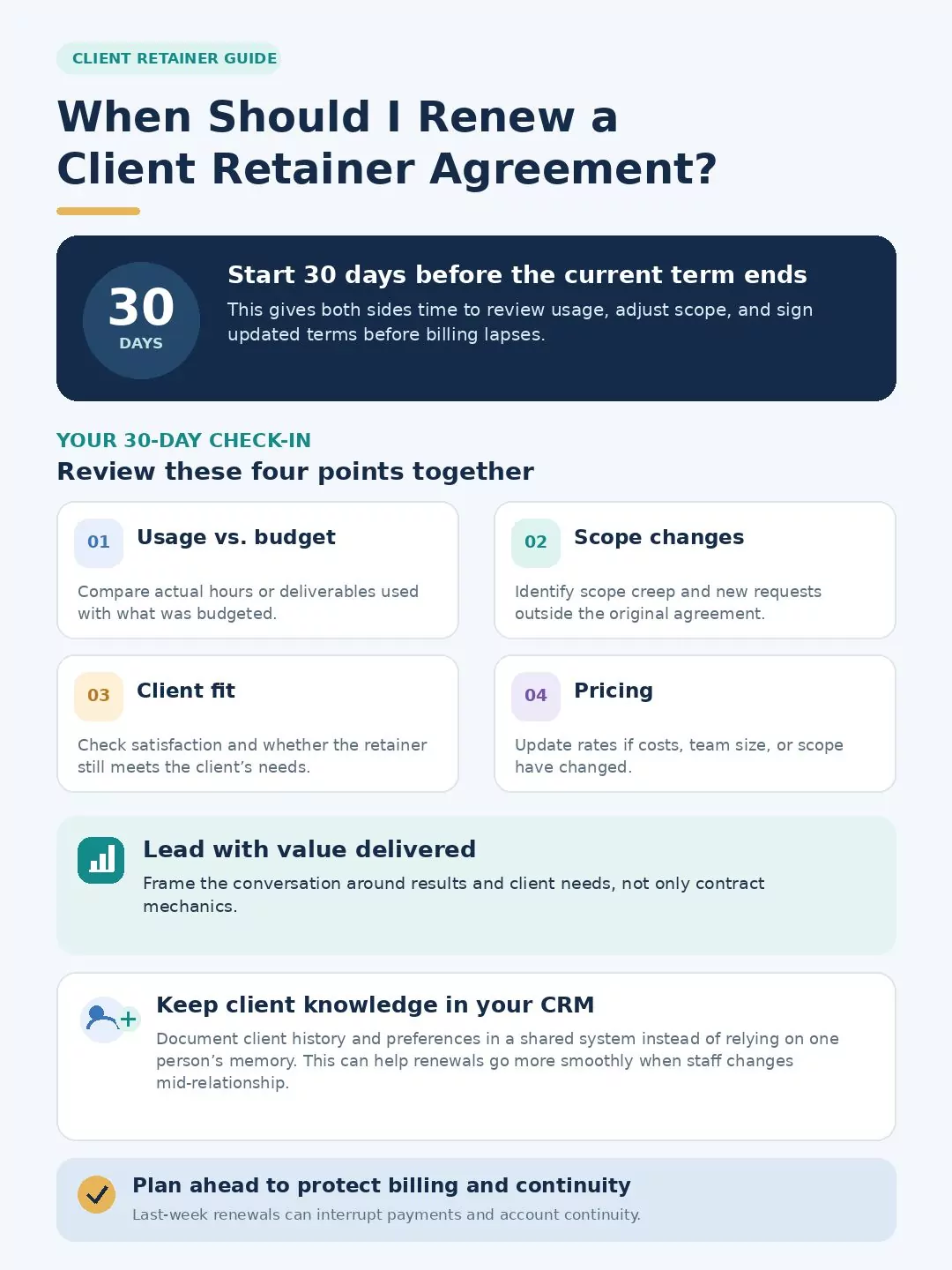
Retainer renewals should be initiated 30 days before the current term ends, giving both sides time to review usage data, adjust scope, and sign updated terms without a lapse in billing. Waiting until the last week creates gaps in payments and account continuity.
A structured 30-day check-in should cover:
- Actual hours or deliverables used versus what was budgeted.
- Any scope creep or new requests that weren’t part of the original agreement.
- Client satisfaction and whether the retainer still fits their needs.
- Updated pricing if costs, team size, or scope have changed.
Renewal conversations work better when framed around value delivered, not just contract mechanics. Firms that institutionalize client knowledge in a CRM, rather than keeping it in one person’s head, renew more smoothly when staff changes happen mid-relationship.
How Do I Set Up Automated Retainer Invoicing and Billing
Automated retainer billing works best through recurring invoicing tools that charge the client automatically on a set date each month, rather than manual invoice creation. This reduces late payments and removes the administrative burden of chasing payments every cycle.
Modern professional services automation platforms, including subscription-style payment infrastructure built on processors like Stripe, support auto-renewing monthly retainers for SEO, paid media (which can scale with ad spend), and content subscriptions billed directly to a card instead of net-30 invoices. This lowers collection risk at renewal time and makes upgrades or downgrades far easier to process.
Decision rule: if your retainers are a fixed monthly fee, automate the billing fully. If retainers scale with variable inputs like ad spend, use a system that can recalculate the invoice amount automatically each cycle rather than editing invoices by hand.
What Happens if a Client Doesn’t Use Their Full Retainer Hours
If a client doesn’t use their full retainer hours, the agency needs a clear, pre-agreed rollover policy, either the unused hours expire (“use it or lose it”) or they carry over with a cap. Without this rule written into the contract, disputes over unused time become common at renewal.
Most retainer-setup frameworks recommend defining rollover policy before the retainer starts, then revisiting it at scheduled reviews. A simple comparison:
| Policy | Pros | Cons |
|---|---|---|
| Use it or lose it | Protects agency margin, simplifies accounting | Clients may feel they’re losing value |
| Limited rollover (e.g., 10 hours max) | Balances fairness and predictability | Requires tracking across periods |
| Unlimited rollover | High client goodwill | Can create large liability balances |
How to Handle Scope Creep and Extra Work Within a Retainer
Scope creep should be handled by defining upfront what counts as in-scope work and billing anything outside that scope separately, either at an hourly rate or through a change order. Letting extra work slide “just this once” repeatedly is how retainers quietly become unprofitable.
Practical steps:
- Define deliverable categories and monthly limits in the contract.
- Require written client approval before starting any out-of-scope request.
- Bill overages promptly, in the same invoice cycle, not months later.
- Document every scope conversation so there’s a record if a dispute arises.
This documentation also protects the agency if a client later claims they weren’t informed about extra charges, proper records are your best defense in any billing disagreement.
Should I Offer Retainer Discounts for Long-Term Commitments
Offering modest discounts for longer commitment terms (6 or 12 months versus month-to-month) can work, but blanket percentage discounts across all retainers usually erode margin without improving retention. Tiered pricing based on commitment length and scope is a better approach than a flat discount.
Instead of discounting, consider adding value: priority support, additional strategy sessions, or locked-in pricing protection against future rate increases. Clients that are only loyal because of a discount tend to churn once a cheaper competitor appears.
How Do I Bill for Work That Goes Over the Retainer Amount
Overage work should be billed either at a pre-agreed hourly rate, through a formal change order, or by upgrading the client to a higher retainer tier, whichever method is specified in the original agreement. Billing overages without a documented rate invites pushback and payment delays.
Set the overage rate when the retainer is signed, not when the overage happens. Communicate proactively once a client approaches their limit, rather than surprising them with a bigger invoice at month-end.
What’s the Best Length for a Retainer Agreement Period
A 3-to-6 month initial term is typical for new retainer relationships, giving both sides time to prove fit before committing to a 12-month agreement. Shorter terms reduce risk for new clients; longer terms improve revenue predictability for the agency once trust is established.
Many firms start with a 90-day trial retainer, then move to quarterly or annual renewals once performance and communication patterns are proven.
Is a Retainer Better Than Hourly Billing for My Agency
Retainers are generally better for agencies seeking predictable revenue and deeper client relationships, while hourly billing suits highly variable, unpredictable workloads. Fewer than 15% of top agencies now bill purely by the hour, reflecting a broader shift in agency pricing strategy.
Choose retainers if: you have repeat clients, predictable monthly workload, and want stable cash flow. Choose hourly billing if: the work is sporadic, scope is impossible to predict, or the client relationship is new and unproven.
How Do I Track Retainer Metrics and Make Sure It’s Profitable
Track retainer profitability by comparing hours or costs delivered each month against the fixed fee collected, watching for burn rate, margin per retainer, and realized versus unrealized revenue. A retainer that looks profitable on paper can quietly lose money if actual delivery time consistently exceeds the budgeted hours.
Key metrics to monitor monthly:
- Burn rate (hours used versus hours budgeted)
- Margin per retainer (fee minus delivery cost)
- Realized vs. unrealized revenue
- Client satisfaction or churn risk signals
Predictive analytics and CRM-based tracking are increasingly used to flag churn risk before it becomes a lost renewal, especially at firms managing dozens of simultaneous retainers.
What Are Common Mistakes When Setting Up Client Retainers
The most common mistakes are failing to define scope clearly, skipping documentation of overage and rollover rules, and not tracking time even on fixed-fee retainers. Each of these creates ambiguity that surfaces at the worst possible moment: renewal or a billing dispute.
Other frequent errors:
- No standard operating procedure for onboarding new retainer clients.
- Relying on one team member’s memory instead of a shared record system.
- Treating retainer billing like one-off invoicing instead of a recurring, structured process.
- Ignoring compliance and documentation requirements around how funds are applied, refunded, or transferred between client accounts.
How Do I Manage Retainer Renewals When Clients Want to Reduce Hours
When a client wants to reduce hours at renewal, offer a smaller tiered retainer rather than losing the account entirely, but make sure the new scope and deliverables are clearly redefined. A reduced retainer should still be profitable; don’t simply discount the existing scope without cutting the work to match.
Steps to handle this cleanly:
- Ask what’s driving the reduction (budget, reduced need, dissatisfaction).
- Propose a right-sized scope that matches the new hours.
- Update the contract with new deliverable limits and overage rules.
- Schedule a follow-up review in 60-90 days to reassess fit.
Final Thoughts
Managing client retainers well comes down to three habits: clear documentation before the work starts, consistent tracking during the billing period, and a structured review before renewal. Agencies that skip any of these steps tend to discover problems, unpaid overages, unclear scope, frustrated clients, right when it’s hardest to fix them, at renewal time.
Start by auditing your current retainer contracts for missing rollover and overage rules. Then set up time tracking tied to each retainer project, even if the fee is fixed. Finally, build a 30-day renewal review into your calendar for every client, every cycle, so retainer management becomes a routine process instead of a recurring fire drill.
Frequently Asked Questions (FAQs)
How do I invoice a retainer?
Invoice a retainer by issuing a recurring invoice at the start of each billing period for the fixed fee, then issuing a separate invoice for any approved overage work. Automated billing software can generate and send these invoices automatically on a set schedule, reducing late payments and manual admin work.
What is client billing?
Client billing is the process of invoicing clients for services delivered, whether through hourly rates, project fees, or recurring retainers. It includes generating invoices, tracking payments received, managing overdue accounts, and maintaining accurate records for accounting and compliance purposes.
What does a $10,000 retainer mean?
A $10,000 retainer means the client pays $10,000 upfront, typically monthly, for a defined scope of ongoing work or access to a set number of hours. The exact deliverables, hour limits, and overage rules depend entirely on the specific agreement signed between the agency and the client.
How to keep track of client payments?
Track client payments using billing software that logs invoice dates, amounts, payment status, and overdue balances in one place. Reconcile these records against your bank or accounting system regularly, and flag any retainer client who is late more than once to address payment issues before they escalate.