
An invoice is not overdue when it feels late. It is overdue when a date you wrote into the contract has passed, and learning how to track overdue invoices begins with computing that date reliably rather than estimating it. Businesses that chase by memory chase the loudest customer rather than the largest debt.
Learning how to track overdue invoices properly takes one afternoon of setup and then about twenty minutes a week. The work splits into
three parts: capture the due date correctly, sort what is owed by age, and follow a ladder you decided in advance.
How to track overdue invoices starts with the due date
The due date is the whole system. Enter it wrong at invoice time and every report you build to track overdue invoices inherits the error.
Payment terms decide the clock, and “net 30” is ambiguous. Net 30 can mean 30 days from the invoice date or 30 days from receipt, and the two differ by however long the invoice sat in an inbox. State on the invoice itself which event starts the count, and keep evidence of the sending date.
Days past due is a calculation, not an observation. It is the number of days between today and the due date, and it goes negative before the invoice is late. A negative value is not a mistake in the report; it is a current invoice, and carrying it separately keeps the overdue total honest.
The terms you actually grant drift from the terms you print. If your system defaults to net 30 but a customer has been on net 45 for a year, the printed terms are wrong and the chase starts early. Record the granted terms per customer, not per invoice template.
Build the aging report before you chase anything
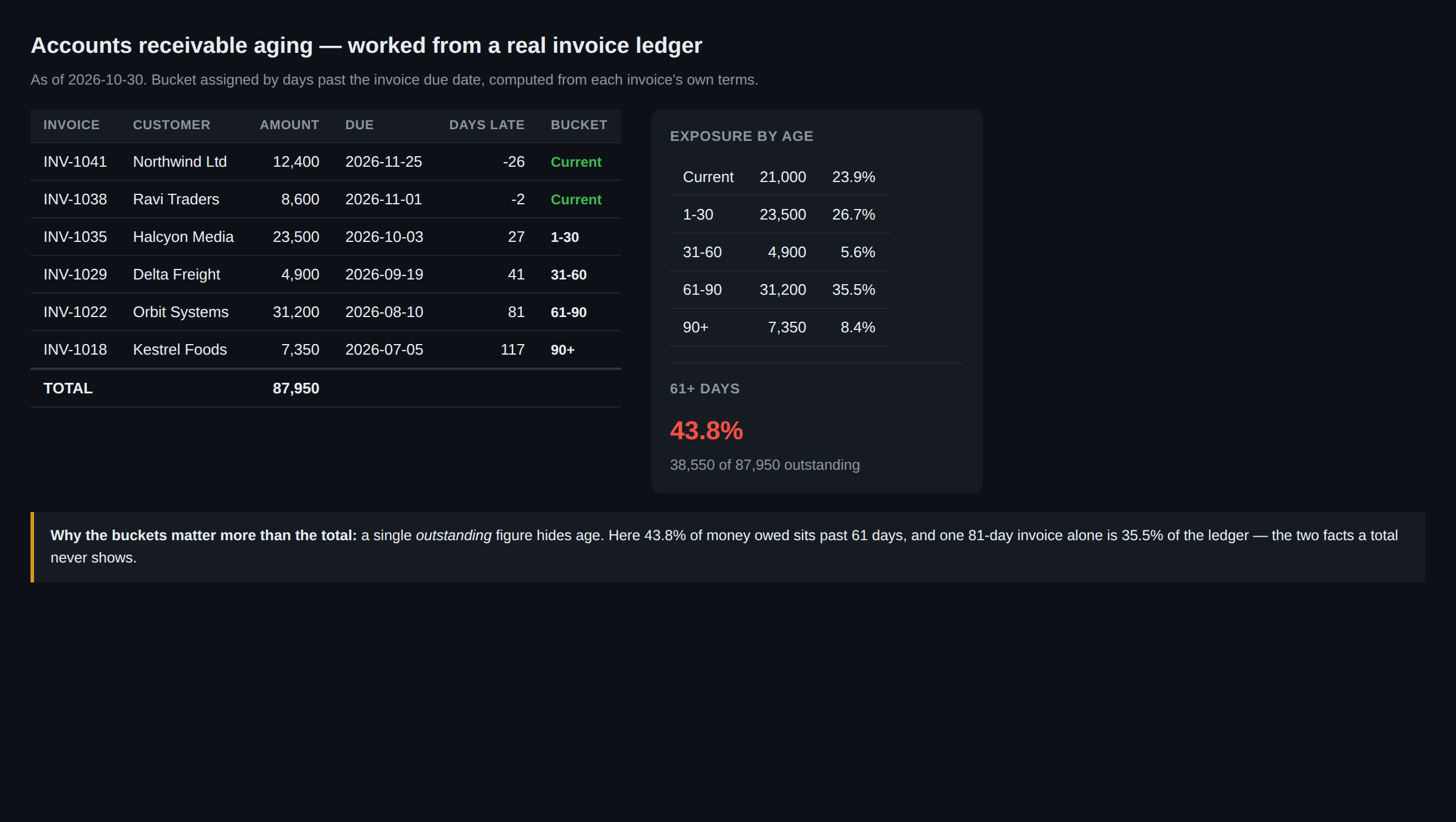
An aging report is the instrument for how to track overdue invoices at any volume, because it groups every unpaid item by how far past due
it is. It is the single artifact this whole process rests on, and it is easier to build than to buy. Every figure in this section is computed from the worked ledger below, dated 30 October 2026, and each bucket is assigned by days past that invoice’s own due date as set by its own payment terms. The amounts, the bucket totals and the shares are the author’s own calculation from that ledger, not figures published by a vendor or an agency.
| Invoice | Customer | Amount | Due date | Days late | Bucket |
|---|---|---|---|---|---|
| INV-1041 | Northwind Ltd | 12,400 | 2026-11-25 | −26 | Current |
| INV-1038 | Ravi Traders | 8,600 | 2026-11-01 | −2 | Current |
| INV-1035 | Halcyon Media | 23,500 | 2026-10-03 | 27 | 1–30 |
| INV-1029 | Delta Freight | 4,900 | 2026-09-19 | 41 | 31–60 |
| INV-1022 | Orbit Systems | 31,200 | 2026-08-10 | 81 | 61–90 |
| INV-1018 | Kestrel Foods | 7,350 | 2026-07-05 | 117 | 90+ |
| Total outstanding | 87,950 |
Sorting those same six invoices by age produces the exposure split:
| Bucket | Amount | Share of outstanding |
|---|---|---|
| Current, not yet due | 21,000 | 23.9% |
| 1–30 days | 23,500 | 26.7% |
| 31–60 days | 4,900 | 5.6% |
| 61–90 days | 31,200 | 35.5% |
| 90+ days | 7,350 | 8.4% |
The standard buckets are current, 1–30, 31–60, 61–90 and 90+ days. Use those five, because they are the ones your accountant will ask for
and the ones lenders expect. Anything you can export from an accounting package already groups this way; a spreadsheet with a due-date column and a formula reproduces it in fifteen minutes.
Read the buckets, not the total
The total is the number that gets reported and it is the least useful one. In the ledger above, 87,950 is owed, and that figure alone would not tell you anything about risk.
Age is the signal. Of that total, 38,550 — 43.8% —sat past 61 days. A book of business where nearly half the receivable is more than two months old behaves very differently from one where the same total is spread across current invoices, even though both report the same number owed.
Concentration hides inside buckets. A single invoice, INV-1022 at 81 days, was 35.5% of everything outstanding. One customer’s delay was driving the entire picture, and no total or count would have shown that.
Watch the bucket boundary, not the average. Debt ages into a worse bucket and does not age back. A balance sitting at 28 days is about to become materially harder to collect, which makes the 1–30 bucket a forward-looking list rather than a status.
Set the escalation ladder once, then follow it
Decide the sequence in advance so no step requires a judgement call while you are annoyed. The ladder below is a workable default; adjust
the intervals to your margin, and write the first two steps into the contract.
Day 0 to 7 past due — a neutral reminder. Assume administrative oversight, because most of the time it is. Restate the invoice number, amount and due date, and ask when payment will be scheduled.
Day 8 to 14 — a direct follow-up to a named person. Move from a generic accounts address to the individual who approved the
work. Ask for a date rather than for payment.
Day 15 to 30 — a phone call, then confirmation in writing. A call resolves ambiguity faster than another email, and the written confirmation of what was agreed is what makes the next step defensible.
Day 31 to 60 — apply the contractual consequence. Late fee or interest, if your terms provide for it, applied as the contract states rather than as a surprise.
Past 60 days — a decision, not a chase. By this point the useful question has changed from when to whether. Choose between a payment plan, a collection route, or a write-off, and record which one.
The ladder works because it removes discretion. A schedule you follow mechanically does not depend on how you feel about the customer that week.
What the law does and does not give you
Most guidance on how to track overdue invoices implies that federal debt-collection law governs your customer. For business invoices, it
largely does not, and knowing this changes how much leverage you actually have.
The Fair Debt Collection Practices Act defines the debts it covers in 15 U.S.C. §1692a(5). The definition reads, in full:
The operative words are personal, family, or household. An invoice to another business does not arise from that kind of transaction, so it falls outside the federal definition. What actually governs a business-to-business debt is the contract you signed and the state law that applies to it, which is why the payment terms, the late-fee clause and the governing-law line are the documents that matter. If you did not
write a consequence into the contract, you are relying on the customer’s goodwill.
Two limits worth stating. State law still applies, and states differ on what interest rate a business may charge, so a rate that is routine in one state may be unenforceable in another. And the FTC’s guidance is written for consumers, so a dispute involving a consumer, even a small
one, is a different matter entirely.
When to stop chasing and write it off
The tax rule surprises most owners, and it decides whether writing an invoice off matters for how you track overdue invoices over time.
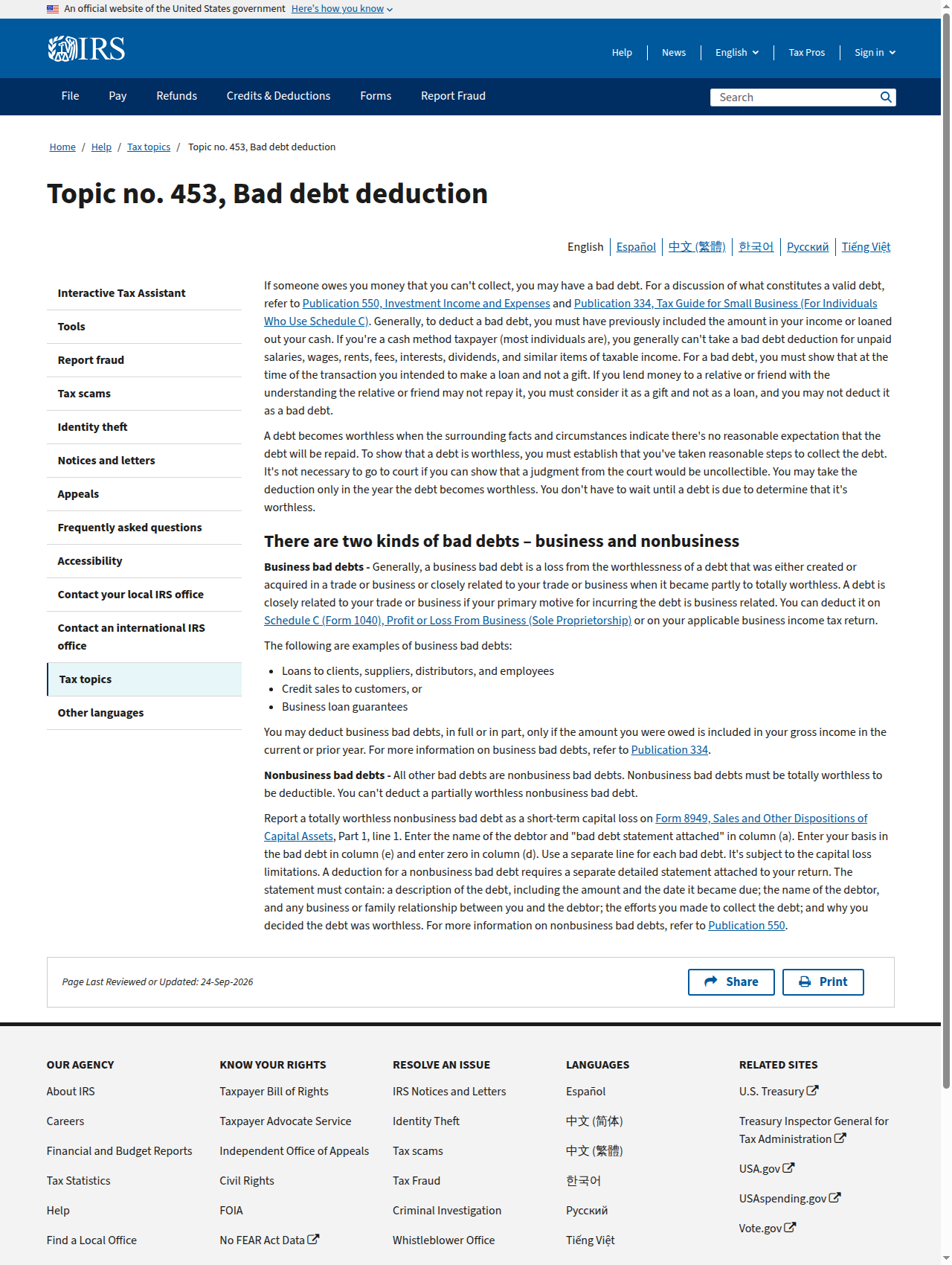
The IRS states in Topic 453 that to deduct a bad debt you must generally have previously included the amount in your income. Most small
businesses are cash-method taxpayers, and the IRS says plainly that a cash-method taxpayer generally cannot take a bad debt deduction for
unpaid items of income. If the invoice went unpaid, the income was never recognized in the first place, and there is no debt left to deduct.
Where a deduction is available, the standard is strict. According to the IRS, a debt becomes worthless when the facts indicate there is no
reasonable expectation of repayment, and to show that, you must establish that you took reasonable steps to collect it. The
deduction is taken in the year the debt becomes worthless, as the IRS states, rather than the year the invoice was issued.
That is the practical link between chasing and tax. The collection ladder above is not only how you recover money; it is the record that
supports a deduction if the money is gone. Written reminders, dated follow-ups and a documented payment plan are the evidence an accountant will ask for.
The verdict: what actually works, in order
Three things matter to how to track overdue invoices well, and they rank in an order most owners get backwards.
Build the aging report first, because nothing else functions without it. Every hour spent reading about collection law before you can age a single invoice is wasted. You cannot escalate a debt whose age you do not know, and you cannot prioritize when you are
working from a total. The report is a one-afternoon job that pays for itself the first week.
Then write the terms into the contract, because that is your real leverage. Since business invoices sit outside the federal collection definition, your position rests on what you agreed. A written late-fee clause and a stated governing law give you a consequence to invoke at day 31; without them, the ladder above is a series of polite letters. Doing this costs nothing at the point of sale, and adding it after a dispute has started is rarely achievable.
Then accept the write-off decision at the 60-to-90-day mark set in the ladder above, because the arithmetic turns against
you. Under 30 days a reminder is a courtesy. Past 60, recovery odds fall and the hours you spend chasing begin to approach the value of
the debt. The decision at that point is not whether to be patient; it is whether to offer a plan, hand it over, or record it as worthless — and
the IRS requires that you can show you tried, so the chase you did run becomes the evidence.
If you take one action from this guide, put the aging report on a weekly cadence. Weekly is often enough that nothing ages two buckets between reviews, and cheap enough that it survives a busy month.
Where this ends and your accountant begins
This covers how to track overdue invoices at a practical level, how to read an aging report, and what the federal rules do and do not provide. It is not legal or tax advice for your situation.
The limits are worth naming. Everything here is United States practice; state law governs what interest a business may charge and how
a debt may be collected, and states differ. The FDCPA definition quoted above settles the federal question, not the state one. Late-fee wording
that holds in a contract depends on your own agreement and your state’s limits, neither of which a general guide can settle for you.
Two things belong with a professional. If a single debt is large enough that its loss would matter, the cost of a letter from a lawyer is usually less than the cost of another month of waiting. And if you are considering a bad debt deduction, bring the collection record with you —
the reasonable-steps requirement is where the deduction is won or lost.