ACH is usually the practical starting point for scheduled US business payments; a wire is worth considering when the recipient needs a wire or a time-critical payment requires it. Same Day ACH adds a middle option, so the choice is not simply “cheap and slow” versus “expensive and fast.”
The useful ACH vs Wire Transfer comparison is the total fee, the recipient’s usable-funds deadline, your bank’s cutoff and the consequences of sending money to the wrong account. This guide focuses on US business payments, with international wires treated separately.
ACH vs wire transfer at a glance
| Question | ACH | Wire transfer |
|---|---|---|
| How does it work? | Credits push money; authorized debits collect it through the Automated Clearing House network. | The sender instructs a bank to transfer funds. Domestic Fedwire payments settle individually in real time between participating institutions. |
| What does it cost? | Provider-specific; standard service can be inexpensive, while expedited delivery can cost more. | Provider-specific; check outgoing, incoming and international conversion charges. |
| How quickly can it arrive? | Same-day service is available for eligible payments; ordinary delivery depends on the bank or platform. | Domestic wires can arrive the same business day before applicable cutoffs. International delivery can take longer. |
| Where does it fit? | Scheduled payroll, vendor bills and recurring collections. | Time-critical transfers, recipients requiring wires and supported cross-border payments. |
| Can you undo it? | Returns and permitted reversals exist, but are not an unrestricted cancellation right. | Fedwire settlement is final once processed. A recall request does not guarantee recovery. |
Compare the payment service, not just the network name
An ACH credit and an ACH debit solve different jobs. When your business sends payroll or pays a supplier, it may originate a credit. When a service provider collects an authorized recurring bill, it may originate a debit. A processor’s price for collecting customer invoices is not automatically the price your bank charges to send vendor payments.
Nacha’s explanation of ACH describes payment files moving through an originating bank, an ACH operator and the receiving bank. Wires use a different mechanism. The Federal Reserve describes Fedwire as a real-time gross settlement service, generally used for large-value, time-critical payments. “Real time” here describes processing between participants; it does not promise that every customer instruction becomes spendable money instantly.
If you are choosing how customers should pay your invoices rather than how to send money, see our separate comparison of ACH and card payments for service business invoices.
Cost: standard ACH, expedited ACH and wires have different prices
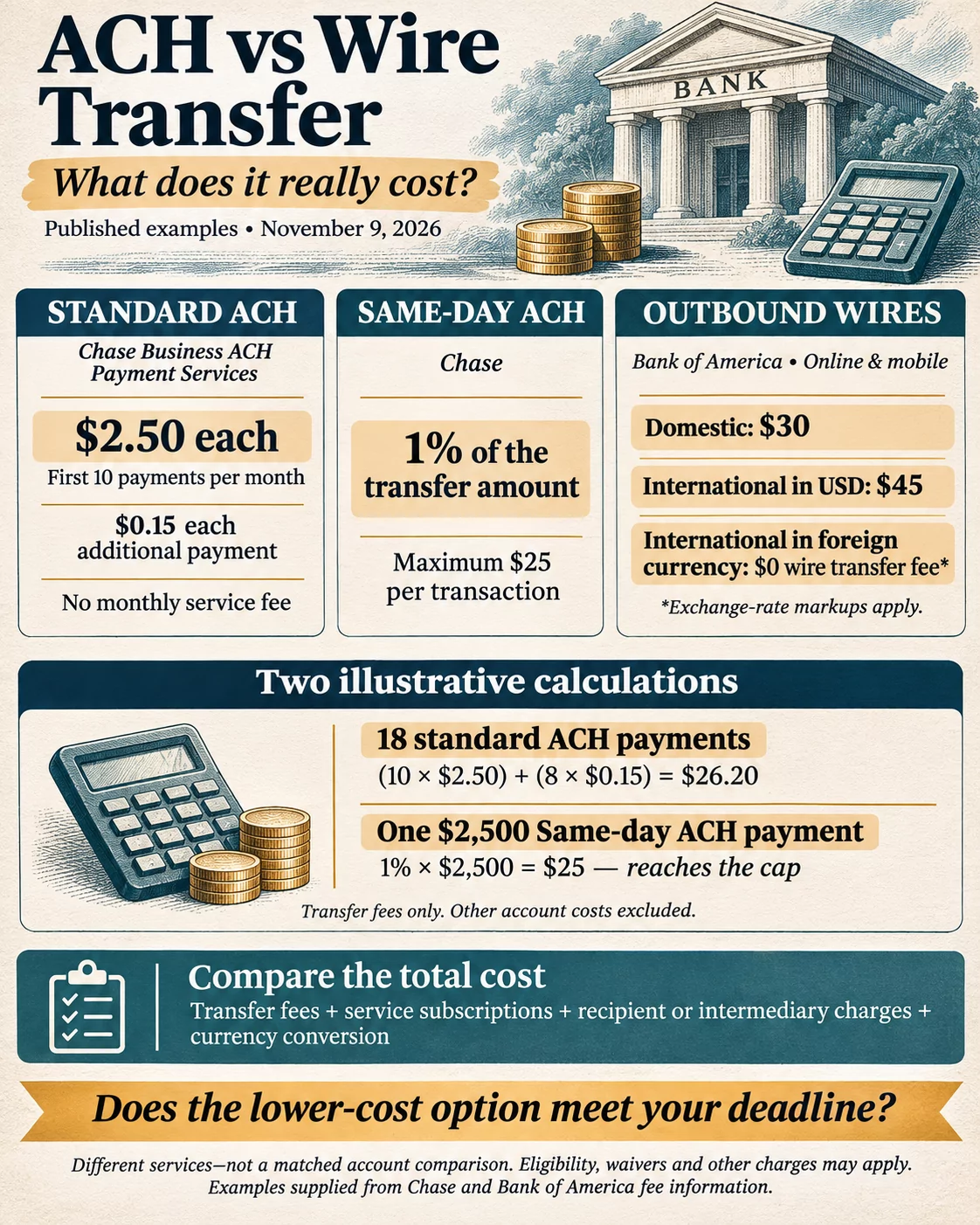
There is no universal ACH fee or wire fee. The account, service, delivery option and any fee waiver matter. Published examples checked on November 9, 2026 show why:
- Chase’s business ACH Payment Services lists standard ACH at $2.50 each for the first 10 payments per month and $0.15 for each additional payment. It says the service has no monthly fee.
- The same Chase page lists Same-day ACH at 1% of the transaction amount, capped at $25 per transaction.
- Bank of America’s online and mobile wire guide lists a $30 outbound domestic wire fee. Its international examples are $45 when sent in US dollars and no wire transfer fee when sent in foreign currency, with exchange-rate markups applying.
These are examples from different services, not a matched comparison of two banks’ complete accounts. Deposit-account charges, eligibility, waivers, recipient charges and other applicable costs still need checking.
An illustrative calculation shows the effect of delivery choice. Using Chase’s published schedule, 18 standard ACH payments in a month would cost (10 × $2.50) + (8 × $0.15) = $26.20 in transfer fees. A single $2,500 Same-day ACH payment would reach the $25 cap. This is arithmetic using listed prices, not a reported customer result; other account costs are excluded.
For your own comparison, add transfer fees, any incremental service subscription, recipient or intermediary charges and currency-conversion costs. Then ask whether the cheaper service meets the actual deadline. A “no wire transfer fee” label does not mean a cross-border transfer has no cost.
Speed: ask when the recipient can use the money
Nacha’s ACH fact sheet says payments can process within hours on the same banking day, the following day, or up to two banking days for ACH credits. It also states that ACH does not currently settle on weekends or federal holidays. That network timing should not be confused with a provider’s complete customer delivery timetable.
A bank or payment platform may need time for funding, approval or review before it releases a payment. Chase, for example, describes standard ACH delivery in as little as one business day and also identifies review and approval statuses in its payment workflow. “Scheduled,” “funded” and “received” are different milestones.
Same Day ACH can bridge the gap when a domestic payment is urgent. Nacha lists a $1 million per-payment network limit, but your bank can impose lower limits and its own submission deadlines. Availability must be confirmed for the actual account and payment.
For domestic wires, Bank of America’s guide gives a 5 p.m. Eastern cutoff and says funds typically arrive the same business day. Other banks set their own cutoffs. The same guide gives a typical international window of one to five business days, depending on currency and receiving-bank processing. Do not apply a domestic wire promise to an overseas supplier.
Before promising delivery, get four answers: which service will be used, the latest submission time and time zone, the applicable transaction limit, and when the recipient is expected to have usable funds. Allow for your own approval process before the bank’s cutoff.
When to use each payment method
For routine payroll and approved domestic supplier invoices, start by checking standard ACH. Its scheduled-payment capabilities suit known counterparties and predictable due dates. Build the send date around the provider’s delivery commitment.
Consider Same Day ACH when a domestic payment must arrive that banking day and the recipient accepts it. Check eligibility, limits, fees and remaining cutoff time before selecting it.
Consider a wire when the recipient explicitly requires one, when a time-critical payment cannot use your available ACH service, or when the destination requires an international banking route. A large amount alone does not establish that ACH is unsuitable: compare the actual limits and recipient requirements.
For an overseas payment, confirm the destination, supported currency, expected recipient amount and fees before comparing quotes. Ordinary domestic ACH instructions should not be assumed to work for a foreign bank account.
Verify the recipient before choosing speed
A faster payment is only useful if it reaches the right account. The FBI’s Internet Crime Complaint Center recommends using a separate channel to verify requests to change account information. For a supplier’s new banking instructions, call a previously verified contact using a number already on file, rather than relying on contact details supplied in the change request.
ACH reversals are restricted by network rules. Nacha’s reversal guidance addresses permitted corrections and improper reversals; it does not make ACH a general refund mechanism for a commercial disagreement. Chase’s own payment guidance also identifies failed reversals. Never choose ACH on the assumption that money can always be pulled back.
For Fedwire, final settlement between participating institutions makes prevention especially important. If fraud or an error is suspected, contact the sending bank immediately and ask about recovery options. IC3 recommends promptly requesting a recall or reversal after business email compromise; success is not assured.
Before releasing either payment, use a short operating checklist:
- Match the payment to an approved invoice or payroll obligation and confirm it has not already been paid.
- Independently verify new or changed bank details and confirm the routing instructions are appropriate for ACH or wire.
- Check the available balance, limit, delivery date, cutoff and total quoted cost.
- Complete the required internal approval, then retain the confirmation and reconcile the payment.
Our guide to invoice automation mistakes that cause duplicate payments explains why duplicate checks belong before release. Keep the payment reference with the invoice so another employee does not send a second payment while the first is still processing.
For the next payment, write down the recipient’s deadline first. Then choose the lowest-cost available service that meets it, satisfies the recipient’s instructions and allows your team to complete verification before release.