ACH vs card payments for service business invoices is mostly a question of fees: if card fees keep eating into each job, ACH bank transfers cost far less on big or repeat bills. On a $10,000 invoice, a card can cost you about $290 in fees, while ACH costs $5.
Cards generally clear faster than standard ACH, and they are easier for small, one-time jobs. Stripe, a large payment company, charges 2.9% + 30¢ for a US card. Its ACH Direct Debit fee is 0.8%, and it never goes over $5.00.
So most service businesses should offer both. Ask for ACH on large and recurring bills, and take cards on small ones.
Below, you’ll see the real fees on invoices from $150 to $10,000, plus simple formulas for your own bills. You’ll also learn what Same Day ACH really changes, how disputes work, and an invoice-size rule you can use on your next bill.
ACH vs Card: How Cost, Speed, and Protection Compare
ACH and card payments move money in very different ways. Those differences change what you pay, how fast you get paid, and what happens if a client disputes a charge.
ACH (Automated Clearing House) and credit card are two of the more common ways to receive money. Here is the headline comparison before we get into the details.
| Factor | ACH Payments | Card Payments |
|---|---|---|
| Stripe fee | 0.8%, capped at $5.00 (ACH Direct Debit) | 2.9% + 30¢ per successful domestic card payment |
| Typical fee range | Low, and capped at Stripe | 1.5% to 3.5% of the payment, plus per-payment charges |
| Approval | Your client authorizes a bank transfer | Real-time approval, which leads to high-confidence payments, though a payment can still be disputed later |
| Settlement time | 1 to 3 business days per Stripe; 3 to 5 business days per Printavo | 2 to 3 business days per Printavo |
| Same-day option | Same Day ACH is becoming more common; check if your provider offers it | Approval is instant, but deposits still take days |
| Fraud protection for the payer | Limited protection, but payments can still be returned or disputed | Payer can usually dispute fraud and get money back |
| Best fit | High-dollar payments from clients you know and trust | Small, one-time jobs and new clients |
Stripe lists one more fee for post-payment invoices: 0.4% of the transaction total, capped at $2.00 per invoice. The fee tables in this article leave that charge out. Where it applies, it’s based on the invoice total, not on how the client pays, so it doesn’t change which method is cheaper.
How does the ACH transaction process work?
ACH moves money straight from your client’s bank account to yours. Your client authorizes the transfer, and their bank sends it through the ACH network.
The ACH network groups payments into batches and sends them on a set schedule each day. Federal Reserve systems process these batches at set times. Then your bank puts the money into your account.
ACH needs no card machine and no payment terminal. The system handles millions of payments every day.
ACH also lets clients set up repeat payments for monthly invoices or ongoing service plans. The whole network runs on shared rules that every bank follows.
How does a card payment work?
A card payment is approved in seconds through the card networks. Your client types in their card or taps it, and the approval comes back right away.
Approval is not the same as cash in your bank, though. Your card processor settles the sale with your bank later, and the funds land a few days after that.
Approval also isn’t a promise that the money is final. A card payer can still dispute the charge after it lands in your account.
How fast are payments settled with ACH vs card?
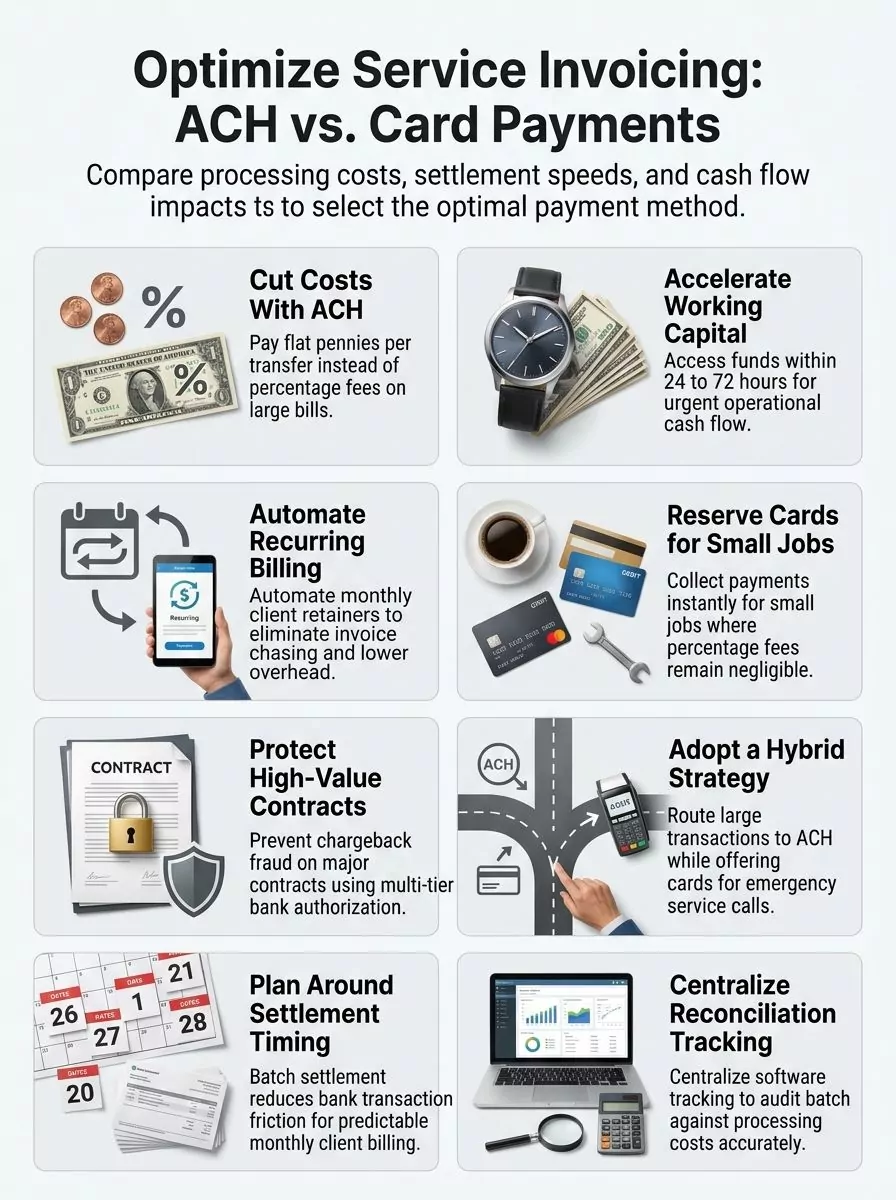
Cards usually put money in your account a little sooner than standard ACH. Printavo lists cards at 2 to 3 business days and ACH at 3 to 5 business days.
Stripe puts standard ACH at 1 to 3 business days, and it notes that same-day ACH is becoming more common. Printavo’s numbers come from a page published in 2023. So your real wait depends on your processor and on whether you use Same Day ACH.
| Payment Method | Settlement Speed | Key Details |
|---|---|---|
| Card Payments | 2 to 3 business days (Printavo) |
|
| ACH Payments | 1 to 3 business days (Stripe); 3 to 5 business days (Printavo) |
|
| Real-World Impact | Speed matters for cash flow |
|
Your cash flow timing shifts based on what clients choose. Say you send an invoice on Monday and the client pays that day.
With Printavo’s timing, a card payment might land by Wednesday or Thursday. A standard ACH payment might land anywhere from Thursday to the following Monday, if there’s no bank holiday.
That gap matters most when payroll, supplies, or rent are due. A cash flow check each week helps you see it coming. It also helps to know how working capital differs from cash flow, so a few extra days don’t catch you short.
Payment reconciliation means matching each invoice to the money that came in. Both methods can be matched cleanly if you note the payment date and method on every invoice.
What does each method cost per invoice?
A card costs 2.9% + 30¢ at Stripe, and ACH Direct Debit costs 0.8% with a $5.00 cap. The cap is the big deal: the ACH fee stops growing once an invoice reaches $625.
Here is the math on five common invoice sizes. These are Stripe’s posted rates, so your processor may differ.
| Invoice Amount | Card Fee (2.9% + 30¢) | ACH Fee (0.8%, $5 cap) | You Save With ACH |
|---|---|---|---|
| $150 | $4.65 | $1.20 | $3.45 |
| $500 | $14.80 | $4.00 | $10.80 |
| $1,000 | $29.30 | $5.00 | $24.30 |
| $5,000 | $145.30 | $5.00 | $140.30 |
| $10,000 | $290.30 | $5.00 | $285.30 |
Rates from Stripe’s pricing page. The table leaves out any post-payment invoice fee.
You can run the same math on your own invoices with these formulas. Use your processor’s rates, or Stripe’s posted rates as a starting point.
- Card fee: invoice amount × 0.029, then add $0.30.
- ACH fee: invoice amount × 0.008. If the answer is over $5.00, your fee is $5.00.
- Savings: card fee minus ACH fee.
- Post-payment invoice fee, if it applies: invoice amount × 0.004, or $2.00, whichever is smaller.
- Monthly total: multiply each fee by the number of invoices you send each month.
The card fee keeps climbing with every dollar. Each extra $1,000 adds $29 to the card fee, while the ACH fee sits at $5 no matter how big the bill gets.
A $5,000 invoice shows it well. By card, you give up $145.30, and by ACH, you give up $5.
Now say you use Stripe’s post-payment invoices on that same bill. The extra fee caps at $2.00, so the totals become $147.30 by card and $7.00 by ACH.
What does that look like over a month?
Monthly totals show the real gap. Small savings per invoice turn into hundreds of dollars when you send dozens of bills.
- Fifty $500 invoices: about $740 by card vs $200 by ACH. That’s $540 a month back in your pocket.
- Four $5,000 invoices: $581.20 by card vs $20 by ACH.
- Fifty $50 payments: $87.50 by card vs $20 by ACH. The gap is smaller, but ACH still costs less.
Small invoices shrink the dollar gap. On a $50 job, the card fee is $1.75 and the ACH fee is $0.40. Many owners decide that difference is worth it for a fast, easy card payment.
How do disputes and fraud protection compare?
Card payers can usually dispute fraudulent charges and get their money back. ACH payers have more limited protection.
Limited protection does not mean an ACH payment can never be pulled back. ACH payments can still be returned or disputed. The payer just has fewer built-in safety nets than a card gives.
Your own collection risk is a separate question from the payer’s protection. A card payment can be disputed after it lands, even though it was approved in real time. ACH fits best with clients you know and trust.
Is ACH Still Slow? What Same Day ACH Changes for Invoices
ACH is not always slow anymore. Same Day ACH lets bank payments settle between banks on the same business day, and its use is growing fast.
What is Same Day ACH?
Same Day ACH is a faster version of a standard ACH transfer that settles on the same business day. Standard ACH typically takes 1 to 3 business days, though same-day ACH is becoming more common.
Same Day ACH still runs on the same bank network, and your client still pays from a bank account. Your provider may set different deadlines, fees, or payout timing for it, though.
How big can a Same Day ACH payment be?
Same Day ACH payments can be up to $1 million each today, and that limit will rise to $10 million. Nacha, the group that runs the ACH rules, approved the $10 million limit, effective September 17, 2027.
The limit has grown before. On March 18, 2022, the cap per payment went from $100,000 to $1 million. For a small service business, even the current limit covers almost any invoice you’ll ever send.
Are people really using Same Day ACH?
Same Day ACH use has about doubled in three years. There were 697.5 million Same Day ACH payments in 2022 and 1.4 billion in 2025.
Nacha expects more business-to-business use, including invoice payments, payroll funding, tax payments, and more. In plain words, paying invoices this way is becoming normal.
What does Same Day ACH mean for your invoices?
Same Day ACH can shrink the wait on bank payments, but it doesn’t erase the speed edge of cards by itself. Network settlement is one step; your processor paying out to your bank is another.
Same-day settlement between banks doesn’t mean the money shows up in your account that day. Your payment processor decides when funds become available to you.
Before you promise clients anything, ask your provider four things:
- Does it offer Same Day ACH at all?
- What is the daily deadline to submit a payment for same-day handling?
- What does it charge for same-day? This article only covers Stripe’s standard ACH Direct Debit price.
- When will the funds actually land in your bank?
When ACH Is the Better Choice for Your Invoices
ACH is the better choice when the bill is large, the client is steady, or the job repeats. Here’s when to ask for it:
- The invoice is over $625. Stripe’s ACH fee hits its $5.00 cap there, so extra dollars add no more ACH fee.
- The client pays you every month. Retainers, cleaning plans, and maintenance contracts add up fast in card fees.
- You know and trust the client. ACH suits high-dollar payments from customers you know and trust.
- The client is a business. Nacha expects more business-to-business invoice payments over ACH.
- You can wait a few days, or your provider offers Same Day ACH. Standard ACH takes 1 to 3 business days per Stripe.
Why are ACH fees lower?
ACH fees are lower because banks group many transfers and settle them in batches. That cuts the work per payment, and at Stripe it shows up as a fee that caps at $5.00.
Card payments go through card networks one at a time, in real time. That speed and the fraud protection behind it cost more. At Stripe, that’s 2.9% + 30¢ per card payment.
Say a contractor bills a client $50,000 for a big project. By card, the fee would be $1,450.30. By ACH, it’s still $5.00.
Why is ACH good for recurring payments?
ACH is good for recurring payments because the client authorizes it once and the money moves on schedule. You don’t have to ask for payment every month.
Repeat ACH payments keep your cash flow steady and predictable. Your client knows when the charge will hit, so there are no surprises. Your team spends less time chasing bills and more time doing the work.
Say a landscaper bills 50 clients $500 a month for upkeep. By card, that’s about $740 in monthly fees. By ACH, it’s $200, a savings of $540 every single month.
What should you watch for with ACH on big invoices?
ACH on big invoices works best with clients you already trust. ACH offers limited fraud protection compared with cards, so it fits known, steady clients best.
Keep a clear record of each client’s ACH authorization. Save the invoice, the amount, and the date they agreed to pay by bank transfer. A clean paper trail makes any question easier to sort out later.
For a brand-new client on a large job, you might take a deposit by card and the balance by ACH. That’s a convenience choice, not fraud protection, since a card payment can still be disputed later.
When Card Payments Are the Better Choice
Card payments are the better choice when the job is small, one-time, or urgent. Here’s when to take a card without a second thought:
- The invoice is small. On a $150 job, the card fee is $4.65 versus $1.20 for ACH. That’s a gap of a few dollars.
- The client is new or one-time. Card approval happens in real time, which leads to high-confidence payments. Approval still isn’t a guard against a later dispute.
- You want to be paid on the spot. Emergency repairs and quick fixes fit card payments well.
- The client won’t share bank details. Some people would rather use a card than give out their account number.
- The client wants buyer protection. Card payers can usually dispute fraud and get their money back.
How fast do card payments work?
Card payments are approved in seconds, and the money usually reaches your bank in 2 to 3 business days. Real-time approval means you know right away the payment went through.
Card speed has a price. Card fees typically range from 1.5% to 3.5% of the payment, plus extra charges per payment. At Stripe, it’s 2.9% + 30¢.
Why do customers like paying by card?
Customers like paying by card because it’s quick and familiar. Most people carry a card or save one on their phone, so they can pay from anywhere.
Card payments work with credit cards, debit cards, and mobile wallets. Clients don’t need to look up a routing number or log in to their bank. Some also like the rewards points their cards earn.
Card payers also get fraud protection. If they see a fraud charge, they can usually dispute it and get their money back. That comfort can make a new client more willing to pay right away.
What does a card cost you on a small job?
A card costs you just a few dollars on a small job. At Stripe’s rates, a $150 invoice costs $4.65 by card and $1.20 by ACH.
A gap of $3.45 is often worth it for a fast, easy payment from a client you may never see again. On a $50 job, the gap is only $1.35. For small, one-time work, taking the card is usually the smart call.
How to Pick the Right Payment Method for Each Invoice
The right payment method depends on invoice size, how often you bill, and how well you know the client. Use this table as your default policy, and let a client’s real needs override it.
| Invoice Type | What to Ask For | Card Fee vs ACH Fee (Stripe) | Why |
|---|---|---|---|
| Under $250, one-time job | Take a card | $150: $4.65 vs $1.20 | Small dollar gap, fast approval, easy for the client |
| $250 to $625 | Offer both, nudge ACH for repeat clients | $500: $14.80 vs $4.00 | The gap grows, but ACH hasn’t hit its cap yet |
| Over $625 | Ask for ACH | $5,000: $145.30 vs $5.00 | The ACH fee stops at $5.00; the card fee keeps climbing |
| Very large project | Ask for ACH, Same Day ACH if your provider offers it | $10,000: $290.30 vs $5.00 | Huge savings; Same Day ACH covers up to $1 million today |
| Monthly or recurring | Ask for ACH | Fifty $500 bills: about $740 vs $200 | Set it up once and save every month |
| New client, big job | Card deposit if they prefer, ACH for the balance | Depends on the split | Easy first payment, low fees on the rest; not fraud protection |
Fees use Stripe’s posted rates: 2.9% + 30¢ for cards and 0.8% capped at $5.00 for ACH Direct Debit.
What invoice-size rule should you use?
Ask for ACH on recurring work and on invoices over $625, and take cards freely on small, one-time jobs. $625 is the point where Stripe’s ACH fee hits its $5.00 cap.
The $625 line is Stripe’s ACH cap threshold, not the point where ACH starts to win. ACH already costs less below it, as the $150 and $500 examples show.
At 0.8%, a $625 invoice costs exactly $5.00 by ACH and about $18.43 by card. Above that point, the card fee grows by $29 for every extra $1,000, and the ACH fee doesn’t move at all.
The $250 line for small jobs is our rule of thumb, not a math result. Below it, the card fee stays under about $8, so the ease of a card usually wins even though ACH still costs less. Move that line up or down to fit your own margins.
How should invoice frequency change your choice?
Invoice frequency matters as much as size. A client you bill every month should be on ACH, even if each bill is modest.
Say a cleaning company bills a client $500 each month. By card, that’s $14.80 a month, or $177.60 a year. By ACH, it’s $4.00 a month, or $48 a year.
A landscaping company might take cards for one-time cleanup jobs but ask for ACH on yearly maintenance plans. Your payment rules should fit your real work, not the other way around.
How do cost and speed weigh against each other?
Cost usually favors ACH, but a few real-world cases can tip a job toward cards. Here are the common exceptions to the default policy.
| Factor | ACH Payments | Card Payments | Impact on Your Choice |
|---|---|---|---|
| Urgent cash need (payroll, supplies) | 1 to 3 business days (Stripe); 3 to 5 (Printavo) | 2 to 3 business days (Printavo) | A card may be worth the fee when a bill is due this week |
| Same Day ACH availability | Depends on your provider, its deadlines, and its fees | Not needed | Confirm payout timing before you count on same-day money |
| Client preference | Some clients want to pay from their bank | Some want card rewards or a familiar checkout | Offer both so the client can pay the way they like |
| Customer Ease | Needs bank account details | Any client with a card | Cards reach more clients; ACH needs a bit more setup |
| Payer Protection | Limited | Can usually dispute fraud and get money back | Use ACH with clients you know and trust |
Speed shapes your choice based on your business. A contractor who needs cash for crew pay might take a card on a rush job. A consulting firm billing monthly retainers can easily plan around a few days of ACH timing.
The smartest path is to offer both. Ask for ACH on big and recurring bills. Allow cards for small jobs and for clients who want them.
How do you work out the fee on your own invoices?
You can work out your own fees with the formulas in the fee section above. Plug in your typical invoice amount and your processor’s rates.
Say your typical invoice is $1,200. The card fee is $35.10. The ACH fee would be $9.60, but the cap brings it down to $5.00, so you save $30.10.
Your accounting software can show last month’s fees by payment method. Run your own numbers once, and the rule for your business will be clear. If you bill clients outside the US, cross-border invoice payments come with their own fees to check, so price those separately.
What does payment reconciliation look like for service businesses?
Payment reconciliation means matching each invoice to the deposit that paid it. Doing it on a regular schedule keeps your books straight and catches errors fast.
- Your accounting software pulls payment data from both ACH transfers and card payments into one place, so you can see all incoming money at a glance.
- Match each invoice number to its deposit in your bank account. Flag any amount that doesn’t match what you expected.
- Card payments often arrive in batches after a short delay, so allow for the gap between when clients pay and when money lands.
- Standard ACH transfers can take a bit longer than cards, so your timeline differs by method. Same Day ACH can shorten that wait if your provider offers it.
- Keep a simple spreadsheet or use invoicing software to log payment dates, amounts, client names, and the method each client chose.
- Review your bank statements weekly. Look for missing deposits, duplicate charges, or payments that went to the wrong account.
- Add up your fees from both methods each month. Subtract them from revenue to see your revenue after processing fees, before your other costs.
- Write down every payment option you offer. Train your team to record which method each client picked, so your records stay clean.
Final Words
ACH vs card payments for service business invoices comes down to this: ACH costs far less on large and recurring bills, and cards are easier on small, one-time jobs. At Stripe, ACH Direct Debit is 0.8% capped at $5.00, while a domestic card is 2.9% + 30¢.
The numbers make the case. A $10,000 invoice costs $290.30 by card and $5.00 by ACH. Fifty $500 invoices cost about $740 by card and $200 by ACH.
Ask for ACH on recurring work and on bills over $625, where Stripe’s ACH fee caps. Keep taking cards for small, one-time jobs under about $250, where the gap is a few dollars.
Check Same Day ACH timing and fees with your provider before you count on it. And if a new client on a big job prefers a card deposit, treat that as a convenience, not as protection against a later dispute.
Frequently Asked Questions
1. Which is cheaper for invoices, ACH or card payments?
ACH usually costs less. Most ACH fees are a flat amount (typically $0.20 to $1.50 per transaction), while card processors like Square charge around 2.9% plus 30 cents. On a $2,000 invoice, you save about $55 by choosing ACH.
2. How fast do I get paid with ACH vs card payments?
Card payments typically show up in your account within 1-2 business days, while standard ACH takes 2-3 business days. If you need the fastest access to your money, cards have a slight edge.
3. Should my service business accept both ACH and cards?
Yes, give clients both options. Platforms like QuickBooks make it simple to accept both ACH and cards on the same invoice, and clients who can pay their preferred way tend to pay faster.
4. Are ACH payments safe for my business?
Yes, ACH is very safe and regulated by NACHA (the National Automated Clearing House Association). It also has way fewer chargebacks than card payments, so you spend less time dealing with disputed invoices.