

A customer spends $50 in your online store, but less than $50 reaches your account. Part of the difference comes from payment processing fees—and the advertised percentage rarely tells the whole story.
At a rate of 2.9% plus 30 cents, processing that order costs $1.75. Your effective rate is therefore 3.5%, even though the headline percentage is lower.
For a small store, these differences matter. Fixed charges eat into low-value orders, international fees reduce overseas margins, and refunds can leave costs behind after the revenue disappears.
Understanding payment gateway fees starts with knowing what you are paying for, then comparing providers against your actual sales.
What Are Payment Gateway Fees?
A payment gateway securely passes payment information between your checkout and the systems that authorize a transaction. Payment processing involves additional parties, including the customer’s bank, card network and your payment provider.
Some businesses buy gateway services separately from processing. Others use an integrated provider that bundles them into one transaction price.
That distinction matters when comparing quotes. A low gateway fee may exclude card processing, while an apparently higher rate may include both.
Behind a card payment are three main costs:
- Interchange: Paid to the bank that issued the customer’s card.
- Network fees: Charges associated with the card network.
- Processor markup: What your provider charges for its services.
A bundled rate combines these costs. An interchange-plus arrangement separates the underlying card costs from the processor’s markup.
The Main Fees to Check
Transaction charges get the most attention, but several other costs can affect your monthly bill.
| Fee | What it covers | What to check |
|---|---|---|
| Transaction fee | Processing a payment | Percentage and fixed charge |
| Monthly fee | Account, gateway or software access | Whether it applies during quiet months |
| Setup fee | Opening or configuring the service | Whether it can be waived |
| Dispute fee | Handling a customer’s payment dispute | Charges for receiving or contesting disputes |
| Refund-related cost | Returning a customer’s payment | Whether original processing fees are returned |
| International fee | Accepting eligible overseas payments | How the provider defines international |
| Currency conversion | Exchanging payment or settlement currencies | Conversion charge and exchange rate |
| Compliance fee | Security administration or noncompliance | Requirements and possible penalties |
| Termination fee | Ending a contract | Contract length and cancellation terms |
| Payout fee | Moving money to your bank | Standard versus accelerated payout pricing |
Request the full schedule before signing. Also ask about authorization attempts, failed payments, subscriptions and optional fraud tools if your store uses them.
How Transaction Fees Work
The calculation for a typical flat-rate payment is:
Transaction fee = payment amount × percentage rate + fixed charge
For a $50 order at 2.9% plus 30 cents:
- Percentage charge: $50 × 2.9% = $1.45
- Fixed charge: $0.30
- Total fee: $1.75
- Amount remaining before other deductions: $48.25
The fixed charge explains why smaller orders cost more to process as a percentage of revenue.
Using the same illustrative rate:
| Order value | Calculated fee before cent rounding | Effective rate |
|---|---|---|
| $5 | $0.445 | 8.9% |
| $15 | $0.735 | 4.9% |
| $50 | $1.75 | 3.5% |
| $150 | $4.65 | 3.1% |
A store selling inexpensive accessories should pay close attention to fixed charges. A store selling costly equipment has more reason to focus on percentage rates.
Stripe, Square and PayPal: Online Pricing Examples
The following examples use published US pricing checked on November 6, 2026. Rates depend on the product, plan, account location and payment type.
| Provider or payment product | Published online rate | Fee on $50 | Fee on $150 |
|---|---|---|---|
| Stripe domestic cards | 2.9% + $0.30 | $1.75 | $4.65 |
| Square online payments, higher listed rate | 3.3% + $0.30 | $1.95 | $5.25 |
| PayPal standard credit and debit card payments | 2.99% + $0.49 | $1.99 | $4.98 |
| PayPal Checkout and Guest Checkout | 3.49% + $0.49 | $2.24 | $5.73 |
Stripe publishes its domestic card rate on its US pricing page. Square lists online rates of 3.3% plus 30 cents and 2.9% plus 30 cents across its pricing options, so confirm the rate for your plan and integration. PayPal lists separate prices for standard card payments and PayPal Checkout.
These examples exclude additional charges and subscription costs. They also do not establish which provider offers the best value: checkout performance, customer preferences and administrative work affect the result.
Flat-Rate, Interchange-Plus or Tiered Pricing?
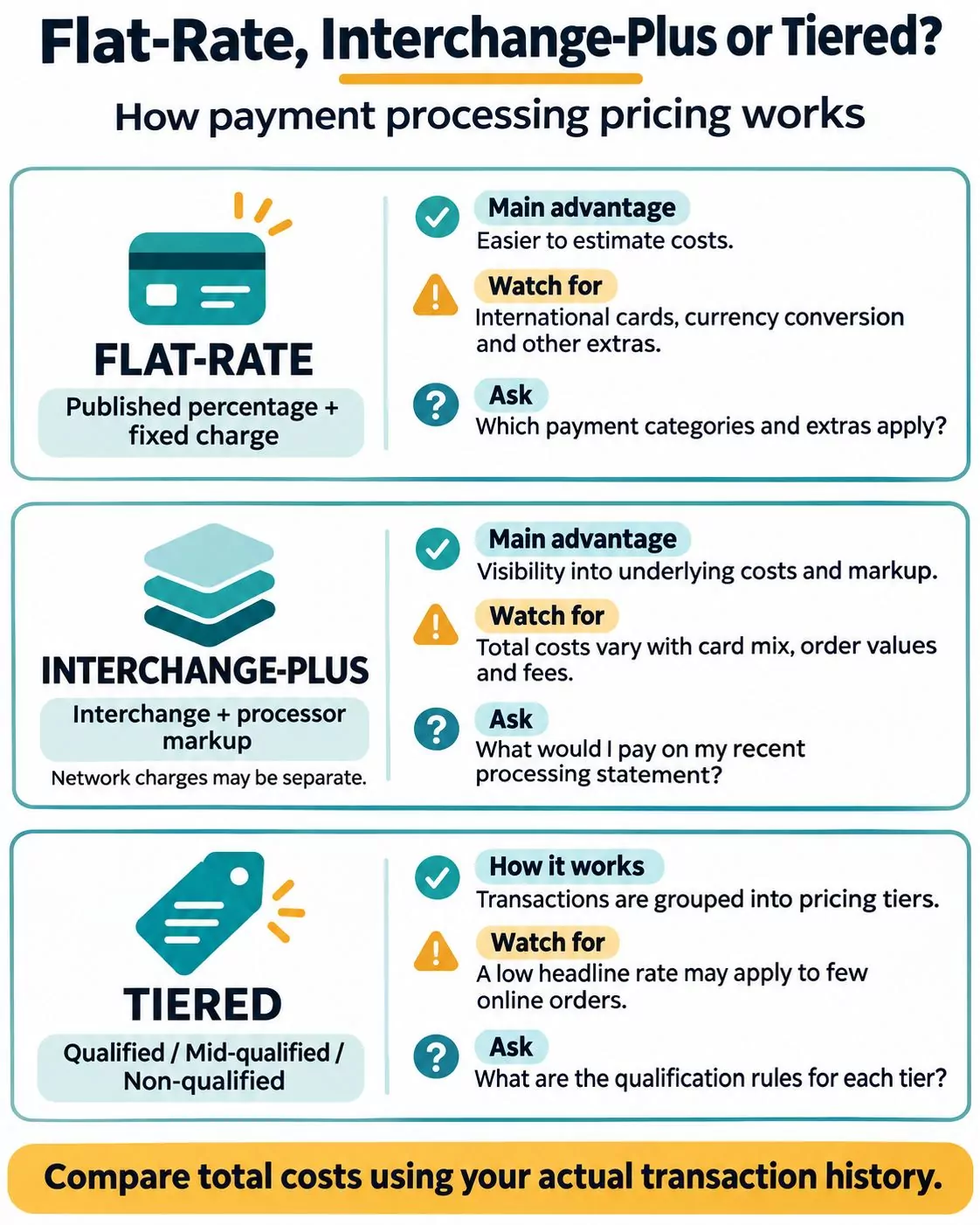
Flat-rate pricing
Flat-rate pricing gives you a published percentage and fixed charge for a defined payment category.
Its main advantage is predictability. You can estimate costs without examining the interchange category behind every card.
However, one base rate does not mean every transaction costs the same. International cards, currency conversion and other payment categories may carry extras.
Interchange-plus pricing
Interchange-plus passes through underlying interchange costs and adds the processor’s markup. Network charges may also appear separately.
For example, a quote might include actual card costs plus a percentage and a fixed amount. The total changes with the cards customers use.
This model can be competitive, but savings depend on your card mix, order values and additional fees. Ask the provider to calculate its proposed charges against a recent processing statement.
Tiered pricing
Tiered plans group transactions into categories, often called qualified, mid-qualified and non-qualified.
The difficulty is knowing which rate your sales will receive. A low advertised tier offers little reassurance if most online orders fall into a more expensive category.
Before accepting a tiered quote, request the qualification rules and an estimate based on your transaction history.
When Does a Monthly Plan Become Cheaper?
There is no universal sales threshold at which switching plans becomes worthwhile. Calculate the break-even point instead.
Break-even orders = extra monthly cost ÷ savings per order
Suppose a proposed plan adds a $30 monthly fee but saves 20 cents on each comparable order.
You would need 150 orders per month to cover the subscription. At 250 orders, transaction savings would total $50, leaving a net saving of $20.
If the estimated savings disappear when your customers use different cards, the plan may offer little benefit. Use a representative month rather than the provider’s most favorable example.
How International Fees Add Up
An international-card charge and a currency conversion charge have different triggers.
A customer can use a foreign-issued card while paying in your settlement currency. That may trigger an international-card fee without requiring conversion.
For a US account, Stripe publishes an additional 1.5% for international cards and 1% when currency conversion is required.
Applying those rates to a $50 payment gives:
| Payment scenario | Calculation | Processing cost |
|---|---|---|
| Domestic card | 2.9% + $0.30 | $1.75 |
| International card without conversion | 4.4% + $0.30 | $2.50 |
| International card with conversion | 5.4% + $0.30 | $3.00 |
These calculations assume the stated charges apply and exclude other services.
Charging everyone in US dollars does not automatically produce the best outcome. Customers may face conversion charges from their own banks, and unfamiliar checkout currencies can affect purchasing decisions.
Compare processing costs alongside customer experience and settlement needs.
Refunds, Chargebacks and Reserves
A refund returns money to the customer through your business. A chargeback begins through the customer’s card issuer.
Before choosing a provider, establish whether it returns the original processing fee after a refund and whether any separate refund charge applies. A refunded order can still leave your store with payment costs.
Disputes can create a larger loss. You may lose the sale proceeds, shipped goods, delivery costs and applicable dispute fees. Fee amounts and reimbursement rules vary by provider and dispute process.
Keep evidence that matches the transaction: order details, delivery confirmation, customer correspondence and any relevant acceptance records. Respond within the deadline shown in your dashboard.
A reserve is different from a fee. It is money temporarily withheld under the provider’s risk terms. The amount and release schedule depend on the account; do not assume every new store faces a standard percentage or holding period.
Calculate Your Effective Rate
Your effective rate shows how much payment acceptance costs relative to processed sales.
Effective rate = total payment-related fees ÷ processed sales × 100
Suppose your store processes $10,000 across 200 orders under a hypothetical 2.9% plus 30-cent plan:
- Percentage fees: $290
- Fixed fees: $60
- Total processing fees: $350
- Effective rate: 3.5%
If another plan charges a hypothetical 3.5% without a fixed fee, it would also cost $350.
But if the same revenue comes from 500 orders, the first plan costs $440. The fixed-fee-free plan remains $350.
For these two hypothetical plans, the break-even average order value is $50.
When reviewing statements, calculate a transaction-processing rate and an all-in rate that also includes monthly charges and payment add-ons. Track disputed sale losses separately so they do not become confused with processing fees.
Use the same definitions when comparing months or providers.
Seven Ways to Reduce Payment Costs
1. Compare providers using your own sales
Collect recent processing volume, transaction count, average order value, international share and refund history.
Ask competing providers to price that activity. A quote based on your business is more useful than an industry average.
2. Raise order value where it helps customers
Relevant bundles and sensible delivery thresholds can spread fixed fees across larger purchases.
Check the margin first. A discount that costs several dollars is unlikely to justify saving a few cents in processing.
3. Consider bank payments for suitable orders
Stripe publishes ACH Direct Debit pricing of 0.8%, capped at $5 per payment.
Bank payments may suit invoices, repeat customers and larger purchases. Compare settlement timing, return risks and any verification costs before adding them.
4. Reduce preventable disputes
Use recognizable billing descriptions, accurate product information, clear delivery estimates and accessible support.
Customers who can resolve a problem directly have less reason to seek a bank reversal.
5. Review paid extras
Check whether you still need premium reporting, accelerated payouts, subscription tools or additional fraud services.
A small recurring software charge can outweigh a modest reduction in transaction rates.
6. Request a better offer
Bring processing statements and competing quotes when asking about custom pricing.
Discuss monthly costs, fixed charges and contract terms as well as the percentage. More volume may improve your position, but it does not guarantee a discount.
7. Protect checkout performance
Lower fees help only if customers can complete their purchases.
Before switching, check payment-method coverage, mobile checkout, integration reliability and support. Include migration work and any disruption in your savings estimate.
Questions to Ask Before Signing
Get written answers to these questions:
- Does the quote include both gateway access and payment processing?
- Which rates apply to online, manually entered and international payments?
- Are original processing fees returned after refunds?
- What dispute charges can apply?
- Are there monthly minimums, subscriptions or compliance charges?
- How are currency conversion and payouts priced?
- Can funds be reserved, and under what terms?
- Is there a contract period or cancellation charge?
- Does my ecommerce platform add a separate transaction fee?
Keep the answers with your agreement and compare them against subsequent statements.
Final Words
Payment gateway fees can have a bigger impact on profitability than the advertised transaction rate suggests. Percentage charges, fixed fees, international payments, currency conversion, refunds and monthly subscriptions all contribute to the actual cost of accepting payments.
The best way to choose a provider is to compare its total fees against your store’s real sales volume, average order value and customer payment habits. Stripe, Square and PayPal offer different pricing structures, so the lowest headline rate does not necessarily deliver the greatest savings.
Calculate your effective processing rate, review your monthly statements and ask providers for a complete breakdown before signing an agreement. A payment solution that balances competitive pricing, reliable processing, customer convenience and transparent terms will help protect your margins as your online store grows.
Frequently Asked Questions
Are payment gateway fees the same for every store?
No. Pricing can vary by country, payment product, business type, transaction method and negotiated agreement. US examples should not be treated as worldwide rates.
Is the lowest percentage always cheapest?
No. Fixed charges, monthly subscriptions and additional fees can outweigh a lower percentage. Compare the total cost at your actual order size.
Do advertising costs change gateway fees?
Advertising and payment processing are separate expenses, but both affect order profitability. Calculate advertising cost per completed purchase; one click does not necessarily produce one sale.
Should I switch as soon as sales increase?
Review your options when sales or order patterns change. Switch when the expected savings and service benefits justify the migration costs.