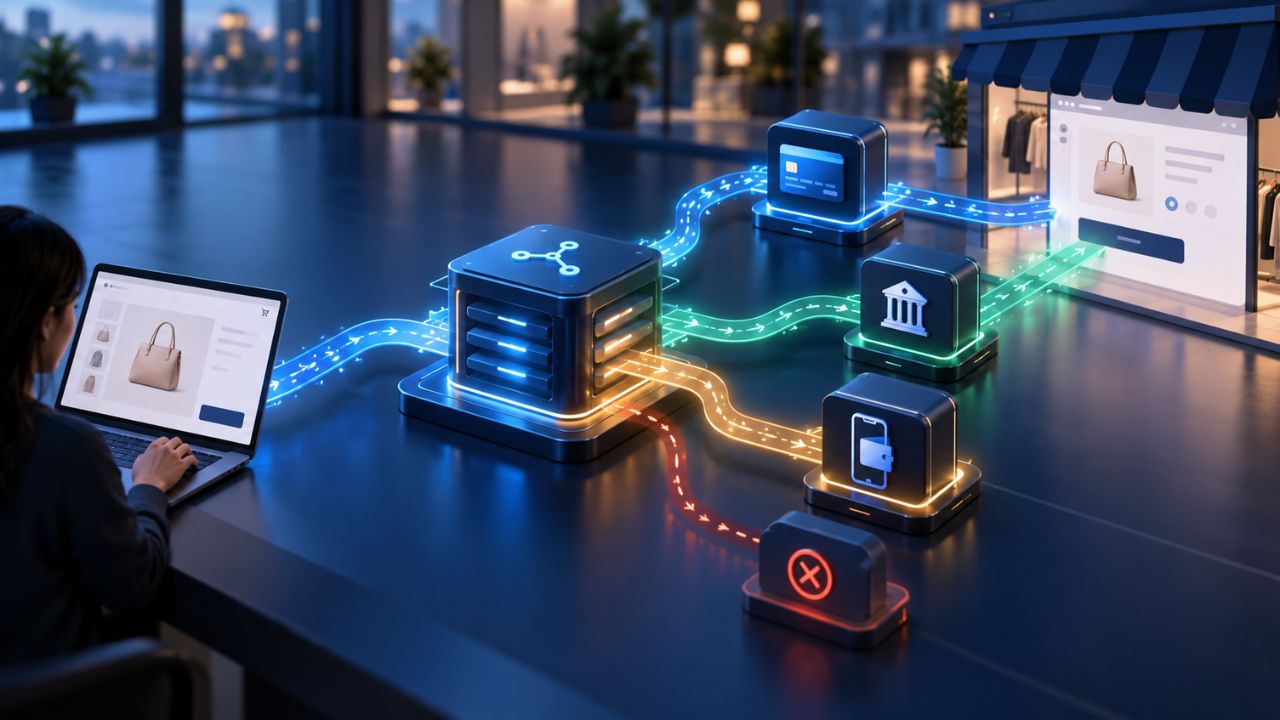
Payment orchestration is a technology layer that sits between your business and multiple payment providers, routing each transaction to the best gateway, processor, or acquirer based on rules like cost, approval rates, and currency.
Businesses that use more than one payment provider, sell across borders, or run subscription billing typically need it. A standalone payment gateway only connects you to one processor, while orchestration manages many at once.
What Is Payment Orchestration (and Do You Need It)?
Payment orchestration is the practice of managing multiple payment providers through one unified platform instead of integrating each one separately. For businesses processing payments across different countries, currencies, or payment methods, orchestration decides, transaction by transaction, which gateway or acquirer to use.
Think of it as air traffic control for money movement. Instead of every transaction flowing through a single payment gateway, an orchestration layer sits above several providers and picks the best route for each one. This matters because no single payment provider performs equally well in every country, for every card type, or at every price point.
Businesses need payment orchestration when they outgrow a single payment gateway setup. A company processing a few hundred transactions a month in one country rarely needs it. A company selling in 20 countries, handling multiple currencies, and running recurring billing almost always does.
How Does Payment Orchestration Actually Work?
Payment orchestration works by intercepting each transaction request and applying rules before sending it to a specific payment provider. The system checks data like card type, customer location, and provider uptime, then routes the transaction to the connector most likely to approve it at the lowest cost.
Here’s the basic flow:
- A customer submits payment data at checkout.
- The orchestration platform receives the request through its API.
- Routing logic evaluates factors like currency, card data, local payment methods, and provider rates.
- The transaction gets sent to the selected gateway or acquirer.
- The result (approved, declined, or flagged for fraud) returns to the orchestration layer.
- If declined, the system can automatically retry the transaction through a different provider.
This routing decision happens in milliseconds. Businesses never see the complexity, they just see higher approval rates and fewer manual interventions. The orchestration layer also centralizes reconciliation, so finance teams get one unified view of transactions instead of pulling reports from five different dashboards.
Payment Orchestration vs Payment Gateway: What’s the Difference?
A payment gateway connects your business to one processor and handles the technical job of passing card data securely. Payment orchestration sits above multiple gateways and decides which one to use for each transaction. They are not competitors, orchestration typically works with gateways, not instead of them.
| Feature | Payment Gateway | Payment Orchestration |
|---|---|---|
| Number of providers | Usually one | Multiple, connected through one API |
| Routing logic | None, fixed path | Dynamic, rules-based |
| Failover on decline | Limited or none | Automatic retry through another provider |
| Local payment methods | Depends on single provider | Can add local methods per region |
| Reporting | Single provider view | Consolidated across providers |
| Best for | Single-market, simple business | Multi-provider, global, or high-volume business |
Choose a plain gateway if you sell in one country, use one processor, and have low transaction volume. Choose orchestration if you already juggle more than one processor or plan to expand internationally within the next year.
Do I Need Payment Orchestration for My Business?
You need payment orchestration if you use or plan to use multiple payment providers, sell in several countries or currencies, run subscription billing, or operate a marketplace with complex payout flows. If you run a single-market business with one payment method and low transaction volume, a standard gateway is usually enough.
Specific signals that indicate you need orchestration:
- You already work with two or more PSPs and manage them manually.
- You sell into multiple countries and want local payment methods to boost conversion.
- Your subscription billing has a high rate of failed recurring charges.
- You run a marketplace or platform business with split payouts to multiple parties.
- Your current provider’s fraud or decline rates are costing you revenue.
A mid-size SaaS company selling only in the US with one payment method rarely needs orchestration. A company selling subscriptions in the US, UK, and EU, accepting cards plus local wallets, almost certainly does.
What Problems Does Payment Orchestration Solve?
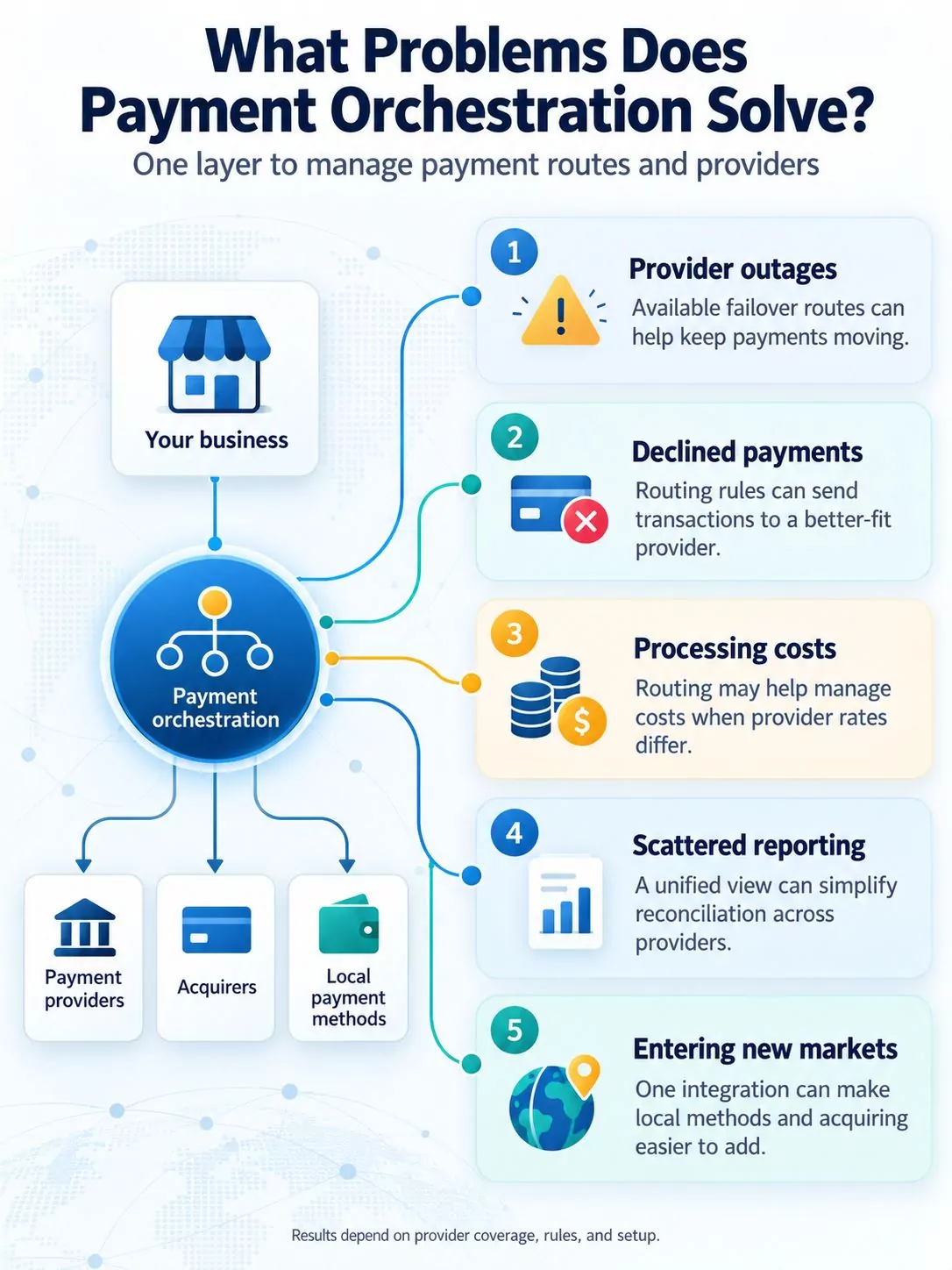
Payment orchestration solves the operational mess that happens when a business depends on a single payment provider for a global, multi-channel operation. It reduces failed transactions, lowers processing costs through smart routing, and removes the engineering burden of maintaining many separate integrations.
Common problems it addresses:
- Single point of failure: If one processor goes down, transactions can automatically reroute instead of failing outright.
- High decline rates: Some acquirers approve certain card types or regions better than others; routing to the right one lifts approval rates.
- Rising processing costs: Orchestration can route transactions to whichever provider offers the lowest rates for that specific transaction type.
- Fragmented reporting: Instead of five dashboards, finance teams get one consolidated view for billing and reconciliation.
- Slow expansion into new markets: Adding local payment methods and local acquiring becomes a configuration change, not a new engineering project.
Payment Orchestration Examples in Ecommerce
A clear example is an online retailer selling in the US, Europe, and Southeast Asia, where orchestration routes US card transactions through one acquirer, EU transactions through a local acquirer for better approval rates, and Southeast Asian transactions through a provider that supports regional e-wallets.
Another common example: a subscription business running recurring billing. When a card payment fails, the orchestration platform can automatically retry it a few days later, sometimes through a different processor, recovering revenue that would otherwise be lost to a single failed charge. Digital goods and in-app purchase businesses use orchestration similarly, managing fraud screening, analytics on in-app purchases, and payment method reporting across providers in one place rather than stitching together several vendor dashboards.
A third example is a marketplace platform that needs to split a single transaction into payouts for multiple sellers. Orchestration can manage that complexity while still keeping a single integration for the platform’s engineering team.
Best Payment Orchestration Platforms and Tools
Several companies offer payment orchestration platforms, and the right one depends on your transaction volume, markets, and existing payment stack. Dodo Payments is one example of a platform built to help businesses manage multiple payment methods and route transactions without rebuilding their checkout integration each time they add a provider.
Other categories worth knowing:
- Dedicated orchestration platforms built specifically to manage routing, reconciliation, and failover across many providers.
- PSPs with native orchestration features, where a primary processor now offers built-in routing to secondary providers as an add-on.
- Enterprise orchestration vendors aimed at large businesses with complex compliance and multi-region requirements.
When comparing platforms, look at the number of pre-built connectors, how routing rules are configured, whether local payment methods are supported out of the box, and how fast their API integration process is. BridgerPay’s expansion announced in October 2026 is one recent example of a provider adding more regional payment method coverage to its orchestration layer, reflecting how fast this part of the market is moving heading into 2026.
Is Payment Orchestration Worth It for Small Businesses?
Payment orchestration is usually not worth it for very small businesses with one payment method, one market, and low transaction volume, because the integration effort outweighs the benefit. It becomes worth it once a small business starts selling internationally, adding a second payment method, or seeing meaningful revenue loss from declined transactions.
A useful decision rule: if failed transactions or processing costs are costing you more each month than an orchestration platform’s fees would, it’s worth evaluating. If you process under a few thousand dollars a month through a single processor, hold off and revisit the decision as volume grows.
How Does Payment Orchestration Reduce Failed Transactions?
Payment orchestration reduces failed transactions through intelligent routing and automatic retry logic that sends declined payments to a different provider or tries again with adjusted parameters. Because different acquirers have different approval algorithms, a transaction declined by one provider may succeed through another.
Mechanisms that reduce failures:
- Cascading retries: A declined transaction automatically retries through a secondary processor.
- Account updater services: Expired or updated card data gets refreshed automatically for recurring billing.
- Smart retry timing: Failed subscription charges retry at optimal times rather than immediately, improving recovery rates.
- Local acquiring: Processing transactions through a local acquirer in the customer’s country often improves approval rates compared with cross-border processing.
Payment Orchestration vs Payment Processor
A payment processor is the entity that actually moves money between banks and settles funds. Payment orchestration does not replace a processor, it manages and routes transactions across multiple processors so a business doesn’t depend on just one. The two work together rather than compete.
Think of the processor as the engine and orchestration as the transmission system deciding which engine to use for each trip. Businesses still need a signed agreement with underlying processors; orchestration just reduces how much manual engineering work is needed to use several of them at once.
Common Mistakes People Make with Payment Orchestration
The biggest mistake businesses make with payment orchestration is adopting it before they have a genuine multi-provider or multi-market need, adding complexity and cost without a matching benefit. Other frequent mistakes include under-investing in data analysis.
Common missteps:
- Adding orchestration without first auditing current decline rates and processing costs to measure improvement.
- Choosing a platform with weak support for local payment methods in your target markets.
- Ignoring PCI compliance scope changes that come with additional integrations.
- Failing to set up proper fraud rules per region, leading to either too many false declines or too much fraud exposure.
- Treating orchestration as a one-time project instead of an ongoing optimization process with routing rules that need regular review.
How Long Does It Take to Set Up Payment Orchestration?
Setting up payment orchestration typically takes between four weeks and six months, depending on how many providers you connect, how complex your checkout and billing flows are, and whether you need custom routing logic. A business connecting two or three existing providers with a modern API can often launch in under two months.
Factors that extend timelines:
- Number of existing systems that need to integrate with the new orchestration layer.
- Complexity of recurring billing rules and retry logic.
- Compliance review requirements, especially for regulated industries.
- Testing time needed across each connected gateway before going live.
Can Payment Orchestration Work with Any Payment Gateway?
Most payment orchestration platforms work with a defined list of supported gateways and acquirers rather than every gateway that exists. Before committing to a platform, confirm your current and planned providers are on its supported connector list, or that it offers custom API integration for providers not yet supported.
If your business uses a niche regional processor, ask the orchestration vendor directly whether a connector exists or can be built within your timeline. This is a common gap that causes implementation delays.
Payment Orchestration and PCI Compliance Requirements
Payment orchestration platforms generally reduce PCI compliance burden by tokenizing card data once and reusing that token across multiple connected providers, rather than exposing raw card data to every system. Most reputable orchestration vendors maintain PCI DSS Level 1 compliance themselves.
Still, businesses remain responsible for confirming:
- The orchestration vendor’s compliance certification is current.
- Card data never touches unencrypted business systems outside the orchestration layer.
- Each connected provider also meets required compliance standards for its region.
Final Thoughts
Payment orchestration is not a universal requirement, but for businesses running multiple payment methods, selling across borders, or managing subscription billing, it solves real operational problems that a single gateway cannot. It improves approval rates through smart routing, reduces dependency on any one provider, and simplifies reporting across a fragmented payment stack.
If you’re still processing most of your volume through one gateway in one country, hold off and revisit the question as you expand. If you already juggle multiple providers, see rising decline rates, or plan international growth in 2026, start by auditing your current transaction data, mapping which markets need local payment methods, and requesting demos from two or three orchestration vendors that support your target regions. That audit alone usually makes the decision obvious.
Frequently Asked Questions
What is the payment system in e-commerce?
A payment system in e-commerce is the combination of gateway, processor, and acquiring bank that allows a customer’s payment method to move funds to a merchant’s account. It includes checkout data capture, authorization, fraud screening, and settlement, often involving several providers working together behind the scenes.
What is orchestration in simple words?
Orchestration means coordinating multiple separate systems so they work together as one. In payments, it means managing several payment providers through a single platform that decides which one handles each transaction, instead of relying on just one provider for everything.
Can I build my own payment processor?
Building your own payment processor is possible but extremely costly and regulation-heavy, requiring banking licenses, card network approval, and massive compliance infrastructure. Most businesses instead use existing processors or an orchestration layer, which gives similar routing control without the regulatory burden of becoming a licensed processor.
What is payment infrastructure?
Payment infrastructure is the full set of systems, including gateways, processors, acquirers, fraud tools, and orchestration layers, that a business relies on to accept and move money. It covers everything from checkout integration to settlement and reconciliation across providers.