
Starting an online business no longer requires a large investment, a physical office, or a big team. With the right idea, a clear business plan, and the right digital tools, almost anyone can turn their skills, knowledge, or passion into a profitable online venture.
Whether you want to start a freelance service, launch an online store, sell digital products, or build a content-based business, there are plenty of opportunities to get started with limited capital.
In this guide, we’ll explore how to start a profitable online business with limited investment, including practical business ideas, essential steps, and budget-friendly strategies to help you build a sustainable income without taking unnecessary financial risks.
Benefits of Starting an Online Business with Limited Investment
Starting an online business with limited investment opens doors that traditional businesses keep locked. Many online business models cost as little as $0 to $100 to start, which puts them within reach for most aspiring entrepreneurs.
Platforms like Fiverr, Upwork, and Etsy let you launch a service-based business or sell digital products without spending much. Freelancing, dropshipping, and affiliate marketing all require minimal cash upfront.
Here’s what keeps costs so low:
- Free marketing channels: Social media marketing on Facebook, Instagram, TikTok, and Pinterest costs nothing, yet reaches millions of people.
- Affordable software: Xero handles accounting and Shopify handles ecommerce at small business prices.
- Scalability and automation: Online businesses lower long-term operating costs as they grow, so you keep more money in your pocket.
- A connected audience: The ITU report notes that 94% of people in high-income countries are online, so US customers are easy to reach.
Speed matters when money is tight, and online businesses deliver fast results. Time to first revenue can be as short as 24 to 72 hours for some digital products if you already have an audience.
Businesses like freelance writing, Canva templates, and digital planners can start generating income within 1 to 2 months. Earnings range from a few hundred dollars to tens of thousands monthly, depending on the business model.
A web designer on Fiverr might earn $500 in week one. A virtual assistant on Upwork could land clients within days. Selling online courses or digital planners through your own website or Etsy creates passive income while you sleep.
Low investment plus quick returns means you risk less while testing ideas that could become your next big income stream.
Profitable Online Business Ideas
You can turn your talents into cash through freelancing, selling digital products, affiliate marketing, or running a dropshipping store. These paths let you start small, spend little, and grow fast as customers find you.
Here’s a quick comparison before we look at each one:
| Business Model | Startup Cost | Typical Monthly Earnings |
|---|---|---|
| Freelance writing | $0 to $100 | $2,000 to $10,000 |
| Dropshipping | $500 to $1,000 | $1,000 to $5,000 |
| Affiliate marketing | $0 | $50 to $5,000+ |
| Digital products | $0 to $5,500 | Varies widely by product |
Freelancing: Monetizing Your Skills
Freelancing offers one of the fastest paths to earning money online with almost zero startup costs. Freelance blog writers like Elna Cain charge between $100 and $1,000 per blog post, and she started with just $0 to $100 in initial investment.
Most freelance blog writers reach their first paycheck in about 14 weeks. Social media writers often see their first dollars within 24 weeks while spending only $0 to $50 to get started. Sneha Tyagi proved this works when she earned her first $1,000 through LinkedIn ghostwriting.
The earnings climb quickly too. Freelance blog writing can bring in $2,000 to $10,000 monthly, while social media writing generates $500 to $10,000 or more each month.
Your existing skills become your product. That might mean writing, web design, coding, or virtual assistance. Platforms like Freelancer connect you with clients searching for exactly what you offer.
Here’s how to get rolling:
- List your skills and match them to services customers actually need. A little market research shows you what rates clients will pay.
- Build a simple portfolio with your best work, even if you start with a few samples or volunteer projects.
- Create profiles on freelancer marketplaces and bid on small jobs to build your reputation. SEO knowledge helps your profile rank higher in searches.
- Track which projects pay best, then focus your energy there.
Many successful freelancers use Google tools and basic website builders to set up their online presence without spending much. As you grow, raise your rates and take on bigger clients who value quality work.
Dropshipping: E-commerce Without Inventory
Dropshipping lets you sell products without holding any stock. You set up an online store, customers place orders, and a supplier ships items directly to them. This e-commerce model cuts your startup costs to just $500 to $1,000, which makes it a solid fit for small business owners with limited investment.
Tze Hing Chan proved this works when he made $19,000 in just two months selling bubble tea plush toys through dropshipping. Your first revenue can arrive in one to two months, so you start earning fast. You handle customer service and digital marketing while your supplier manages inventory and shipping.
One smart approach is testing multiple products quickly to find what actually sells. A small dropshipping experiment ran tests on eight SKUs over 30 days, and only two gained real traction. Those two winners generated 134 orders and $19,400 in gross revenue over 60 days, with an 18 percent net margin after supplier and marketing fees. Time to first sale was just 12 days.
The seller validated demand with low-cost product pages and influencer swaps, then scaled the winners while keeping inventory risk at zero. This stepwise process helps you find profitable products without betting everything on untested stock.
A quick reality check before you spend ad money. According to 2026 dropshipping statistics compiled by Carro and AffMaven, industry estimates suggest only about 10 to 20 percent of dropshipping stores turn a profit in their first year. Typical margins run 10 to 30 percent (closer to 10 to 15 percent for electronics), and only about 1.5 percent of stores earn over $50,000 a month. Knowing these base rates helps you set realistic expectations and treat the big success stories as exceptions, not promises.
Still, the model has real appeal. Building a dropshipping business on platforms like WooCommerce or Wix takes minimal cash upfront, and most dropshippers who gain traction earn between $1,000 and $5,000 monthly. You pick a niche, add products, and drive traffic through social media and SEO.
No warehouse, no packing, no shipping headaches. Your profit comes from the gap between what customers pay and what suppliers charge. That’s why this business model works well for startups: you test ideas without risking thousands on inventory that might not sell.
Affiliate Marketing: Earning Through Recommendations
Affiliate marketing costs nothing to start, which makes it perfect for tight budgets. You recommend products or services you actually like, and you earn money when someone buys through your link.
Ryan Robinson made $450,000 from affiliate marketing on his blog in 2021, which shows the model can work at serious scale. Most affiliates earn between $50 and $5,000 or more each month, depending on audience size and effort. Treat the big numbers as outliers, not typical results.
Platforms like Amazon Associates let you join for free and start promoting right away. Your income grows as your audience grows, so this approach rewards patience and consistency.
Getting your first paycheck usually takes six to twelve months, but the wait pays off once you build momentum. You can scale affiliate marketing through blogging, a YouTube channel, or social media posts without spending money on inventory or customer acquisition.
Paid newsletters powered by affiliate links offer another route, with startup costs from zero to $200 monthly and earnings of $1,000 to $3,000 per month. Lenny Rachitsky earned $65,000 from his newsletter with just 500 subscribers in a single year. Quality audiences beat massive ones.
Selling Digital Products: Templates, E-books, and More
Selling digital products opens the door to serious income without draining your wallet. E-books lead the charge, with the global market sitting at roughly $59.2 billion. Aleksandra proved this works by selling a low-carb recipe e-book bundle for $24.58 each, bringing in over $30,000 in August 2025.
You can start an e-book business for $0 to $5,500, then earn anywhere from $100 to $82,000 annually. And e-books are just the start:
- Notion templates: Thomas Frank made $1 million selling them in 2022, with startup costs of just $0 to $100.
- Canva templates: They cost $0 to $150 yearly and generate $500 to $3,000 monthly for sellers like Nishad Mubarak, who earns over $2,000 each month.
- Digital planners: Savan Vyas generated $7,479.53 in revenue in less than 10 months.
- Swipe files and cheat sheets: Justin Welch made $7,500 from a single downloadable swipe file.
Real results can show up fast when you launch to even a small audience. One digital planner seller launched to 1,200 Instagram followers and recorded 72 downloads in the first 14 days, generating $3,599.40 at an average price of $49.99 per planner. The link-in-bio conversion rate hit 6.0 percent, and ad spend stayed at zero.
That seller shipped a first version with just three template pages and posted organic reels every other day. The sales spike arrived in week one without any paid ads. A simple first product plus steady content creation can drive real revenue when you target an engaged niche.
AI prompt packs add another way to monetize. Randy Liu generates $60 to $80 daily selling them, with startup costs between $0 and $100.
Your startup game changes when you focus on what people actually need. Use free tools like Canva or Google LLC services to build your templates. Test your digital products with small audiences first, track what sells and what flops, then scale what works. This kind of e-business takes hustle, not heavy capital, which makes it a great fit for solopreneurs launching their first venture.
Steps to Start Your Online Business
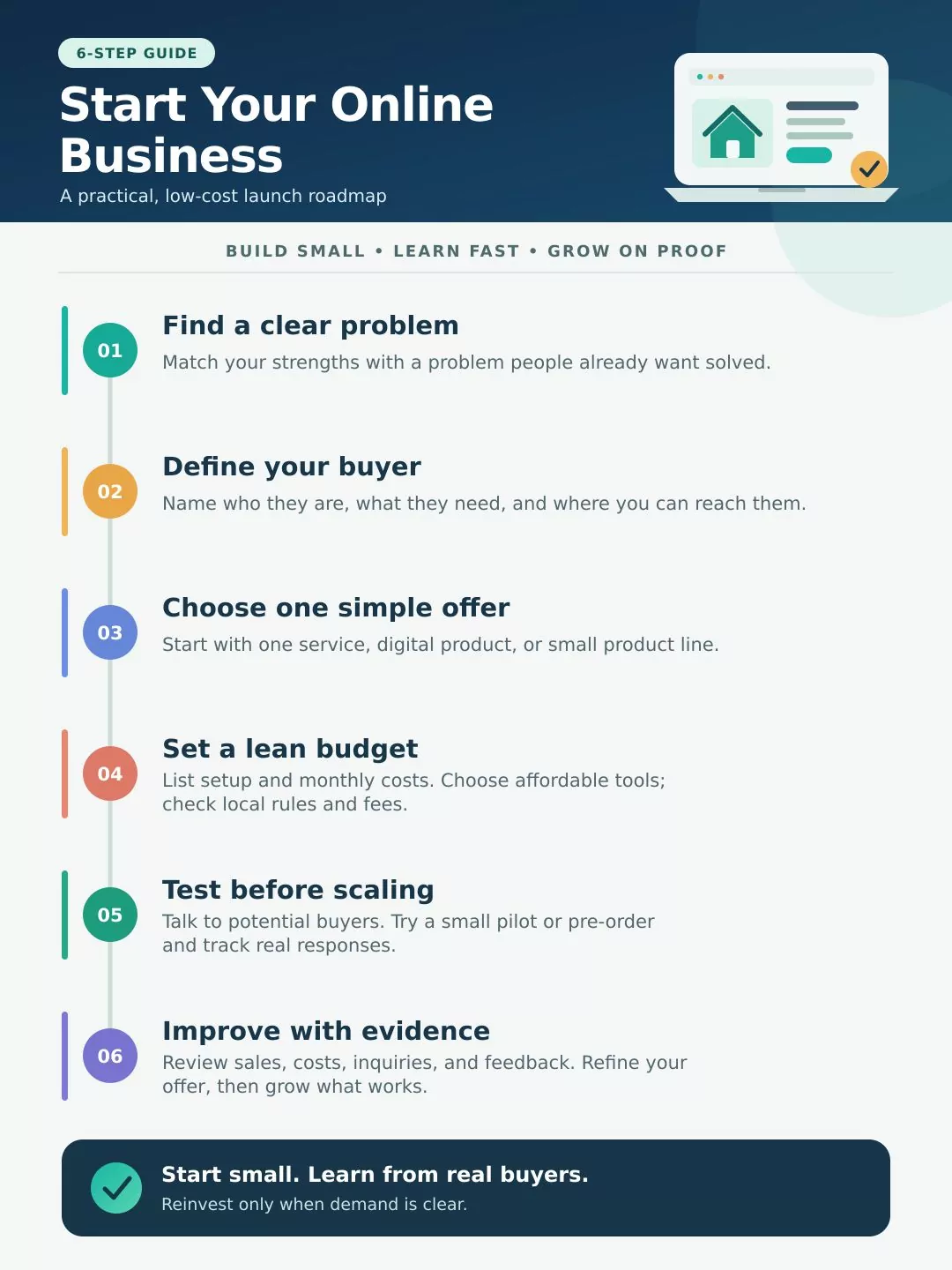
Starting your online business means making smart choices from day one. You pick your niche, gather affordable tools, and test your idea before you spend big money.
Identify Your Niche and Target Audience
Your niche is the specific problem you solve for a specific group of people. Start by listing your skills, then match them with market demand. Ask yourself what problems you face daily, what frustrates you, and what you could teach others. You already know those pain points, which gives you an edge.
Look at online business ideas with low investment that match your strengths. If you have design or writing skills, consider print on demand, blogging, or app development. The U.S. Small Business Administration recommends matching skills to demand this way because it saves money and time.
Your target audience is the group most likely to buy from you. Define them by age, income, interests, and the specific problem they need solved. A profitable niche has customers ready to pay right now.
Want to see how fast you can test a niche? Here’s a structured workflow for freelance writing:
- Create three 300-word sample posts in your chosen subniche within 48 hours.
- Post those samples to LinkedIn and a freelancer marketplace profile at the same time.
- Pitch 15 small business owners over the next seven days with personalized outreach that highlights your samples.
- Land your first paid assignment, often around $150, by day 18.
With repeat clients, you can ramp up to $1,200 monthly by month three with four steady clients. Narrowing to one subniche and doing targeted outreach proves your concept in under three weeks, before you invest more time or money.
Scalability and automation should guide your choice too. Some niches generate revenue fast: e-books can bring in money within 24 to 72 hours if you have an audience. Others take longer, like membership sites, which need about 13 months to hit first revenue but can earn $1,000 to $10,000 monthly once established.
Startup costs range from $0 to $5,500 or more depending on your pick, and AI automation niches have produced up to $300,000 monthly for entrepreneurs who found the right angle. Test your idea with real people before investing heavily, and use free tools like ChatGPT to research competitors and validate demand. That groundwork prevents costly mistakes and points you toward profitable small business opportunities.
Use Free or Affordable Tools to Launch
You don’t need to spend a fortune to launch your small business online. Free and affordable tools let you start making money without breaking the bank.
- Canva templates cost between $0 and $150 per year, giving you professional designs for social media, digital products, and marketing materials without hiring a designer.
- Social media management services require only $150 to $600 in startup costs, letting you offer SEO-friendly content creation to clients on platforms like TikTok and Instagram.
- Browser extension businesses launch for free to $500, a low-risk entry point into the online business ideas market.
- Paid newsletter subscriptions start at $0 to $200 monthly, letting you build an audience and earn through email marketing without pricey software.
- AI prompt packs need just $0 to $100 to start, letting you sell ready-made prompts to people using AI tools daily.
- Digital planner businesses cost $0 to $100 to launch, so you can sell organizational templates to productivity-focused customers right away.
A few more low-cost options: online tools directories run $50 to $200 annually and pay you for reviewing software, affiliate marketing costs nothing to start, and freelancing platforms charge zero upfront fees so you can monetize your skills immediately.
One budget note worth planning for. According to Aspire’s 2026 guide to starting an online business in the US, LLC registration fees run roughly $50 to $800 depending on your state, and initial marketing often costs $300 to $1,000. Many sole proprietors can skip formal registration at first, but check your state’s filing office for exact fees so you can budget ahead.
Test Your Idea Before Scaling
Start small and prove your concept works before you spend big money. Aleksandra and Savan Vyas did exactly this, making $30,000 and $7,479.53 in early sales before expanding their small business efforts.
Testing product-market fit takes just one to two months for dropshipping and digital planners, so you can validate your idea quickly with low investment. Notion templates can generate revenue in 48 hours if you have an audience, though beginners should expect about 13 months. E-books move quicker, generating cash within 24 to 72 hours with existing followers.
This testing phase separates successful ventures from failed ones. You learn what customers actually want before scaling up.
Launch your first version with free or affordable tools and track every metric that matters. Checklists can produce first revenue in 26 weeks, giving you real data about demand. Run your small business through this validation stage, measure what happens, and improve based on actual results, not guesses.
Paid communities and memberships typically need six to twelve months to generate revenue, so pick your model wisely. Testing saves you money, builds confidence, and shows you exactly where to focus when you scale. Your SEO efforts and network marketing tactics also work better when you try them on a small audience first.
Tips for Growing Your Online Business
Growing your online business comes down to smart moves with social media and content marketing. You track what works, then adjust your approach to get better results.
Use Social Media and Content Marketing
Social media platforms like TikTok, Instagram Reels, Pinterest, and X give your small business free marketing power. TikTok creators start with zero dollars and earn between $1,000 and $10,000 monthly once they build an audience.
Khaby Lame makes an estimated $257,583 per video with 161 million followers, proof that consistent content attracts real money. You don’t need fancy equipment or a big budget. Your phone and free editing tools work fine.
Post videos, images, and written content regularly to keep your audience engaged and coming back.
Content marketing builds trust with people who might buy from you later. The numbers back this up:
- YouTube channels with 100,000 subscribers earn $2,000 to $5,000 monthly through ads and sponsorships.
- Blogs can generate $1.4 million annually after four years of steady work.
- The podcast industry is worth nearly $40 billion globally, and Steven Bartlett’s podcast made $20 million in revenue during 2024.
Share helpful tips, behind-the-scenes stories, and honest advice that solves real problems for your target audience. That’s how online business ideas become something people actually care about, and how followers turn into paying customers.
Track Performance and Optimize Strategies
Numbers tell the real story of your online business. Jake Demi tracked his bookkeeping revenue and hit $22,718 monthly, which guided his scaling choices. Gillian Perkins watched her membership business reach $10,000 per month with just 300 members by studying what worked.
Watch your metrics closely. Check your conversion rates, click-through rates, and customer costs every week. Use free tools like Google Analytics to see where your traffic comes from, and note which products sell best and which sit untouched.
This data shapes your next move. Small business owners who skip this step often waste money on the wrong strategies.
Your SEO and content marketing need real numbers behind them, and the payoff from testing can be huge:
- Neil Patel’s SEO agency jumped from $10,000 to $20,000 monthly within one year, then grew to $240,000 to $1,200,000 annually by testing and tweaking.
- Harlan Rappaport’s email marketing agency made $833,000 profit after five years of constant refinement.
- CodexLab’s website development team earned $100,000 in just eight months by tracking what clients wanted most.
Test one small change at a time, measure the results, then decide what stays and what goes. Your online business grows fastest when you act on performance data instead of hunches.
Final Thoughts
You now hold the keys to launch a profitable online business without breaking the bank. The ITU counts about six billion internet users worldwide in 2025, and plenty of them are ready to buy what you sell. That could be freelance services, digital products, or affiliate recommendations.
Starting costs run between zero and five hundred dollars, so money shouldn’t stop you from taking action today. Pick one idea that excites you, test it with real customers, and watch your small business grow into something meaningful.
Frequently Asked Questions (FAQs)
1. How can I start a profitable online business with limited investment?
You can start a profitable online business with limited investment by choosing a low-cost business model, such as freelancing, blogging, affiliate marketing, dropshipping, or selling digital products. Start with essential tools, focus on a specific audience, and reinvest your initial earnings to grow.
2. What is the most profitable online business to start with little money?
Some profitable online businesses with low startup costs include freelance services, affiliate marketing, online tutoring, blogging, digital product sales, and social media management. The best option depends on your skills, interests, and market demand.
3. How much money do I need to start an online business?
You can start certain online businesses with as little as $50 to $500, depending on the business model. Freelancing and digital services may require almost no upfront investment, while e-commerce businesses may need additional funds for inventory, marketing, and website development.
4. Can I start an online business without any experience?
Yes. You can start an online business without prior experience by learning essential skills through free online courses, tutorials, and practice. Begin with a simple business model and gradually develop your knowledge as your business grows.