Two businesses using Square Free can accept an online card payment and pay different processing rates. One pays 3.3% plus 30 cents through Square’s standard online payment service. The other pays 2.9% plus 30 cents through Square’s Online API.
They haven’t chosen different payment processors. They’ve chosen different ways to collect the money.
PayPal has a similar distinction between its standard Checkout and Expanded Checkout products. Stripe, meanwhile, includes its basic hosted checkout in standard payment processing but charges separately for certain invoicing and subscription features.
For small businesses comparing Stripe, Square and PayPal in 2026, these product-level differences deserve attention. A published percentage isn’t necessarily the rate a merchant will pay, and the cheapest processing arrangement may require software or administrative work that another product handles automatically.
The useful starting point is the payment method, not the provider’s name.
The Rates You Can Actually Compare
The standard US rates below apply to domestic transactions using the specified services. Businesses with negotiated pricing, international cards or additional payment products may pay different amounts.
| Service | Transaction fee | Monthly base fee |
|---|---|---|
| Stripe online domestic cards | 2.9% + 30¢ | $0 |
| Square Free, standard online cards | 3.3% + 30¢ | $0 |
| Square Free, Online API | 2.9% + 30¢ | $0 |
| PayPal Checkout, cards | 2.99% + 49¢ | $0 |
| PayPal Expanded Checkout, cards | 2.89% + 29¢ | $0 |
| PayPal or Venmo wallet checkout | 3.49% + 49¢ | $0 |
| Stripe Terminal, card present | 2.7% + 5¢ | $0 for basic processing |
| Square Free, card present | 2.6% + 15¢ | $0 |
| PayPal POS, card present | 2.29% + 9¢ | $0 |
These are published list rates, not quotes for individual businesses. They exclude hardware, optional subscriptions, international charges and other applicable fees.
PayPal Expanded Checkout has the lowest listed standard online card rate in this comparison. PayPal POS also has the lowest listed in-person rate.
Neither observation settles the wider choice.
Expanded Checkout offers more payment customization and risk-management control than PayPal’s standard hosted checkout arrangement. Using Square’s Online API similarly involves a different implementation from collecting payments through Square’s standard online tools.
A merchant can compare the prices only after establishing which products its website or sales system can actually use.
A Lower Rate Can Come With More Work
Square’s two Free-plan online rates show how much implementation can affect pricing.
A small business can use Square’s existing online-selling and invoicing tools without building a custom payment application. The standard card rate for those payments is 3.3% plus 30 cents.
Square’s API offers a lower rate of 2.9% plus 30 cents. That option is intended for payments integrated into a merchant’s own web or mobile application.
An existing custom application might make the API attractive. A merchant who would need to hire a developer, maintain an integration and troubleshoot payment failures has more to consider than the processing discount.
Square Plus also offers the 2.9% plus 30-cent standard online rate, but costs $49 per month per location. Premium costs $149 monthly per location and offers the same listed online card rate alongside a different set of software features.
A business shouldn’t assume that buying Plus is the cheapest route to Square’s lower online card pricing. The API is already available at that rate on Free, provided the business can use it.
PayPal presents another variation. Its standard Checkout product offers a PayPal-hosted experience with payment options and eligible Seller Protection. Expanded Checkout offers more control over the checkout experience and risk management, with a lower published card-processing rate.
That lower price may be attractive to a merchant that already has the technical and operational resources to use it. Another business may place more value on the simpler hosted arrangement.
Stripe’s standard online card pricing sits between those PayPal card rates. Stripe Checkout and Payment Links are included in its standard payment pricing, making them options for businesses that want hosted checkout or payment links without building a payment interface from scratch.
Stripe’s APIs remain available when greater control is needed.
For a small ecommerce business, the question is whether the processor’s existing checkout meets its requirements. Customization creates opportunities, but it also creates work.
When a Payment Processor Becomes Business Software
An ordinary card reader is enough for some merchants. Others need payment acceptance tied to products, inventory, employees and customer records.
Square sells that broader operating system alongside processing.
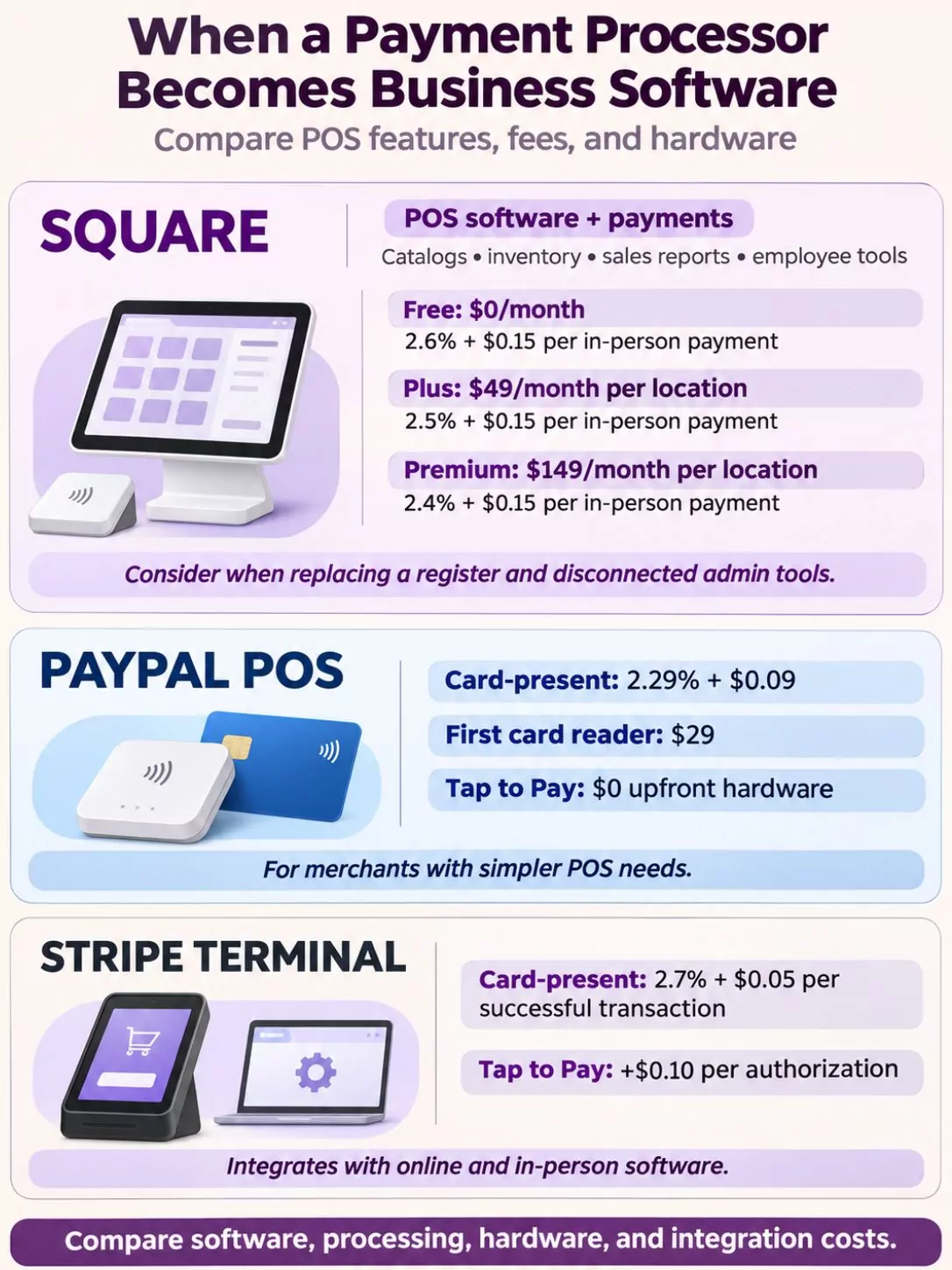
Its point-of-sale software supports product catalogues, inventory tracking and sales reporting. The company also offers hardware ranging from mobile card readers to countertop equipment and industry-specific tools for retail, restaurants and service businesses.
That makes Square an attractive starting point for a physical store replacing a cash register and several disconnected administrative processes.
The subscription cost needs to be considered separately from transaction fees.
Square Plus is $49 per month per location, with a standard in-person card rate of 2.5% plus 15 cents. Premium costs $149 per month per location and reduces the in-person rate to 2.4% plus 15 cents.
Square Free charges 2.6% plus 15 cents.
For a business with relatively modest card volume, the lower processing percentages may not recover the paid subscription expense. Better inventory controls, employee access or other operating features would need to justify the difference.
PayPal POS makes an interesting alternative for merchants whose requirements are simpler.
Its published card-present rate is 2.29% plus 9 cents. PayPal lists the first compatible card reader at $29 and provides Tap to Pay through its app without an upfront hardware purchase. Its POS offering also includes business-management features, although merchants should compare the specific functions they require rather than assume that every POS system works identically.
Stripe Terminal supports physical payments as well. Its standard domestic card-present rate is 2.7% plus 5 cents, and the system can integrate with software used by an online or in-person business.
There are implementation details beyond that rate. Stripe lists an additional 10 cents per authorization for Terminal’s Tap to Pay capability, for example. A merchant comparing smartphone-based acceptance with a separate card reader needs to account for the actual hardware and payment arrangement.
A retailer already using a capable point-of-sale system may prefer the processor that integrates with it. A business replacing its entire retail workflow has stronger reasons to examine Square’s software.
Card Fees Are Only One Line on an Invoice
A consultant collecting large invoices and an online store processing small purchases may pay similar advertised card rates but have very different opportunities to reduce costs.
Stripe’s ACH Direct Debit pricing is 0.8% per successful payment, capped at $5. Square lists a 1% fee for ACH invoice payments on Free, with a $1 minimum; paid plans introduce a $10 cap for that invoice payment method. Square’s API-based ACH option has different terms, including a $5 fee cap. Its help documentation also identifies fee exceptions for applicable payments deposited into Square Checking.
PayPal’s merchant fee schedule includes bank-payment options with their own limits and eligibility requirements.
These methods can be worth examining when customers are willing to pay from a bank account instead of using a card. They are not interchangeable with card payments: authorization, settlement, returned payments and customer convenience all need consideration.
Stripe’s invoicing and subscription tools also illustrate why businesses should distinguish payment processing from payment-management software.
Stripe Invoicing Starter costs 0.4% per paid one-time invoice, excluding underlying payment-processing charges. Stripe Billing’s pay-as-you-go option costs 0.7% of billing volume and supports recurring subscriptions and related billing workflows.
A software company that needs subscription changes, recurring charges and payment recovery may find Billing useful. An agency sending a few straightforward payment requests might not need those additional functions.
For the agency, a payment link or bank-payment arrangement could be sufficient. The software company may have good reasons to pay more for automation.
The appropriate comparison is the cost of collecting and managing payments together, rather than the card-processing percentage in isolation.
What Happens When the Money Isn’t Available?
Payment approval and payout availability are different matters.
Stripe, Square and PayPal all publish policies allowing reserves under certain circumstances. A reserve means that some merchant funds are temporarily held to cover potential refunds, disputes or related financial exposure.
Square identifies advance payments, irregular processing activity and elevated dispute rates among the factors it considers. Its documentation also explains how rolling reserves work and how merchants can review reserve terms.
Stripe identifies risks such as longer delivery windows, increased disputes and unexpected growth in processing volume. PayPal considers processing history, delivery times, presales and customer claims when evaluating account reserves.
Those are published policies, not proof that one processor is more likely than another to restrict a particular merchant’s funds.
Still, they have practical implications.
A business collecting money before delivery should understand how reserves could affect its ability to pay suppliers. A company experiencing rapid sales growth should also understand what records a processor may request during an account review.
Disputes bring separate expenses.
Stripe lists a $15 fee for received disputes and another $15 for disputes manually contested, with the latter returned when the dispute is won. Square says it does not charge an additional dispute-management fee. PayPal’s applicable charges depend on the payment service and dispute conditions.
Merchants should examine these rules alongside the tools available to document fulfillment, process refunds and respond to customer complaints.
A processor’s published reserve policy cannot predict the experience of an individual account. But ignoring the policy during selection leaves an important cash-flow risk unexamined.
The International Payment Question
The rates discussed so far are primarily domestic US prices.
Stripe’s standard online pricing adds 1.5% for international cards and another 1% when currency conversion is required. Square also lists an additional 1.5% for cards issued outside the country of the merchant’s Square account. PayPal’s US merchant fee schedule has separate international transaction and currency-conversion provisions.
For a business selling primarily to overseas customers, those costs may deserve more attention than a small difference between domestic card rates.
Account eligibility must be checked separately. A processor may accept payments from customers in many countries without offering merchant accounts to businesses registered in all those countries.
The legal location of the business, supported payment methods and applicable account requirements should be established before selecting a provider for international sales.
How to Compare Costs Without Guessing at Sales Volume
Businesses evaluating a processor often begin with an arbitrary monthly revenue figure. A more useful calculation starts with actual transactions.
Take the most recent representative payment statement and separate online card payments, in-person cards, digital-wallet payments, bank transfers and international transactions. For each group, record the gross value, number of transactions and any processing fees already charged.
For a flat-rate domestic card product, the basic processing calculation is:
Total fee = (transaction value × percentage rate) + fixed per-transaction charge, summed across the relevant payments.
For example, Stripe’s standard domestic online card fee can be estimated as 2.9% of qualifying card revenue plus 30 cents for each qualifying transaction. Square Free’s standard online rate uses 3.3% of the corresponding revenue plus the same 30-cent fixed charge.
The volume of payments matters because the fixed fee is charged repeatedly. The proportion of payments processed through each checkout method matters because a provider may apply more than one pricing schedule.
The resulting comparison should include monthly software subscriptions, necessary equipment and applicable add-on costs. It should also identify charges that can’t be predicted accurately from the statement alone, such as future disputes or account-specific reserve arrangements.
Businesses with enough processing volume may be able to request a custom quote rather than rely on standard published rates. Square explicitly invites businesses processing more than $250,000 annually to discuss custom pricing. Stripe and PayPal also offer arrangements for qualifying merchants.
Those opportunities are worth exploring, but a custom rate should never be assumed before an actual quote is received.
Where the Decision Lands
Square has a strong case for a retailer that wants payments, inventory and day-to-day store operations managed in one system. Its Free plan can cover basic needs, while paid features may justify an upgrade as the operation becomes more demanding.
Stripe is a compelling candidate for a website or software business that needs flexible payment integration, subscriptions or other specialized billing arrangements. The processing rate is only one component of that investment.
PayPal merits closer examination than its familiar checkout buttons might suggest. Expanded Checkout offers competitive online card pricing, while PayPal POS has a lower standard in-person rate than the other options compared here. Supporting PayPal and Venmo wallets can also give online shoppers additional choices, although those transactions carry different fees.
Existing merchants have another option: keep the processor that already works and change only the payment methods or services that cost too much.
Before replacing a checkout, ask the prospective provider for a cost comparison based on the business’s actual transaction mix and the specific product it will use. Include the operational features needed to process, record and reconcile those payments.
A quote built around those details will be more informative than any universal ranking of Stripe, Square and PayPal.