

A profitable month can still contain a difficult Friday. Suppose your business expects a $12,000 customer payment near the end of the month, but payroll and a supplier invoice are due next week. Your sales report may look healthy while your bank balance tells a different story.
A 13-week cash flow forecast helps you see that timing problem in advance. It estimates when cash will enter and leave your business each week, then calculates the expected balance after those movements. You do not need to predict every transaction perfectly. You do need a reliable starting balance, realistic payment dates, and a routine for comparing estimates with what actually happened.
What Is a 13 Week Cash Flow Forecast
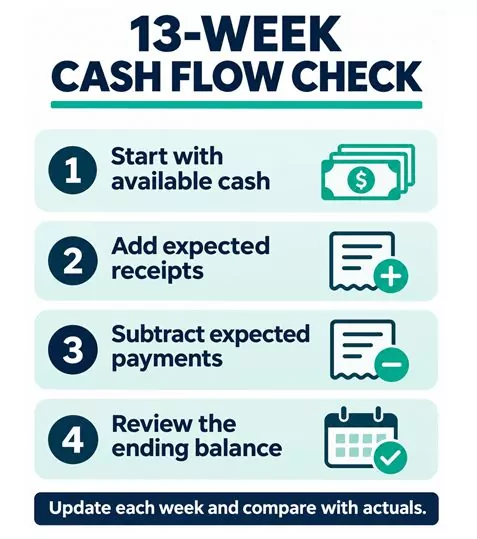
A 13-week cash flow forecast is a week-by-week estimate of your business’s available cash over the next 13 weeks. It starts with your opening cash balance, adds expected receipts, subtracts expected payments, and shows projected closing cash for each week.
Closing cash = Opening cash + Cash receipts – Cash payments
The closing balance becomes the following week’s opening balance, unless you replace it with the actual closing balance after the week ends. This is a cash timing tool, not a profit-and-loss statement or a guarantee that expected payments will arrive.
Why Cash Flow Can Look Different From Profit
Profit measures income and expenses under your accounting method. A cash forecast asks when money will actually become available or leave the bank. If you invoice a client today but expect payment in four weeks, the invoice may matter to revenue reporting before the money is available to pay bills.
- A loan deposit adds cash but is not sales revenue.
- Loan principal repayment uses cash but is not the same as an operating expense on a profit-and-loss statement.
- Buying equipment uses cash even though its accounting treatment may extend over time.
- Moving money between accounts already included in the forecast is an internal transfer, not new income.
Download the 13 Week Cash Flow Template
Open the Excel cash flow template
The workbook includes 13 weekly columns, receipt and payment categories, automatic balances, a minimum cash buffer, a calculated shortfall, weekly actual totals and a closing-balance variance.
Blue cells are inputs. Enter receipts and payments as positive amounts; the workbook subtracts payments. The template starts November 9, 2026: change the first week’s date to your own start date. It does not connect to a bank, import transactions, or automatically create a new rolling period.
How to Build Your 13 Week Cash Flow Forecast
1. Choose your starting date and available cash balance
Pick a consistent week boundary, such as Monday through Sunday. Enter the first week’s date in cell B5; later dates calculate automatically. Enter starting available cash in cell B4.
Use a balance that reflects the accounts included in the forecast and cash available at the start of the period. Reconcile it with your bank records and decide how to handle pending transactions. Do not count the same deposit in both starting cash and future receipts. Transfers between included accounts are not new cash receipts or payments.
2. Add expected receipts in the week cash should arrive
Use unpaid invoices, customer payment history, settlement reports and signed orders to estimate collections. The template includes customer collections, cash sales and card deposits, other operating receipts, loan proceeds or owner funding, and other receipts.
Place each amount in the week you reasonably expect it to clear and become available, rather than when you send the invoice. If you issue a $5,000 invoice in Week 1 but expect payment in Week 4, enter the collection in Week 4. Keep financing separate from customer receipts when reviewing the forecast.
3. Add expected payments when they will leave the account
Use your payroll calendar, contracts, supplier terms, tax calendar, bank records and loan schedules. Enter employee payroll, payroll taxes, contractors, rent, software, business taxes, loan principal and interest, equipment purchases and owner draws in the expected payment week.
For payroll, be consistent about what each amount includes. If the payroll row contains net pay to employees, include applicable payroll taxes separately when paid. If a payroll provider withdraws a single combined amount, avoid adding the same taxes again. Confirm applicable federal employment tax deposit dates for your circumstances.
4. Set a minimum cash buffer
Enter a minimum cash buffer in cell B3. This is a planning cushion you choose, not a universally required reserve. The amount should reflect your obligations, payment timing, risk tolerance and access to funds.
The Shortfall below buffer row shows the larger of zero, or the cash buffer minus forecast closing cash. A positive forecast balance can still be below your chosen buffer.
5. Review the low weeks not just Week 13
Scan each week for a negative projected balance, a balance below your buffer, large payments concentrated together, or a major unconfirmed receipt. If cash is tight within a week, weekly totals can hide a day-by-day problem. Build a daily view when a time-sensitive payment falls before the expected deposit.
A Simple 13 Week Cash Flow Example
The following figures are illustrative, not results from a real business. Assume a small agency starts Week 1 with $12,000 in available cash.
| Details | Week 1 | Week 2 | Week 3 |
| Opening cash | $12,000 | $9,000 | $12,000 |
| Cash receipts | $5,000 | $11,000 | $4,000 |
| Cash payments | $8,000 | $8,000 | $13,000 |
| Closing cash | $9,000 | $12,000 | $3,000 |
Week 1: $12,000 + $5,000 – $8,000 = $9,000. Week 2: $9,000 + $11,000 – $8,000 = $12,000. Week 3: $12,000 + $4,000 – $13,000 = $3,000.
With a $5,000 minimum buffer, Week 3 is $2,000 below the buffer. That does not automatically mean the business is insolvent or will miss a payment. It is an early signal to investigate dates and decide what to do.
How to Update the Forecast With Actual Results
- Review forecast receipts and payments for the completed week.
- Enter actual total receipts and actual total payments.
- Enter Yes in the Week completed? row.
- Check actual closing cash and variance.
- Reconcile actual closing cash with the bank records.
Enter 0 if an actual total was zero. Leaving a total blank prevents calculation of actual closing cash. Once both totals are entered and the week is marked Yes, the workbook uses actual closing cash as the next week’s opening balance.
Example A late customer payment
If Week 1 was forecast to close at $9,000 but actual closing cash was $7,500, the closing variance is -$1,500. The template carries $7,500 into Week 2. Decide whether the missing customer payment is still expected and add it to the appropriate future week if needed; avoid counting it twice.
How to Roll the Forecast Forward Each Week
A rolling forecast always looks ahead. This workbook does not shift columns automatically.
- Save an archived copy of the completed forecast.
- Reconcile the latest actual closing cash to the bank balance used for the next forecast.
- Start a fresh copy or carefully update the existing workbook.
- Change the first week’s start date and enter the reconciled starting cash.
- Update the next 13 weeks of receipts and payments.
- Add a new final week so the forecast continues to look 13 weeks ahead.
Transfer only future items that remain expected. Check the dates and amounts; do not carry over payments that have already cleared.
What to Do If the Forecast Shows a Cash Shortfall
Check the assumptions
Look for an incorrectly dated receipt, duplicated expense, missing deposit, or payment that has already cleared. Reconcile starting cash before making decisions.
Contact customers early
If a large invoice is due soon, confirm that it was received, accepted and scheduled for payment. Correcting an invoice issue early can prevent a late discovery.
Review the timing of discretionary spending
Consider whether equipment purchases, advertising or other nonessential spending can be delayed. Distinguish discretionary spending from contractual or legally required payments.
Speak with suppliers or lenders before the deadline
Discuss available options early. A supplier may agree to revised terms, or a lender may explain financing options. Evaluate financing cost, eligibility and repayment obligations separately; approval is not guaranteed.
Recheck all 13 weeks
Moving one payment can improve one week while making another worse. Update the full forecast before concluding the gap is resolved.
Common Mistakes to Avoid
- Counting invoices as cash received before money arrives.
- Assuming every customer pays on time rather than using payment history.
- Forgetting nonmonthly taxes, insurance, debt or equipment payments.
- Mixing net payroll with combined payroll withdrawals and counting taxes twice.
- Treating a loan as customer revenue.
- Using a forecast without reconciling actuals.
- Relying only on weekly totals when a specific day has a shortfall.
Frequently Asked Questions
How often should a small business update a 13-week cash flow forecast?
A weekly review is a practical starting point. If cash is tight or large payments are approaching, review relevant dates more often and consider a daily schedule.
Is a 13-week forecast the same as a cash flow statement?
No. A cash flow statement reports past cash movements. A forecast estimates future receipts and payments. Historical statements and bank records can inform the estimates.
Should I include a loan in a cash flow forecast?
Yes, if proceeds are expected to enter included accounts. Show them separately from customer receipts and include expected repayments when cash leaves.
What if my forecast is positive but below my minimum cash buffer?
You have not necessarily run out of cash. You have fallen below a threshold you selected. Review obligations, receipt reliability and possible action.
Can I use this template in Google Sheets?
You can try importing the Excel file, but check formulas and formatting after import. Google Sheets conversion has not been tested.
Final Words
A 13-week cash flow forecast gives you time to respond before a payment problem arrives. Start with reconciled available cash, estimate receipts and payments in the weeks they should clear, and review the lowest expected balance. Then enter actual results, understand the difference and update the next 13 weeks.