
International payments for small media company require more than a checkout button. You need a provider that can onboard the actual seller, a payment method the customer can use, a supported path to the business bank account and records that explain the money received. Verify those four connections before promising a new market or publishing a payment logo.
A publisher may sell reader subscriptions, research reports, event access, content licenses and advertising services. Those sales can have different billing cycles, delivery evidence and refund arrangements. A method that works for one sponsor’s invoice may not be suitable for recurring reader subscriptions.
This is a research-based operating guide, using official provider and government information checked on November 20, 2026. It does not describe transactions performed by this publication, a tested country count or accounts opened with the services discussed.
1. Map the seller, customer and bank separately
Begin with the entity named on the contract or checkout, its actual business activities and the account that will receive payouts. Then identify the customers you intend to serve, their likely payment methods and the currency in which you quote prices.
These are separate questions. A provider’s list of supported merchant locations does not establish that every buyer can pay with every method. A buyer’s familiar wallet does not establish that your company can open the required merchant account. And a successful charge does not prove that the proceeds can be withdrawn to the bank account you intend to use.
For each proposed route, write a complete sentence: “This legal seller accepts this kind of sale from this customer market, using this method and currency, then receives a payout in this currency to this business account.” Any blank is a verification task.
| Connection | Evidence to collect | Question it answers |
|---|---|---|
| Seller to provider | Applicable onboarding requirements and actual account status | Can this business use the service? |
| Customer to checkout | Supported buyer method, currency and integration | Can the intended customer complete this purchase? |
| Provider to bank | Eligible payout account, currency and conditions | Can the business receive usable funds? |
| Transaction to books | Order, payment, adjustments and payout references | Can finance explain the final amount? |
Our payment gateway versus payment processor guide explains the roles behind the interface. Assign responsibilities by the actual agreement rather than assuming the checkout plugin controls every part of settlement.
2. Give each media revenue stream its own requirements
For reader subscriptions, examine recurring billing, cancellation, renewal communication, failed-payment handling and access changes. A one-time payment demonstration does not validate a recurring arrangement. The relevant question is whether the particular integration supports the entire subscription lifecycle for your seller and customer.
For advertising or sponsorship invoices, agree the legal buyer, currency, invoice reference and what counts as delivery. Keep an approval trail for the placement or service. Collection terms should not imply that payment buys favorable editorial coverage; any commercial relationship still needs the appropriate disclosure and editorial separation.
For report downloads and content licensing, retain the order and a proportionate record of access or delivery. Match that evidence to the product sold and the customer’s agreement. Avoid collecting unnecessary personal information just to build a larger evidence archive.
Do not select a provider only because another publisher uses it. Your legal seller, owners, sales activities and integration may differ. A software demonstration or another merchant’s approval is not approval for your business.
3. Evaluate the four named payment routes on their actual scope
Stripe: distinguish merchant location from charge and payout currency
Stripe’s availability page lists supported business locations, including the United States. Its currency documentation separately describes the customer’s payment-method currency, the currency charged and the settlement currency. If the charge differs from settlement currency, conversion can occur; the customer’s issuer can also impose its own foreign-exchange charge in relevant circumstances.
For a publisher considering a Stripe integration, that distinction matters when pricing a subscription in a reader’s currency while budgeting expenses in dollars. Identify who converts the money and which statement shows the conversion before treating the displayed price as the amount that reaches the bank.
Confirm the exact merchant account, business model and payment method for the integration. General availability is a starting point for that review, not proof of an approved account or support for every recurring-payment scenario.
PayPal: read the withdrawal qualification beside the global message
PayPal’s US cross-border page describes international acceptance and different customer payment options. Its qualifications say availability depends on factors including merchant status, sector and integration. The same page states that US account holders may withdraw funds only in US dollars.
That is a practical distinction for a US publisher quoting a foreign-currency invoice: accepting the customer’s payment and retaining or withdrawing that currency are not the same capability. Check conversion treatment and the account’s actual withdrawal arrangements before deciding where to hold operating cash.
Do not describe Seller Protection as a guarantee that every digital subscription or advertising sale is covered. The page limits protection to eligible purchases and claims, with further exclusions. Assess the terms applicable to the particular product and transaction.
bKash: verify a merchant relationship, not a personal workaround
bKash describes merchant accounts with facilities such as Merchant QR and transaction history. Its business site also describes online-business services, including a payment gateway and APIs. The merchant application asks about identity documentation, a valid trade license and a bank account.
Those details matter to a publisher serving customers who use bKash: a consumer wallet, a merchant QR arrangement and an online integration should not be treated as interchangeable. Establish which business entity will be onboarded and what the proposed service permits.
The public pages do not establish that an arbitrary US media company is approved for merchant collection or a particular cross-border settlement route. Keep that route unverified until the applicable eligibility and payout requirements are resolved. Do not use another person’s account as a shortcut around the seller’s requirements.
UPI: identify the acquiring arrangement before assuming online access
UPI is a payment system, not a single merchant-account product. The Reserve Bank of India’s December 2024 Payment System Report describes overseas merchant QR acceptance through particular cross-border arrangements. That is evidence of a specific acceptance model, not a universal online collection facility for every foreign publisher.
If customers ask to pay through UPI, identify the provider or acquiring partner offering that facility, the eligible merchant location and category, the supported purchase flow and the final settlement destination. An overseas in-person QR arrangement does not by itself establish support for your online subscription checkout.
Keep merchant collection separate from personal remittances. Verify the actual commercial route and refund process before advertising it. A network-expansion announcement is not evidence that your company, product or integration has been enabled.
4. Build an international payments verification register
Use one row for each seller–method–market combination. Record the provider, product, merchant account country, customer market, charge currency, payout currency, bank destination, refund route, evidence date and person responsible for the next check.
Use evidence states that mean something. “Documented” means current material describes the required capability. “Account enabled” means the actual account shows the relevant permission. “Reconciled” means an authorized transaction can be traced through the records to its payout. These are proposed labels for your register, not results obtained for this guide.
| Situation | Appropriate next action |
|---|---|
| Buyer method exists, seller eligibility unknown | Resolve onboarding before displaying that option |
| Account enabled, recurring flow unverified | Verify subscription behavior separately from a one-time charge |
| Charge recorded, payout missing | Review availability, restrictions and payout records; do not mark bank receipt complete |
| Bank credit received, amount unexplained | Match fees, adjustments, currencies and the payout batch |
Start with the markets that already generate credible reader or customer demand. Adding many unverified logos creates maintenance work and customer confusion. One well-understood route with a clear alternative can be more useful than a long list that finance cannot support.
5. Compare usable cash, not just the headline processing rate
Build the comparison around the actual transaction: seller location, buyer location, payment method, amount, charge currency, settlement currency and refund scenario. Record any percentage fee, fixed charge, international component, conversion cost and withdrawal charge that applies. Do not combine rates from different account countries into an apparently universal price.
Then separate cost from timing. A reserve or unavailable balance can affect cash you can spend without being the same thing as a processing fee. A settlement estimate is not a guarantee of bank receipt, and a customer’s successful authorization is not the same as a completed payout.
Here is an illustrative cash bridge, using invented amounts solely to show the calculation. Suppose a payout batch starts with $900 in gross payments, then has $30 in processing charges, $12 in conversion costs, $100 in refunds and $50 temporarily unavailable. The amount available for that illustrative payout is $708: $900 − $30 − $12 − $100 − $50.
Those are not vendor prices, and the example is not a profit calculation or tax treatment. Releasing the temporarily unavailable $50 later would need its own reconciliation. A real payout can also contain other transactions or adjustments, so use the provider’s actual statement rather than forcing the example onto it.
For a US business receiving Form 1099-K, the IRS explains that it should be used with other records when figuring and reporting taxable income. Do not treat the bank deposit, payment report and taxable-income calculation as interchangeable records.
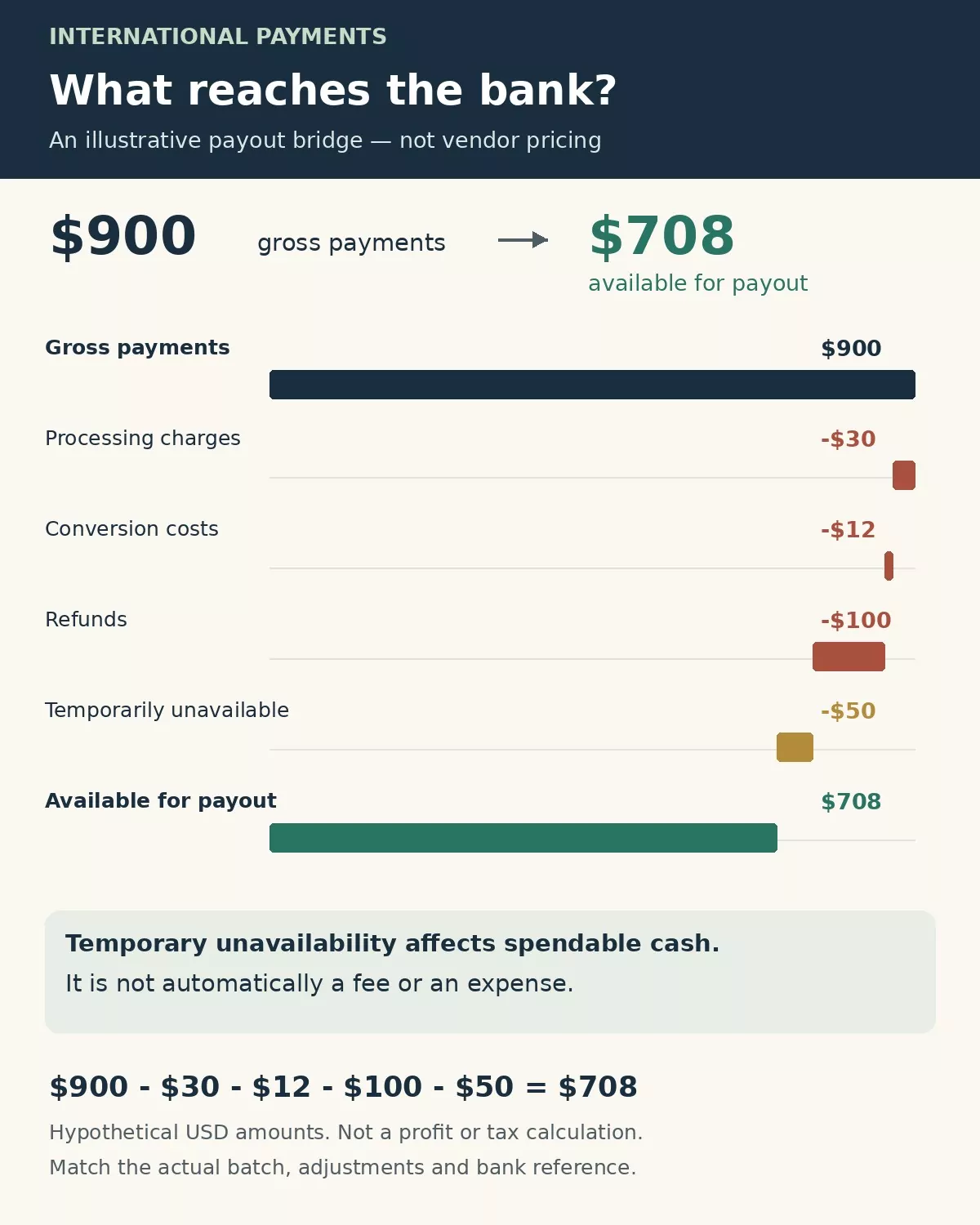
The diagram uses a common scale to distinguish charges, refunds and temporarily unavailable funds. It illustrates the cash bridge, not a provider’s actual fee schedule or a tax calculation.
6. Verify the lifecycle with authorized tests
Before launch, define the outcomes you need to inspect: a successful purchase, a declined attempt, a canceled subscription, a refund, a duplicate notification and a payout that can be matched to the bank. Use the provider’s authorized testing facilities where available and clearly label test records.
A test environment can help verify the integration, but it does not establish real-world acquiring approval, actual settlement timing or every customer’s bank behavior. If a controlled live transaction is needed, obtain the appropriate authorization and document its limited scope. Do not manufacture a customer purchase or claim a test happened when only documentation was read.
For recurring access, decide what happens when payment fails or a refund is issued. For an advertising invoice, decide who confirms the payer and applies the receipt. Keep the payment event and the access or fulfillment event connected by an identifier rather than an informal message saying “paid.”
Assign exception owners. Someone must investigate missing payouts, disputed charges, mismatched currencies and customer replies. A checkout integration can automate data movement; it does not remove the need to resolve an unexplained balance.
7. Protect payout changes and keep an exit path
Limit who can change payout instructions and review account access when responsibilities change. Verify new bank details through an established contact route. The FBI’s business email compromise guidance specifically recommends verifying changes to account numbers or payment procedures with the person making the request.
Keep a documented response for a disabled method or delayed payout. Decide how to notify customers, which approved alternative they can use and how finance will prevent the same invoice from being collected twice. Preserve the original order and payment references when moving a customer to a different route.
Export the records needed to explain orders, refunds and payouts. Periodically check that another authorized person can follow the workflow. A payment setup is easier to maintain when its conditions, evidence and exceptions are understandable without relying on one employee’s memory.
Make international payments a verified operating process
For a small media company, reliable international payments begin with an eligible seller and end with money that can be explained in the business records. Compare the named services and networks by their actual account, integration, currency and payout conditions—not by a shared label of “global payments.”
Confirm one complete route, record its limitations and expand when there is a supported customer need. That gives the publisher a practical basis for accepting payments without inventing geographic coverage or promising capabilities that have not been enabled.