
A US company can sign contracts, own software and sell to American customers. It cannot, by itself, guarantee that a bank or payment platform will keep serving its overseas owner. For nonresident US founders, that distinction can determine whether a successful sale becomes usable cash.
The immediate worry is understandable: if a business loses its account, where will Stripe send its payouts? The larger question is whether the company’s legal structure, actual operations and payment arrangements still fit together. Opening another account may solve a temporary interruption. It will not necessarily solve a mismatch that another provider will also identify.
The available evidence does not establish that all banks and fintech platforms are closing accounts held by nonresidents. It does show why founders should stop treating incorporation and continuous access to financial services as a single purchase. A workable future remains possible, but it depends on the particular business, the owner’s residence and an approved route from customer payment to spendable funds.
What We Checked
This analysis reviews two founder-supplied Mercury notices, the earlier reporting based on them and current official documentation from Mercury, Stripe, Relay, Airwallex, Wise, Paddle, payment processors, FinCEN, the Reserve Bank of India and the IRS. Policy pages and legal materials were checked on November 19, 2026. This is document-based reporting; no account application, payment transfer or provider approval was tested for this article.
The Monitor Daily’s earlier business bank account closure continuity guide explained the immediate response. Editorialge’s report on US LLC banking after account closure covered the India and Bangladesh context. This follow-up examines the longer-term operating choices rather than repeating the emergency checklist.
Editorialge Media LLC is associated with this publishing group, and its founder, Sukanta Kundu, supplied his company’s experience. That relationship is disclosed because the case is not an independently selected sample. The notices were reviewed as supplied documents, not authenticated through Mercury’s internal systems. Two cases cannot establish an industry-wide closure rate.
Two Notices Describe Different Problems
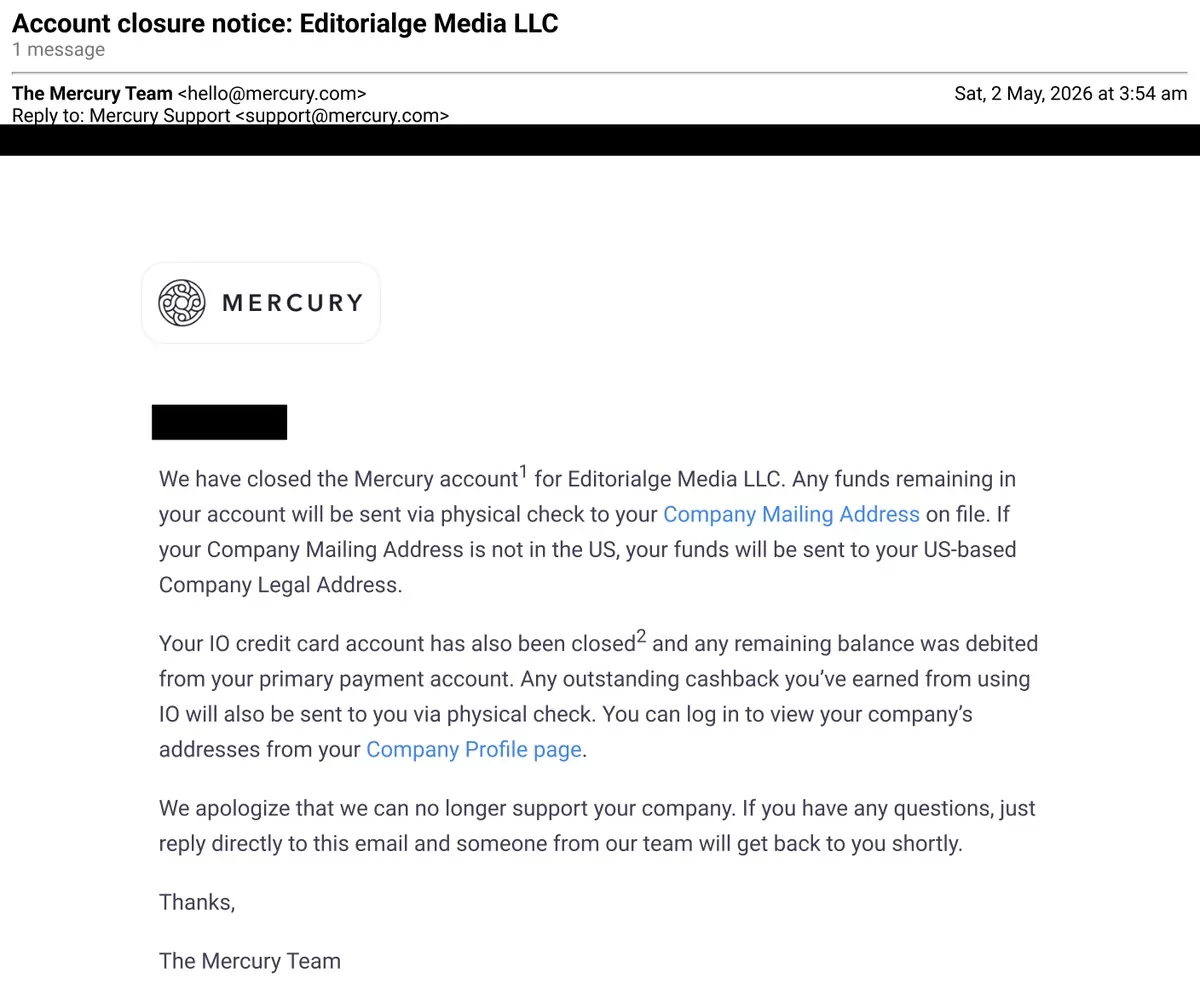
The Editorialge Media LLC notice, dated May 2, 2026, confirms that the account was closed. It describes returning any remaining balance by physical check and the address arrangements for doing so. It does not state the reason for closure. Kundu’s explanation of the circumstances should therefore remain distinct from what the notice itself proves. The document does not establish a final recovered amount or a financial loss.
Mercury’s current prohibited-country list includes Bangladesh. That is relevant policy context for a Bangladesh-resident founder, but it does not retrospectively establish the reason for this particular decision.
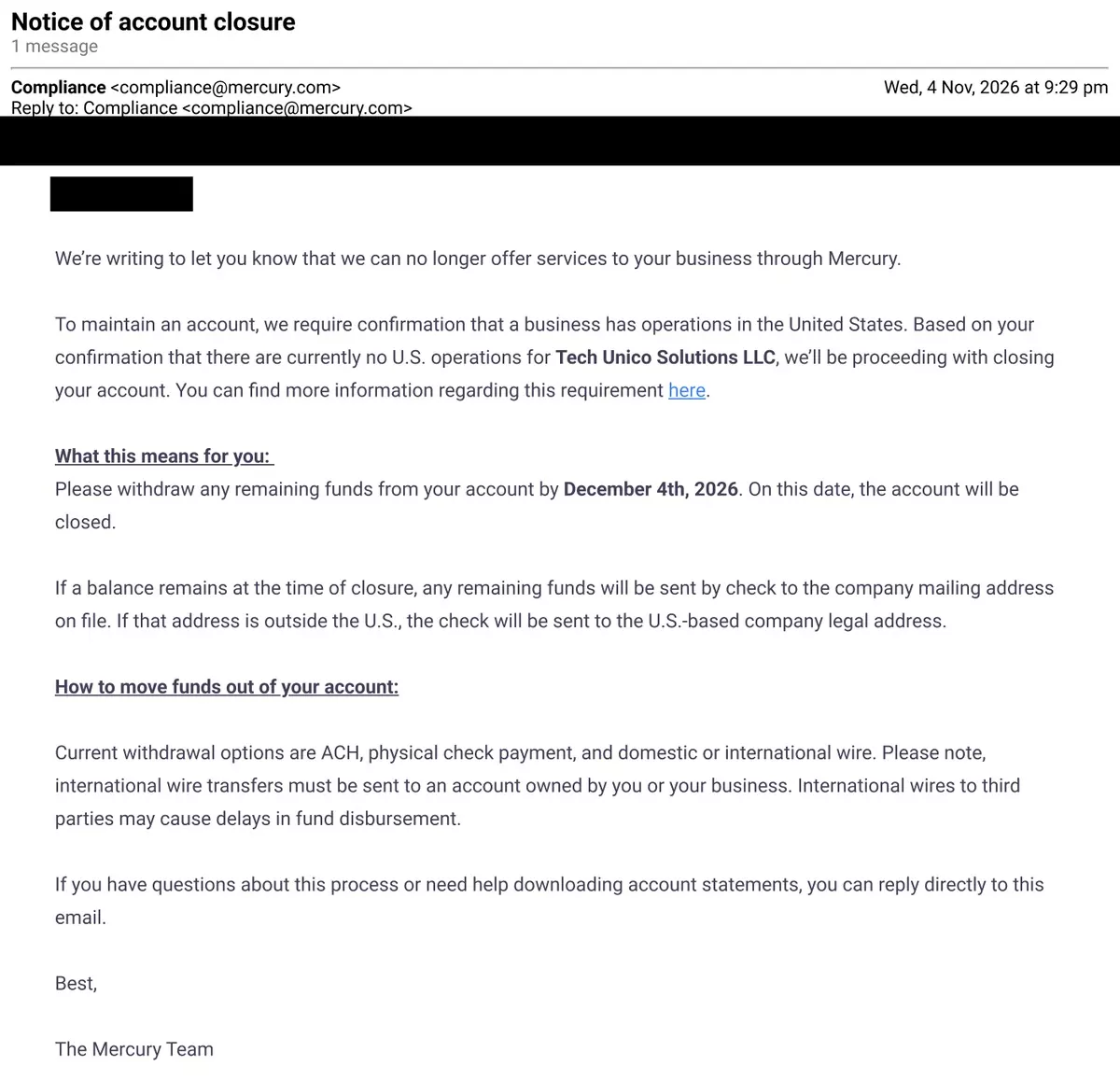
The Tech Unico Solutions LLC notice, dated November 4, 2026, is more specific. It says the company had confirmed that it did not currently have US operations. It gives December 4, 2026, as the closure and withdrawal deadline. As of this article’s November 19 review date, that deadline has not passed. The earlier reporting identifies the company’s founder and CEO as India-resident Aushnik Das.
The distinction matters. “No US operations” is broader than “no rented US office.” It would be inaccurate to turn this notice into proof that every overseas founder must lease American premises. It would also be inaccurate to describe Tech Unico’s account as already closed on the evidence available here.
No US Office Does Not Always Mean No US Business
Mercury’s current eligibility rules distinguish the owner’s residence from the company’s operations. A founder does not have to be a US citizen or resident to apply. A qualifying company must be formed in the US and have existing or planned US operations. Its principal business address may be in the US or abroad, including an eligible residential address. That does not mean a registered-agent address, PO box or mailbox is acceptable as the company’s operating address.
Mercury’s operations-verification page is unusually specific: it lists a record of a sale to a US customer and an invoice or contract with a US customer, partner or supplier as possible evidence. It also lists investment records, US payroll evidence, a signed lease for a physical office or coworking space, a recent utility bill and a federal tax return. The listed evidence must match deposit or payment activity in the Mercury account. A US customer can therefore matter even when the founder works overseas and has no conventional office. It is evidence for the provider to assess, not an automatic ruling that every company selling to an American has qualifying US operations.
That condition is central to the Tech Unico notice. The notice says Mercury is proceeding based on the company’s confirmation that it currently has no US operations. The founder’s later explanation that the business has American clients raises a factual question: were those customers contracted and invoiced by Tech Unico Solutions LLC, or by a separate Indian business? Which entity appears as seller, and which account received the customer’s money? The answers could change what evidence should be presented, but they do not change what the November 4 notice says.
Founders should distinguish four questions:
| Question | What it actually establishes |
|---|---|
| Where is the company incorporated? | The entity’s legal jurisdiction, not necessarily its operating location. |
| Where does the owner actually live? | A residence fact relevant to provider eligibility and verification. |
| Where does the business actually operate? | Where work, management and other genuine activities take place. |
| What US commercial activity can be documented? | Evidence of customers, contracts, personnel or other qualifying relationships. |
Nationality alone does not answer these questions. India not appearing on a particular prohibited-residence list is not an approval promise for every India-resident founder. Similarly, a US incorporation certificate does not override the actual owner’s residence or a company’s operating facts.
If an India-resident founder’s customers are in the US, Germany and elsewhere, that is genuine commercial context. But the customer’s location, the entity named in the contract, the invoice issuer, the party responsible for delivery and the account receiving settlement are different facts. If an Indian company is the contracted seller and receives the payment into its own account, that helps describe the Indian company’s exports. It does not by itself show that the separate US LLC was the seller or had the matching payment activity Mercury asks to see. A properly documented parent, subsidiary, licensing or sales-agent relationship may connect the entities, but a reviewer needs to see the actual agreements and money trail.
A Rented Address Is Not the Same as a Business Presence
A genuine office or coworking lease can be a lawful business expense, and Mercury specifically lists a signed lease for a physical office or coworking space among possible operations evidence. The founder does not necessarily have to live at that office. But buying a mail-receiving address, using a registered agent, or renting space on paper while representing that work is performed there creates a different problem. Mercury says registered-agent, virtual, PO box and mailbox addresses cannot serve as its physical US-operations proof. A lease is one document in an operating record, not a guarantee of approval.
There is no single rule that every nonresident owner must personally move to the US. Some financial products do impose a physical-presence test; ordinary payment processing, company address requirements and account representative requirements can have different tests. Before paying for a location, ask the specific institution what kind of presence it requires, whether a coworking lease qualifies and what activity it expects to see. Have the provider answer against the exact LLC and owner profile.
Can a US-Based Relative Be the Representative?
A cousin or other relative can take a real, authorized management role if the company actually gives that person responsibility and accurately discloses the arrangement. That does not make the nonresident founder a US resident, remove the duty to identify the real beneficial owners or automatically satisfy an address or operations test. A relative’s utility bill is not evidence that the founder lives there.
If a bank asks for someone responsible for managing the account, the company may identify a genuine senior officer or manager where its rules allow. The person must understand the role, have real authority and accept its responsibilities. Naming a relative only to lend documents, act as a nominee or make a reviewer believe that the founder or the business is physically present risks a false statement and an account restriction. Federal customer-due-diligence guidance does not impose a single in-person appearance method for every beneficial owner: FinCEN says a covered institution may verify an owner who is not present using a valid identity-document copy or non-documentary methods, subject to its risk-based procedures. That does not require a bank or fintech to accept a remote owner, and it does not override a provider’s own physical-presence, product or address rules. Ask the institution whether this owner can be verified remotely and what actual representative details it requires. Do not move ownership or control on paper to solve an address question.
What the Founder Should Clarify Before December 4
The screenshot shows that the November 4 email set December 4, 2026 as the withdrawal deadline. On the date of this analysis, there is still time to ask Mercury to review the statement that Tech Unico has no US operations. If the company does have direct US contracts, invoices and sales, the founder should tell Mercury exactly which legal entity owns each relationship and provide the requested matching records through the logged-in support channel. He should ask whether a correction can change the closure decision. No public policy promises that it will. Meanwhile, the stated withdrawal instructions and deadline still need to be followed unless Mercury confirms otherwise in writing.
If the customer contracts and receipts belong to an Indian company instead, describe the Indian company as the seller and ask an Indian authorized-dealer bank or qualified adviser how to document the export proceeds. Do not retroactively label those payments as US-LLC revenue merely because the founder owns both entities.
The practical lesson is to describe the business as it exists. Buying an address service or changing a profile field cannot create operations that are absent. A nominal US partner or borrowed personal account introduces additional ownership and control problems instead of resolving the original issue.
Stripe Can Accept a Payment Before the Business Can Use It
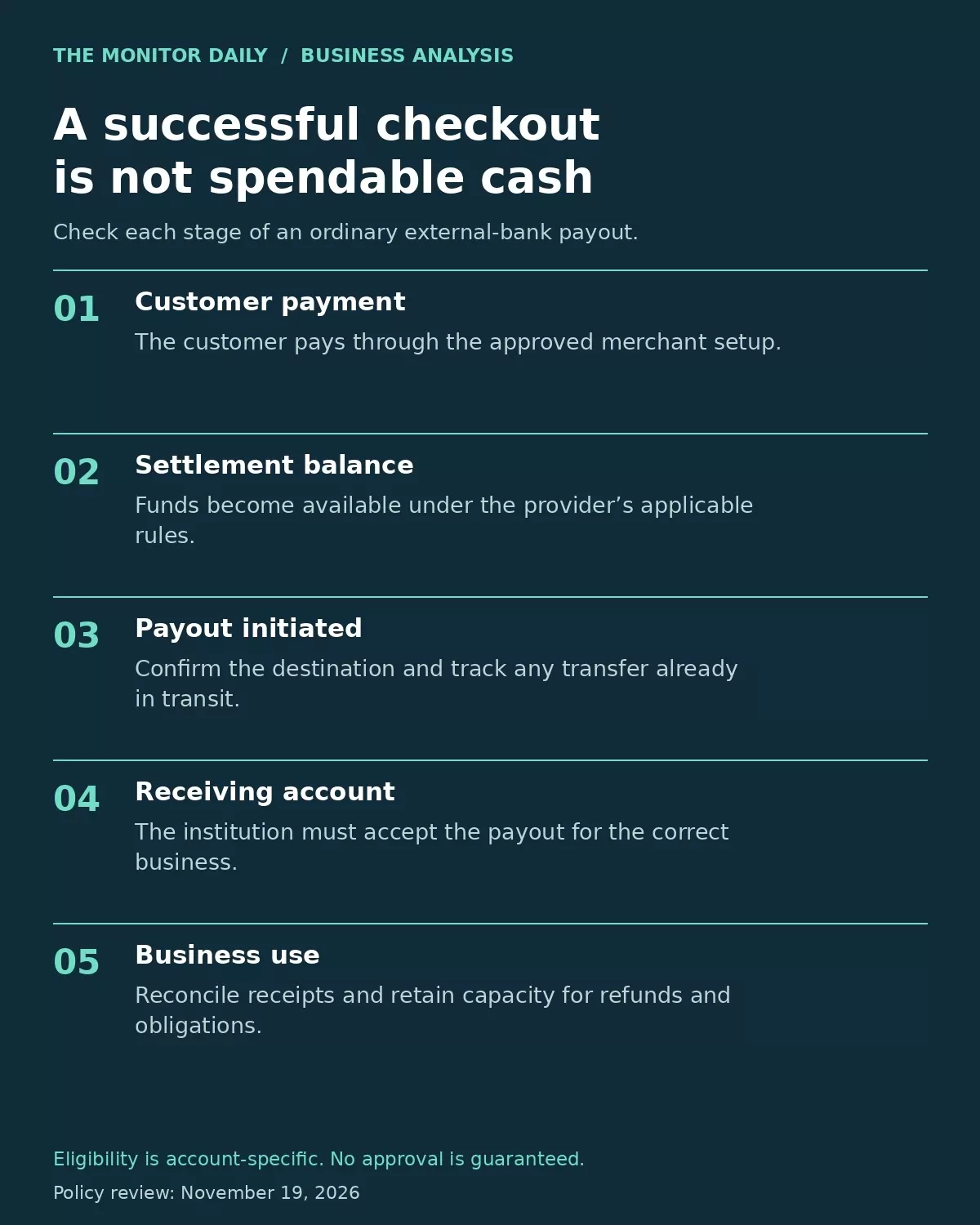
For an ordinary arrangement with external bank payouts, the money moves through separate stages: customer payment, settlement into the Stripe balance, payout initiation and receipt by the destination institution. Refunds, disputes and negative balances can create obligations along that path. A functioning checkout is not proof that the last stage works.
Stripe’s payout documentation supports several account types, including some virtual bank accounts, while warning that nonstandard accounts can experience higher payout failure rates. The receiving setup also needs to meet relevant credit and debit requirements. An account number that accepts one incoming transfer is not sufficient evidence that it supports the merchant’s complete workflow.
There is an important exception to the external-bank assumption. Stripe says eligible US businesses can have proceeds settle into a Stripe financial account, with an external bank account needed for transfers out to an external bank. This means “no separate bank account always makes Stripe unusable” is too absolute.
That exception is not an assured rescue route for an overseas founder. Stripe determines Treasury eligibility account by account. Its onboarding guidance identifies US location or physical-presence requirements as a possible barrier. Its physical-presence FAQ specifically distinguishes Issuing, Treasury and Opal requirements from ordinary payment processing; it does not accept a registered-agent or mailbox address as qualifying physical presence for those capabilities.
There is another reason to avoid blanket advice about virtual accounts. Stripe’s separate guidance for opening an account in another country specifies a physical bank account in that onboarding context. General payout compatibility and cross-country onboarding requirements answer different questions. Get confirmation for the exact merchant account, legal entity and proposed destination rather than assuming one page overrides every other requirement.
If a payout is already in transit, changing bank details does not necessarily redirect it. Stripe’s payout FAQ explains that closed-account transfers may be returned and that the outcome depends on the receiving institution and payment status. Track the individual payout with Stripe and the institution; do not assume an edited dashboard has recovered it.
Five Operating Models Worth Comparing
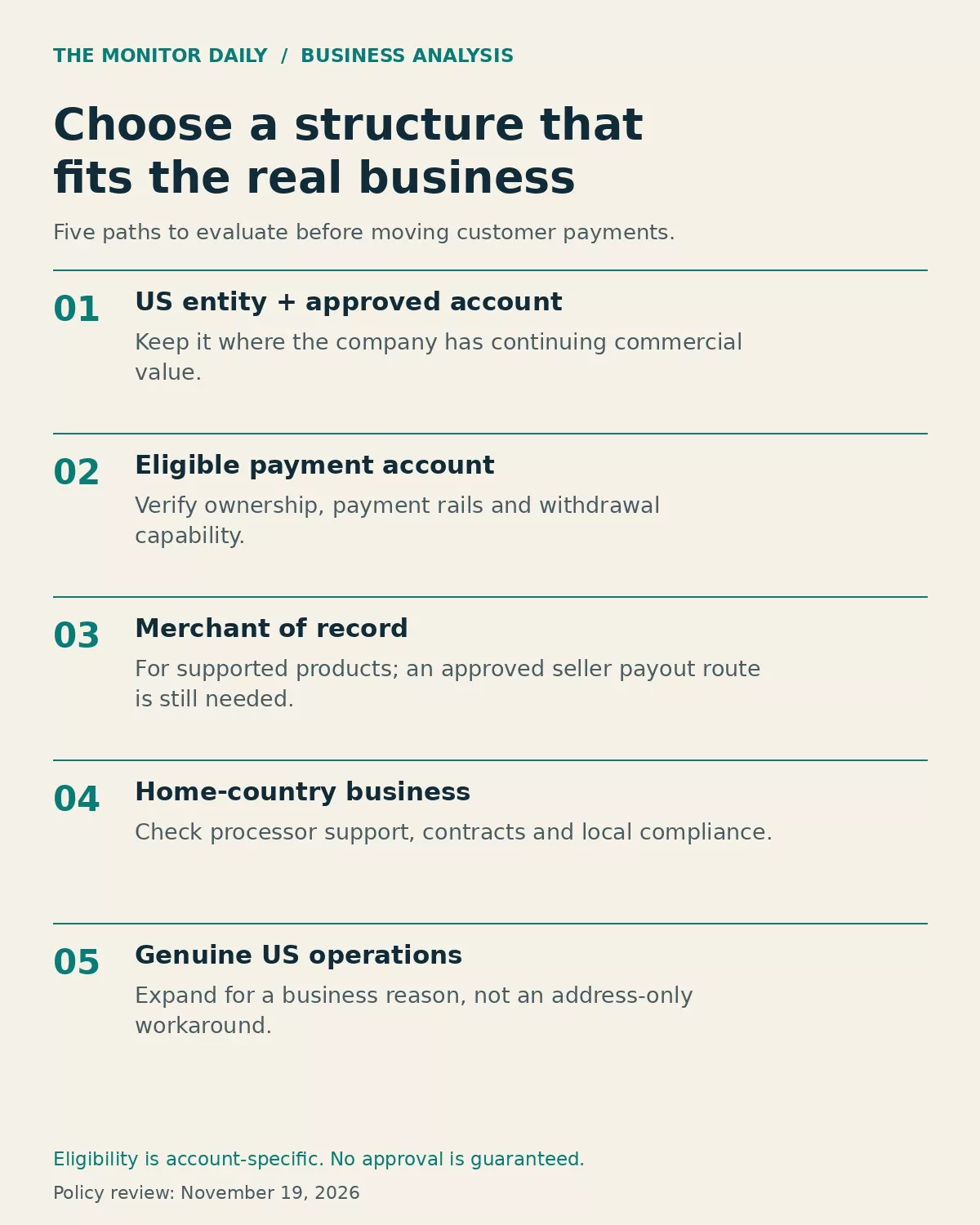
The useful comparison is between business models and their requirements, not a list of providers supposedly willing to accept anyone.
| Route to assess | Which business should examine it? | What the provider still needs | What it does not solve |
|---|---|---|---|
| US LLC with an approved US business bank or fintech account | A company that remains the contracting seller | Actual owners, operations, address and same-entity payment path | Future reviews or account interruption |
| US LLC with a processor that permits a verified foreign payout account | A company whose processor and bank both accept the arrangement | Written confirmation for the LLC, foreign account owner, currency and payout rail | A personal or sister-company account cannot be assumed acceptable |
| India operating company plus Razorpay International Payments or PayPal India export services | A real Indian seller invoicing foreign customers | Indian KYC, export purpose/documentation and the Indian company’s own bank account | It does not automatically process revenue belonging to the US LLC |
| Malaysia or UAE operating company with a local Stripe account | A real company registered and operating in that market | Local company, address, tax/KYC details and eligible local settlement account | A founder’s residence or a US LLC alone does not create local eligibility |
| Paddle or Verifone/2Checkout as merchant of record | Eligible software, SaaS, games or digital products | Product acceptance, supplier-country approval and a supported payout beneficiary | Not every service qualifies; no instant payout or recovery of old funds |
| Payoneer Checkout | Larger e-commerce or digital businesses able to meet its specific terms | Current published offer requires a US or Hong Kong entity and webstore volume above $20,000 a month | Not a general gateway for every foreign founder or a substitute bank |
| Adyen or Checkout.com direct acquiring | Larger businesses with a clear acquiring need and supporting documents | Sales-led approval plus verified entity-owned settlement details | They are not a shortcut around entity, address or account underwriting |
Keep the US Company When It Has a Business Purpose
A US entity may still make sense for American contracts, investment arrangements, intellectual-property ownership or an established customer base. Banking difficulty does not automatically erase those reasons.
However, founders should distinguish the value of the entity from the convenience of a particular account. List the benefits that would remain if the original fintech disappeared tomorrow. If the answer is only “it lets me open a payment gateway,” the structure deserves a fresh assessment.
An additional approved account can reduce dependence on one provider, but two accounts do not necessarily mean two independent sources of resilience. Check the underlying institutions, transfer capabilities and eligibility dependencies. Maintain enough accessible working capital to meet the business’s own obligations without assuming disputed or restricted money will arrive on a particular date.
Treat Replacement Providers as Applications, Not Solutions Already Secured
Relay’s published materials permit nonresident ownership subject to US operating presence. Its address guidance allows a US or international operating address, while some entity checklists describe US-address requirements. That tension needs clarification for the specific applicant. It is not a basis for promising a remote founder acceptance.
Airwallex’s US-company documentation generally calls for a physical principal business address. It describes exceptions for certain businesses selling goods online and for recently incorporated companies. A software subscription or marketing agency should not assume it qualifies as an online goods seller. Ask which rule applies to the actual business before buying address services or changing the structure.
Wise’s USD-details guidance excludes Bangladesh addresses in relevant eligibility conditions, including business or personal-profile circumstances. The fact that a service can send money to a country does not mean a resident there can obtain every kind of receiving account through it.
These examples illustrate the limits of generic “best bank for nonresidents” advice. Ask each candidate to assess the real facts: entity type, actual owner residence, operating address, business activity, customers and intended payment flows. Written clarification is useful, but it does not guarantee permanent service or replace approval.
Which Payment Gateway Alternatives Fit India, Malaysia or the UAE?
The cleanest alternative is usually a processor account belonging to the entity that truly sells to the customer. A founder may own companies in several countries, but that does not make the companies interchangeable merchant accounts. The product, contracting seller, settlement beneficiary and accounting records must agree.
| Where the operating seller is established | Provider route to investigate | Important limit |
|---|---|---|
| United States | A traditional bank or business-fintech account for the US LLC; separately, a processor such as Verifone/2Checkout or enterprise acquirer if it approves the company | Confirm the LLC and the exact payout account in writing. A customer-facing gateway does not itself supply an operating bank account. |
| India | Razorpay international cards/payment links or export bank transfers; PayPal India export payments; Stripe India only if invited and eligible | These routes are designed for the qualifying Indian merchant. Export-purpose rules and settlement into the Indian business’s account matter. |
| Malaysia | Stripe Malaysia for a qualifying Malaysian business; PayPal or local acquiring providers under their own merchant rules | Stripe’s country list means local onboarding is available for supported Malaysian businesses, not that a US LLC can use a Malaysian address as a shortcut. |
| United Arab Emirates | Stripe UAE for an eligible UAE entity with a supported payout bank; compare local licensed acquiring providers | Stripe lists specific supported banks and requires the payout account type to match the entity structure. A trade licence or bank account remains subject to approval. |
| SaaS, games and other supported digital products | Paddle or Verifone/2Checkout merchant-of-record models | Check the seller country, product rules, payout method, reserves, refunds, subscription migration and contract. |
| Higher-volume cross-border checkout | Payoneer Checkout, Adyen or Checkout.com only after the provider confirms eligibility | Payoneer Checkout’s published terms are narrow; Checkout.com requires bank-owner/address/statements and may request more for foreign or third-party settlement. |
For India in particular, Stripe’s India international-payments guidance says onboarding is invite-only. An India account can accept international payments when approved and configured for that purpose; the seller must be an eligible Indian company, LLC or sole proprietor, and export-specific requirements apply. Razorpay’s international-payment documentation describes a route for Indian businesses that settles to the Indian business’s bank account, including local-currency conversion options. PayPal India’s user agreement describes export-payment services for Indian residents and requires a linked, verified bank account. India’s regulatory position also needs a current check: the Reserve Bank of India’s 2026 Foreign Exchange Management export/import regulations took effect on October 1, 2026, and its directions require authorized-dealer banks to ensure FEMA and Foreign Trade Policy adherence when handling export/import transactions. An Indian founder should ask the actual authorized-dealer bank how the specific service export, invoices, purpose and receipt reconciliation must be documented under the current rules. These are useful alternatives when an Indian company is the real seller, not evidence that the US LLC can simply enter the Indian company’s payout details.
Stripe lists Malaysia and the UAE as supported locations. For a founder with a genuine Malaysian or UAE company, a local Stripe account may be more coherent than continuing to force every sale through the US LLC. The company needs to be registered and operating in that country and must meet its onboarding and payout rules. In the UAE, Stripe says supported-bank and bank-account-type rules vary by establishment type. A founder should verify the exact legal form and bank before transferring subscriptions.
Verifone/2Checkout advertises both payment-service and merchant-of-record arrangements, with payouts that can include wire, ACH, PayPal or Payoneer depending on agreement. The distinction matters: when the supplier remains the seller, it continues to carry obligations assigned to the seller; under a merchant-of-record model, the provider becomes the customer-facing seller for transactions it accepts. Neither model guarantees that an applicant or payout beneficiary will be approved.
Payoneer Checkout deserves a specific qualification because it is easy to mistake it for a universal Payoneer gateway. Its current page says the checkout service is provided through Stripe entities exclusively for US and Hong Kong entities, and its eligibility note calls for an existing or planned Hong Kong entity and monthly webstore volume above $20,000. It is therefore a narrow route, not the answer for a small US LLC that has lost a bank account.
Adyen and Checkout.com can be appropriate direct processors for some businesses, but they are not a deposit-account substitute. Checkout.com asks applicants to verify the account owner and address, bank details and a recent statement. It may request more information when settlement goes to a country different from the entity’s main place of business or to a third party. Adyen likewise requires the payout bank to be in the name of the onboarded legal entity, subject to limited exceptions. A cousin’s account or a sister company’s account should not be assumed to qualify.
For business-to-business customers, a bank wire or approved invoice payment can provide a second collection channel while a card gateway is unavailable. Payoneer’s B2B payment requests or receiving accounts may be relevant when both sides and the transaction qualify. These are collection/payment services, not proof that a company has a proper operating bank account, and they do not automatically support recurring consumer checkout. A gateway authorizes or processes a customer payment; a bank or eligible financial account holds or receives settlement. A merchant of record can become seller for accepted transactions, but still pays the supplier through an approved payout route. The founder should compare all three roles separately, not use “gateway” and “bank account” as synonyms. The business should confirm payment purpose, fee, currency conversion, withdrawal route and accounting treatment before sending clients new instructions.
Consider a Merchant of Record for the Right Product
A merchant of record can change who conducts the customer-facing sale. Paddle, for example, describes itself as a reseller and merchant of record for the software transactions it supports. This differs from merely adding another payment gateway to the same seller account.
That model may suit eligible software, SaaS and games. Paddle’s product rules do not make it a general solution for a business primarily selling consulting, design services or physical goods. A company with both software subscriptions and agency work may need separate, accurately documented arrangements for those revenue streams.
Paddle’s payout guidance describes a monthly cycle, a minimum threshold and supported bank-transfer or Payoneer arrangements. The seller still needs an eligible, usable payout destination. A merchant of record does not eliminate identity checks or turn revenue into immediate cash.
Nor does it recover money already held in an old Stripe or bank account. Existing subscriptions, customer terms, refunds and accounting records need an explicit migration plan. Responsibility for transaction taxes within a merchant-of-record service should not be confused with the founder’s own company-tax and reporting obligations.
Examine a Home-Country Structure Without Assuming It Is Easy
If the staff, management and work are based in the founder’s home country, a local business and an approved local collection arrangement may align more closely with commercial reality. A US customer does not have to buy from a US-incorporated seller. The question is whether the local arrangement can serve the customers, currencies and recurring-payment requirements, and whether the business is prepared to contract and account through that local company.
Start with the payment and contractual requirements, then compare structures. Can the provider onboard this business activity? Can it collect the necessary currencies and remit to the company’s own account? Will customers accept the contracting entity? Can recurring mandates move, or must customers subscribe again?
A local company cannot simply be substituted as the recipient of every payment owed to a US LLC. Contracts, invoicing and transfers between related entities need appropriate documentation. Local foreign-exchange, tax and export rules require jurisdiction-specific advice. Those checks should precede a migration rather than follow the first blocked remittance.
Add US Operations Only When They Make Commercial Sense
Hiring a US employee or opening genuine premises can support an actual expansion. Doing so solely to satisfy an assumed rule can create costs that exceed the benefit, while still failing the provider’s requirements.
Compare the complete annual cost of the arrangement with its commercial value. Include administration and professional advice, not just a mailbox subscription or advertised formation price. Obtain the provider’s requirements before committing money, and do not describe a service address as an office where work takes place if that is untrue. The purpose is to operate a real location the provider recognizes, not to make the founder appear resident there.
What Nonresident US Founders Should Do Before the Next Disruption
The earlier continuity guide covers the immediate closure response. For the longer term, build a short operating file that another reviewer can understand without reconstructing the business from scattered emails.
- Record the legal entity, beneficial owners, actual residences, operating locations and business activities. Resolve discrepancies across bank, processor and tax records truthfully.
- Build a customer-to-cash file for each major US client: signed contract, invoice, actual delivery evidence, paying legal entity and bank-credit record. Match the seller name to the LLC whose operations are being reviewed.
- Keep separate files for each country entity. Record which company owns each product, signs the contract, invoices, pays staff, bears refunds and receives funds. Document intercompany licensing or agency agreements before using them.
- Obtain eligibility clarification before funding or migrating. Ask about the exact entity and owner profile, supported payment rails, account-name match, destination-country rules and any physical-presence test.
- After approval, confirm an end-to-end payout from a genuine permitted transaction. A sandbox transaction does not establish that real settlement works. Do not manufacture sales or self-charge to simulate customers.
- Plan transition liquidity and customer communications. Track funds already in transit separately from new revenue, and retain enough records to reconcile both.
A useful decision test is whether the business could explain its entire payment chain to a new bank, its accountant and a major customer using the same facts. If each receives a different version of the company’s location or activity, changing providers will not fix the underlying weakness.
An Account Closure Does Not Close the Company
Formation, banking and tax compliance are separate matters. An LLC can remain in existence after an account closes, with obligations that need attention even if sales have stopped.
The IRS Form 5472 instructions cover certain foreign-owned reporting entities and reportable related-party transactions. A foreign-owned US disregarded entity can have Form 5472 and associated pro forma Form 1120 filing obligations when the applicable conditions are met. Contributions or distributions may be relevant; looking only for customer revenue can miss the issue.
The correct treatment depends on entity classification and actual transactions. Obtain qualified US and home-country advice before leaving an entity dormant, transferring its business or winding it down. A bank notice is not evidence that corporate filings have ended.
The Future Depends on the Operating Model
The evidence supports a conditional outlook, not a prediction that nonresident ownership will disappear. Three broad situations deserve different responses.
A business with genuine US commercial activity and an eligible owner profile may continue using its US company, while improving documentation and reducing dependence on one financial provider. A digital-product company may find that an approved merchant-of-record arrangement better fits how it sells, provided the payout destination works. A company formed mainly to unlock a gateway may need to reconsider the structure if maintaining an eligible financial arrangement costs more than the entity contributes.
These are strategic assessments, not promises of approval. Provider rules can change, and an acceptable arrangement today still needs monitoring. Review the payment setup when the owner moves, the product changes, a new country becomes significant or the provider asks for updated information.
For nonresident US founders, the durable objective is a business whose legal structure, actual operations and financial access agree with one another. The next incorporation certificate or account number is useful only if customers can pay, the business can receive and use the funds, and the company can meet its obligations throughout that process.