
How chargebacks work becomes clearer when you separate the customer’s complaint, the movement of money and your opportunity to respond. A cardholder questions a payment through the issuing bank; the merchant receives a case through its acquiring bank or payment provider and may challenge it with relevant records.
To win a dispute, you need a defensible answer to the actual claim, submitted through the required process before the case deadline. Good paperwork improves the response; it does not guarantee the outcome.
For a US business owner, finance manager or operations team, the immediate job is practical: identify the transaction, protect the deadline, decide whether the complaint is valid and make the evidence understandable. Arguing that your company is trustworthy will not explain a missing delivery, duplicate charge or canceled subscription.
This research-based guide draws on card-network, processor and US government guidance checked on November 20, 2026. The workflow and worked example are planning aids, not a report of disputes handled or won by this publication.
1. How chargebacks work from complaint to resolution
A chargeback is a reversal of a card payment through the card-payment system. It differs from a refund you initiate through your own sales process. A customer can have a legitimate complaint, a misunderstanding or an unauthorized payment; the existence of a case alone does not establish which situation occurred.
The issuing bank serves the cardholder. The acquiring bank serves the merchant, while the payment provider may operate the interface through which your team receives notices and sends records. A gateway’s checkout role does not make it the final decision-maker. Our payment gateway versus payment processor guide explains those service relationships.
In a typical card dispute, the cardholder contacts the issuer, the merchant is notified and there is a window for a response. Funds can be removed while the case is considered. If the merchant challenges the claim, the response travels through the payment chain for review. A temporary financial adjustment should not be treated as a final result.
The route can differ by network, case type and stage. An inquiry requesting information is not necessarily a formal chargeback, and an initial response may not end every case. Record the stage shown in the actual notice rather than labeling every customer question a chargeback.
2. Open the case before you start writing a defense
Use a single case record that connects the notice to the payment and order. Capture the dispute ID, transaction ID, amount, currency, reason code, current stage, response deadline and the account that received the notice. Assign one accountable owner and a backup who can act if that person is unavailable.
Copy the deadline exactly, including its time zone. Then set an earlier internal review target that leaves room for a missing document or failed upload. That internal target is your operating choice; it does not extend the provider’s deadline.
Do not substitute a generic “120-day rule” or a deadline found in an unrelated article. Network time limits, processor submission cutoffs and customer rights operate at different points in the process. The deadline shown for your case is the one your team needs to resolve with its provider if anything is unclear.
The CFPB’s consumer billing-error guidance describes a written notice within 60 calendar days after the charge appeared on the consumer’s statement. That consumer-facing guidance is not a merchant evidence-submission deadline, and it should not be copied into your response calendar.
Also check the amount actually disputed. A partial complaint, an earlier refund and a full original payment can produce different numbers. Finance should be able to explain the amount being challenged before anyone prepares a response about it.
3. Decide whether to accept, challenge or investigate
Start with the strongest question: if an independent reviewer read the customer’s claim and the business records together, what would remain unexplained? A dispute is not an instruction to defend every sale regardless of what happened.
| What the records show | Practical decision | Next action |
|---|---|---|
| A genuine duplicate or another clear business error | Do not invent a defense. | Use the provider’s appropriate acceptance or resolution process and correct the operational cause. |
| The claim conflicts with relevant, consistent records. | Consider a challenge. | Build a response around the specific disputed fact. |
| The order matches but the evidence is incomplete. | Investigate promptly. | Locate the missing record and keep the deadline visible; a search is not an extension. |
| A refund already exists. | Reconcile before another money movement. | Match the refund reference, date, currency and amount to the disputed payment. |
Customer contact can help clarify a misunderstanding. Keep the exchange factual and respectful, and use an established contact channel. A customer’s promise to withdraw a dispute should not replace the formal response your provider requires. Check the actual case status rather than assuming a conversation closed it.
If the customer is right, resolution may be the appropriate business outcome. If the customer is wrong, the response still needs evidence. Avoid calling someone a fraudster merely because a payment is disputed; an accusation adds little to a record that should explain what occurred.
4. Match the evidence to the reason for the dispute
A receipt establishes a purchase record. It does not answer every question about authorization, fulfillment, quality or cancellation. Use the reason code and any available complaint narrative to choose the documents, rather than sending the same attachment bundle for every case.
| Claim to answer | Records to examine | Gap to check before responding |
|---|---|---|
| Goods or services not received | Order details, delivery record, service completion or relevant access history | Does the record connect the disputed purchase to the promised recipient or service? |
| Unauthorized payment | Available authentication results, order details and relevant account history | Does the evidence address authorization, rather than merely showing that something was delivered? |
| Duplicate payment | Both payment references and the underlying orders | Are these separate purchases or the same sale collected twice? |
| Canceled recurring service | Applicable subscription terms, cancellation request and billing timeline | What was canceled, when, and which charge is being disputed? |
| Credit or refund not processed | Refund reference, status, date and amount | Was a credit actually processed or only promised? |
| Product or service not as described | Offer as presented at purchase, agreed scope and relevant customer communications | Does the response address the alleged mismatch? |
This table is an investigation aid, not a substitute for network-specific evidence requirements. A tracking event does not by itself establish that a cardholder authorized a payment. A login may support an account-use timeline without proving that every contractual obligation was fulfilled. Describe what each record shows and stop short of what it cannot establish.
For a B2B service, distinguish an employee’s request, the business’s approval and the actual deliverable. For a subscription, distinguish access being available from a cancellation being handled correctly. Those distinctions help your team find a real weakness before submitting an overconfident response.
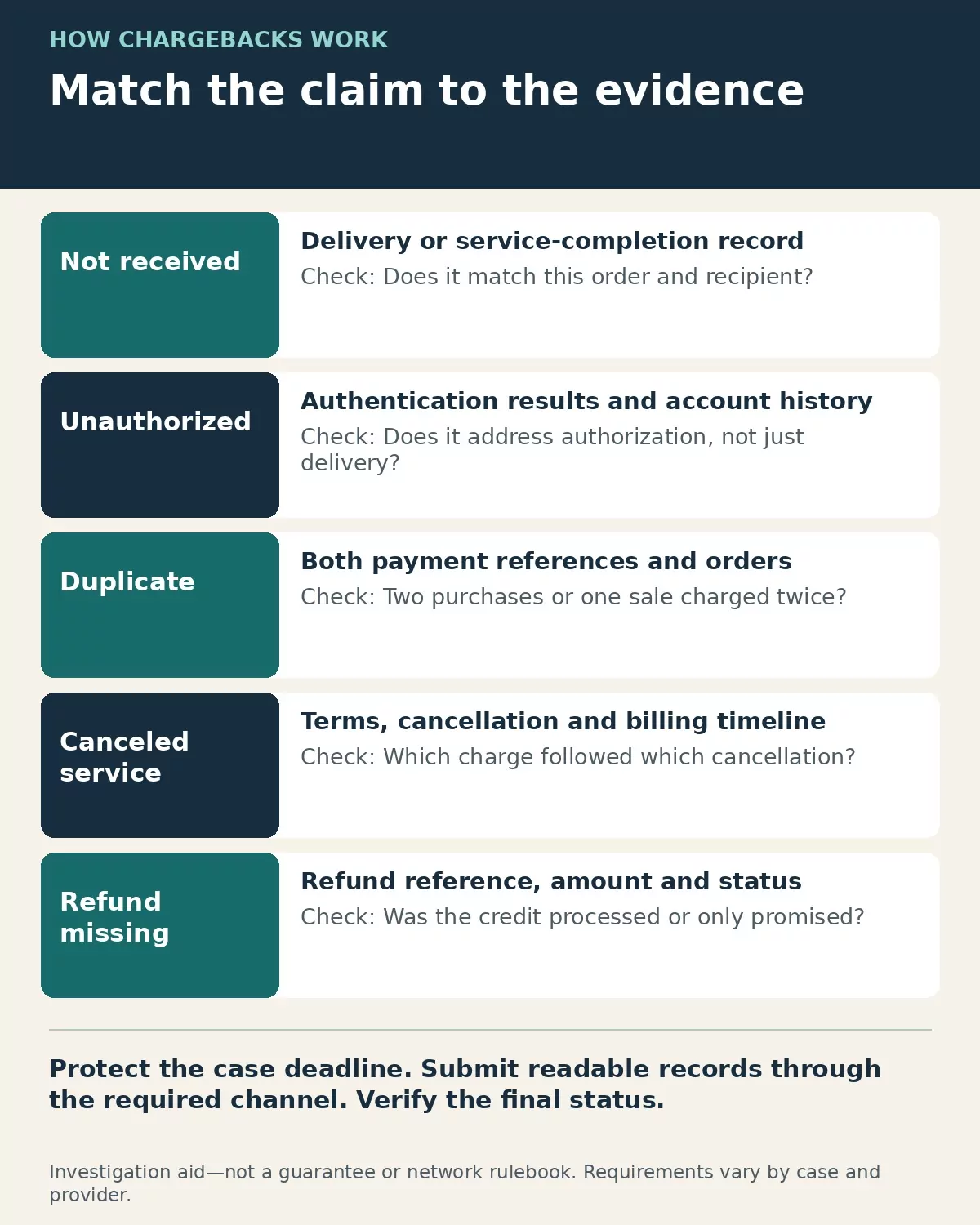
The five checks distinguish authorization, fulfillment, duplicate billing, cancellation and refund questions. Use the specific notice and response requirements to decide which records belong in the actual case.
5. Build a response packet a reviewer can follow
Arrange the essential events chronologically, then connect each disputed fact to a clearly labeled record. Use the provider’s required fields and accepted attachments. A large archive is harder to assess than a short explanation with the right exhibits.
As a concrete provider example, Stripe’s current response documentation says its evidence submission is final once sent and cannot be amended with additional files. It also says reviewers will not inspect external content. For that workflow, a cloud-drive link or a request to telephone your team is not a replacement for the relevant evidence in the submission. Other providers can have different interfaces and limits.
| Packet component | What to put in it |
|---|---|
| Case summary | Identify the disputed payment, claim and specific reason you believe a correction is justified. |
| Event timeline | Purchase, fulfillment, cancellation, communication and refund events relevant to this claim |
| Evidence index | A short label for each exhibit and the fact it supports |
| Relevant records | Readable extracts or exports that preserve necessary context and match the transaction |
| Review and submission log | Reviewer, final file set, submission confirmation and next status check |
Keep a copy of the original records. If you annotate an extract, make the annotation distinguishable from the underlying record and preserve its meaning. Do not create a receipt retrospectively, alter a timestamp or turn a policy written today into supposed evidence of terms accepted months ago.
The FTC’s business data-security guide recommends limiting collection, retention and access to information with a legitimate business need. Apply that principle to the evidence folder: include relevant material, restrict access and follow an appropriate retention policy. Do not circulate complete customer records simply because they are easy to export.
A hypothetical delivery dispute
Suppose a business sells a $240 replacement part and receives a non-receipt dispute. Its order record names the recipient and address; its carrier record shows a delivery event. The team must check whether those records actually correspond before relying on them. If the addresses differ, that difference needs investigation, not a confident statement that delivery is proven.
A draft response structure might read: “We are responding to the non-receipt claim for payment [reference]. Exhibit A identifies the ordered item and agreed destination. Exhibit B records delivery on [date] to [destination]. Exhibit C contains the relevant communication about receipt. We request review of these records against the claim.”
That is a writing example, not real transaction evidence. Use a sentence only if the underlying record supports it, remove any nonexistent exhibit and explain a material inconsistency. The same wording would be unsuitable for an authorization claim, where delivery alone does not answer the question.
6. Review once more, then verify the submission
Ask a colleague who did not assemble the packet to read the complaint and response together. Can that person identify the payment, understand the disagreement and find the supporting record without asking the preparer? If not, improve the explanation before sending it.
- Confirm the transaction, disputed amount and currency match throughout.
- Check that the response answers the stated reason and any material complaint detail.
- Open every attachment and confirm that dates and relevant text are readable.
- Resolve contradictory records or describe their limits accurately.
- Check the actual form’s file, page and submission requirements.
- Save the final submission confirmation and assign the next case-status check.
A saved draft response is not the same as submitted evidence. After submission, verify the status shown by the provider and retain the confirmation. If an upload fails, inspect what was saved before retrying so your team does not confuse a partial upload with a completed response.
Likewise, “under review” is not “won.” Keep any later information request or escalation separate from the first submission. Before escalating, understand the additional process, possible costs and authority required to proceed.
7. Reconcile the money and fix the recurring cause
Track the disputed principal, any fees, any earlier refund and the eventual outcome separately. Your credit card processing fee review can help frame the broader cost discussion, but the agreement and case records determine the actual dispute charges. Do not assume that a favorable decision returns every fee.
Compare the response effort with the amount potentially recoverable. This is a management decision, not a reason to submit weak or inaccurate evidence. A small dispute can also reveal a larger billing defect, so investigate patterns even when the business elects not to challenge an individual case.
Use specific prevention actions. If customers do not recognize charges, review the descriptor and purchase confirmation. If cancellations generate complaints, examine the cancellation-to-billing handoff. If deliveries are repeatedly disputed, review the promised delivery terms and record collection. Assign an owner to the correction and check whether it was implemented.
Separate outcome reporting from process quality. A team can submit a timely, accurate response and still lose; it can also recover money while retaining an operational problem. Review missed deadlines, missing evidence and repeated complaint types alongside the financial result.
Understand how chargebacks work before defending the next sale
Understanding how chargebacks work gives a small business a repeatable way to respond: preserve the case deadline, establish what happened, choose an appropriate resolution and submit relevant records through the required channel. Winning depends on the facts and applicable rules, not an aggressive letter or a universal evidence template.
Keep one clear case record from the first notice to the final reconciliation. When the complaint is valid, correct it. When the records support a challenge, make the disputed fact easy to verify—and use what the case reveals to prevent the next avoidable dispute.