

A supplier check you mailed on October 30 can sit in the mail until November. Your books already reflect the payment. Your October bank statement still includes the cash. Enter the check a second time while reconciling and you turn an ordinary delay into a bookkeeping error.
Monthly business bank reconciliation answers two questions. Which transactions had cleared by the statement date? Which differences require you to change your books? Start with one account and one statement period. Finish when you can explain every difference and both adjusted balances agree.
1. Start with the statement closing date
Download the complete statement and pull the transaction register for the same account through the same date. Use the closing balance printed on the statement. The available balance in your banking app can include activity from the following month. If you operate several accounts, label each worksheet with the account nickname and last four digits.
Open last month’s reconciliation alongside the register. The prior closing statement balance should carry into this statement as its opening balance. Check that the opening reconciled balance in your bookkeeping system agrees with the prior report. If it changed, look for an edited, deleted or unmarked transaction before matching this month’s activity. For a first reconciliation, establish the opening balance from a statement and identify any payments or deposits already outstanding on that date.
2. Match transactions, including last month’s open items
Work down the statement. For each line, find the corresponding entry in your books using the amount, payee or payer, and a check number, transfer reference or deposit slip. Mark it cleared once. When two payments have the same amount, the reference tells you which one to clear. A suggested bank-feed match still needs that check.
A September check paid in October belongs among October’s cleared items. Find the September entry in the register and clear it against the October statement. Its original payment date stays intact. For a transfer between two business accounts, match the withdrawal in one register and the deposit in the other as each clears.
Card payouts take an extra step. A $970 bank deposit might represent $1,000 of customer payments less $30 in fees. Open the payout detail for your merchant account and trace the batch to the deposit. If the sales and fees are already recorded, match the payout to the existing transfer. Recording another $970 sale would count the same receipts twice. If the batch includes a refund or chargeback, identify it separately so the fee entry remains accurate.
3. Decide which differences need an entry
Start with transactions left in the books. For a deposit recorded before cutoff, find the deposit receipt and look for the credit on the next statement. Until it clears, add the deposit to the statement balance on your worksheet. For a check issued and recorded before cutoff that has yet to clear, subtract it on the worksheet. Both amounts already appear in your register.
Next, inspect unmatched statement lines. A verified monthly service charge missing from the books needs an expense entry that reduces bank cash. Interest credited by the bank and missing from the register increases bank cash and interest income. For an amount entered incorrectly, document the original entry, supporting record and correction. The IRS illustrates both timing differences and book corrections in its recordkeeping guide for small businesses.
An unfamiliar withdrawal deserves a separate investigation. Check the payment authorization and transaction details. If you still cannot identify it, contact the bank promptly through its official channel and keep the case reference. A confirmed bank error belongs on the reconciliation until the bank corrects it. Leave unresolved questions visible to the reviewer.
4. Prove the two balances with a month-end example
Suppose the October 31 statement ends at $12,480. A $900 deposit recorded that afternoon reaches the bank on November 2. A $650 supplier check remains outstanding. The register ends at $12,755 before anyone enters the bank’s $25 monthly fee.
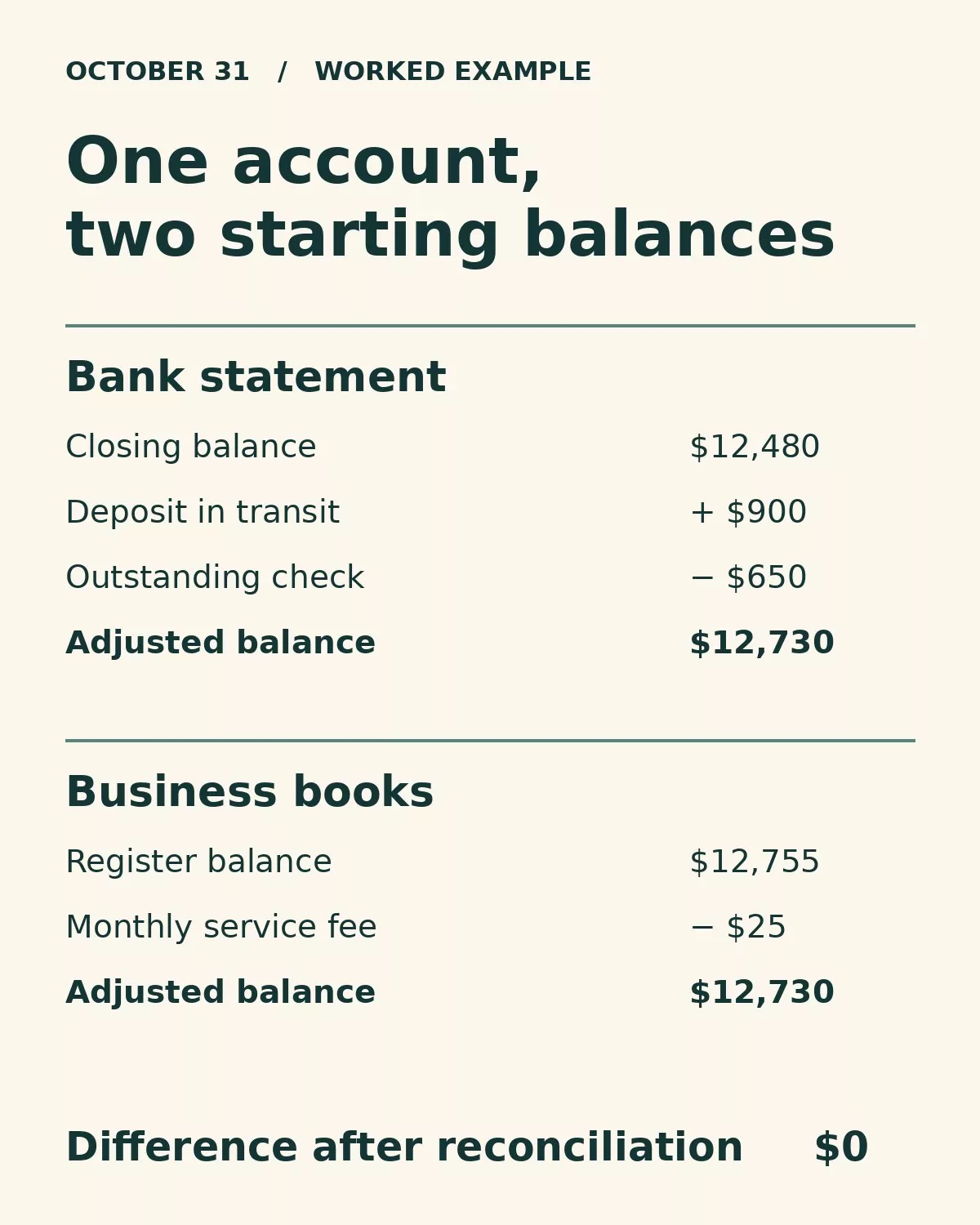
On the bank side, $12,480 + $900 − $650 = $12,730. On the book side, $12,755 − $25 = $12,730. The difference is zero. Save the fee entry and confirm the register now shows $12,730 at October 31. When the $900 appears in November, clear the original deposit against that statement.
If your figures still differ, use the amount as a clue. In this example, a remaining $25 difference points back to the service charge. A $1,300 difference is twice the outstanding check and suggests someone added $650 instead of subtracting it. These are places to look. Verify the transaction before changing an entry.
5. Close the month and carry the open list forward
Save the statement, dated reconciliation report, itemized outstanding list and support for corrections together. Give each open item an amount, original date, reference and next action. Where duties are shared, have someone other than the preparer review the corrections and older outstanding items and record the review date.
Begin next month with that list. If the deposit cleared November 2, mark it off. If the supplier check still has not cleared, ask the supplier whether it arrived and confirm its status with the bank before arranging a replacement. That follow-up prevents a balanced worksheet from hiding a missing deposit or a supplier who is still waiting to be paid.