The purchase order vs invoice distinction is easy to state: a purchase order comes from the buyer before anything is delivered, and an invoice comes from the seller after it is. Everything else in the transaction follows from that single fact, which is why the two documents carry different numbers, different approval routes and different legal weight. Get the order backwards and you will either pay for something nobody approved or chase money against a document that proves nothing.
The Difference in One Line: Who Sends It, and When
The purchase order is the buyer’s document. It states what you intend to buy, at what price, on what terms, before the supplier commits to
anything. Once the supplier accepts it, it stops being a request and becomes a contract, which is the part most small businesses miss.
The invoice runs the other way. The seller issues it after shipping the goods or finishing the work, and it is a request for payment against
an order that already exists. The debt came into existence when the ordered goods were delivered; the invoice is the seller’s record of it
and the formal ask to be paid.
The timing gap between the two documents is where the control lives. Issuing the PO before delivery keeps the refusal option open. Once the
invoice lands, the goods have usually shipped and the conversation has
narrowed to how much you owe.
What a Purchase Order Actually Does
A purchase order is a sequentially numbered document the buyer’s procurement function prepares, approves internally, and sends to a
supplier. It carries the PO number, the buyer and seller details, line items with item numbers, descriptions, quantities, unit prices and
extended prices, any discounts, the subtotal, sales tax and total, the payment and shipping terms, the expected delivery date, and the billing
and shipping addresses.
Its real job is authorization. Tipalti, which sells accounts payable software, puts the sequence plainly: the PO is prepared by procurement,
approved, and submitted to initiate a purchase. Three months later, when someone asks who signed off on twenty thousand dollars of equipment, the PO is the record that answers it.
Everything that follows in the transaction gets measured against the PO, which is what makes it the reference document for the whole
purchase. The receiving report is checked against the PO for quantity, and the invoice is checked against the PO for price and terms. Remove
the PO and you have nothing to check the invoice against except your own memory of the conversation.
Blanket purchase orders handle the case where you buy from the same supplier repeatedly. Procurify, another procurement platform, describes the pattern: the buyer issues one blanket PO for volume terms over a period, then releases sub-orders against it as goods are needed. The alternative is a fresh PO for every reorder, which is administrative overhead with no added control.
Not every purchase needs one. Tipalti notes that for low-cost items not ordered in bulk, the cost of preparing a PO can exceed the value of
the control it provides. That is a judgment call about thresholds, and it should be a written one.
What an Invoice Actually Does
An invoice is the seller’s formal request for payment, issued after delivery. Procurify’s breakdown of the invoice lists the fields: an invoice number as a unique tracking identifier, the seller’s and buyer’s details, an itemized list of what was supplied with quantities and
prices, the total amount due, and the payment terms stating how and when
payment should be made.
The number that matters most on a well-built invoice is not the total. It is the PO number, which the invoice should carry whenever one exists. Tipalti states the reason directly: an invoice that contains the original purchase order number demonstrates to the buyer’s finance team that the transaction was previously budgeted for and approved, and it can help the supplier get paid faster. The seller gains a faster route to payment, and the buyer gains a control, since an invoice without a PO number has to be traced by hand before anyone can approve it.
The invoice is also the last point at which a mistake is cheap to fix. Once it is approved and paid, recovering an overpayment means asking for money back, which is a slower and less certain process than refusing to pay it in the first place.
The Purchase Order vs Invoice Comparison Table
Every row below answers a question that comes up at some point during the transaction.
| Question | Purchase order | Invoice |
|---|---|---|
| Who creates it | The buyer | The seller |
| When it is created | Before delivery | After delivery |
| What it does | Authorizes the spend | Requests payment |
| Numbered how | PO number, sequential | Invoice number, seller’s own series |
| Carries the other’s number | No | Yes — the PO number belongs here |
| Triggers payment | No | Yes |
| Needs internal approval | Yes, before issue | Yes, but against the PO and receipt |
| Proves what you owe | No, it fixes what you agreed | Yes, when matched |
The row that decides most disputes is the last one. A PO fixes the price and quantity you agreed to. An invoice asserts what you owe. Those
two numbers agree in a clean transaction, and when they do not, the PO is the one you agreed to.
Which One Is Legally Enforceable, and the $500 Line
Here is where the standard pages go quiet, and it matters. The rule that decides whether your paperwork holds up is the statute of frauds in
UCC §2-201, and its threshold is $500, not the higher figure that gets repeated.
The statute’s own text, as published by Cornell Law School’s Legal Information Institute: a contract for the sale of goods for the price of $500 or more is not enforceable by way of action or defense unless there is some writing sufficient to indicate a contract for sale has been made, signed by the party against whom enforcement is sought.
That last clause is the trap. A purchase order is normally issued unilaterally by the buyer and never signed by the seller. Michigan attorneys John R. Trentacosta and Jason D. Menges made exactly this point in the Michigan Bar Journal, writing that most purchase orders are
unenforceable unless they satisfy an exception to the statute of frauds — and their article puts the threshold at $1,000.The statute says $500. Where a bar publication and the statute disagree on a figure, the statute is the one a court reads, and the lower threshold means the writing requirement bites on far smaller orders than that article suggests.
Three exceptions do most of the work, and two of them are in the statute itself.
Goods specially manufactured for the buyer and not suitable for sale to others are enforceable without the writing, under §2-201(3). Trentacosta and Menges caution that commentators and courts have largely restricted this exception to sellers rather than buyers, so a buyer cannot lean on it as comfortably as the text suggests. Goods that have been paid for and accepted, or received and accepted, are also enforceable, and the partial-performance doctrine does the same work.
The Ten-Day Clock Most Buyers Have Never Heard Of
The most useful sentence in the statute for anyone who sends purchase orders is the merchant’s confirmatory memorandum rule, and it is a
deadline nobody warns you about.
Between merchants, where a written confirmation of the contract is received and the recipient has reason to know its contents, that writing
satisfies the writing requirement against the recipient — unless written notice of objection is given within 10 days after it is received. The statute’s wording is in subsection (2), and the ten days is its own.
What that means in practice cuts both ways. If you send a PO to a supplier and they never object in writing within ten days, the PO can bind them even if they never signed it. And if a supplier sends you an order confirmation containing terms you did not agree to, doing nothing
for ten days is a decision — the terms can bind you by silence.
That is why the objection has to be in writing and inside the window. A phone call saying “we didn’t agree to that” leaves you with nothing to
show, and the ten days does not pause while you think about it.
The Three-Way Match, and What Fails Inside It
The control that catches bad invoices before payment is the three-way match, and it compares three documents rather than two. AccountingCoach, a longstanding accounting reference, defines it as the procedure used when processing a vendor invoice: the vendor’s invoice, the purchase order your organization prepared, and the receiving report your organization prepared. The “match” is the comparison of quantities, price per unit, terms and other information across all three. Only when the details agree does the invoice get entered as an account payable.
Checking the invoice against the PO alone catches a wrong price and nothing else, because neither document knows what actually arrived at
your loading dock. That is the gap the receiving report fills.
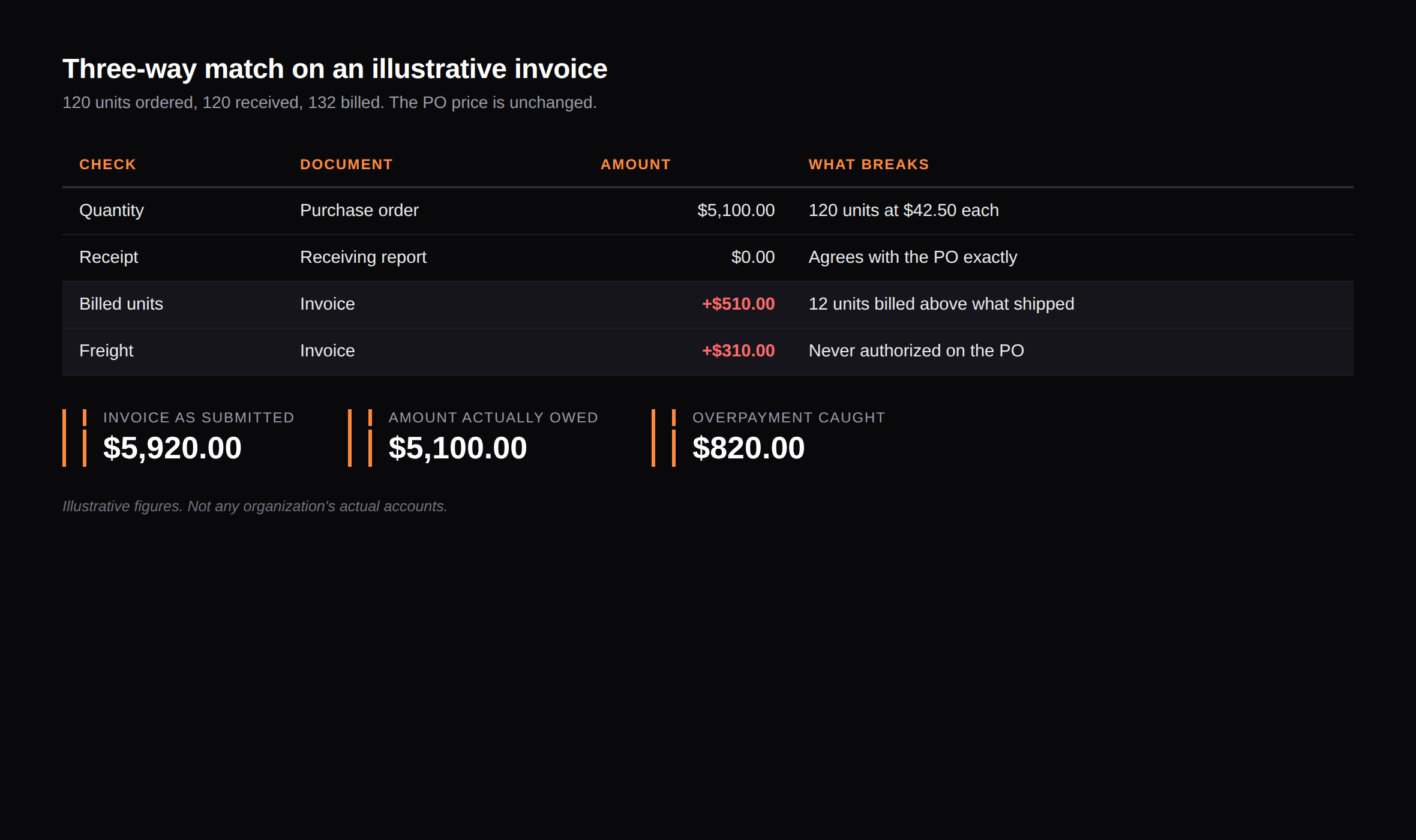
The exhibit above is my own arithmetic on illustrative figures, not any organization’s accounts. In it, 120 units are ordered and received
at $42.50 each, but 132 are billed, and $310 of freight appears that was absent from the purchase order. The invoice arrives at $5,920.00 against $5,100.00 actually owed — an $820.00 overpayment, 13.9% of the invoice, that a bare approval would have waved through. The quantity excess alone accounts for $510 of it and the unauthorized freight for $310.
Notice what the match caught. The unit price was correct on both documents, so a price check finds nothing. The failure was quantity
against receipt, plus a charge with no authorization behind it. Those are the two shapes most likely to reach you, and only the third document
catches the first.
What the IRS Actually Requires You to Keep
The tax rule is narrower than most businesses assume, and it is about substantiation rather than document type. The IRS says plainly that you may choose any recordkeeping system suited to your business that clearly shows your income and expenses.
On the supporting documents, the IRS lists sales slips, paid bills, invoices, receipts, deposit slips and canceled checks, and says these
documents contain the information you need to record in your books.
Then comes the requirement that decides whether a shoebox of paper survives an examination.
Your supporting documents should identify the payee, the amount paid, proof of payment, the date incurred, and include a
description of the item purchased or service received that shows the amount was for a business expense. The IRS notes that a combination of
supporting documents may be needed to substantiate all elements of the expense.
Read that list against a bare invoice and the gap is obvious. An invoice names the payee, the amount and the date, but it is not proof of
payment by itself. That is what the canceled check or the bank record supplies. Which is the accounting reason to keep the payment record
alongside the invoice rather than instead of it — and the same logic that makes the receiving report necessary in the three-way match.
Employment tax records carry their own rule: keep all records of employment for at least four years, per the IRS.
Frequently Asked Questions
Can I use an invoice as a purchase order?
No, and the confusion usually starts when one business has no procurement process and writes “invoice” on a document that is really a bill for work not yet done. An invoice requests payment for something supplied. If nothing has been supplied, there is no debt to request payment for, and the document cannot authorize the spend the way a PO does. Issue the PO, then invoice against it.
What happens if an invoice arrives with no PO number on it?
Nothing stops it legally, and that is the problem. The invoice is still a valid request for payment, but you have lost the cheap way to check it against what you approved. Finance then has to reconstruct the authorization from email or memory. Businesses that reject invoices lacking a PO number are buying themselves a control.
Is a purchase order legally binding?
Acceptance by the supplier creates the binding contract, on the same reasoning that any offer and acceptance does. Enforceability is the separate question, and UCC §2-201 answers it: a sale of goods at $500 or more needs a writing signed by the party you are trying to hold to it. An unsigned PO may well be a real contract that you cannot enforce in court, which is worth understanding before a dispute rather than during one.
Do I need both for a small purchase?
Not usually. The cost of preparing and approving a PO can exceed the value of the control on a low-cost, non-bulk order. The decision belongs in a written threshold policy — a dollar figure above which a PO is mandatory — because an unwritten threshold gets applied inconsistently, and inconsistent application is what makes a PO look like bureaucracy.
Who signs a purchase order?
Internally, a purchasing manager or whoever holds budget authority for the line, and larger organizations require two approvers above a set amount. Externally, no signature is needed for the PO to function — but remember the ten-day rule, because between merchants a written confirmation that goes unobjected to can bind the recipient regardless of a signature.
Does an invoice have to be paid within a set time?
The payment window comes from the terms on the invoice and the PO, not from law. Net 30 and Net 60 are commercial terms the parties choose. If the invoice and the PO state different terms, that mismatch is itself a three-way match failure and should be resolved before payment, not after.
Which Document to Reach for First in a Purchase Order vs Invoice Dispute
If you are the buyer, the purchase order is the one that protects you, and it has to exist before the goods move. Write the approval threshold down, put the PO number on every order, and run the three-way match on anything above it. In the purchase order vs invoice comparison
table above, the price column agreed on both documents and the loss still reached $820, since a quantity check is what catches units that
were billed but never shipped.
If you are the seller, the invoice is your cash-flow instrument, and the single highest-return change you can make is to print the buyer’s PO
number on it. It marks the transaction as pre-approved in the buyer’s own system, which is what moves it out of the query pile and into the
payment run.
Then deal with the one thing neither document fixes by itself. Between merchants, a written confirmation you disagree with binds you if
you stay silent for ten days. Put the objection window on your calendar, because after it closes the argument is over and the terms are the ones on their paper.