
A merchant account helps a business accept card payments and receive the proceeds through its payment provider. It is different from the checking account you use to pay rent and payroll. You need a way to accept and settle card payments if customers will pay by card, but you may not need to arrange a separate merchant account yourself: some providers bundle that function into their service. The useful question is which arrangement fits your sales, cash needs, and operating responsibilities.
What is a merchant account?
In a traditional card acceptance arrangement, a merchant account is the account relationship through which an acquiring bank or its service provider handles a business’s card payment proceeds before payout to its regular bank account. “Acquiring” refers to the merchant side of the card transaction; the issuing bank is on the cardholder’s side.
This is not an extra checking account for everyday spending. Think of it as part of the card acceptance system, with rules for settlement, fees, refunds, disputes, and possible reserves. Your business bank account is normally the destination for payouts and may also be the account from which the provider collects amounts you owe under the agreement.
The labels in a sales pitch can blur these roles. A company selling “merchant services” might supply processing, a terminal, a gateway, and support together. Ask which legal entity contracts with your business, which bank or provider handles acquiring, and who answers questions about withheld payouts. One dashboard does not necessarily mean one organization does everything.
Merchant account, checking account, gateway, and processor: the differences
| Component | Its job | Question to ask |
|---|---|---|
| Business checking account | Holds operating deposits and supports business payments. | Can this account receive the provider’s payouts and handle required debits? |
| Merchant account or bundled acquiring arrangement | Provides the merchant-side relationship for card acceptance and settlement. | What are the underwriting, reserve, payout, and termination terms? |
| Payment gateway | Passes payment information from a checkout to the processing system. | Does it work with this checkout and processor? |
| Payment processor | Handles transaction messages and processing functions. | Which services, reports, and support are included? |
A gateway alone does not answer who will settle your card receipts. A checking account alone does not give your website a card checkout. The Monitor Daily’s explanation of payment gateways versus payment processors covers that distinction in more detail.
Before replacing anything, map the current setup. Write down the storefront or invoicing tool, gateway if separate, processor, acquiring arrangement, and payout bank. This small inventory can prevent buying a service your existing platform already provides.
Two ways to arrange card acceptance
1. A separately arranged merchant account
Here, you apply for a merchant relationship for your business, often through an acquiring bank or merchant services provider. The review may consider your business activity, expected volume, average sale, fulfillment timing, and exposure to refunds or disputes. Supplying documents is part of the application; it does not guarantee approval.
This route is worth investigating when you need a particular integration, more control over payment arrangements, or a quote tailored to a substantial, established sales pattern. Those are reasons to compare written offers, not proof that a separate account will be cheaper or more reliable. Equipment, gateway access, support, and contract obligations can change the result.
2. A bundled service using a payment facilitator
A payment facilitator can onboard businesses as submerchants under its broader acquiring arrangement. The seller may get checkout tools and payment acceptance through one service without independently opening a traditional merchant account. Other payment service providers use different models, so confirm the actual arrangement rather than treating every bundled provider as identical.
Bundling can reduce the number of systems a small team has to coordinate. It also makes the provider’s rules important: eligible business activities, account reviews, reserves, payout restrictions, and support procedures still matter. A quick signup is not a promise of unrestricted processing or immediate access to every payment.
Neither model removes your responsibility to deliver what you sell, handle refunds, maintain records, or answer disputes. Compare the proposed arrangement against your real workflow instead of choosing by the account label.
Do you need one? Start with how customers pay
| Your situation | Practical starting point | What could change the choice? |
|---|---|---|
| You take cash, checks, or bank transfers and do not need cards. | Check the banking and payment services needed for those methods. | Customer demand for cards or a new sales channel. |
| You want to start accepting cards with a small team. | Compare a bundled service with a separately arranged option. | Business eligibility, integrations, total cost, and payout terms. |
| You already accept cards through a storefront or invoicing platform. | Identify the acquiring arrangement already included. | A feature gap, unfavorable terms, or an unsupported business model. |
| You have established volume and specialized requirements. | Request comparable written proposals using the same transaction profile. | Contract flexibility, reconciliation, support, and an actual cost comparison. |
You do not need card acquiring solely because you receive an ACH transfer. Bank payment services have their own requirements. Conversely, a business bank account is not a substitute for card acceptance when a customer expects to enter card details at checkout.
For a business already using a platform, the first action is usually an account and contract review, not another signup. Ask whether a new provider can actually connect to that platform, who controls the checkout, and what changes for recurring payments or stored payment credentials.
An approved card payment is not a bank payout
Keep three moments separate. Authorization is the card issuer’s approval of the transaction request. Capture submits the charge for processing. Settlement and payout then move the proceeds through the relevant arrangements toward the business’s bank account. Their timing depends on the provider, payment method, account, and banking schedule.
A provider may show funds as pending before they become available for payout. A scheduled payout can also reach the bank later than the date shown as available in the processing balance. Refunds, disputes, fees, and reserves can affect what is paid out. Use the provider’s actual status definitions when forecasting cash.
Consider this illustrative reconciliation, not a provider quote: a business records $2,000 in captured card sales. Assume $60 in processing charges, $120 in refunds, and $200 temporarily withheld under a reserve arrangement. The resulting payout would be $1,620 if those are the only adjustments. The withheld $200 is a timing or access issue in this example, not an additional $200 processing fee.
This is why the deposit alone cannot tell you gross sales or the full cost of acceptance. Match the sales register to the processor’s transaction and adjustment reports, then match the payout to the bank statement. Keep a separate list of amounts still pending and when the provider says they may be released.
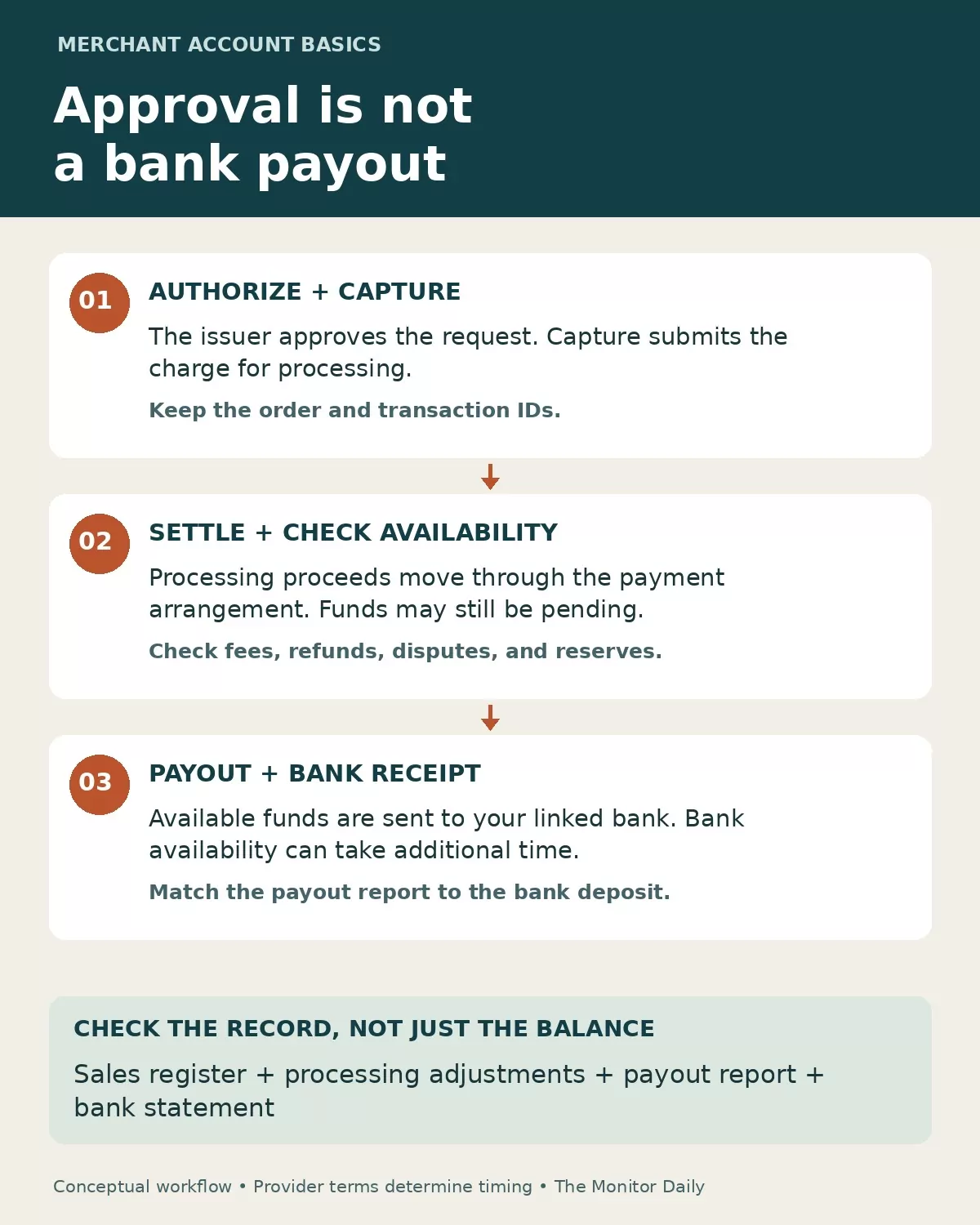
For each payout, retain the order and transaction IDs, check processing adjustments, and match the payout report to the bank receipt. A pending or available processing balance is a different checkpoint from money available in your operating bank account.
Compare the whole agreement before the headline rate
The SBA’s business banking guidance identifies several merchant service charges to compare, including percentage-based charges, transaction fees, verification charges, batch fees, and monthly minimums. The items applicable to your business depend on the offer.
Request the full fee schedule, then compare the same sample month across providers. Include transaction count, sales total, average ticket, card-present versus online payments, refunds, and any international card activity relevant to your business. A lower advertised percentage can still produce a higher bill if fixed charges or minimums dominate.
Read equipment and software terms separately. A terminal purchase, rental, or lease may have obligations beyond the processing agreement. Check whether you can keep using the equipment if you switch providers and whether cancellation ends every related charge.
Then examine access to cash. Ask what can trigger a reserve, how its amount is determined, how release works, whether payout timing can change, and how you can challenge or clarify a restriction. Avoid building payroll commitments around a marketing promise that is absent from the agreement.
Check refunds, chargebacks, and responsibility for records
A refund you initiate and a dispute raised through the cardholder’s bank are different events. Find out how each affects the processing balance, which fees apply, and whether the provider can debit your linked account when the balance is insufficient. Do not assume issuing a refund automatically resolves a dispute already in progress.
Assign one person to monitor notices and maintain the order, delivery, refund, and customer communication records needed to respond. The provider’s response deadline and requested evidence should drive the workflow. The Monitor Daily’s guide to how chargebacks work explains the merchant response process.
Also distinguish payment access from deposit protection. The FDIC explains that nonbank companies are not FDIC-insured; any applicable coverage depends on funds being deposited at an insured bank and the relevant conditions. Deposit insurance addresses insured bank failure, not the failure of a nonbank provider. A balance displayed in a processing dashboard does not by itself establish coverage or guarantee immediate access.
A short worksheet for choosing the arrangement
Before requesting proposals, prepare a one-page payment profile. It should describe what you sell, where customers pay, average and largest expected orders, normal monthly card volume, time between payment and delivery, refund practices, and required software connections. Use actual records if available and label estimates clearly.
For each option, record written answers to these questions:
- Does the provider explicitly support our business activity and fulfillment model?
- Who is responsible for acquiring, processing, support, and payout decisions?
- What would our sample month cost, including fixed and conditional charges?
- When do funds become available, and what can delay or restrict a payout?
- How are refunds, disputes, reserves, and negative balances handled?
- Can accounting export transactions, fees, adjustments, and payouts separately?
- What are the contract term, cancellation requirements, and migration limits?
Resolve unsupported activity or a critical integration gap before comparing price. Next, check whether payout uncertainty is compatible with the cash buffer you actually have. Compare cost only among arrangements that satisfy those operating requirements. This order makes the decision more useful than a ranking based on one advertised rate.
If you proceed, begin with a controlled setup: verify the payout bank details, restrict account permissions, check receipts and statement descriptors, and reconcile the first completed payout. Record who will monitor exceptions. Opening the account is only the beginning of running the payment process.
Choose the merchant account arrangement your business can operate
A merchant account belongs to the system that accepts and settles card payments; it does not replace your operating bank account. You may arrange that relationship separately or receive the function through a bundled provider. Choose using supported business activity, integration fit, total cost, payout rules, and the records your team needs to reconcile cash. The best next step is a clear payment profile and comparable written terms.