
The best business checking accounts for small business match the way money actually enters and leaves the company. A cash-heavy shop needs a workable deposit route; an online consultancy may care more about wires, accounting records, and avoiding a recurring fee. This 2026 comparison examines four US bank accounts with different operating strengths, then shows how to choose using your own transaction pattern rather than a signup bonus.
Business checking accounts for small business: the short comparison
| Account | Monthly account fee | Useful fit | Main issue to check |
|---|---|---|---|
| Chase Business Complete Banking | $15, with waiver routes | Branch banking and integrated payment tools | Daily balance rule and counted transactions |
| Bank of America Business Advantage Fundamentals Banking | Advertised $0 for first 12 months, then $16 unless waived | Branch access with qualifying debit activity | Ongoing cost after introductory period |
| U.S. Bank Business Essentials | $0 maintenance fee | Digital activity with occasional teller use | Cash units and separately priced services |
| Axos Basic Business Checking | $0 maintenance fee | Online banking and incoming wires | A workable cash deposit and support routine |
These four are a starting shortlist, not a claim to cover every local bank or credit union. A community institution with a convenient deposit route and appropriate services may be a better match. “Best” here means suitable for the stated workflow, not a guaranteed approval, lowest possible cost, or promise of service quality.
1. Chase Business Complete Banking: consider it for branch and payment convenience
Chase lists a $15 monthly service fee. One waiver route is a $2,000 minimum daily ending balance; other routes include specified eligible payment deposits, business credit-card purchases, and qualifying linked relationships. The account includes 20 in-branch transactions before a $0.50 additional-transaction charge, plus no processing fee on the first $5,000 of cash deposits per statement period. Electronic deposits, ACH, ATM activity, debit purchases, internal transfers, and QuickDeposit are listed without transaction fees.
This is worth comparing when branch access and collecting customer payments in the same environment would reduce administrative work. QuickAccept card acceptance is available, but payment processing is a separate cost consideration. A business that repeatedly drops below the daily balance threshold should budget the fee unless it qualifies through another route. Check that the actual branch, cash channel, and payment setup suit your location; a broad branch network does not establish convenience for your particular shop.
2. Bank of America Fundamentals: assess the ongoing waiver, not just year one
Bank of America advertises no monthly fee for the first 12 months on Business Advantage Fundamentals Banking, followed by $16 unless waived. Ongoing options include $500 in new net qualified business debit-card purchases per statement cycle, a $5,000 combined average monthly balance in eligible linked business deposits, or qualifying Preferred Rewards membership. The fee schedule includes 20 counted transactions, then $0.45 per additional item, with stated electronic and mobile-deposit exclusions. The first $5,000 of cash deposits per cycle is included, then $0.30 per $100.
The debit-purchase route may suit a business that already makes qualifying purchases and wants branch banking without holding the full balance threshold. Do not create unnecessary spending to avoid a smaller fee. Model the account beyond the introductory period and confirm the offer applying to your application. Staff should understand which items count toward the transaction allowance, rather than treating every entry on the statement as the same type.
3. U.S. Bank Business Essentials: useful for low base fees and mostly digital activity
Business Essentials lists a $0 monthly maintenance fee and $25 opening deposit. Its pricing brochure includes 25 teller and paper transactions per statement cycle, then $0.50 each, while the product page advertises unlimited digital transactions. The cash allowance is 25 units, followed by $0.35 per $100; units use per-deposit rounding rules, so this is not a simple promise of a $2,500 monthly cash allowance.
For a mainly digital business with occasional branch needs, the absence of a maintenance-fee balance test can simplify budgeting. However, “digital transactions” does not make every banking service free. Examine the charges for the specific ACH, wire, and cash-management tools you require. A cash-heavy seller should calculate units from actual deposit sizes and frequency. Ask whether the needed branch and deposit services are available to your business before selecting the account on the headline fee alone.
4. Axos Basic Business Checking: consider it for an online operating account
Axos lists no monthly maintenance fee, no initial deposit or minimum balance requirement, unlimited transactions, and unlimited domestic ATM fee reimbursements. Its product page states that domestic and international incoming wires are free and that two domestic outgoing wires are reimbursed monthly. These features make it worth assessing for a business that receives electronic payments and does not rely on a routine teller visit.
Build the cash workflow before relying on the account for a business with physical sales. ATM reimbursement is not evidence that every ATM accepts business cash deposits, and a digital bank’s service model is different from a nearby staffed counter. Confirm your available deposit method, limits, payment tools, and escalation process. Incoming-wire pricing also does not describe the entire cost of a foreign-currency transaction or every intermediary’s charges. Evaluate the actual payment route rather than equating one waived fee with a cost-free international payment.
Start with a month of activity, not an advertised bonus
Pull a representative month of bank activity and a busier month. List cash deposit amounts and frequency, paper checks written, checks deposited, incoming and outgoing transfers, and the lowest end-of-day balance. Note when payroll and large supplier payments occur. This gives you a workload against which to compare each account.
Keep balance measurements separate. A minimum daily ending balance requires the threshold on the relevant days; an average monthly balance measures something different. An account that looks inexpensive at your average balance may still charge a fee after payroll lowers the daily balance. Use the exact definition in the applicable disclosure.
The SBA’s business banking guidance recommends comparing account fees, minimum balances, and related services. Apply that comparison to the services you will actually use. A bank’s basic account fee and the cost of its payment services are different lines in the budget.
One useful worksheet has a column for each shortlisted account and rows for maintenance, counted transactions, cash processing, wires, required software or treasury services, and other recurring charges. Put “not yet confirmed” in a cell when the terms do not answer your specific use case. A blank cell should not silently become zero.
A worked example: compare the same activity across accounts
Suppose a hypothetical service business has no cash deposits, ten paper or teller transactions per cycle, and ordinary digital activity that fits the stated exclusions or included categories. It maintains a $1,200 balance every day, makes $600 in qualifying Bank of America business debit purchases, and meets no other maintenance-fee waiver. Assume no wires, overdrafts, or paid add-on services.
| Account | Illustrative monthly maintenance cost | Reason |
|---|---|---|
| Chase Business Complete | $15 | Assumed balance is below the $2,000 daily route; no other waiver assumed |
| Bank of America Fundamentals | $0 | Assumed qualified debit activity meets the $500 route, including after the introductory period |
| U.S. Bank Business Essentials | $0 | No monthly maintenance fee |
| Axos Basic Business Checking | $0 | No monthly maintenance fee |
Under those assumptions, Chase’s maintenance charge would total $180 over twelve identical cycles. This is a narrow fee illustration, not a complete account-cost quote. Change the balance, eligibility, transaction category, or services and the result can change. The fee difference may be acceptable if a useful branch or integration saves enough real work, but that benefit needs evidence from your operation.
Now test a bad month. Remove the qualifying purchases, let the balance fall before payroll, or add a time-sensitive wire. The purpose is to find which conditions your business can reliably meet. A waiver that requires constant monitoring has an administrative cost even when the bank charge is zero.
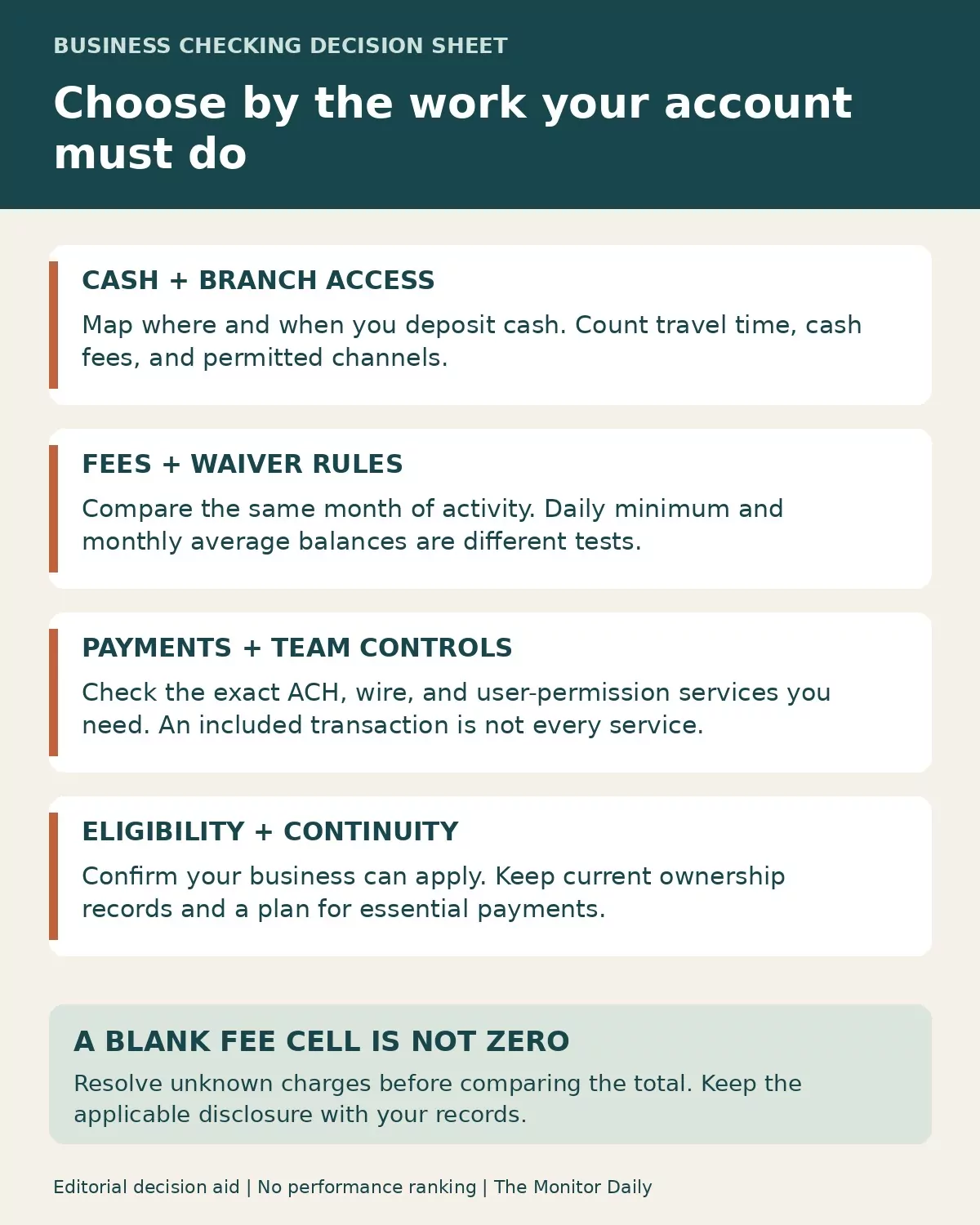
Start with the deposit route and essential payment services, then check fee conditions and eligibility. Resolve unknown charges before treating an account as the cheapest option.
Cash deposits, access, and permissions can decide the outcome
A retailer should test the physical deposit route on paper before selecting an account. Identify the permitted channel, opening hours, cutoffs, daily and monthly limits, cash charges, and who can make the deposit. Count the travel time and staffing coverage as well as the bank fee. A low-cost account can become inconvenient if someone must leave the business repeatedly to use it.
For a remote business, focus on incoming receipts, outgoing vendor payments, and what happens when an account action needs review. Separate the ability to receive ACH deposits from the ability to originate a payroll file or approve a wire. Those capabilities, limits, and fees may differ.
Ask for individual user access and suitable permissions for whoever handles bookkeeping. An employee who reconciles statements may not need authority to move money. Confirm available approval controls for your account and services; do not share the owner’s credentials as a substitute for access management.
Verify deposit protection and opening eligibility
The FDIC explains its deposit insurance limits as $250,000 per depositor, per insured bank, for each ownership category. Deposits in the same ownership category at the same bank are added together. Opening multiple checking accounts at one bank does not automatically multiply coverage.
Consider insurance alongside the practical need to access payroll and supplier cash. Deposit protection does not replace an operating contingency for a delayed payment, account review, or unavailable login. Maintain current records of account ownership and authorized users, and decide how essential payments would be handled during an interruption.
Eligibility comes before preference. Business type, ownership, location, identification, and the bank’s review determine whether an application can proceed. None of the selections is a promise that every US entity, nonresident owner, or business activity qualifies. An EIN alone is not an approval guarantee.
Prepare the required entity, ownership, and identity information for the actual application. Our guide to what to prepare before opening a business bank account provides a preparation framework. Keep the submitted information consistent with the business’s genuine records.
Make the switch without losing the payment trail
Once an account is approved, plan the transition rather than changing every payment instruction at once. List customer receipts, card-processor payouts, payroll, tax payments, subscriptions, and vendor debits linked to the old account. Assign an owner and confirmation state to each change.
Retain enough funds for outstanding commitments and keep reconciling both accounts during the transition. Verify replacement instructions through trusted channels, especially for large payments. Close the old account only after checking unresolved items and the bank’s closure requirements. This is an operating checklist, not a recommendation to open accounts merely to collect incentives.
Choose business checking accounts for small business by operating fit
Chase and Bank of America warrant comparison when local branch access matters and their fee-waiver conditions fit normal activity. U.S. Bank Business Essentials offers a low base-fee starting point with specific teller and cash-unit rules. Axos Basic Business Checking is a useful online candidate when its payment and access model matches the business.
The strongest choice among business checking accounts for small business is the one that supports your deposit route, payment controls, cash needs, and records at a predictable cost. Use the same month of activity for every comparison, resolve eligibility and service gaps, and keep the final fee disclosure with your account-opening records.