
To categorize business expenses accurately, first decide what each payment represents, then assign a consistent account based on what you bought—not just the merchant’s name. A bank withdrawal might be an operating cost, a transfer, a loan repayment or an asset purchase. Separating those decisions before you pick a category gives you more useful reports and fewer corrections at month-end.
For a small US business, the aim is a repeatable process that the owner, bookkeeper and tax preparer can understand. You do not need dozens of finely divided accounts to begin. You need clear definitions, supporting records and a place to send transactions that require a decision.
This research-based bookkeeping guide uses current IRS guidance checked November 16, 2026. The chart and examples are proposed working tools, not a tax-return template or a report of testing a particular accounting product. Tax treatment depends on your entity, accounting method, circumstances and applicable rules.
1. Decide what happened before you categorize business expenses
Read the transaction as a business event. Ask who was paid, what was received and whether you have already recorded the purchase elsewhere. A card statement saying “online marketplace” does not tell you whether you bought packing tape, a computer or a personal gift.
Keep three questions separate: which account describes the transaction, which reporting period it belongs to, and how it should be treated for tax. Selecting “software” answers the first question. It does not settle the other two.
The IRS’s Tax Guide for Small Business explains that deductible business costs generally must be ordinary and necessary, while personal portions must be separated. It also distinguishes current expenses from costs included in inventory or capitalized. A useful bookkeeping label is therefore a starting point, not proof that the full payment is deductible this year.
Separate the payments that are not new operating expenses
| Transaction | First classification decision | What to check |
|---|---|---|
| Transfer between two business bank accounts | Transfer between accounts | Match both sides; do not create income or an expense simply because cash moved. |
| Payment of a business credit-card balance | Payment against the card liability | Confirm the underlying purchases are recorded once. Record separate interest or fees appropriately. |
| Loan payment | Split principal from interest and any fees | Use the lender’s statement; the whole withdrawal is not automatically an expense. |
| Owner withdrawal or personal purchase | Owner-related or other appropriate non-expense treatment | Entity structure matters; ask the accountant how to record it. |
| Equipment or a long-term purchase | Asset or expense review | Apply the business’s accounting policy and obtain tax advice where needed. |
If these decisions are skipped, an expense report can look convincing while counting the same purchase twice. Deal with the transaction type before debating whether it belongs under office costs or administration.
2. Start with a simple expense category chart
Use the chart below as a starting structure for an ordinary service business. Rename or combine accounts to fit your operation. A retailer, manufacturer or construction business will need a more developed treatment of inventory, direct costs and projects.
| Working category | Typical items to examine | Boundary to document |
|---|---|---|
| Software and online services | Recurring business application subscriptions | Separate ordinary subscriptions from long-term rights, implementation projects or prepaid costs needing review. |
| Office supplies | Paper, pens and other routine consumables | Do not automatically include equipment just because the same store sold it. |
| Advertising and marketing | Campaign placements, promotional design and related services | Define where website projects and ongoing marketing services belong. |
| Professional services | Routine bookkeeping, legal or consulting work | Check whether work relates to an asset purchase, formation or a personal matter. |
| Premises and utilities | Business rent, electricity and similar premises costs | Keep deposits and mixed home/business arrangements out of automatic coding. |
| Telephone and internet | Business connectivity services | Document any business/personal allocation instead of assuming full business use. |
| Banking and payment fees | Account charges and payment-processing fees | Separate fees from transfers, loan principal and customer receipts. |
| Travel and meals | Potentially business-related travel or meal costs | Use separate accounts or tracking fields where helpful; retain purpose and request tax review. |
| Insurance | Business policy premiums | Review coverage dates and any personal component; payment date may not settle recognition. |
Do not build a separate account for every merchant. The category explains the economic purpose; the supplier field records who was paid. If you need to compare spending by client, location or department, a project or department field may be more useful than multiplying the account list.
A good test is whether an extra category changes a decision. Separating software from advertising may help you review two different budgets. Splitting stationery into six accounts is less useful if nobody uses the detail.
3. Attach evidence that explains the purchase
For every transaction, retain enough information to reconnect the payment to the business purpose. The IRS recordkeeping guidance identifies details such as the payee, amount, payment evidence, date and a description of what was purchased. More than one supporting document may be needed.
Make the record useful for the next person who opens it. “Annual design subscription for the marketing team” explains more than “business expense.” An invoice may identify the service while a statement confirms payment; neither should be expected to explain everything on its own.
In a spreadsheet, a practical row can include transaction date, supplier, description, gross amount, chosen account, business purpose, receipt location, reviewer and review status. In accounting software, use the equivalent fields without duplicating data the system already retains.
Keep the original document linked to the entry. If an invoice contains several types of purchase, preserve the item detail that supports a split. Avoid embedding bank credentials or unnecessary personal information in shared notes.
4. Use a decision path for uncertain transactions
Work through four checks: confirm the transaction is genuine and not already recorded; identify whether it is a transfer, liability payment or owner-related item; inspect any asset, prepayment or mixed-use issue; then choose the operating expense account if appropriate. Missing evidence belongs in a review queue, not in a guessed category that disappears from attention.
A temporary review label is a workflow tool. Give each open item a named reviewer, a question and a follow-up date. “Ask Maya whether the payment includes a refundable deposit” is actionable. “Miscellaneous” without an explanation is not.
Split a mixed purchase using documented information
Suppose a hypothetical $240 phone bill has a supported 60% business allocation for the period. The calculation is $240 × 60% = $144 for the business portion and $96 for the personal portion. This illustrates the arithmetic only; it does not establish an acceptable allocation method or a tax deduction.
Record the basis for the percentage and ask your accountant which accounts to use for the personal portion under your entity structure. Do not invent a percentage just to complete the bank feed. If the evidence is not available, flag the entry and resolve it before treating it as final.
Pause asset and prepayment decisions
A computer used over several years deserves a different review from printer paper consumed in routine work. Likewise, paying a year’s insurance in advance raises a timing question that a supplier-based rule will not answer. Capture what was bought, when it became available or what period the service covers, then apply the appropriate policy.
Keep the initial bookkeeping decision distinct from any later tax election or adjustment. Avoid choosing a universal dollar threshold from an online checklist; the relevant treatment needs to fit your facts and current rules.
5. Check a worked example before approving the batch
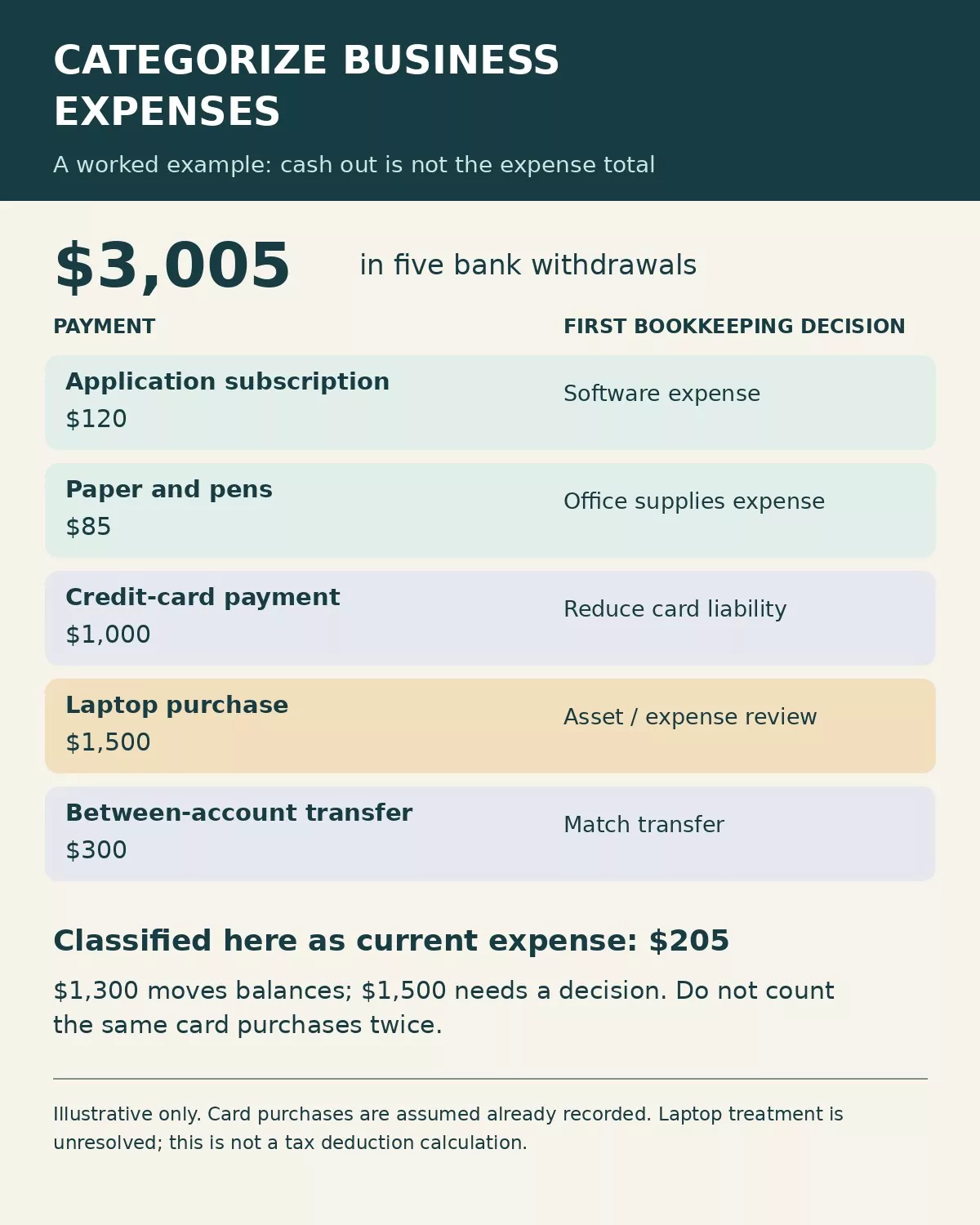
Imagine a small service business reviewing the following five withdrawals. The amounts are illustrative, and the example assumes the credit-card purchases were already recorded correctly.
| Withdrawal | Amount | Proposed handling |
|---|---|---|
| Monthly business application subscription | $120 | Software expense for the current service period. |
| Paper and pens for the office | $85 | Office supplies expense. |
| Payment to the business credit card | $1,000 | Reduce the card balance; do not repeat the underlying expenses. |
| Laptop purchase | $1,500 | Send for asset/expense treatment review. |
| Transfer to another business bank account | $300 | Match as a transfer between the accounts. |
The withdrawals total $3,005. Only $205 is classified here as current operating expense from these entries before resolving the laptop and considering any separate adjustments. The $1,000 card payment does not erase or replace the expenses already recorded on that card.
This is why a bank-spending total cannot simply become the expense figure in your profit report. Our bank statement vs accounting ledger guide explains how the two records serve different purposes and why reconciliation matters.
6. Add automation only after the rule is stable
Start with predictable, well-understood transactions. A recurring supplier can be a candidate for a proposed rule when the description, account and underlying service are consistent. Test the rule on examples first and inspect what it would change.
A rule based solely on a large marketplace’s name is much less dependable. The same supplier may sell consumables, equipment and personal items. Set those entries aside for document review rather than treating the previous category as proof.
Distinguish matching an existing transaction from adding a new one. If a purchase or bill payment is already in the books, importing its bank entry should not create another expense. Product terminology differs, so verify the workflow in your actual system before approving a batch.
When choosing a tool, assess receipt attachment, split entries, review permissions and correction history alongside automation. Our accounting software for small business comparison guide provides a broader buying framework. This article does not assume that every plan supports the same controls.
7. Close the month with a short review
Reconcile the bank and card accounts, resolve unsupported entries and compare category totals with the prior month. Investigate an unexpected change before changing its label: a higher software total might reflect an annual renewal, a new service or a duplicate entry.
Review the temporary queue by age and owner. Ask whether each item needs a missing receipt, an allocation, an asset decision or a correction. Keep unresolved amounts visible to the person preparing the reports instead of silently calling the month complete.
Document corrections with the reason and reviewer. If a category definition changes, decide whether earlier transactions need a consistent correction and preserve the audit trail. Do not rewrite closed periods casually; coordinate adjustments with the person responsible for the books.
Categorize business expenses with a rule someone else can follow
The dependable way to categorize business expenses is to identify the transaction first, choose a defined account second and preserve the evidence behind the decision. Use a small chart that fits your business, split supported mixed costs, keep transfers and liability payments distinct, and escalate uncertain entries. Consistency makes the reports useful; a clear review process keeps consistency from becoming a repeated mistake.