

To pay international contractors, a US business needs more than a transfer app. Establish who is being paid, where the services are performed, whether the working relationship has been reviewed, what the agreement requires, and how the payment will be approved and reconciled. A provider’s successful transfer confirms a payment event; it does not determine employment status, tax treatment, or sanctions compliance. Build those decisions into the process before money leaves the account.
This workflow is for US owners and finance teams purchasing services from overseas individuals or businesses. It separates routine payment administration from questions that need qualified tax, employment, or sanctions review. It does not assume that every overseas worker has the same status or that every destination supports the same payment route.
1. Identify the payee and the work before choosing a provider
Create a vendor record for the actual person or entity named in the agreement. Record the legal name, business contact, country of residence or establishment, and the location where the services will be performed. An individual’s nationality, mailing address, bank location, and place of work can answer different questions.
Also identify what you are buying. Service fees, software subscriptions, licenses, expense reimbursements, and purchases of goods should not automatically be treated as one payment category. Give the reviewer the agreement and a clear description of the deliverable rather than only an invoice total.
A contractor who travels or relocates can change facts that mattered at onboarding. Ask for a process to report material changes in work location, entity, ownership, or payment instructions. The original vendor record should remain traceable after an update; silently overwriting it makes later questions harder to answer.
2. Review the relationship separately from the payment label
Calling someone a contractor in an agreement does not settle the classification question. The IRS’s US federal framework considers behavioral control, financial control, and the relationship between the parties. These are fact-dependent considerations, not a universal checklist that can certify an overseas arrangement.
Give the appropriate adviser the real operating facts: who directs the work, how deliverables are accepted, who supplies tools, the expected duration, and how the person works with the business. Relevant local employment rules may require a separate assessment. A payment platform’s “contractor” category is not that assessment.
Record who reviewed the relationship, the facts reviewed, and when the decision should be revisited. If the proposed arrangement needs a different employment or engagement structure, resolve that before treating the first invoice as an ordinary vendor payment. Do not change the label merely to fit the transfer method you prefer.
3. Establish the tax documentation and review path
For personal service income, the IRS generally looks to where the services are performed to determine the source, rather than simply where payment is sent or where the payer lives. Work performed partly inside and partly outside the US can require further analysis. This makes an accurate work-location record useful to the tax reviewer.
The IRS explanation of personal service income describes the general sourcing principle and qualifications. It does not establish the withholding or reporting answer for every payment in this guide. Do not infer a blanket exemption from the word “international.”
Ask the qualified tax reviewer to identify the appropriate documentation, withholding treatment, and reporting obligations for the actual payee and payment. Forms such as W-8BEN and W-8BEN-E have different purposes and eligible users; they are not interchangeable forms for every supplier. A document in a folder is useful only when it is the correct document and the business can rely on it under the applicable rules.
Keep the review result accessible to the staff approving payment, while restricting access to sensitive tax and identity records. The payment queue can show “tax review complete” and the responsible person without displaying the contractor’s full personal information to everyone.
4. Agree on currency, fees, delivery, and payment evidence
The agreement should make the commercial promise clear. Record the deliverable, acceptance process, billing event, invoice currency, due date, and how approved changes are handled. If payment depends on a milestone, describe evidence of that milestone rather than relying on an informal message that the project is “done.”
Decide who carries transfer and conversion costs. A promise to pay a stated invoice amount in US dollars is different from a promise that a contractor receives a fixed amount of local currency after all deductions. The business and contractor should understand which outcome the agreement requires.
Make room for exceptions: a rejected transfer, an incorrect destination, a bank review, or a genuine invoice dispute. Establish a contact and escalation path. Avoid promising immediate arrival when the selected route includes processing steps you do not control.
5. Compare payment routes using the same requirement
| Route to investigate | When it may fit | What to verify before relying on it |
|---|---|---|
| Business bank international transfer | An established bank relationship and a supported destination. | Recipient details, currencies, fees, intermediaries, timing, and trace procedure. |
| Cross-border business payment provider | A supported local payout route or useful currency handling. | Business eligibility, payee country, funding method, conversion quote, limits, and records. |
| Contractor management platform | A recurring administrative need for agreements, invoices, approvals, or records. | Actual service scope, per-user or usage costs, withdrawal route, and which reviews remain your responsibility. |
No route is the cheapest or most appropriate for every transaction. Compare the amount the business must fund with the amount the contractor is expected to receive, using the same currency promise and quote time. A low displayed transfer fee can coexist with a less favorable conversion rate or another charge elsewhere in the route.
Check that the particular business activity and destination are supported before adding someone to a recurring payment run. A provider accepting your business account does not establish that every future payee or transfer will be accepted. Preserve the quote, payment terms, and relevant service limits used for the decision.
Our international payments verification workflow explains why provider access, customer payments, payout destinations, and bank records need separate checks. For contractor payments, the added requirement is a traceable connection between the engagement, approved invoice, and recipient.
6. Make sanctions and changed bank details explicit review gates
OFAC recommends a risk-based sanctions compliance program rather than treating one screening step as the entire process. Define how the business checks relevant parties, locations, and activity, who evaluates potential matches, and when a transaction must be escalated. The appropriate response depends on the applicable rules and facts.
A possible match needs review; it is not automatically proof that a person is prohibited. Equally, a provider letting a transfer proceed is not a substitute for the business’s own applicable responsibilities. Do not route around a restriction or use different identifying details to get a blocked transaction through.
Bank-detail changes deserve a separate fraud control even for a familiar contractor. The FBI’s business email compromise guidance recommends verifying changes through a secondary channel. Use an established contact method, rather than a new telephone number supplied in the same message asking for the change.
Keep the verification result and approver with the vendor update. An urgent invoice, recognizable email thread, or apparently correct logo should not replace that check. Where the team is large enough, separate changing payee details from releasing the payment.
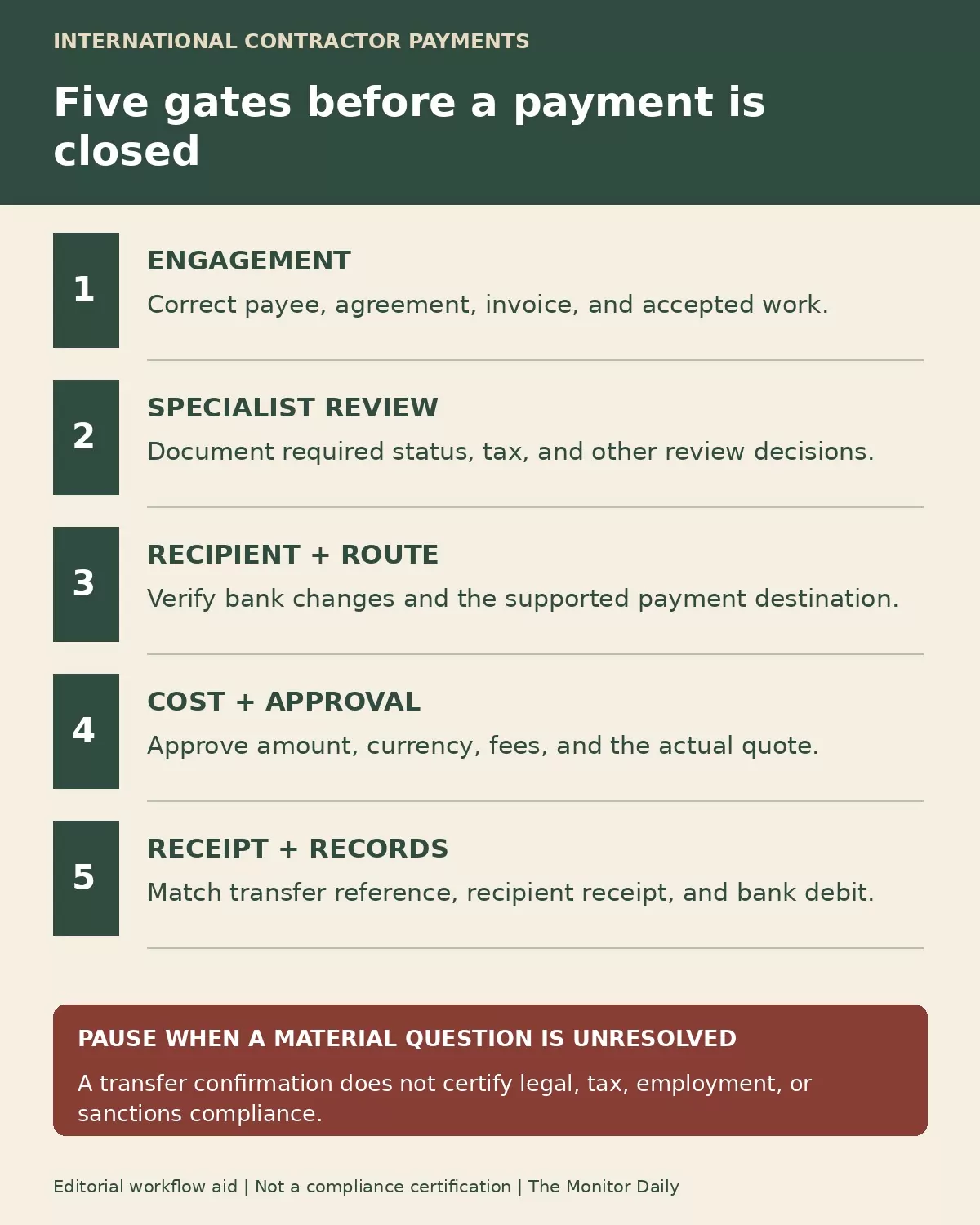
Use each gate to identify the evidence still missing. Pause for a substantive decision when the payee, review result, payment route, cost, or final receipt cannot be established.
7. Use a payment-release record with clear stop conditions
| Gate | Evidence in the payment file | Reason to pause |
|---|---|---|
| Engagement | Correct payee, agreement, deliverable, and acceptance. | The invoice names a different party or the work is disputed. |
| Specialist review | Documented status, tax, and other required review decisions. | A material question is unresolved or facts have changed. |
| Recipient and route | Verified destination and supported currency/payment method. | Unverified bank change or unsupported destination. |
| Cost and authorization | Approved amount, currency, quote, fees, and approver. | The actual funded or received amount conflicts with the agreement. |
| Completion | Transfer reference, status, receipt confirmation, and accounting match. | The transfer is pending, returned, or cannot be reconciled. |
The record does not have to be a complicated system. It can be a controlled vendor file linked to an invoice queue, provided people can identify the latest approved facts and unresolved exceptions. The important feature is that “ready to pay” has a defined meaning.
For a recurring engagement, avoid treating last month’s approval as permanent approval of every fact. Check the current invoice, any material changes, and the controls required for the current payment. Retain evidence of exceptions and who resolved them.
8. Reconcile the cost, the transfer, and the contractor’s receipt
Consider a hypothetical invoice of $1,200 payable in US dollars. Assume the business pays a separate $12 transfer fee, with no currency conversion or other charges in this simplified example. The business funds $1,212, while the intended contractor receipt is $1,200. This is arithmetic, not a provider quote or a statement about tax treatment.
If a later report shows the contractor received $1,185, investigate the $15 difference. It could reflect a deduction somewhere in the route or an incorrect assumption about the arrangement. Do not silently mark the invoice fully settled just because the sender’s account was debited.
Keep the invoice, approval, quote, bank debit, transfer reference, any returned amount, and receipt evidence linked. Record the service amount separately from payment charges so the accountant can apply the appropriate treatment. Where currencies differ, retain the actual rate and transaction information rather than reconstructing a rate from memory.
A pending transfer needs tracking, not an automatic second payment. Check its current saved status and the provider’s tracing process before trying again. If a payment is returned, reconcile the return and any unrecovered costs before deciding how to resend.
Pay international contractors through a repeatable verification workflow
To pay international contractors reliably, connect the engagement decision to the payment evidence. Identify the payee and work location, obtain the necessary qualified reviews, agree on the currency and cost allocation, verify the recipient, and reconcile the final receipt.
A transfer provider is one part of that workflow. A clear approval record and an exception process help the team recognize when it can proceed and when it needs to stop for a substantive decision. Review the arrangement when the worker, work location, contract, payment route, or relevant requirements change.