
Customer retention means keeping existing customers engaged, purchasing or subscribed over a defined period. Start by identifying which customers return, where relationships break down and who owns the next action. A useful retention system combines a clear measurement method, timely service and a workflow that stops inappropriate or duplicate messages.
For a small business, retention can mean a second purchase, a renewed service agreement or an active subscription. The right goal depends on the buying cycle: a weekly coffee order and an annual equipment purchase should not be judged by the same inactivity threshold.
How to measure customer retention
Choose a starting group and compare it with the same group at the end of the period. Customer retention rate is: retained customers from the starting group ÷ customers in the starting group × 100. Exclude newly acquired customers from the numerator. ChartMogul describes this cohort approach for subscription customers.
For example, a fictional business starts a quarter with 240 customers and 198 of that original group remain active at the end. Retention is 198 ÷ 240 × 100 = 82.5%. If it also wins 60 new customers, those customers belong in the acquisition report; they do not replace the 42 customers lost from the original cohort.
Define “active” before calculating. For a subscription, it might mean a paid subscription at the period end. For a retailer, it might mean a purchase within an appropriate lookback window. Specify whether a canceled and later reactivated customer counts as retained, and apply the same rule consistently.
Track revenue as well as customer count
For subscription businesses, gross revenue retention (GRR) measures recurring revenue kept from an existing group before expansion. Net revenue retention (NRR) also includes expansion. Using starting monthly recurring revenue (MRR), a simple movement-based calculation is:
- GRR = (starting MRR − contraction MRR − churn MRR) ÷ starting MRR × 100.
- NRR = (starting MRR + expansion MRR − contraction MRR − churn MRR) ÷ starting MRR × 100.
In this simplified example, assume no reactivations. With $20,000 starting MRR, $1,000 in downgrades, $2,000 in cancellations and $4,000 in expansion, GRR is 85% and NRR is 105%. Expansion can therefore conceal losses in the original revenue base. ChartMogul notes that calculation methods can differ, including how reactivations are treated; document your reporting rules and reconcile them with the billing system.
For a store without subscriptions, use repeat-purchase rate for a defined acquisition cohort alongside time between purchases and contribution margin. Do not call an infrequent purchaser lost until the chosen interval reflects how the product is normally bought. Compare cohorts at the same age: a one-month-old cohort has not had the same opportunity to return as a six-month-old cohort.
Find the point where customers need help
Map the customer journey from purchase or contract signing through onboarding, first value, support, renewal and possible return. At each stage, record the expected customer action, the evidence that it happened, a responsible owner and a sensible follow-up.
- Onboarding: Can the customer complete the first useful task, or are setup and instructions getting in the way?
- Usage or repeat purchase: Has the expected activity happened within the normal cycle for that segment?
- Support: Is an unresolved issue preventing the customer from using what they bought?
- Renewal or payment: Is a decision approaching, or did an attempted payment fail?
- Feedback: What reason did the customer give, and who will follow up on recurring problems?
These are prompts for investigation, not proof that an individual intends to leave. A customer may use a service less because a project ended, or may have purchased in another channel that has not yet synchronized. Check the record before acting.
A practical customer retention workflow
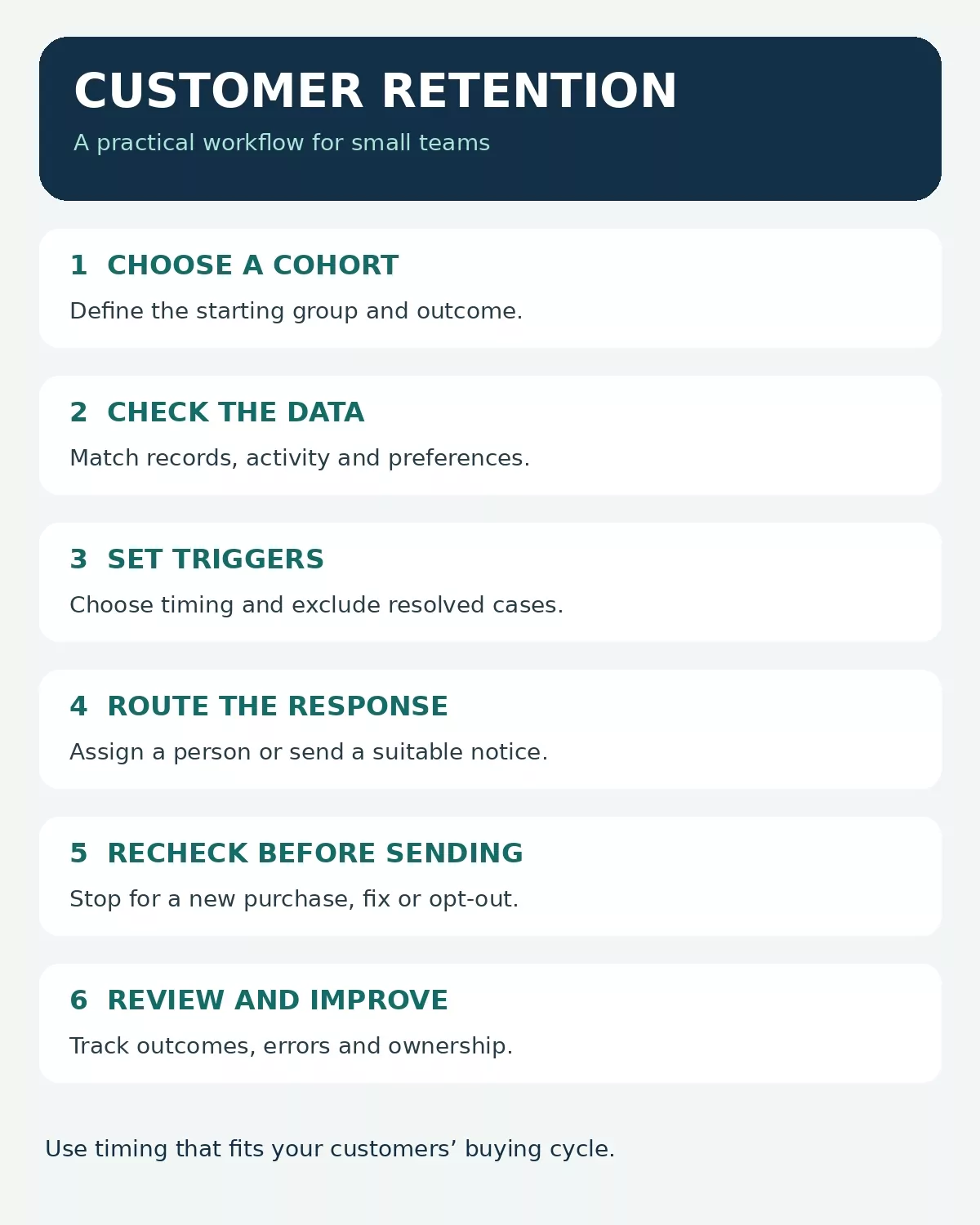
- Choose one group and one outcome. For example, focus on new subscribers reaching an onboarding milestone or first-time buyers returning within a product-appropriate window.
- Connect reliable data. Identify the authoritative customer ID, purchase or subscription status, last meaningful activity, open support issues and communication preferences. Decide how duplicates and delayed imports are handled.
- Set a trigger and exclusions. An illustrative rule might flag a new customer who has not completed setup after 14 days. Exclude accounts already completed, canceled, in an active support case or opted out of the proposed marketing channel. Adjust the timing after reviewing actual behavior.
- Route the right action. A setup problem may need a support task; an approaching renewal may need an account owner; a past-due payment may need a secure billing notice. Avoid offering a discount before understanding the issue.
- Recheck before sending. Confirm that a new purchase, resolution or opt-out has not arrived since the trigger. Record the result, owner and next review date; suppress repeat messages and provide a manual escalation route.
- Review results and exceptions. Compare eligible customers who received an intervention with an appropriate comparable group where feasible. Inspect delivery failures, duplicate tasks and complaints, not just clicks or short-term sales.
For an e-commerce win-back flow, Klaviyo recommends considering the normal purchase cycle and filtering out people who have placed another order since the flow began. Other sales channels need equivalent checks. A marketing automation cannot correct missing order data on its own.
Document the trigger, decision points and recovery instructions so another team member can maintain the process. This guide to documenting an automation workflow explains how to record owners, dependencies and safe recovery steps.
Tools for different retention jobs
Choose the smallest stack that covers the problem. The examples below are based on vendor documentation, not hands-on testing; features, integrations, prices and plan limits can change. Check the relevant contract, seat requirements and current documentation before buying.
| Tool | Potential use | What to check |
|---|---|---|
| HubSpot Service Hub | Organize customer-success work and build account health scores. | HubSpot lists its customer-success health score for Service Hub Professional and Enterprise, with a required service seat and permissions. A score reflects the rules and data you choose, not certainty about churn. |
| Klaviyo | Build post-purchase and win-back messaging for connected commerce data. | Confirm integrations cover all purchase channels, segment exclusions, message eligibility and the relevant plan. |
| Zendesk Support | Route support tickets and follow up on unresolved issues. | Zendesk distinguishes event-based ticket triggers from time-based automations. Check plan availability, ownership and escalation conditions. |
| Amplitude | Study product usage cohorts and return events. | Agree on the start event and return event. Amplitude distinguishes return on a specific day from return on or after that day; the measures answer different questions. |
| Stripe Billing | Manage supported subscription billing and payment-recovery workflows. | Stripe documents payment retry exceptions, including hard declines and unavailable payment methods. Verify your configuration, account eligibility and applicable charges. |
A shared spreadsheet can be enough for a small portfolio if one owner maintains it, access is controlled and the information is reconciled with the source systems. Move to dedicated software when the manual handoffs or data gaps create a real operational problem. Record the procedure using a standard operating procedure that names the backup owner and exception path.
Improve retention without relying on discounts
Start with service delivery. Make onboarding instructions specific, give customers a clear place to ask for help and review recurring support issues for a root cause. If customers cannot reach the promised outcome, more email may simply remind them of the problem.
Use feedback to decide what to investigate, not as a substitute for behavior. A short survey can reveal a reason for dissatisfaction, but nonrespondents may differ from respondents. Review cancellation reasons and support conversations with appropriate access controls, group similar issues and assign an owner to each significant issue.
Use incentives selectively. Calculate the discount, fulfillment and support costs against expected contribution, and compare repeat behavior with an appropriate baseline. A campaign that increases orders while eroding margin may not be a useful retention improvement. Treat any forecast as an estimate, not a guaranteed return.
Protect customer preferences and avoid workflow errors
Separate essential service notices from promotional messages according to their actual primary purpose. In the United States, the FTC’s CAN-SPAM guidance says commercial email, including business-to-business messages, must meet requirements such as accurate headers, a valid physical postal address, a clear opt-out and timely honoring of opt-out requests. Other laws, jurisdictions and channels can impose additional rules; obtain appropriate advice for your circumstances.
Give people a straightforward way to update preferences. Limit access to customer data, avoid placing unnecessary personal information in shared notes and test automations with safe sample records. If a payment fails, never ask a customer to send card details by ordinary email. Direct them to the provider’s secure update process and follow its documented retry rules.
Review the program every month
Bring the owner, support and marketing teams a short report: starting cohort, retained count, period and definition; renewal and recurring revenue where applicable; top reasons for departure; open exceptions; and the cost and outcome of interventions. Break down results only where the sample is large enough to interpret responsibly.
Choose one change for the next cycle, identify who will make it and agree on what evidence would justify continuing or stopping it. A clear owner, a reliable customer record and a useful response are often a better starting point than adding another dashboard.