

A customer pays a large invoice on Thursday. By Friday morning, the owner of a small print shop sees $18,000 available and wants to put some aside for a new cutter. The question is how much can leave checking before the payroll provider draws its money and the paper supplier’s bill comes due.
For a small team comparing business checking vs savings accounts, the payment calendar is a good place to start. Use checking to collect sales and pay bills. Use savings for cash the business can leave alone until a known date or an unexpected expense. The amount to move depends on when the business needs the money back.
Which transactions belong in each account?
Give customers one set of payment instructions and point the payroll provider, landlord, and recurring vendors to the operating account. That gives whoever pays bills one place to check upcoming withdrawals. The savings account serves a different reader of the books. An owner deciding whether to replace equipment can see how much has accumulated for that purchase.
| Cash or commitment | Usual home | What determines the timing? |
|---|---|---|
| Customer payments and card settlements | Checking | Count receipts once funds are available. |
| Wages, rent and supplier bills | Checking | Use the earliest debit or funding date. |
| Annual renewals and equipment purchases | Savings until needed | Move funds back before payment is initiated. |
| Cash for a slow season | Savings | Review the forecast before each planned draw. |
A single savings balance can cover several purposes. A short reserve schedule can show how much belongs to the insurance renewal, how much is earmarked for equipment, and how much is available for a slow month. If the shop has $9,000 in savings and $6,000 is already committed to insurance, the cutter budget has at most $3,000 available.
How much should stay in business checking?
Start with the available balance. List every payment due before the next dependable receipt, including checks already issued and automatic debits. Subtract each outstanding payment once. If a pending debit has already reduced the bank’s available balance, counting it again understates what the team can move. Leave a cushion based on the timing problems the business actually encounters.
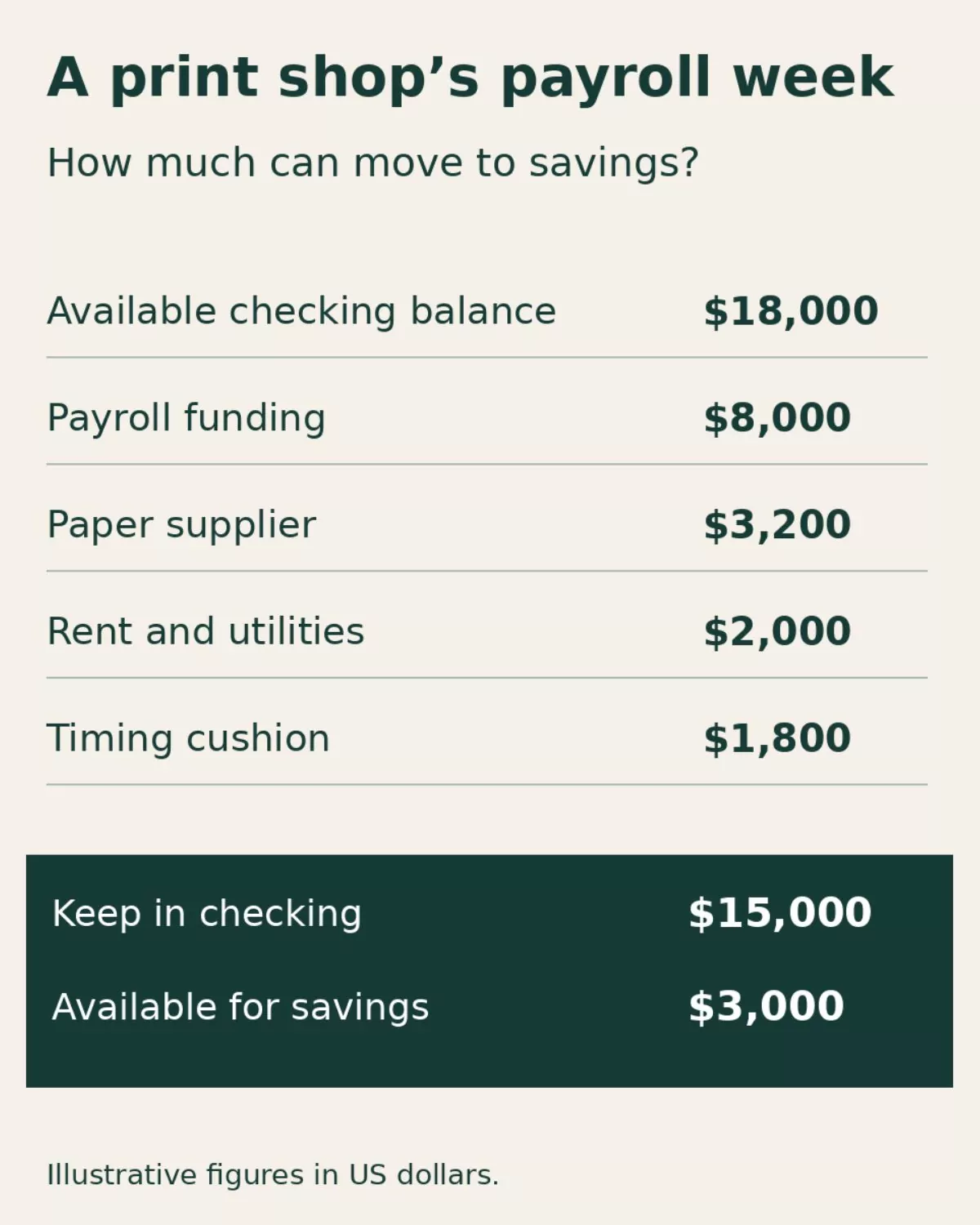
In the illustrative print shop, payroll needs $8,000, the paper supplier is due $3,200, and rent and utilities take another $2,000. The owner allows $1,800 for timing differences. Together, those amounts set a $15,000 checking floor. With $18,000 available, the shop can transfer $3,000 to savings.
One change can reverse the decision. Suppose the supplier asks for another $3,500 before releasing a rush order. The revised floor is $18,500. The owner now has a $500 gap to address before approving the order. Leaving the original $3,000 transfer on autopilot would make that gap larger.
Read the account terms against a normal month
Take a recent statement and count the transactions that matter to the team. A shop that deposits cash most afternoons should review cash-deposit allowances. An agency that pays freelancers in batches should look at electronic payment fees and approval controls. Compare the monthly charge, any balance needed to waive it, and the cost of the team’s actual activity. The Small Business Administration’s banking guidance is a starting point for that comparison.
For savings, check the annual percentage yield, the balance that qualifies for it, monthly fees and transfer terms. A higher yield is worth putting into dollars. At a constant balance of $10,000 for a year, an illustrative one-percentage-point difference in annual percentage yield amounts to $100 before fees. A $10 monthly fee would cost $120 over that same year.
The Federal Reserve removed the federal six-transfer limit from its savings-deposit definition in 2020. Banks could keep their own restrictions. Read the agreement for the specific business account and check which transfers count, what they cost, and when incoming funds become available. This matters especially if savings sits at a different institution from payroll checking.
Give the transfer a date and an owner
At the weekly bills review, have the person who prepares payments update the checking floor. Record the amount available for transfer, its purpose, and the next date the team expects to need it. Have someone with transfer authority review any exception, such as drawing on the slow-season reserve to fund a routine paper order.
Work backward from the payroll provider’s funding deadline. If employees get paid Friday but the provider draws on Wednesday, checking needs the money by Wednesday’s cutoff. For a transfer between banks, verify the sending cutoff and receiving bank’s availability terms, then put the transfer date on the calendar. Assign a backup for weeks when the usual approver is away.
At month-end, match each transfer out of one bank account to the corresponding deposit in the other. Moving the shop’s own $3,000 into savings changes where its cash sits. Recording the deposit as sales would count the customer’s payment twice. Record any bank interest or fees separately and reconcile both statements.
When a second account earns its keep
A team with little cash left after each payroll may get more value from a clear payment calendar than from opening a second fee-bearing account. Savings becomes more useful when cash regularly accumulates for a purpose that is easy to lose sight of in checking, such as a quarterly insurance bill or a winter slowdown.
For the print shop, the test comes the next time the cutter goes on sale. The owner can check the equipment reserve, confirm that the next payroll is funded, and make a purchase decision without reconstructing a month of transactions. That is the practical value of using business checking and savings together.