

Knowing how to read a business bank statement helps you identify incoming money, outgoing payments, fees and transactions that need a closer look. Work from the statement period to the ending balance, then compare each entry with your own records.
Use the bank’s official statement rather than an unexpected email attachment. This guide uses a fictional example and does not assume that every bank presents fields in the same order.
1. Check the account and statement period
Confirm the business name, the account’s masked number and the opening and closing dates. If you have more than one account, match the statement to the right ledger account. Check that the opening balance agrees with the previous statement’s closing balance. An unexpected gap or overlap can make a sound reconciliation look wrong.
2. Read the balance summary
The opening balance is the amount carried into the period. The closing balance reflects transactions the bank processed through the statement date. Available and current balances may differ because of holds or pending activity; ask the bank how its labels work before treating either figure as cash you can spend.
3. Review deposits and credits
Match each deposit to invoices, sales reports or other supporting records. A customer payment and an owner contribution are different kinds of receipts. A card processor’s deposit may be net of fees or refunds, so compare its settlement report with the individual sales records rather than treating the net deposit as one sale.
4. Review withdrawals and debits
Check the date, description and amount of each debit against invoices, payroll records, card receipts or transfer authorizations. Look for duplicate amounts, unfamiliar payees and payments that do not match the approved amount. A transaction description can be abbreviated; use a bank-provided reference to investigate before assuming it is fraudulent.
5. Examine fees, interest and adjustments
Identify service charges, interest, returned payments and corrections. Verify each item before recording it in the books. For an illustrative account with a $10,000 opening balance, $3,000 in deposits, $2,400 in payments and a $25 fee, the closing balance is $10,575. If the statement does not support that arithmetic, review the entries and ask the bank for clarification.
6. Reconcile the statement to your books
Match posted bank entries to the same period in your cash ledger. Investigate outstanding checks, deposits in transit, omitted fees and duplicate entries. Do not create an unexplained balancing entry to make the numbers agree. Our guide to bank statements and accounting ledgers shows a worked reconciliation.
The IRS guide to business recordkeeping discusses reconciling bank statements and maintaining supporting documents. Retention requirements depend on the records and circumstances; seek professional advice for your situation.
What to do with an unfamiliar entry
Preserve the statement and supporting details, check whether another authorized user recognizes the payment and contact the bank promptly through a verified channel. Review your account agreement for notice deadlines and follow the bank’s dispute process. Consumer-account protections should not be assumed to apply identically to a business account.
How to read a business bank statement: a line-by-line example
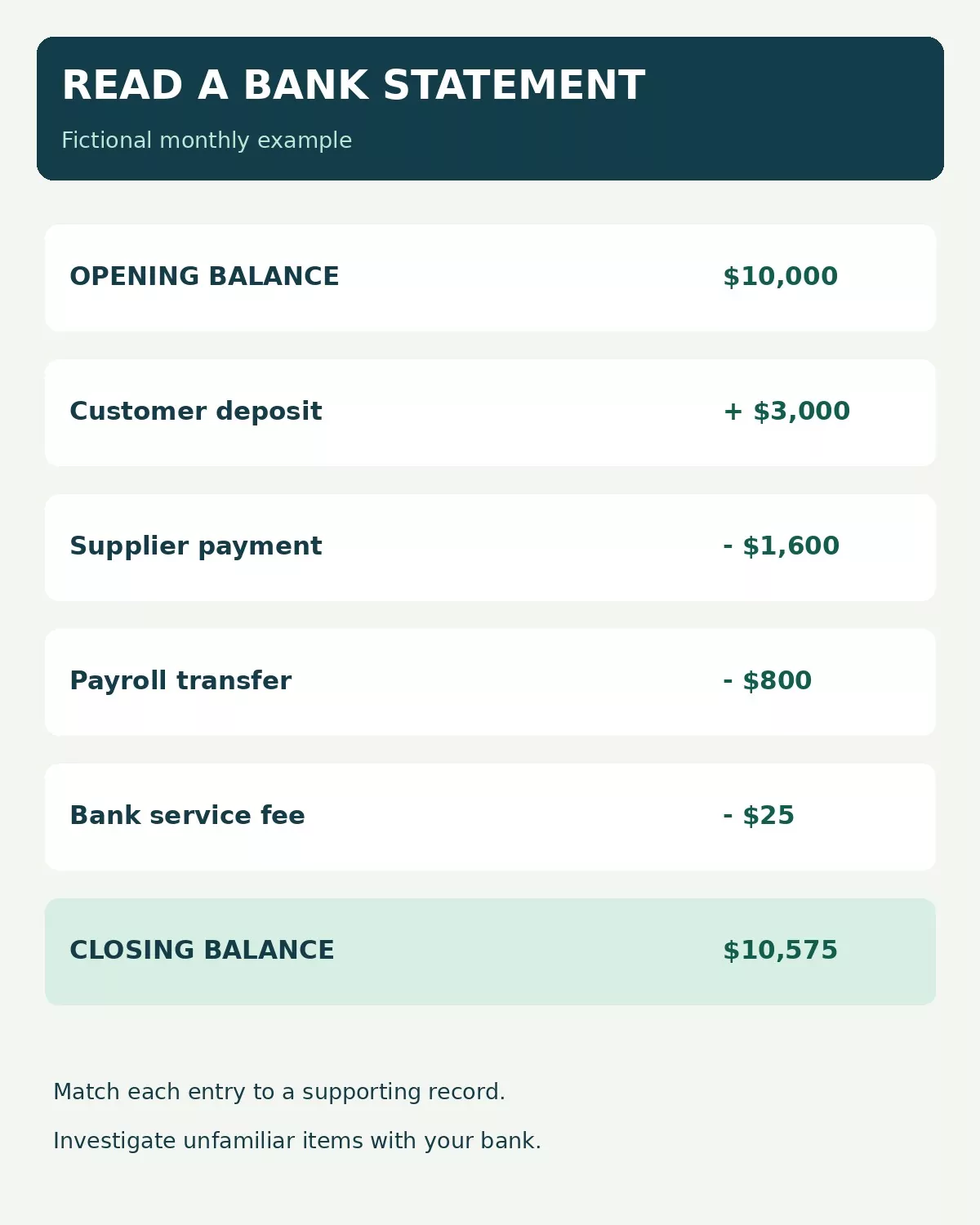
Consider a fictional design studio with a $10,000 opening balance. Its statement shows a $3,000 customer deposit, a $1,600 supplier payment, an $800 payroll transfer and a $25 service fee. Each entry tells a different story: the deposit should be traced to the customer remittance, the supplier payment to an approved bill, and the payroll transfer to the payroll register. The fee should be checked against the bank’s schedule and recorded if valid.
| Statement line | Amount | What to check |
|---|---|---|
| Opening balance | $10,000 | Agrees with the prior closing statement. |
| Customer deposit | +$3,000 | Match the payer and invoice or remittance. |
| Supplier payment | −$1,600 | Match the approved invoice and recipient. |
| Payroll transfer | −$800 | Compare with the payroll register. |
| Service fee | −$25 | Confirm against the account terms. |
| Closing balance | $10,575 | Recalculate and reconcile with the ledger. |
This example does not include pending transactions. A payment initiated on the last day of the month may not appear until the following statement. Keep a separate list of verified outstanding items and check that they clear; do not simply assume they have.
Understand dates, descriptions and transaction references
The date you authorized a payment, the date the bank posted it and the date you entered it in your ledger can differ. When matching, start with the amount and recipient, then examine the dates and transaction reference. A one-day difference may be ordinary processing; an unfamiliar recipient or a duplicate payment needs investigation.
Descriptions may show a processor or merchant identifier instead of the name on a receipt. Use the bank’s transaction detail screen, your card receipts and the relevant settlement report to identify the item. Do not follow a link in an unexpected message asking you to log in. Use your bank’s established app or a verified phone number instead.
Review recurring charges and returned payments
Compare subscriptions and service fees with the agreed terms. Note the owner responsible for each recurring charge, the renewal date and the process for cancellation. A legitimate charge can still reveal an unused service or a pricing change. Separately, investigate a returned deposit or reversed payment: the customer’s invoice may need to remain open or be reopened after the correct accounting treatment is confirmed.
Keep a short exception log with the statement date, amount, issue, owner, next action and resolution date. Avoid storing full account numbers or login details in the log. For an unidentified debit, preserve the evidence and contact the bank promptly; business-account notice rules and the contractual process may differ from consumer protections.
A worked reconciliation: why two balances can differ
The closing bank balance and the cash balance in your books do not always match on the statement date. Timing differences are not automatically errors. Suppose the same fictional studio’s statement closes at $10,575. Its books already include a $900 deposit that the bank has not yet credited and a $400 check that has not cleared. To reconcile the bank side, add the deposit in transit and subtract the outstanding check: $10,575 + $900 − $400 = $11,075.
Now suppose the book balance is $11,100 because the $25 bank service fee has not been recorded. After verifying the fee and recording it, the adjusted book balance is $11,075. Both adjusted balances agree. This is an illustration, not a substitute for checking your own records; avoid recording the outstanding check a second time if it is already in the books.
If the adjusted balances still differ, revisit the prior reconciliation, look for entries dated outside the period, compare amounts digit by digit and check whether an item was duplicated. A match in total is useful but does not prove that every underlying transaction is legitimate. Keep the unresolved difference visible and assign a person and follow-up date.
What a statement can and cannot tell you
A statement is a record of account activity, not a complete profit-and-loss report. A deposit may include a loan, an owner contribution or a transfer between accounts rather than revenue. Likewise, a loan payment may include principal and interest, while a transfer to savings moves cash without necessarily creating an expense. Use the underlying documentation and your accounting method to classify each item; ask your accountant when the treatment is unclear.
A statement also may not show open invoices, unpaid bills or all activity initiated near the closing date. Compare it with accounts receivable, accounts payable and the cash ledger before making a cash-flow decision. If you use a payment processor, reconcile gross sales, refunds and fees to the net settlement rather than assuming the deposit equals total revenue.
A practical month-end handoff
Save the original statement securely and use a working copy for review. Mark matched entries, retain the supporting invoice or settlement record, and list unmatched transactions separately. Record who investigated each exception, the evidence reviewed and whether the bank or the business needs to take the next step. Limit access to people whose work requires it, and avoid copying full account numbers into a general-purpose tracking file.
Before closing the month, have an authorized reviewer check the reconciliation, any manual corrections and outstanding items where practical. On the next statement, confirm that deposits in transit and outstanding checks actually clear; an old unresolved item deserves investigation rather than indefinite rollover.
Make the monthly review repeatable
Have the preparer match transactions and assemble supporting records, then have another authorized person review unusual items where practical. If the owner performs the review alone, arrange periodic independent review with a bookkeeper or accountant. Save the statement, reconciliation and exception log securely, and follow your actual retention obligations.
Finally, track unresolved items into the next period. Mark an item complete only after you have confirmed the explanation or correction. This gives the team an audit trail and makes the next monthly review faster without hiding a problem.
Read a business bank statement from beginning balance to ending balance, but give each unexplained entry an owner and a follow-up date. A short, consistent review is more useful than a reconciliation that hides unresolved differences.