

Two Mercury notices show what a business bank account closure means for a US LLC run from overseas. Editorialge Media LLC, led by Bangladesh-based founder Sukanta Kundu, received confirmation that its account had already closed. Tech Unico Solutions LLC, led by India-based founder Aushnik Das, received a different notice: its lack of US operations would lead to closure, with funds to be withdrawn by December 4, 2026. The documents point to different immediate tasks—recovering access to remaining funds in one case and arranging a controlled exit in the other.
The redacted notices below are the starting point for this analysis. They show the companies named, the dates displayed, the account decisions and the instructions for remaining funds. They do not disclose the companies’ balances or establish any measured revenue loss. Later cash-flow calculations are explicitly hypothetical.
Mercury is a fintech company, not a bank; its banking services are provided through partner banks. Losing that arrangement does not dissolve the LLC. It does force management to resolve how the business will receive customer payments, meet obligations and recover any remaining balance.
Case Study 1: Editorialge Media LLC’s Account Was Already Closed
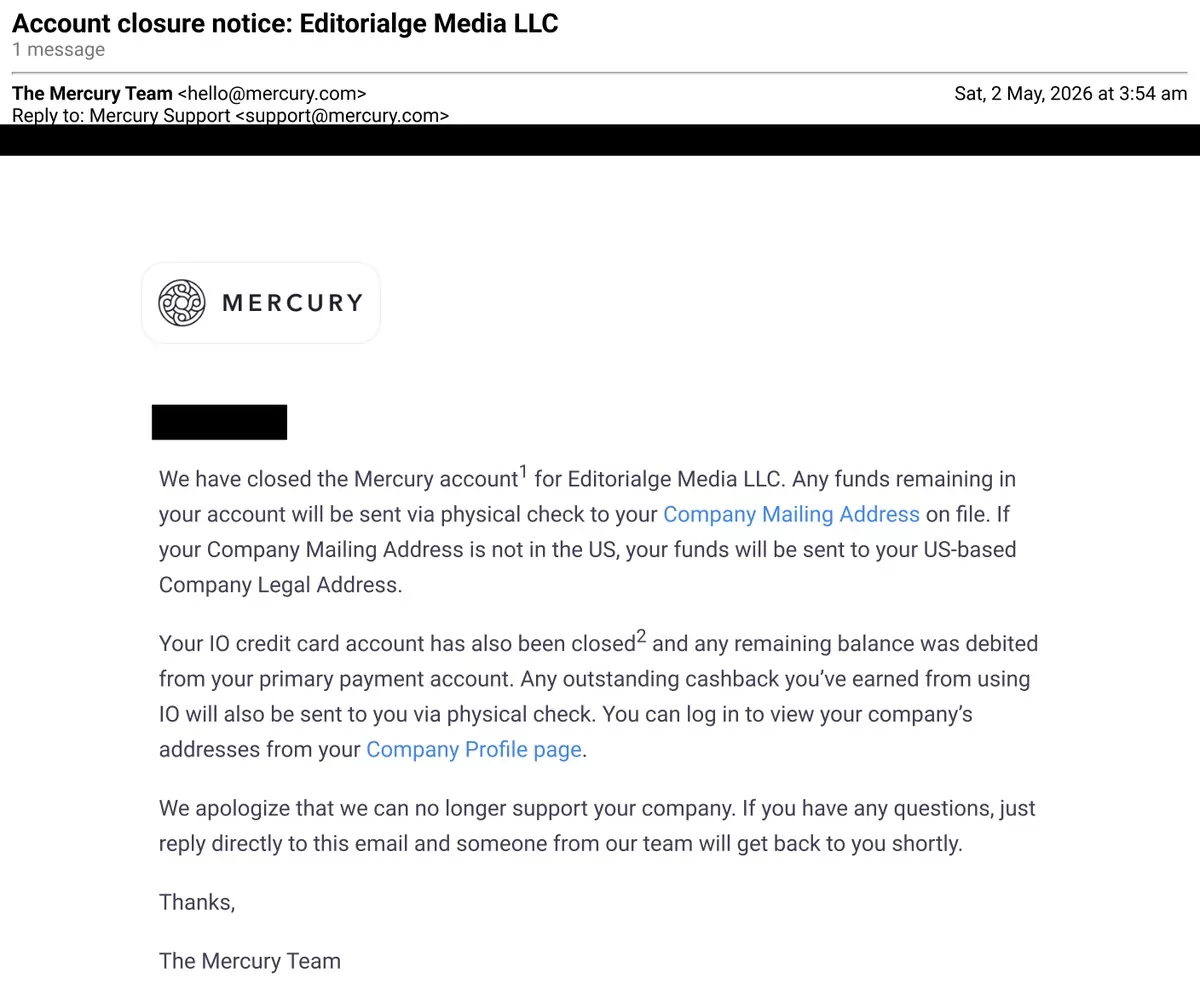
Sukanta Kundu, founder and CEO of Editorialge Media LLC, is a Bangladeshi entrepreneur living in Bangladesh. He reports that normal account operations became unavailable around the beginning of May 2026. The supplied Gmail notice displays May 2, 2026 and names Editorialge Media LLC.
The opening statement is direct:
“We have closed the Mercury account”
The next instruction explains how any remaining funds would be returned: by physical check to the company mailing address on file, or to its US-based legal address if the mailing address was outside the United States. The notice also says the IO credit card account was closed, describes handling the remaining card balance and says outstanding cashback would be sent by check.
What the Document Proves About the Closure
The notice confirms a closure that had already taken place. It does not give a future withdrawal deadline or state why Mercury closed the account. Kundu attributes the problem to the restriction affecting Bangladesh residents. That is his explanation, rather than a reason quoted from this email.
Mercury’s published “Prohibited countries” policy, rechecked on November 12, 2026, lists Bangladesh and explains that the restriction concerns residence rather than citizenship. This is relevant policy context, but it does not replace the missing case-specific explanation in the closure notice.
The Business Problem Is Receiving and Using the Returned Funds
The check instruction makes the next task concrete. Management needs to establish whether a check was issued, the destination used, who can receive it and where the company can permissibly deposit it. A replacement service that accepts electronic transfers but not checks may restore future collections without resolving the old balance.
The card closure creates another item to investigate: whether any essential subscriptions or suppliers were using that card. The notice establishes that the card account closed; it does not establish that any particular payment failed. A payment-method review is therefore a recommended response, not a claim about losses the company suffered.
Neither the notice nor the information supplied for this article confirms the amount returned, a check-clearing date or the final recovery outcome. Those remain matters to verify before treating the funds as available cash.
Case Study 2: Tech Unico Solutions LLC Received a Defined Exit Window
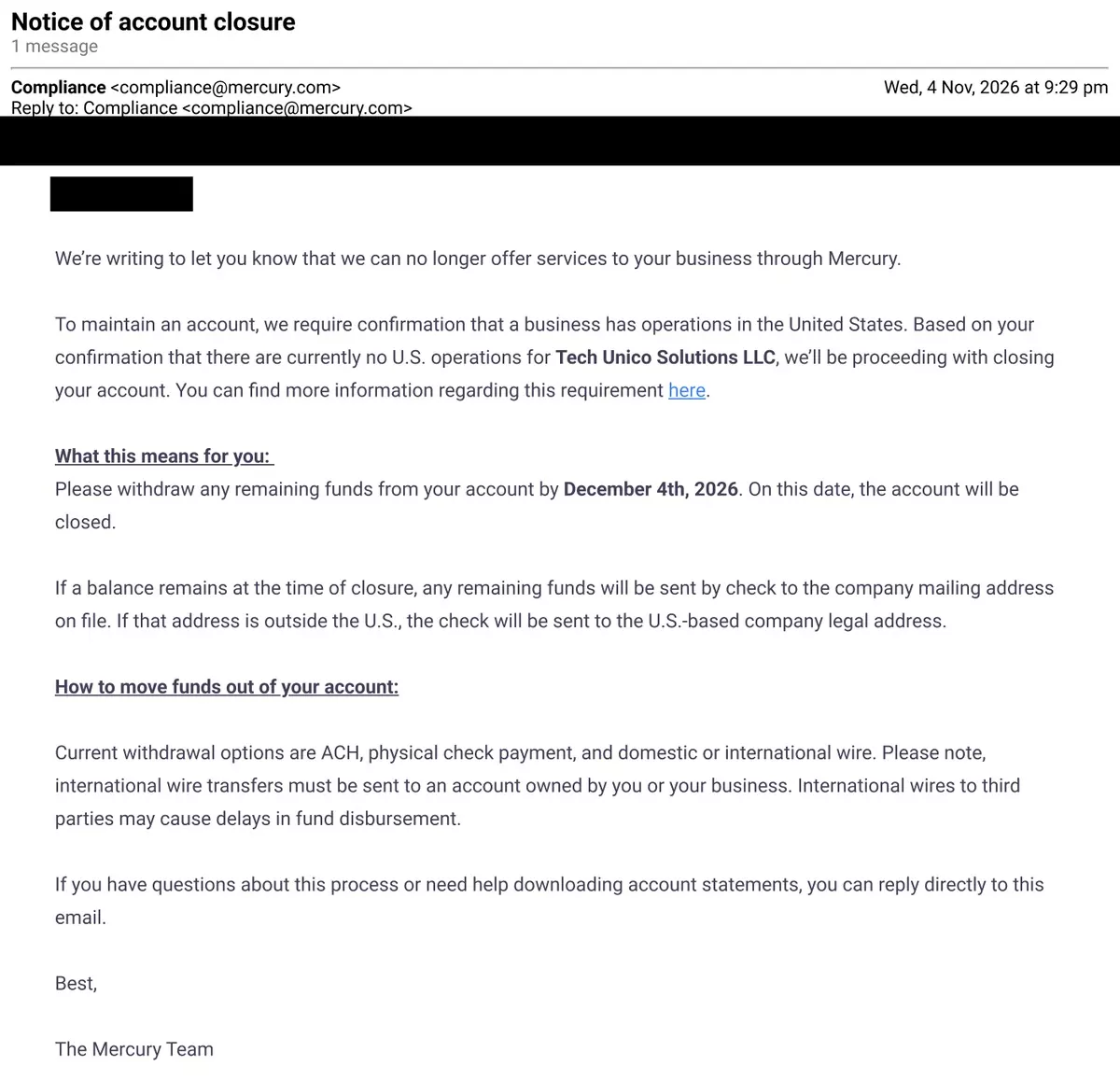
Aushnik Das, founder and CEO of Tech Unico Solutions LLC, is an Indian entrepreneur living in India. The supplied notice is dated November 4, 2026. Unlike the Editorialge notice, it states a reason for the decision, referring to the company’s confirmation that:
“there are currently no U.S. operations for Tech Unico Solutions LLC”
It then instructs the company to withdraw remaining funds by December 4, 2026, when the account is to close. The date in the document is December 4, not December 24.
The Stated Reason Is US Operations, Not Indian Citizenship
The notice identifies the absence of US operations. It does not say that Indian nationality caused the decision. India is absent from Mercury’s prohibited-country list reviewed for this article. The company-specific notice is therefore the most useful starting point for understanding this case.
“No US operations” should also not be silently changed to “no rented US office.” Mercury’s general eligibility guidance refers to existing or planned US operations and separately explains its address requirements. What the company can truthfully document matters more than purchasing an address that merely appears American.
The Withdrawal Instructions Shape the Migration Plan
The notice lists ACH, physical check and domestic or international wire as withdrawal options. It says international wires must go to an account owned by the recipient or their business, and warns that wires to third parties may delay disbursement. If money remains at closure, the notice describes a check sent to the company mailing address, or its US legal address when the mailing address is outside the US.
For management, that means checking a receiving destination against the notice’s ownership instructions and the receiving provider’s rules before initiating a transfer. Opening an account somewhere is not sufficient if it cannot accept the relevant company funds or payment method.
The document provides a date around which to plan. It does not confirm that a replacement account has been approved or that a withdrawal has completed. Preparation should cover pending customer payments, processor payouts, essential outgoing payments and account records before the stated deadline.
Read the Two Notices Side by Side
| Evidence point | Editorialge Media LLC | Tech Unico Solutions LLC |
|---|---|---|
| Date displayed | May 2, 2026 | November 4, 2026 |
| Status described | Account already closed | Closure announced for December 4, 2026 |
| Reason stated in this notice | Not stated; Bangladesh restriction is the founder’s explanation and separate policy context | No current US operations, based on the company’s confirmation |
| Remaining-funds instructions | Physical check to the company mailing address, or US legal address where applicable | Withdraw through listed channels before the deadline; residual funds to be returned by check |
| First management task | Trace any check and establish a permitted way to receive and clear it | Verify a receiving route and organize the exit before the stated deadline |
| Not established by the evidence | Balance amount, exact closure rationale or completed recovery | Approved replacement account, completed withdrawal or closure caused by nationality |
Evidence and disclosure: The reproduced images are excerpts from founder-supplied Gmail PDF notices, also used in Editorialge’s published “US LLC Banking After Account Closure” report. Editorialge Media LLC is that publication’s company. Personal names and recipient email addresses are masked in the images; company names, dates and substantive wording are retained. The notices have not been independently authenticated through Mercury’s systems. No provider interview, successful replacement application or actual company cash-flow figures are claimed.
The cases explain why the business response must begin with the notice. Editorialge’s documented issue is an already-closed account with check-return instructions. Tech Unico’s is a stated eligibility problem with an exit deadline. The operating framework below follows from those differences; it is not evidence that both companies suffered the same financial outcome.
Business Bank Account Closure Is a Liquidity Problem First
The balance in the accounting system is not the same as money available for tomorrow’s obligations. A company may have cash awaiting return, unsettled processor proceeds, collectible invoices and usable funds in another approved account. Combining them into one reassuring total hides the immediate risk.
Prepare a short cash-position report with four separate lines:
- Funds currently accessible for permitted business payments.
- Funds unavailable pending a transfer, check, review or other resolution.
- Receipts expected from customers or processors, with a realistic arrival date.
- Committed payments, their due dates and the consequences of delay.
Do not count an expected check as available cash until the business has a workable, permitted way to receive and clear it. Similarly, an approved customer card payment is not proof that the payout can reach the company’s new account.
A $50,000 Balance Can Leave Just 12 Days of Flexibility
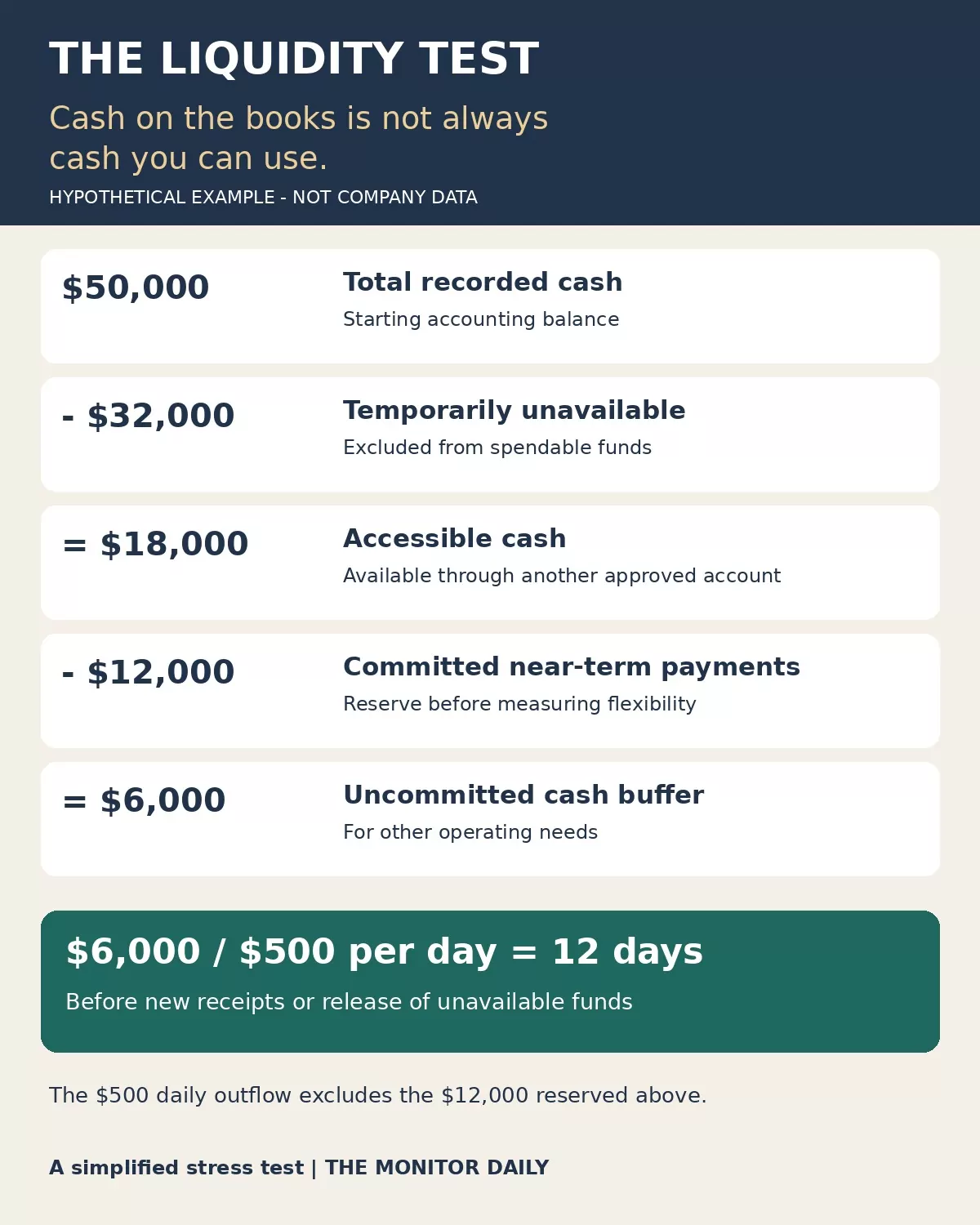
Consider a hypothetical company with the following position. The figures illustrate a stress test; they are not provider forecasts or a forecast for the two companies discussed above.
| Item | Illustrative amount | Treatment in the short-term plan |
|---|---|---|
| Total recorded cash | $50,000 | Starting accounting figure |
| Cash temporarily unavailable | $32,000 | Excluded from available liquidity |
| Cash accessible elsewhere | $18,000 | Available starting balance |
| Near-term committed payments | $12,000 | Set aside before measuring flexibility |
| Uncommitted cash remaining | $6,000 | Buffer for other operating needs |
| Other daily cash outflow | $500 | Excludes the $12,000 already reserved |
Without new receipts or release of the unavailable funds, the $6,000 buffer covers 12 days of those other outflows. Dividing the full $50,000 by $500 would give 100 days and a dangerously misleading impression. This is a simplified flexibility measure, not a substitute for a dated cash forecast.
For an operational response, forecast daily movements over the next two weeks and weekly movements over the following quarter. Use separate scenarios for an on-time transfer, a delayed release and no release during the planning period. These are planning choices, not assumed closure timelines.
Map the Payment Chain Before Buying Another Product
A business often says it needs “another bank” when the broken part may be more specific. The checkout may work while payouts fail. Invoices may still be issued with obsolete details. Outgoing supplier payments may be the only immediately blocked function.
| Business function | Evidence it still works | Failure to investigate |
|---|---|---|
| Customer checkout | Permitted payment accepted and correctly recorded | Confusing authorization with usable cash |
| Processor payout | Funds arrive in an approved account in the right company name | Payout sent to obsolete or incompatible details |
| Invoice collection | Customer has verified beneficiary details and payment instructions | Payment returned or sent to the old destination |
| Operating payments | Payroll, suppliers and essential services can be paid through permitted channels | Assuming a receiving-only product supports outgoing payments |
| Refunds and reconciliation | Staff can process permitted refunds and match transactions to records | Breaking the audit trail during migration |
Our explanation of payment gateways and payment processors separates the collection functions. During an account closure, the practical lesson is to test the whole route from customer payment to spendable company funds.
Restoring card checkout alone may not satisfy B2B customers who pay invoices by bank transfer. Conversely, new receiving details may not support the refunds, recurring charges or outgoing payments the business needs. Ask each provider about the exact job, rather than treating every account as interchangeable.
The First 48 Hours: Establish Control, Not a New Fiction
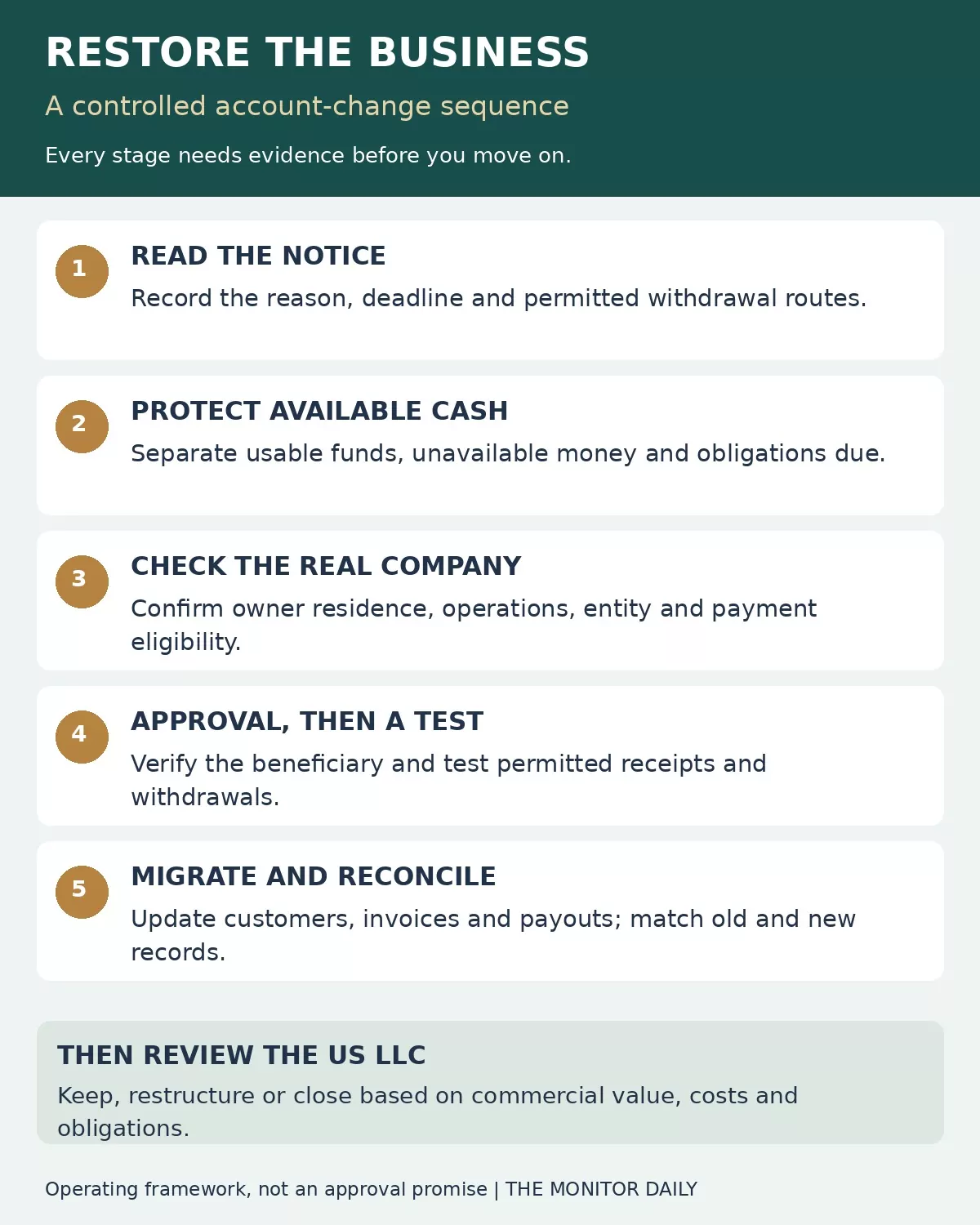
Use the notice’s actual deadline to set the pace. A 48-hour internal response target is a suggested operating discipline; it does not replace a provider’s instructions or promise that another institution can onboard the business that quickly.
| Workstream | Suggested owner | Concrete output |
|---|---|---|
| Notice and account records | Founder or finance lead | Verified reason, deadline, balances and permitted withdrawal routes |
| Liquidity and obligations | Finance or bookkeeping | Dated cash forecast and list of imminent payments |
| Collections and customers | Accounts receivable or operations | Open invoices and customers needing updated instructions |
| Replacement assessment | Authorized company representative | Accurate company file and provider-specific eligibility questions |
| Tax and entity obligations | Qualified adviser with management | Obligations that continue regardless of account status |
In a small company, one person may own several workstreams. Write the responsibilities down anyway. Otherwise, the founder can spend days completing applications while an essential vendor continues charging a closed payment method.
Preserve statements and correspondence while access remains available. Check where any residual-balance check will be sent and whether that address can actually receive it. If depositing the check is a problem, ask about permitted alternatives before treating the balance as recovered.
Do not invent US employees, premises or operations to improve an application. The address that receives legal correspondence is not automatically where the company conducts business. Inaccurate onboarding information creates another failure point.
India and Bangladesh Require Different Eligibility Screens
For an India-resident founder, the Tech Unico case puts operating presence at the center of the review. Mercury’s general guidance allows nonresident founders to apply, but requires existing or planned US operations. Its principal business address can be in the US or internationally, including a residential address; registered-agent and mailbox addresses do not meet that principal-address requirement.
That policy should not be paraphrased as a universal obligation to rent a US office. The meaningful question is what the company actually does and whether the provider accepts the evidence. A purchased address does not establish an operating business.
For a Bangladesh-resident founder, Mercury’s residence restriction is an additional barrier. A US certificate of formation does not change where the beneficial owner lives. Screening only the company’s incorporation country misses that distinction.
Neither an EIN nor an ITIN should be treated as a banking access pass. Keep tax identification, entity registration, beneficial ownership and service eligibility as separate checks.
A Shortlist Is an Investigation Queue
The following routes deserve different levels of attention. “Investigate” means resolve the stated conditions; it does not mean the account will be approved or opened quickly.
| Route | Business reason to investigate | Condition that can stop the plan |
|---|---|---|
| Relay | Possible business-account route; India and Bangladesh are absent from its published prohibited-country list | Separate US operating-presence and address requirements must be resolved |
| Airwallex | International business payments for an eligible US company | US principal-place-of-business rules, owner-residence screening and application review |
| Payoneer | Approved commercial collections where a full bank replacement is not essential | Exact corporate profile, incoming payment types and withdrawal destination need approval |
| Direct corporate-bank application | A documented banking relationship and the services the company actually needs | Nonresident-owner eligibility, business footprint, documentation and payment-rail availability |
| Wise USD details | Only where the exact company and owner profile meet the requirements | Published Bangladesh-address restrictions make it unsuitable as an assumed replacement for that profile |
| nsave Business | A specialized payroll inquiry where the business genuinely fits | General business applications are paused; payroll has separate fees and activity conditions |
Relay’s address guidance and entity-document checklist need to be read together. The ability to provide an international residential address in one context does not remove every US-presence requirement.
Airwallex’s US guidance generally requires a genuine US principal place of business. It identifies exceptions allowing a registered-agent address for businesses selling goods online and businesses incorporated within the previous year. These exceptions do not extend to virtual mailboxes or remove other onboarding checks. Airwallex also says it cannot confirm eligibility before an application.
For Payoneer, judge the approved receiving and withdrawal functions rather than assuming the product duplicates a bank account. For nsave, personal availability in a country does not establish acceptance of a US LLC; its published reopening references are inconsistent, so a rescue plan should not depend on a predicted reopening date.
If a bank advertises corporate accounts, ask specifically about a US LLC whose owners reside in India or Bangladesh. Personal-account testimonials and broad “international customer” marketing do not answer that question.
Buy Continuity, Not Just a Low Monthly Fee
Start with pass-or-fail eligibility. Only compare cost and convenience after the provider accepts the actual entity, ownership, residence and business activity. A product that fails a mandatory requirement cannot make up for it with a high score for design or low fees.
For surviving candidates, request evidence of five capabilities: receiving the required payment type, making essential outgoing payments, integrating with existing processors, exporting usable records and escalating a payout problem.
Compare cost against the company’s own transaction mix. A business converting most receipts into BDT or INR may care more about the conversion spread than a subscription fee. A company retaining dollars for US expenses may have a different cost profile.
| Hypothetical monthly comparison | Option A | Option B |
|---|---|---|
| Amount converted | $30,000 | $30,000 |
| Illustrative conversion cost | 1.8% = $540 | 0.7% = $210 |
| Monthly account fee | $0 | $40 |
| Combined modeled cost | $540 | $250 |
In this invented example, the paid account costs $290 less for the modeled month. These are not quotes from named providers. Collection, wire, withdrawal and intermediary charges are excluded and would need to be added for a real comparison. Use the same conversion benchmark and timing for both quotes.
Migration also consumes staff time. Include reconciliation work, customer communication, integration changes and any necessary professional advice. A cheap account that cannot receive the company’s principal payment method can be more expensive than an apparently costly account that fits.
A Second App Is Not Automatically a Backup
Ask which institution holds the money, which service controls access and what happens if that service becomes unavailable. Two interfaces can still leave the company dependent on the same underlying relationship or the same eligibility restriction.
The FDIC’s guidance on third-party banking apps explains that nonbank companies themselves are not FDIC-insured. Potential pass-through coverage depends on how funds are deposited and other conditions; it does not insure the nonbank company against failure. Deposit protection and uninterrupted access are different questions.
For continuity planning, a backup should be approved, usable for the necessary transactions and tested. Keep its company information current. Confirm any ongoing activity requirements and avoid assuming that an unused account will remain ready indefinitely.
Where feasible, hold an appropriate operating buffer in another approved arrangement, based on actual obligations and risk. There is no universal percentage that makes every company safe. Moving money to an ineligible account or an unrelated person is not diversification.
Move Customers Through a Controlled Changeover
Replace payment instructions in stages. First verify the company name, currency, receiving details and supported payment type. Then make a small permitted test and check that the money can be used as intended. A successful login is not an end-to-end test.
Maintain a migration register for open invoices: customer, invoice number, amount, old instructions, new instructions, confirmation date and payment status. Record returned payments separately so staff do not mistake a failed transfer for an unpaid invoice that needs a second collection attempt.
For a customer’s bank-detail change approval, use an established contact channel. An unexpected email with new account details can resemble invoice fraud. Give customers a way to confirm the change without relying solely on the new message.
Update invoice templates, payment links, processor payout settings and supplier payment methods. For a practical starting point on invoice fields and payment instructions, see how to write an invoice that gets paid.
Reconcile the old account’s final activity to the new account’s receipts. Keep refunds, disputes and historical records in view even after new collections work. Closing the old relationship does not erase transactions that still need administrative attention.
Does the US LLC Still Earn Its Keep?
An account closure can expose a weak business assumption: the entity was created mainly to obtain a payment product, and the product is no longer available. That is a reason to reassess the structure, not a reason to abandon it without examining its obligations.
Separate the value of the company from the value of one provider. A US entity may support important customer contracts, ownership of assets or a genuine expansion plan. Those benefits can survive a banking disruption. Other companies may find that their commercial activity no longer justifies the administration.
Use an annual decision worksheet rather than comparing this week’s frustration with the original formation fee.
| Decision input | What to measure |
|---|---|
| Commercial contribution | Profit contribution from business that genuinely depends on the US entity—not all company revenue |
| Recurring entity costs | Applicable state charges, registered-agent costs, tax preparation and recordkeeping |
| Payment costs | Account fees, transaction charges, conversion costs and reconciliation time |
| Continuity costs | Maintaining a tested backup and responding to disruptions |
| Change costs | Contract transfer, customer approvals, advice and any orderly wind-down costs |
Management can compare continued operation, a revised structure and closure using the same assumptions. A lower-cost structure is not automatically viable if contracts or payment eligibility cannot move with it.
Our LLC versus sole proprietorship comparison explains general structural differences. It is not a conclusion that an overseas founder can replace a US LLC with a US sole proprietorship or avoid local obligations. Cross-border restructuring needs advice relevant to the actual countries and entity.
No Bank Account Does Not Mean No Filing Obligations
Foreign-owned US entities can have information-reporting obligations separate from whether an account is open or income tax is due. The IRS instructions for Form 5472 describe reporting rules for covered entities and reportable related-party transactions, including special treatment for foreign-owned US disregarded entities.
Owner contributions, distributions and transactions associated with formation or dissolution may matter in that assessment. Do not infer that a quiet or closing company has nothing to report. The applicable return and filing method depend on the entity’s tax classification and transactions; this is a question for a qualified adviser, not a universal filing checklist.
If closure is the decision, plan it as a project with records, final obligations and responsibility for remaining funds. The IRS business-closing guide covers federal steps and reminds owners to check state responsibilities. An empty bank account does not complete that process.
Measure Recovery by What the Business Can Do
A business bank account closure is not resolved merely because another dashboard is available. Recovery means the company can receive customer payments, access the funds, meet obligations and reconcile the records through an approved arrangement.
Track those outcomes in a short management review: usable cash today, obligations due next, receipts still exposed to old instructions and unresolved onboarding conditions. Once operations stabilize, review whether the company’s structure and backup arrangements remain commercially sensible.
The India and Bangladesh cases show why generic lists of “easy accounts” fall short. The practical route begins with the actual closure reason and ends with a payment system that works for the actual business. Between those points, disciplined cash management can matter as much as finding a new provider.
Source: Editorialge