
Corporate spend management platforms help finance teams see and control purchases before and after money leaves the business. For a scaling enterprise, the right choice depends on where spending happens: Ramp and Brex are natural starting points for card-led workflows, while Coupa and Ivalua address broader procurement. SAP Concur is worth examining when travel and employee expenses are central.
Cards, purchase orders, supplier invoices and reimbursements create different control problems. A platform that handles one well does not automatically cover the others. The comparison below helps finance and procurement teams choose a shortlist and evaluate it against their actual workflows.
How We Selected These Corporate Spend Management Platforms
We reviewed current supplier descriptions and public product information on November 11, 2026. This is a research-based selection, not a hands-on test or a measured ranking. The numbered order helps navigation; “best for” describes a potential fit, not an independently proven winner. Product availability, contracts and eligibility vary by market and legal entity.
Compare the Platforms at a Glance
| Platform | Useful starting point | Key question |
|---|---|---|
| Ramp | Card and expense controls | Coverage beyond cards? |
| Brex | Cards for distributed teams | Entity eligibility? |
| SAP Concur | Travel and expense | Which modules are included? |
| Coupa | Procurement and invoices | Implementation ownership? |
| Paylocity for Finance (Airbase) | Procure-to-pay and HR context | Which finance tools are included? |
| Payhawk | Multi-entity spending | Which entities can use cards? |
| Spendesk | Connected European spend | Availability outside Europe? |
| Pleo | European employee spending | Where is the service available? |
| Ivalua | Source-to-pay processes | What modules are required? |
| Procurify | Purchasing approvals | Does the ERP sync fit? |
1. Ramp
Best for: Card-led control for growing US businesses.
Ramp combines corporate cards, expense workflows and finance controls. Its enterprise offering emphasizes visibility across entities and currencies. It is a useful starting point when card transactions and employee purchases are the immediate source of fragmented records.
What to consider: An illustrative pilot can follow a software subscription from request through card authorization and accounting reconciliation. Confirm which controls apply to the selected card and plan, and how non-card invoices enter the same reporting view. Companies with complex sourcing and supplier-contract processes should compare a procurement suite as well.
2. Brex
Best for: Cards and expenses across distributed teams.
Brex offers corporate cards, expense management and accounting-related tools. Teams operating across entities can examine how employee spending and policy controls fit their structure. Its global positioning makes it relevant to companies with cross-border employees, though individual services and eligibility vary by country.
What to consider: Test a real expense across two entities: determine the card issuer and currency, approval owner, reimbursement method and accounting treatment. Compare the cost of foreign exchange, implementation and support within the actual agreement; broad country coverage does not mean every product is available to every legal entity.
3. SAP Concur
Best for: Travel, expense and invoice workflows.
SAP Concur offers separate travel, expense and invoice products, including purchase requests and three-way matching options. It deserves attention when travel policy, employee reimbursements and established finance workflows drive the purchase.
What to consider: A travel-heavy enterprise can map an approved trip through booking, card feed, receipt submission and reimbursement. Ask which modules and integrations are included, where exceptions are reviewed, and how employee and supplier data reach the accounting system. The relevant comparison is total process coverage and operating effort, not a single expense-report feature.
4. Coupa
Best for: Procurement-led spend governance.
Coupa addresses business spend through procurement, invoicing and related processes. It suits a shortlist where purchase requests, supplier relationships and approvals must be coordinated across departments rather than managed only after a card transaction.
What to consider: For a proposed purchase, follow intake, budget review, purchase order, invoice matching and final accounting. This exposes gaps that a polished dashboard can hide. A broad procurement program may require substantial implementation and process ownership; a company seeking only employee cards should compare narrower card-led alternatives.
5. Paylocity for Finance (Airbase)
Best for: Procure-to-pay alongside employee systems.
Paylocity integrated Airbase into its finance offering. Its published materials describe procurement, accounts payable, expense management and corporate-card capabilities. That combination is relevant to teams seeking approval before spending as well as a path to payment and reconciliation.
What to consider: A practical comparison should trace a vendor subscription from intake to approval, invoice and accounting entry. Organizations already using Paylocity can investigate the employee-data connection, but integration scope, product packaging and support arrangements should be confirmed for the actual contract. Do not assume every component is included in a single base price.
6. Payhawk
Best for: Multi-entity cards and expense controls.
Payhawk combines cards and expense management with budgeting and procurement features. Its documentation identifies a multi-entity management capability in its enterprise plan, making it relevant when finance needs both local entity ownership and group-level visibility.
What to consider: An illustrative pilot could compare card spending for a US entity and a European subsidiary while tracking different approval routes. Check eligibility, issuing arrangements and currencies for each entity, then verify how intercompany allocation and exchange differences reach the ERP. Features shown for the enterprise plan should not be assumed to be available in every package.
7. Spendesk
Best for: Connected cards, invoices and purchase workflows.
Spendesk describes a platform covering corporate cards, expenses, accounts payable and procure-to-pay workflows. It can be a useful candidate for companies that want employees to request spending while finance keeps a connected view of approvals and reconciliation.
What to consider: Its public positioning is strongly European, so a scaling enterprise with US or other international entities should establish where each card, reimbursement and payment service is available. During a demonstration, submit one out-of-policy request and one duplicate invoice; observe the actual exception path and who can override it.
8. Pleo
Best for: European employee spending and entity visibility.
Pleo offers employee and vendor cards, spending limits and visibility across entities. Its public site positions the service around European business spending. For organizations with European employees and frequent smaller purchases, card-level controls can be an attractive place to begin.
What to consider: Compare how a recurring vendor purchase and an employee reimbursement are recorded, approved and exported. A company that also needs deep supplier sourcing or complex purchase-order controls should compare those requirements against a procurement-focused platform. Confirm country and entity eligibility rather than assuming a European service covers every market.
9. Ivalua
Best for: Complex supplier and procurement processes.
Ivalua lists source-to-pay, supplier management, sourcing, contracts, procure-to-pay and accounts payable among its solutions. Its scope makes it relevant for enterprises whose purchasing process involves multiple stakeholders and supplier lifecycle decisions.
What to consider: A useful pilot follows one supplier from onboarding and sourcing through contracting, purchase approval and invoice handling. Ask which modules are needed, who maintains approval rules and how master data syncs with the ERP. Broader process coverage can demand more implementation effort than a focused employee-expense tool; decide whether that complexity solves a real operating problem.
10. Procurify
Best for: Purchase requests through invoice handling.
Procurify describes a workflow for purchase requests, approvals, budget checks, invoice matching and approved bill payment. It is a practical candidate when a growing organization wants employees to request purchases before spending is committed.
What to consider: Use a representative order with an unavailable approver, a partial delivery and an invoice mismatch to test how the process is handled. Determine the supported payment arrangements and integration depth for your accounting system and locations. If strategic sourcing or supplier-contract management dominates the requirement, compare a broader source-to-pay suite before deciding.
How to Evaluate a Spend Platform Before Buying
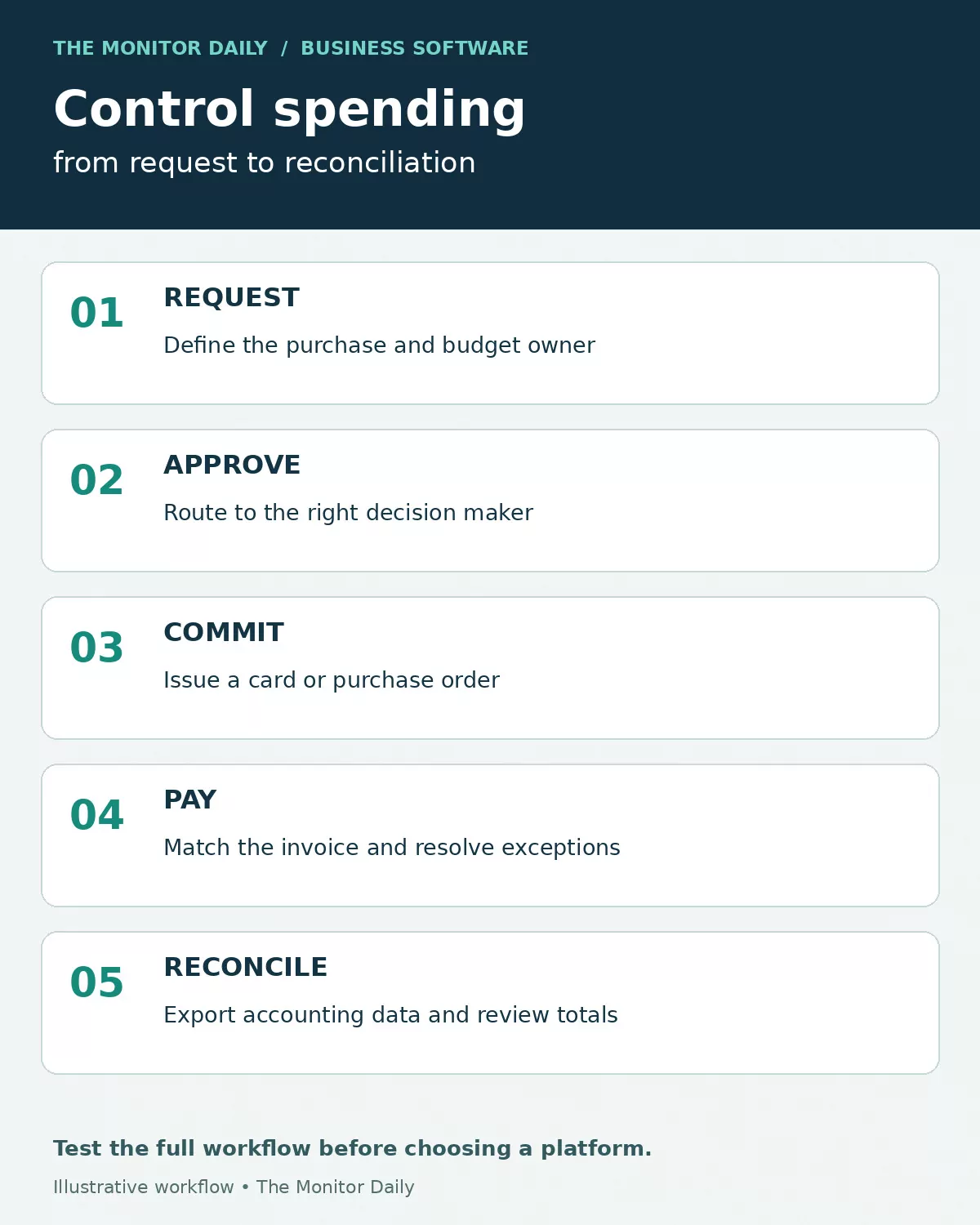
First, map the categories of spend you need to control: employee card purchases, supplier invoices, purchase orders, travel and reimbursements. Review how your accounting software handles financial records and identify what happens in the existing ERP and which steps can be changed without disrupting operations.
Next, run a proposed pilot with representative transactions. Include a new supplier, an invoice without a purchase order, an employee expense in a second currency, a rejected request and an approval that times out. Include controls against duplicate invoice payments. Record whether the correct owner sees each exception and whether the final entry reconciles to the general ledger. Use approved or synthetic data.
The U.S. Small Business Administration recommends maintaining accurate records of business revenue and expenses. Compare total contract cost, including setup, integrations, users, payment or foreign-exchange charges, support and renewal terms. Clarify data ownership, access permissions, audit logs, exports and what happens if the service is unavailable. Card eligibility and payment processing can depend on jurisdiction and underwriting; a software demo is not proof that a particular entity qualifies.
Which Platform Should Your Enterprise Shortlist?
Start with card-led platforms when the immediate problem is employee spending; examine procurement suites when supplier intake, purchase orders and contracts dominate. For travel-heavy workflows, include SAP Concur. The best corporate spend management platforms for your business are those that support your entities, controls and accounting process at a cost your team can sustain.