
A marketing campaign brief template gives a team one place to agree on the audience, offer, budget, deliverables, timeline and measure of success before work begins. The useful test is whether a designer, channel owner or approver can make the next decision without guessing.
A brief is a working agreement, not just a creative request. Define the commercial outcome first, then connect it to a specific audience, a message supported by evidence and a measurement plan.
Start with the business decision
State the problem, the reason for acting now and what the campaign can realistically influence. For example, an illustrative service business might aim to generate qualified consultations for a new offering over six weeks. This is a hypothetical example, not a measured result.
Identify the baseline, target, time frame and owner. Separate a business outcome such as qualified consultations from a channel measure such as clicks. If a lead becomes a customer after the campaign ends, record the follow-up window rather than declaring it an immediate result.
Define the audience and the reason to respond
Describe the people most likely to need the offer, the problem they are trying to solve, their decision constraints and the evidence behind those assumptions. The Small Business Administration’s market research guidance explains how research and competitive analysis can help businesses understand customers and the market. Separate known customer research from an untested assumption.
Write the offer, core message and call to action in plain language. Identify the proof that supports each claim. The CDC’s creative brief example distinguishes audience, objectives, obstacles, a key promise and supporting statements. Its public-health context differs from a commercial campaign, but the distinction between a promise and its evidence is useful.
Specify channels, deliverables and responsibilities
For each channel, record its job, audience, format, destination and owner. A landing page may explain the offer while an email directs existing subscribers to it; use only channels that can plausibly reach the selected audience. Include asset dimensions, required accessibility features and approval requirements when known.
Assign one accountable campaign owner, a budget approver, production leads and backup contacts. Give each milestone a date: brief approval, first draft, fact and rights review, final signoff, launch, monitoring and retrospective. State what happens when an approver is unavailable or a claim cannot be substantiated.
Budget and measurement: connect spend to outcomes
Separate media spend from creative production, software, external services and contingency. Record whether the cap includes taxes or agency fees under the actual agreement. A budgeted amount is a plan, not evidence that spending occurred.
Define the source of each metric, reporting cadence, attribution window and limitations. If a campaign generates 45 inquiries and 18 meet the agreed qualification criteria, the illustrative qualification rate is 18 ÷ 45 = 40%. This does not establish how many inquiries were incremental or profitable. Where feasible, compare outcomes with an appropriate baseline and investigate missing tracking before drawing conclusions.
Copyable marketing campaign brief template
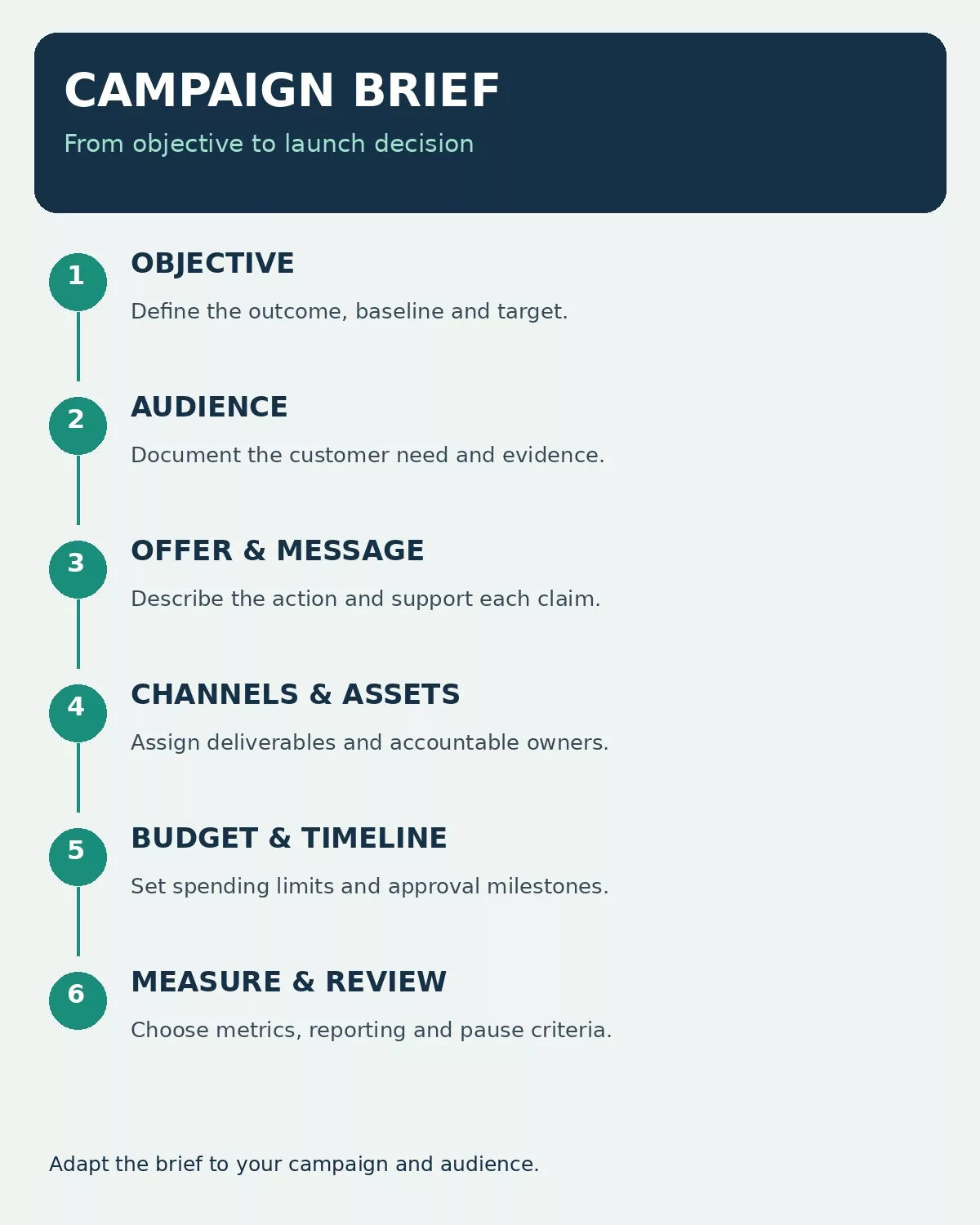
- Campaign name, owner and approval date:
- Business problem and background:
- Objective, baseline, target and end date:
- Primary audience and supporting research:
- Audience problem, offer and desired action:
- Core message, evidence and restrictions:
- Channels, deliverables, destination and responsible owners:
- Budget by category, contingency and approver:
- Milestones, dependencies and review dates:
- Primary metric, source, reporting period and attribution limits:
- Rights, accessibility, privacy and required reviews:
- Pause criteria, escalation and change approval:
Review the brief before launch
Have the owner and relevant reviewers check that the offer is deliverable, claims have evidence, assets have appropriate rights, links and tracking work, and spending is authorized. A service update and a promotional message may have different requirements; follow applicable rules and the organization’s policies.
When an offer, budget or audience changes, record the decision and notify the people whose work is affected. At the end, compare actual results with the defined baseline, document what the data can and cannot show, and keep a version for the next campaign.
For related planning, see our guides to customer retention and writing standard operating procedures.