
You have delivered the work and the client has approved it. Then the invoice sits unpaid because it went to the wrong inbox, lacks a purchase order number, or leaves the payment date open to interpretation.
A clear invoice cannot guarantee payment. It can remove avoidable reasons for delay by showing what the charge covers, when it is due, and how the customer can pay. Start with the client’s agreed terms and approval process, then use the template below to make each bill easier to understand.
Start With the Client’s Payment Process
A solo client may accept a PDF by email. A larger company may require a purchase order, supplier number, or submission through its payment portal. Before sending your first invoice, ask who receives it, which reference is required, when the payment period starts, and which payment methods the client accepts. QuickBooks’ invoice guidance notes that larger organizations may require a specific invoice number or code.
What to Include on an Invoice
Requirements depend on the transaction and jurisdiction. For a typical US small-business invoice, these fields provide a practical starting point:
| Field | What to include | Why it matters |
|---|---|---|
| Business and client | Correct names and contact details | Identifies sender and recipient |
| Invoice number | A unique identifier | Supports tracking and follow-up |
| Dates | Issue date and specific due date | Makes the payment timeline clear |
| Description | Work or products, quantity and rate | Lets the customer check the charge |
| Amount due | Subtotal, applicable tax, credits and total | Shows the remaining balance |
| Payment instructions | Accepted method and relevant instructions | Helps the customer make payment |
| Client reference | Purchase order or project number, if required | Connects the bill to the customer’s records |
Check the arithmetic and show deposits or credits separately. If the client uses a purchase order, our explanation of purchase orders and invoices can help clarify the different roles of the two documents.
Choose a Numbering System You Can Maintain
A unique invoice number helps both sides discuss the same bill. A small firm might use sequential numbers such as INV-1041 and INV-1042, or include a project code such as WEB-1041. Choose a system that stays consistent across clients and accounting records.
Record the invoice number, client, issue date, due date and amount in one place. If a client asks you to correct an invoice, follow your accounting process for documenting the change; avoid quietly reusing the same number for an unrelated bill.
Describe the Work So It Can Be Approved
“Consulting services — $1,500” gives an approver little context. A useful description connects the amount to the agreement: “Website content review, project milestone 2: review of five landing pages and delivery of recommendations.”
For hourly work, show hours and rate. For a fixed-price project, identify the milestone or deliverable. Include enough detail for the person approving payment to recognize the work without reproducing the whole contract.
Show How You Calculated the Amount
For time-based work, list the quantity of hours, the agreed hourly rate and the resulting line total. For a fixed-fee engagement, identify the deliverable or milestone and show the fixed amount. If you bill reimbursable expenses, separate them from your service fee and include supporting detail where the agreement requires it.
Suppose a consultant completed eight hours at $125 per hour. The service subtotal is $1,000. If the client has already paid a $200 deposit and no other adjustments apply, the remaining balance is $800. This is a hypothetical example; add tax only when applicable to the actual transaction and jurisdiction.
Make the Due Date Unambiguous
Terms such as Net 30 are useful shorthand, but a calendar date is easier to act on. For example: “Net 30 from invoice date. Due December 10, 2026.” Use the terms already agreed with the client; placing a shorter deadline on an invoice does not necessarily change an existing agreement. Stripe’s due-date guidance recommends making the date easy to find.
Choose Payment Instructions That Fit the Client
Offer the payment methods you have agreed to accept and provide the information needed to use them. A payment link may suit a client that pays invoices online; a business customer may instead have a bank-payment process or an accounts-payable portal. Confirm any processing charges and who bears them under your agreement.
If bank instructions change, contact the client through an independently verified channel before they act on the new details. A professional-looking email alone is not proof that a payment-instruction change is legitimate.
Free Invoice Template
Copy the template into a document or spreadsheet, replace the bracketed fields, and adapt it to your agreement and applicable requirements.
INVOICE
From: [Business name and contact information]
Bill to: [Client billing name and contact]
Purchase order or project reference: [If applicable]
Invoice number: [Unique number]
Invoice date: [Month day, year]
Payment due: [Month day, year]
Agreed terms: [For example, Net 30 from invoice date]Description: [Work or product]
Quantity: [Number] Rate: [$0.00] Amount: [$0.00]
Subtotal: [$0.00]
Applicable tax: [$0.00]
Less deposit or credit: [$0.00]
Total due: [$0.00]Payment method: [Approved instructions]
Billing questions: [Contact]
Use an appropriate secure channel for payment information and verify any change to payment instructions through a trusted contact.
A Worked Example
Imagine a design studio completed an agreed project milestone. The client approved a fixed fee of $1,200 and already paid a $300 deposit.
| Item | Amount |
|---|---|
| Approved milestone | $1,200 |
| Deposit already paid | −$300 |
| Remaining balance | $900 |
The invoice should identify the milestone, show the charge and deposit separately, and request the $900 balance by the agreed date. Include a purchase order number if the client requires one. This example is hypothetical; tax treatment and contract terms depend on the actual transaction.
Check the Invoice Before You Send It
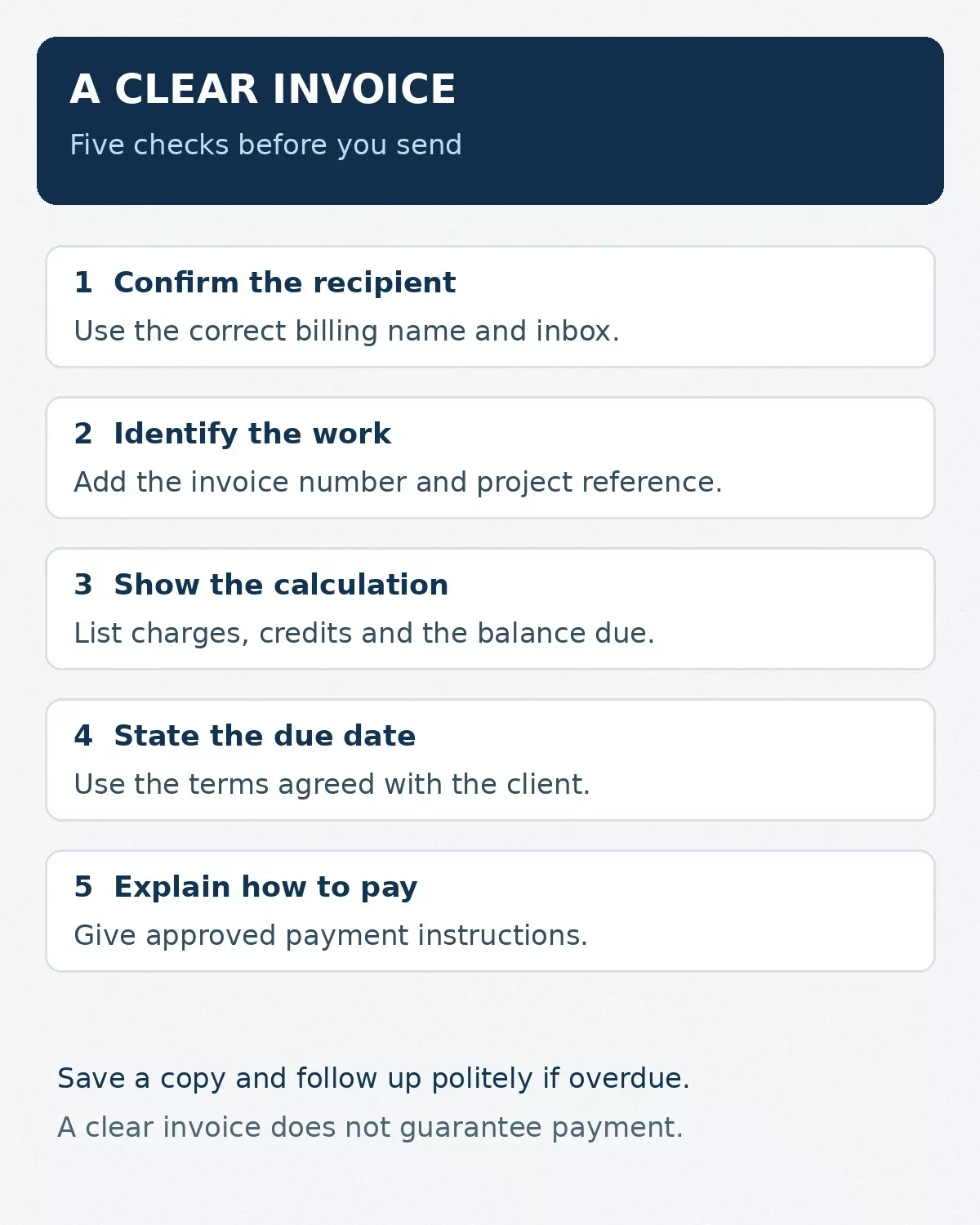
Compare the invoice with the contract, approved quote or purchase order. Confirm the client name, contact, description, rate and payment terms. Check the line totals, credits and final balance, then verify the payment instructions. If the work was delivered in stages, identify which stage this invoice covers.
Save the version sent to the client and note the date and destination. A simple register can include the invoice number, customer, amount, due date, status and follow-up owner. This makes it easier to tell the difference between an invoice that is still awaiting approval and one that is genuinely overdue.
Send, Track, and Follow Up
Before sending, review the recipient, total, due date, payment instructions and required reference. Save a copy and record when and where it was sent. If payment has not arrived by the due date, begin with a polite message that includes the invoice number, amount and original due date. Ask whether the client needs anything else to process it.
For example: “Hi [Name], I’m following up on invoice [number] for [amount], due on [date]. Could you confirm that it reached the right person and let me know if you need any additional information? Thank you.”
If there is a dispute, investigate before repeating reminders. A missing purchase order, an incorrect amount and a customer’s cash-flow difficulty call for different responses. For a wider follow-up process, see our guide to tracking overdue invoices.
What to Do When a Payment Is Late
First, check your own records for a payment in transit, a partial payment or a credit that has not yet been matched. Then ask the customer whether the invoice was received and whether it needs a purchase order or correction. If the invoice is disputed, resolve the specific issue and document any agreed adjustment.
If a reminder does not resolve the matter, follow the escalation process in your agreement and applicable law. Late fees, collection options and tax treatment vary by contract and jurisdiction, so confirm the rules that apply before taking the next step.
A good invoice makes the agreed transaction easy to understand and act on. Pair it with clear terms, the right recipient and consistent follow-up to reduce avoidable friction in getting paid.