

A bank statement vs accounting ledger comparison explains why the cash balance at your bank can differ from the balance in your books on the same date. The difference may be a timing issue, a bank charge, an entry error or a transaction that needs investigation. Reconciliation shows which explanation applies before you change the books.
Start with the same account and closing date in both records. Gather the statement, cash ledger and prior reconciliation, then match transactions and document the items that remain. The following example is fictional and is intended to illustrate the method.
Bank statement vs accounting ledger: what each record shows
The bank statement reports transactions processed by the bank during the statement period. Your cash ledger records transactions in your accounting system. A check can be recorded in the ledger when issued but appear on the bank statement only when it clears. Likewise a deposit may be recorded in the books before the bank processes it.
The Utah Office of the State Auditor’s reconciliation guidance explains outstanding payments and deposits when reconciling accounting records to a statement. Although written for local governments, the arithmetic is useful for understanding the process in a small business.
Common reasons the balances differ
| Item | Where to investigate | Typical treatment |
|---|---|---|
| Outstanding check | Recorded in books but not yet cleared by the bank | Deduct from the statement-side balance in the reconciliation. |
| Deposit in transit | Recorded in books but not yet shown by the bank | Add to the statement-side balance, subject to verification. |
| Bank fee or interest | On the statement but absent from the ledger | Investigate and record a valid missing book entry. |
| Error or duplicate | Amount or transaction differs between records | Trace the evidence and correct the responsible record. |
| Unknown transaction | Statement or ledger entry has no matching support | Investigate; do not force a match. |
A worked bank reconciliation example
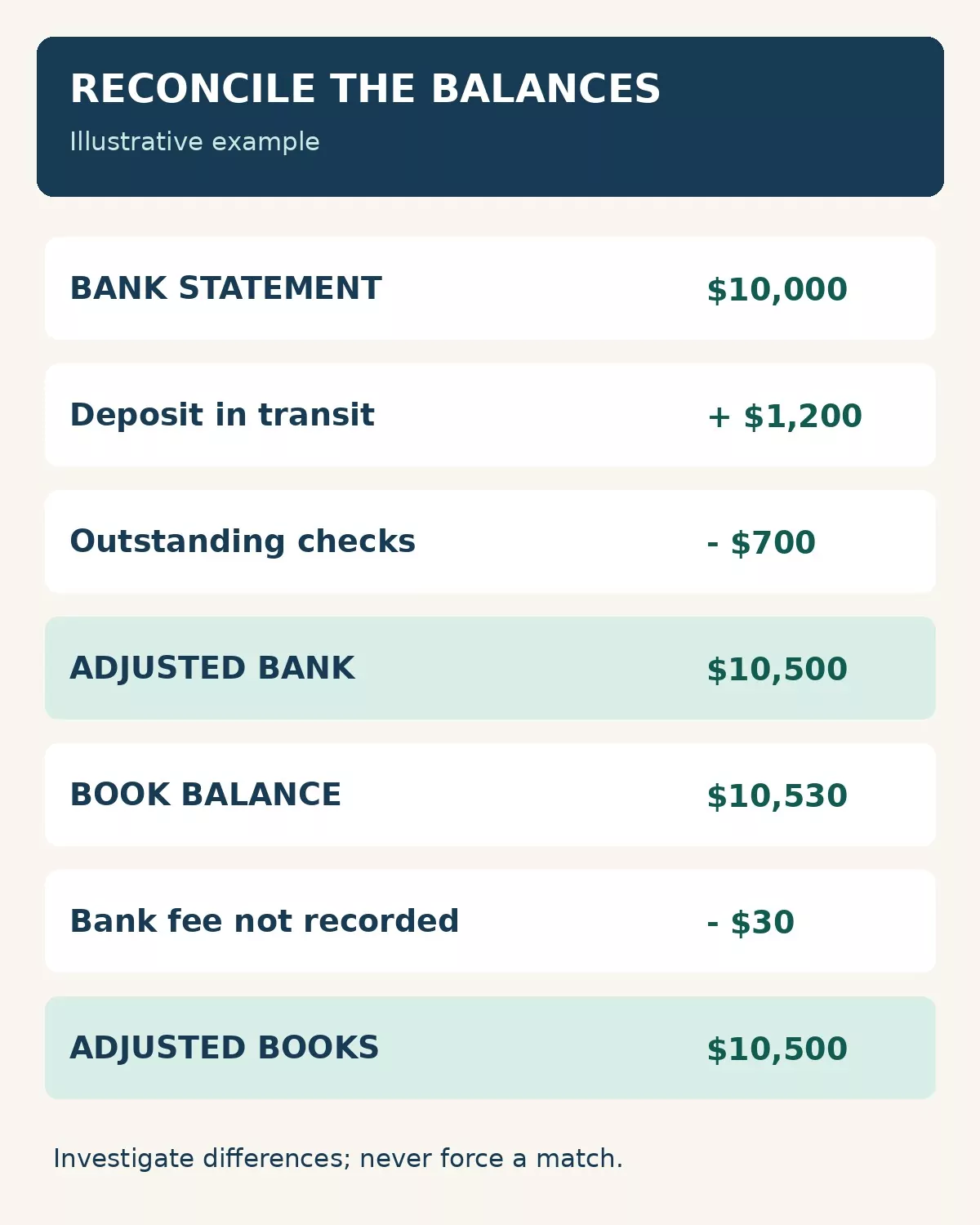
Suppose a statement ends at $10,000. The business recorded a $1,200 deposit before the closing date that the bank has not yet processed, and issued $700 in checks that remain outstanding. The adjusted bank-side balance is $10,000 + $1,200 − $700 = $10,500.
Suppose the ledger shows $10,530 before a $30 bank service charge appears in the books. After confirming and recording the charge, the adjusted ledger balance is $10,530 − $30 = $10,500. Both adjusted balances now agree. The outstanding checks and deposit remain on the reconciliation until they clear; they do not normally require duplicate entries in the ledger simply because they are timing differences.
How to reconcile the records
- Use the same bank account and statement end date; verify that the prior reconciliation was completed and review old outstanding items.
- Match statement deposits and withdrawals to ledger entries using dates, amounts and supporting documents. Do not assume identical amounts always mean identical transactions.
- List recorded deposits not yet processed and issued payments not yet cleared, confirming that each belongs in the period.
- Identify statement items missing from the books, such as a verified bank fee, interest or returned payment. Prepare appropriate entries after investigation.
- Investigate mismatches, duplicates and unfamiliar activity. Contact your bank through a verified channel when a bank-side item is unclear.
- Calculate the adjusted bank and ledger balances, resolve the difference, and have the reconciliation reviewed under your business’s controls.
- Save the statement, reconciliation, supporting documents and evidence of review in an access-controlled location.
What if the totals still do not match?
Recheck the opening balance and the end date first. Look for a transposed amount, a duplicate import, a payment posted to another account or a previously outstanding item that cleared without being marked. Confirm whether a returned deposit was recorded correctly. Do not post a balancing entry merely to make the report agree; it can conceal an underlying error or unauthorized transaction.
If the statement contains a transaction you cannot explain, preserve the details and contact your bank promptly through a known channel. Restrict access while the issue is reviewed. A second person should review adjustments where the business has enough staff to separate preparation and approval.
Make reconciliation a repeatable routine
The IRS explains how supporting documents help substantiate business records. Retention periods depend on the record and circumstances; consult your adviser and applicable rules. A documented standard operating procedure can specify who prepares, reviews and follows up on outstanding items.
How to handle timing differences in the next month
Carry forward each outstanding check and deposit with its date, amount and supporting record. On the next statement, verify whether it cleared and mark it accordingly. A deposit that remains outstanding longer than expected deserves a fresh investigation: confirm when and how it was submitted, check for a returned item and contact the bank through a verified channel if necessary.
Apply the same discipline to old checks. A check that has not cleared is not automatically an error or income. Check the original payment, payee and your organization’s procedures before voiding or replacing it. If a replacement is needed, coordinate the accounting treatment with your bookkeeper and confirm the status of the original payment with the bank.
Review controls for a small team
Where possible, one person prepares the reconciliation and another reviews the statement, outstanding items and supporting adjustments. When one owner performs both roles, arrange an independent periodic review with an accountant or another authorized person. Record who completed the work, the date and any unresolved item with a responsible owner and follow-up date.
Bank-feed imports can reduce manual entry, but an imported item still needs a correct match and classification. Review exceptions and duplicate imports before posting. If the business uses more than one bank account or credit card, reconcile each separately and check that transfers appear on both sides without being counted as income or expense.
A bank statement vs accounting ledger comparison becomes easier when the same account, date and evidence are used consistently. Reconcile regularly, investigate unusual items and keep a record of both the explanation and the correction.