
To build business credit from zero, start with a consistent business identity, an affordable account that serves a real need and a way to verify whether its payment history reaches a business credit bureau. Then pay as agreed and check the record. An EIN, a bank account or a purchased “credit-building” package does not by itself prove that you have established useful borrowing history.
For a new business, “from zero” usually means little or no established commercial credit history—not a verified score of zero. The immediate goal is to create accurate, usable evidence of how the business handles obligations while protecting its cash. Approval for a particular loan remains a separate decision.
This US-focused guide is based on government and credit-bureau information reviewed on November 18, 2026. The register, examples and review workflow below are proposed decision aids. They are not results from opening accounts, submitting credit applications or testing a provider.
1. Understand what you are trying to build
A business credit report collects information about a company and its financial relationships. A score is an assessment produced using a particular model and available information. Neither should be confused with a lender’s complete application decision, which can include information beyond a commercial credit file.
The SBA’s business-credit guidance emphasizes both personal and business credit history. It notes that a new business’s loan eligibility is typically based on the owner’s personal credit score and identifies Experian, Equifax and Dun & Bradstreet among sources of business reports. A commercial profile therefore does not automatically remove the owner from consideration.
Define the actual decision ahead of you. Do you want a supplier to allow 30 days to pay, a card for routine purchases or financing for equipment? Each purpose can lead to different eligibility questions, costs and repayment commitments. Buying a generic score-improvement service before defining that purpose reverses the process.
Keep two workstreams visible: the quality of your credit information and the business’s ability to pay. A record can be accurate while the requested borrowing is unaffordable. Conversely, a profitable business may still need to correct incomplete or mismatched records.
2. Make the business identifiable before applying
Choose and document the legal structure appropriate to your situation. Do not form an entity solely because someone promises that it will produce an instant credit score. Tax, liability and operating considerations need their own review.
Maintain a reference record for the exact legal name, any registered trade name, business address, contact details, formation information where applicable, and tax identifiers. Use the correct information when opening accounts and submitting applications. If a form asks for a legal name, do not substitute a marketing variation without checking the instructions.
The IRS provides EINs directly without a fee. Its current instructions explain who can use the online tool and direct applicants who cannot use it to other application methods. An EIN is a tax identifier; receiving one is not a lender’s approval and does not demonstrate a repayment history. If you are forming an LLC or corporation, follow the IRS instruction to form the entity with the state before applying for its EIN.
Keep the confirmation and registration records securely. A shared working checklist does not need to display complete tax identifiers or account numbers. Record where an authorized person can find the evidence rather than copying sensitive documents into every planning spreadsheet.
| Record | What to check | Evidence to retain |
|---|---|---|
| Business identity | Legal name and structure match the applicable records | Current registration or other relevant identity document |
| Tax identity | The identifier belongs to this business and is used correctly | IRS confirmation where an EIN applies |
| Operating account | The account is opened for the intended business and authorized users | Account-opening documents and current statements |
| Commercial credit file | The report refers to the correct entity and location | Report date, bureau and any correction reference |
3. Separate banking records from credit reporting
A business bank account helps organize business money and supplies records for financial review. Do not assume that deposits, account age or ordinary debit-card spending create a reported borrowing account. Ask what a particular product actually does rather than treating every financial relationship as a credit-building tool.
Prepare a simple account map: which account receives customer payments, which pays suppliers, who reconciles it and who can authorize a payment. Reconcile the statements to your records so that unexplained transfers and duplicate expenses do not complicate a later application.
Our business banking meeting guide can help structure the conversation. Bring the purpose of the requested credit, current records and repayment assumptions. A discussion about eligibility and reporting is more useful than asking only how large a limit the bank might offer.
If an application requests owner information, read why it is required. Distinguish an identity check, a personal credit inquiry and a personal guarantee. Do not assume that applying in a company’s name removes any guarantee you sign. Obtain an explanation of the actual agreement before accepting liability you do not understand.
4. Check existing files before trying to create another
A thin history is not proof that no commercial file exists. Search through the relevant bureau’s official process and check that any returned record matches your business. Similar names, old addresses and multiple locations can make a superficial match unreliable.
Dun & Bradstreet describes its D-U-N-S Number as a nine-digit business identifier and offers a free request process. Its instructions tell applicants to check whether a number already exists before requesting one. The identifier connects to a business record; it is not itself a credit score or a guarantee of funding.
Use the identifier or file process relevant to the institution you are dealing with. Do not assume that obtaining one bureau’s identifier creates a complete record at every other bureau. Ask which commercial report or information the prospective creditor considers, where it will disclose that information.
When you obtain a report, review identity information and the accounts shown before focusing on the score. Keep the date and source of the report. If information appears wrong, use that bureau’s official correction or dispute process and retain supporting records. Follow the actual commercial process rather than assuming consumer-report procedures apply unchanged.
5. Choose a useful account and verify its reporting
Start with a purchase or financing need that already exists. Supplier terms may fit recurring materials; a business card may fit controlled routine expenses. Eligibility, fees, deposits, guarantees and reporting differ by provider and product. A recognizable brand or the word “business” in an account name does not answer those questions.
Experian’s business-credit guidance specifically advises checking whether vendors report payments. Turn that into a verification task before relying on an account to build a file. Ask which bureau receives information, whether this exact product reports positive payment activity, how often reporting occurs and whether any qualifying conditions apply.
| Before applying, ask | Why the answer matters |
|---|---|
| Does this account meet a real business need? | A reporting benefit does not justify buying goods or services you do not need |
| What are the complete fees and repayment terms? | A small monthly charge can become a material annual cost |
| Is collateral, a deposit or an owner guarantee required? | The business needs to understand the cash commitment and liability |
| Which bureau receives which payment information? | An account cannot be counted as a verified reporting relationship merely because it was opened |
| How can you confirm the first reported activity? | A statement and a commercial credit report show different parts of the process |
Do not invent a universal requirement to open a certain number of accounts. Nor should you borrow more than needed because a guide says activity is beneficial. The useful initial relationship is one the business can understand, afford and maintain.
6. Use a reporting-verification register
The following proposed register separates what a provider says from what you can observe. It is a recordkeeping method, not a test we performed or a scoring model.
| Status | Meaning | Next action |
|---|---|---|
| Unknown | Reporting has not been established for the exact account | Ask the provider and retain the answer |
| Documented | You have written reporting information, including relevant conditions | Check whether the account meets those conditions |
| Payment recorded | Your statement shows the payment, but the bureau entry has not been confirmed | Reconcile the payment and check the relevant report after the stated reporting period |
| Observed | The matching account activity appears in the bureau’s report | Record the report date and review accuracy |
| Exception | Information is missing or inconsistent after the expected process | Investigate with the provider or bureau; retain the case reference |
For each relationship, record the product name, last verified reporting policy, bureau, due date, payment confirmation and review owner. Do not label it “Observed” merely because a salesperson said it reports.
For example, a hypothetical business buys $240 of supplies on 30-day terms and pays the full balance by the deadline. The payment confirmation supports its own accounting record. Only a matching bureau entry supports the claim that this transaction appeared in that bureau’s file. Missing reporting calls for investigation, not another unnecessary purchase.
The repayment deadline does not move just because your customer pays late. A 30-day supplier arrangement creates a deadline you must plan for even when cash collection is uncertain. Keep a dated cash plan so an attempt to establish history does not create avoidable arrears.
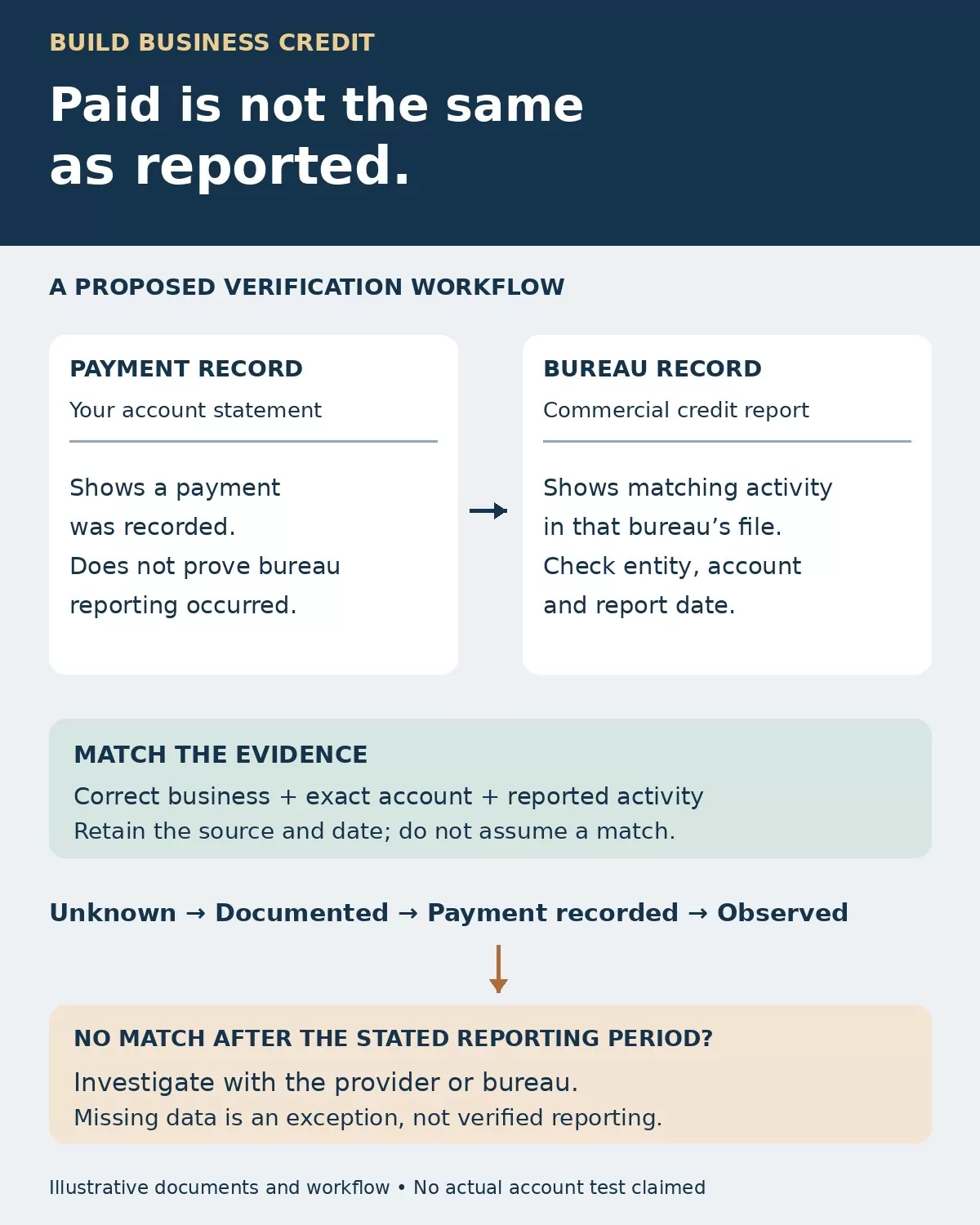
The diagram separates your own payment record from the bureau’s information. Keep a missing or inconsistent entry in the exception queue until the underlying records explain it.
7. Keep the cost and the repayment plan visible
Compare the full cost of a proposed account with its practical value. In a hypothetical offer, a $25 monthly membership costs $300 over 12 months before any purchase, interest or other charge. If its only attraction is an unverified promise of reporting, you have not established that the annual expense solves your problem.
For routine purchases, assign an owner to check the amount due and ensure cash is available before payment. Automatic payment can be useful, but it still needs a valid funding account and a review process. A failed debit or disputed bill should create an exception someone resolves, not an assumption that automation handled it.
When comparing borrowing offers, look beyond the headline limit. Read the cost disclosures, repayment frequency, minimum payments, fees and consequences of a missed payment. Ask how an introductory arrangement changes later. No single utilization percentage or score threshold in a general guide guarantees approval across all business products.
Where personal credit matters to an application, review it through the appropriate consumer process as well. Keep personal and commercial records distinguishable, while recognizing that the creditor may consider both.
8. Avoid shortcuts that replace evidence with promises
The FTC’s small-business scam guidance warns about sellers falsely claiming you need to pay for unnecessary services to improve a business credit report. A paid service should have a clear deliverable, disclosed cost and a purpose you can explain.
Be cautious about guaranteed funding or a promised score increase on a fixed timetable. Ask what information supports the claim, what the service actually changes and which results it cannot control. Do not submit false revenue, business age, ownership or other application information to satisfy a package seller’s instructions.
If someone offers to fix a record, distinguish correcting an error from promising to erase an accurate obligation. Use the bureau’s official process for the actual issue. Buying a different business identity or a story about “instant credibility” is not a substitute for an accurate application and a repayment plan.
9. Review progress by evidence, not account count
Set a practical review routine around payment dates, provider reporting information and the financing decision you are preparing for. The order matters more than an arbitrary 30-, 60- or 90-day promise: establish identity, understand the account, pay as agreed, confirm the information and resolve exceptions.
A useful review asks whether the records are accurate, payments are current, costs remain justified and the business can fund its commitments. A new account or a changed score does not answer all four questions.
Before applying for more credit, identify what improved and what remains uncertain. That makes it easier to explain the business to a supplier or lender without overstating what a thin file proves.
Final Thoughts: build business credit through useful, verifiable activity
To build business credit from zero, organize the identity and financial records first, choose only credit the business can use responsibly and verify reporting instead of assuming it. Maintain on-time payments and correct inaccurate information through the appropriate official process.
The goal is not the largest collection of accounts or the fastest advertised score change. It is an accurate financial record, manageable obligations and evidence that supports the particular credit decision the business needs to make.