

A marketing to sales handoff gives a small team a clear way to decide when a prospect is ready for a conversation, who takes responsibility and what happens next. Without those decisions, a promising inquiry can sit in a shared inbox while both teams assume someone else has followed up.
Use this practical checklist to agree on the trigger, the information that travels with the lead, response expectations and a route back when a lead is not ready. The examples are illustrative; adapt them to your customers, available staff and communication preferences.
What a marketing to sales handoff should accomplish
A handoff is complete when the receiving person accepts responsibility and has enough context to make an appropriate next move. A form submission alone does not necessarily show buying intent. Someone who asks for a quote needs a different response from someone who downloads a guide for general research.
Agree on a minimum definition of readiness. It might include a relevant problem, a supported service area and an explicit request to talk. Avoid treating a guessed budget or an unverified job title as fact. Make room for an urgent request even when a routine form field is missing.
Marketing to sales handoff checklist
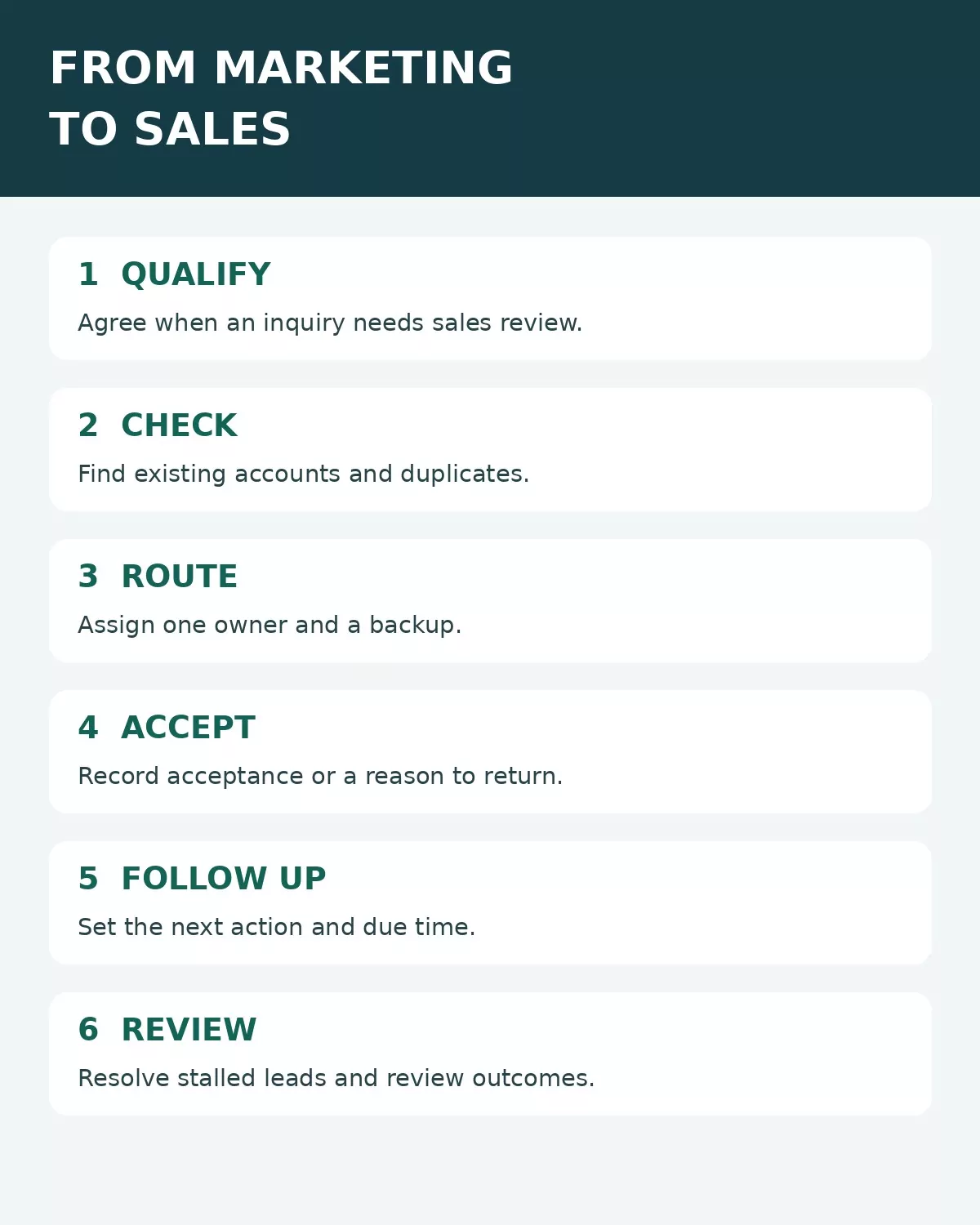
Qualify the inquiry, check for duplicates, assign an owner, confirm acceptance, follow up and review the result.
- Define the trigger: identify the inquiry or combination of signals that requires a sales review, and list exceptions.
- Check the record: look for existing customers, open opportunities and duplicates before creating a new assignment.
- Capture context: record the request, source, relevant conversation, preferred contact method and a link to the original inquiry.
- Route to one owner: apply an agreed rule based on account ownership, location or capacity; identify a backup if the owner is absent.
- Confirm acceptance: ask sales to accept the lead or return it with a specific reason, rather than leaving it in an unmonitored queue.
- Set the next action and deadline: record the task, owner and due time using the team’s working hours and coverage rules.
- Check permissions and preferences: carry forward opt-outs and contact restrictions before any outreach.
- Review exceptions: inspect unassigned, rejected, duplicate and overdue records and assign someone to resolve each case.
Agree on a practical response commitment
A service-level agreement can be a short internal agreement rather than a complex contract. State which leads qualify, who receives them, the first-response target, business hours, the backup and the escalation path. Define whether the clock starts when the inquiry arrives, when it is qualified or when an owner is assigned. Each choice measures a different part of the process.
For example, a fictional three-person team might route a direct quote request to the account owner during business hours, with a backup checking the queue at midday. A general newsletter signup could stay with marketing until the person asks for a conversation. These are example choices, not universal response-time benchmarks.
What information should travel with the lead?
| Field | Why it matters |
|---|---|
| Request and desired outcome | Helps the recipient understand what the prospect asked for. |
| Source and recent interactions | Prevents the next person from repeating an earlier conversation. |
| Owner and next action | Makes responsibility and the follow-up visible. |
| Contact preferences | Helps the team respect the chosen channel and recorded opt-outs. |
| Missing or uncertain details | Separates confirmed information from assumptions. |
Keep notes short and relevant. Avoid collecting sensitive details that are unnecessary for the request, and restrict access according to your organization’s policy. If a person already has an account owner, decide which colleague coordinates rather than sending competing messages.
Measure the handoff without hiding the gaps
Track the number of eligible handoffs, the share accepted, time to assignment, time to first documented action and the reasons leads return to marketing. Define the denominator and reporting window first. A lead assigned at 5 p.m. on Friday may require a different response target from one received on Tuesday morning.
In an illustrative month, if sales accepts 18 of 24 handoffs, the acceptance rate is 75%. That does not show whether the leads generated revenue or whether six rejections were justified. Review the reasons and a small sample of records before changing the threshold. Compare like with like: a quote request and an event signup are not the same kind of opportunity.
Handle rejected, stalled and duplicate leads
Use a short set of rejection reasons such as outside service area, missing contact information, existing customer or not ready. Each reason should have a next owner. For a duplicate, retain the existing record where appropriate and connect the new inquiry to it; do not delete useful history without checking. A stalled task should go to a backup or a manager rather than disappearing into an exception report.
Before sending marketing email, review the actual message and recipient preferences. The FTC’s CAN-SPAM guide explains US requirements for commercial email, including accurate sender information and an opt-out mechanism. Rules vary by jurisdiction and channel; consult appropriate advice for your situation.
Review the process each month
Have marketing and sales review a few accepted and returned inquiries together. Ask whether the trigger reflected the person’s request, whether the recipient had useful context, and whether the follow-up happened. Assign one owner to any correction and record when it will be reviewed. A standard operating procedure can preserve the rules, backups and exception paths as the team changes.
A handoff agreement your team can adapt
Write the agreement on one shared page and give it an owner. Record the types of inquiries that go directly to sales, the conditions that send an inquiry back for clarification, the assignment rules and the location of the live queue. Add the hours when someone monitors the queue and the backup who covers absences. Both teams should agree on the process before it becomes the default.
Example: a prospective customer asks for a quote and provides a contact address and a description of the work. Marketing checks the existing customer record and assigns the inquiry to the account owner. The owner accepts the task, reviews the request and records a next action. If the business cannot serve the requested location, sales returns the lead with that reason and the agreed owner closes the loop. This is an illustrative workflow, not a record of an actual customer.
Set up the queue before adding automation
A shared spreadsheet or inbox can support a small volume if responsibilities are visible. At minimum, keep the inquiry date, owner, status, next action, due time and reason for any return. Choose one person to check for unassigned or overdue items. When volume grows, a CRM can support routing, but migrating a disorganized process into software will not resolve unclear ownership.
Before enabling a rule, test it with fictional records: an existing customer, a new quote request, a duplicate inquiry and a request received outside business hours. Check who receives each item and what happens when no owner is available. Record the rule and its backup in plain language so another team member can correct it.
The Small Business Administration’s planning guidance discusses using market research to understand customers; treat your handoff criteria as hypotheses to review against your own qualified inquiries, not as proven facts about every prospect.
A reliable marketing to sales handoff does not require a complicated score. Start with a shared definition, a named owner, an achievable next action and a way to return incomplete inquiries. Improve those decisions with the records your team actually has.