
Turning on real-time business bank account alerts is one of the fastest ways to stop unauthorized withdrawals before the window to recover funds closes. Unlike personal checking accounts covered by federal Regulation E consumer protections, commercial accounts operate under stricter Uniform Commercial Code and payment-network rules that place far tighter reporting deadlines on the business owner.
If an unauthorized electronic debit hits your operating account, waiting until your monthly reconciliation to spot it can mean absorbing the loss permanently.
For small-business owners, finance leads, and sole proprietors, automated bank notifications act as an early-warning tripwire across cash flow, vendor payments, and login security. Rather than enabling every routine deposit ping and creating notification fatigue, prioritize the specific alerts that catch fraud, vendor-impersonation scams, and liquidity crunches in real time.
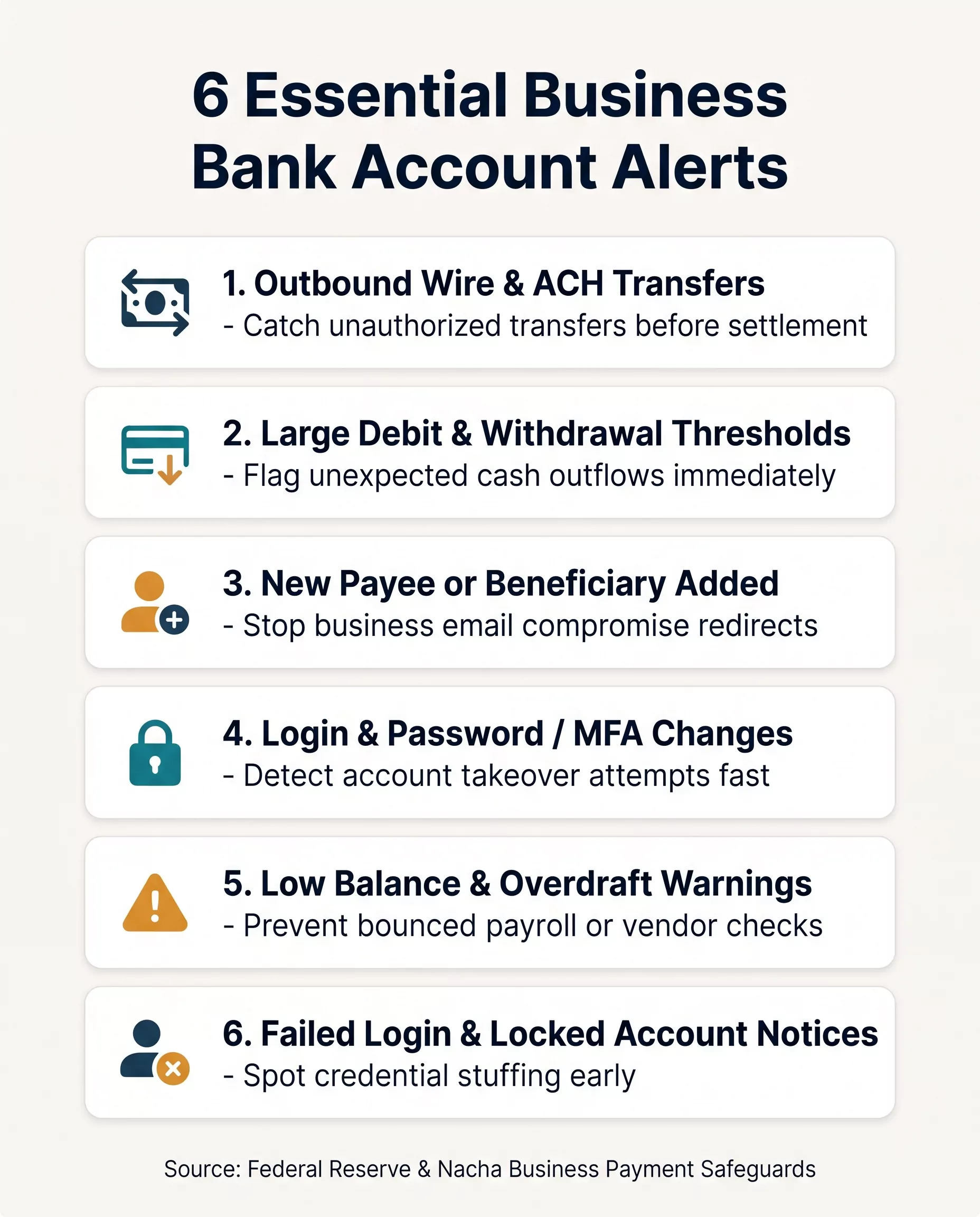
1. Outbound Wire and ACH Debit Alerts
Every outgoing wire transfer and Automated Clearing House (ACH) debit should trigger an immediate text or push notification, regardless of dollar size or at a very low threshold such as $1. Electronic transfers move fast, and commercial return windows leave virtually no margin for delay.
Under Nacha operating rules, corporate ACH receivers generally have only until the opening of the next banking day following settlement to report an unauthorized debit and use the standard return process, compared with 60 calendar days for consumer accounts. Once a domestic or international wire settles, recalling funds becomes even harder and depends on the receiving institution’s cooperation. An instant outbound-transfer alert lets you call your bank’s fraud desk within minutes rather than weeks.
2. Large Single-Transaction and Cumulative Withdrawal Thresholds
Set a custom dollar threshold for any single debit, check clearing, or card charge that exceeds your normal daily operating pattern. A practical baseline for many small businesses is an alert set slightly below your typical payroll run, rent payment, or largest recurring supplier invoice, alongside a daily cumulative outflow alert.
Fraudsters who gain access to account credentials or test stolen routing numbers frequently initiate multiple medium-sized debits just below standard executive sign-off limits. Pairing a single-item threshold with a daily cumulative withdrawal alert ensures that structured, split transactions still trigger an immediate warning on your phone.
3. New Payee, Beneficiary, and External Account Link Alerts
Business email compromise (BEC) remains one of the highest-loss fraud schemes targeting small and mid-sized companies, according to the FBI’s Business Email Compromise guidance. In a typical attack, criminals spoof a trusted supplier or executive and convince a bookkeeper to route an upcoming invoice payment to a new bank account.
Enable alerts whenever a new wire beneficiary, ACH payee, or external transfer account is added or edited in your online banking portal. When that alert fires, pause the payment and confirm the banking change by calling the vendor at a verified phone number already on file, never using contact details from the email requesting the change.
4. Login, Password, and Multi-Factor Authentication Changes
Account takeover alerts are non-negotiable for any business profile with online banking access. Turn on notifications for:
If a criminal compromises an employee’s email or password, their first move inside online banking is often adding a secondary MFA method or quietly raising transfer limits. Catching a security-setting change immediately lets you lock the profile before any payment instruction is submitted.
5. Failed Login Attempts and Account Lockout Warnings
A burst of failed sign-in notifications indicates credential-stuffing or brute-force attempts against your business login portal. Even if multi-factor authentication blocks the attacker from entering the account, repeated lockout alerts signal that your username or password may have been exposed in a third-party data breach.
Treat a failed-login spike as an immediate trigger to rotate your banking password using a dedicated password manager and verify that every authorized team member uses unique credentials rather than shared logins.
6. Low-Balance, Overdraft, and Returned-Item Alerts
Security is only half the value of automated bank monitoring; cash-flow protection is the other half. Set a minimum-balance alert comfortably above your next scheduled payroll, tax remittance, or automatic loan debit.
If a major client payment clears late or an unexpected vendor debit lands early, a low-balance buffer alert gives you time to transfer reserves from a business savings account before checks bounce or ACH debits return unpaid. Pair this with instant alerts for returned deposits or non-sufficient funds (NSF) notices so you can follow up with customers the same day.
How to Configure Alerts Without Creating Notification Fatigue
An alert system only works if you actually read the messages when they arrive. If your phone buzzes 30 times a day for routine $15 card swipes, critical fraud warnings get ignored. Use a two-tier routing setup to keep high-risk alerts visible:
Route security changes and outbound transfer alerts directly to the business owner’s mobile device via SMS or push notification, even if a bookkeeper or controller manages day-to-day payables. Separating alert visibility from payment initiation creates an automatic second pair of eyes without slowing down daily accounting work.
What to Do the Moment a Suspicious Alert Fires
When an unexpected debit or login alert appears, speed determines whether funds stay in your account. Follow this sequence immediately:
Reviewing and testing your business bank account alerts takes less than 15 minutes inside your bank’s security and notification settings, yet it closes the most dangerous gap in small-business cash management: finding out about fraud weeks after the money is gone.