
My US business address verification problem became clear in a short support email. The address attached to our company appeared to belong to a registered agent, Priyo told us. It could not accept that address. To move forward, we needed to provide a different one or evidence that its assessment was mistaken.
I could explain why we used that address. It was part of the company’s formation arrangements. What I could not honestly do was describe it as an office where our business operated.
That distinction became the central issue in our application. The experience has changed the question I would put to a financial provider before building a business around its service: can you support the company as it actually works, rather than as its registration paperwork might make it appear?
For Bangladesh-based entrepreneurs with US companies, this is a commercial planning question as much as a verification question. A company may have customers and valid documents while still lacking an approved path from a sale to money it can use.
The Evidence Behind This Account
This first-person account concerns Editorialge Media LLC. It draws on the founder-supplied Priyo email thread of October 11–12, 2026, a November 5 card-application screenshot, and an earlier Mercury notice dated May 2, 2026. Personal names, recipient details and identifiers are omitted or concealed in the reproduced evidence. The email records have not been independently authenticated inside the providers’ systems.
Priyo’s public document requirements and Mercury’s country policy were checked on November 19, 2026. The analysis separates those policies from what happened in our case. No replacement account was opened or payment route tested for this article.
What I Explained—and What Priyo Required
Our October request asked Priyo to review a US business account showing an “Under Review” status. The correspondence said we had previously held an approved US business account with the service. That history explains why we sought a review; it did not establish that the new application had to be accepted.
After the address objection, I clarified the company’s structure. The registered-agent address was for legal registration. It was not our physical operating office. The company’s actual operations and team were outside the United States, and it had no US office, leased premises or employees.
I asked whether a verified overseas operating address could be used while the registered-agent address remained on the legal registration. That was an attempt to distinguish two legitimate address functions, not to disguise one as the other.
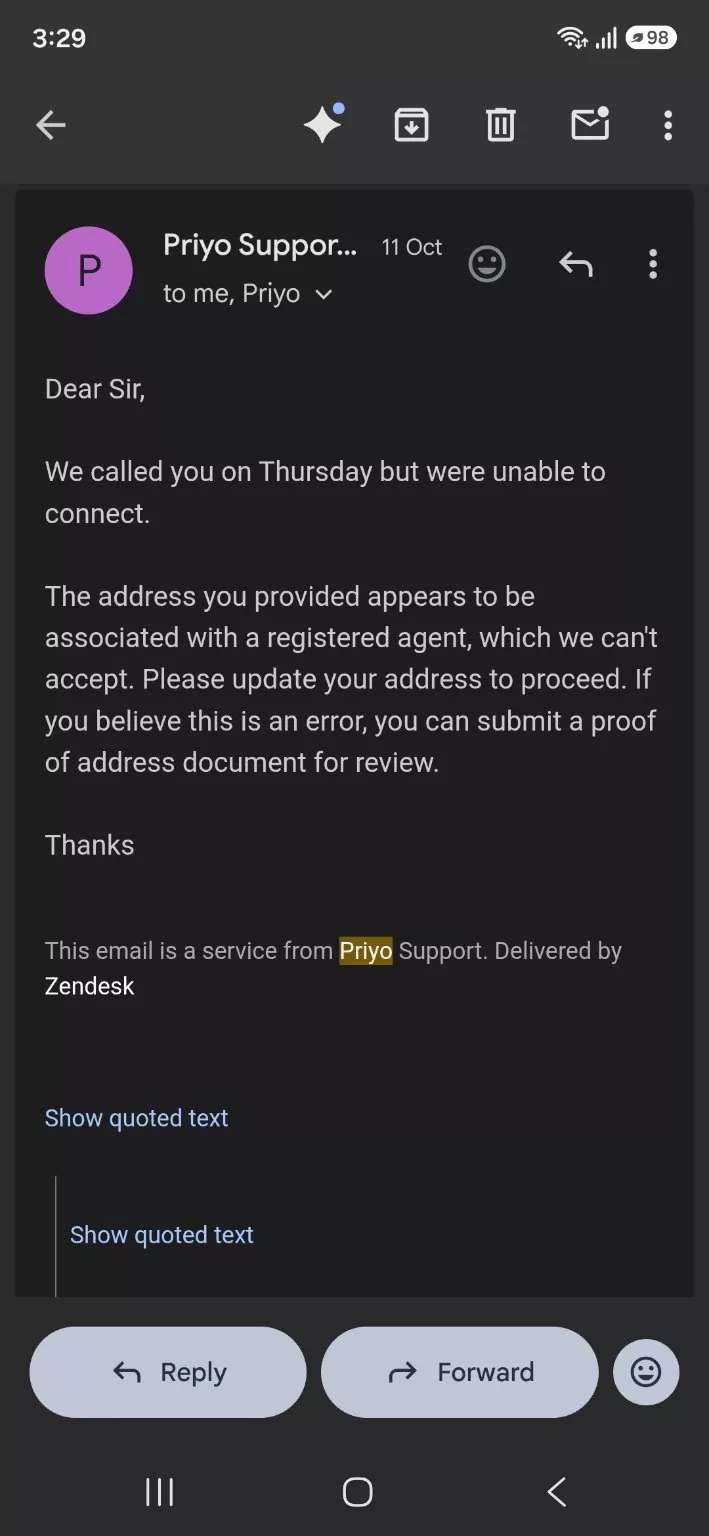
Priyo’s reply was specific: its banking partner required a valid US physical operating address unique to the business, excluding virtual and registered-agent addresses. A further response said the physical operating address was mandatory for opening the account.
Our thread then asked whether a relative’s house would be acceptable. Support did not approve that arrangement. It declined to provide specific details and suggested looking elsewhere for information.
That left an important question unanswered. A relative’s willingness to receive mail is not the same as a provider accepting that property as the company’s operating location. I would not turn that unanswered question into advice that another founder should buy an address or borrow documents.
The Missing Answer Was Commercial, Not Just Administrative
Once a provider requires a genuine operating location, the founder needs more than a street address. What activity must happen there? Who must perform it? What proof will the reviewer accept? Would a particular arrangement qualify before the business pays for it?
A real office or properly authorized representative may make sense for some companies. But the expense should serve the business and meet the provider’s disclosed requirements. It should not be incurred merely because somebody selling formation services says it will “work for banking.”
My interpretation of the exchange is that the application had reached a structural mismatch. We had described the company honestly; the provider wanted a business presence that the company did not have. More copies of the same formation document could not, by themselves, supply that missing fact.
This is where a founder needs a clear stop point: do not keep spending on an application until the unresolved eligibility condition is understood.
A Later Card Rejection Was a Different Decision
The November screenshot concerned an application for cards through Priyo Payments LLC. It said identity could not be verified within 30 days. The message identified Stripe and Priyo Payments LLC acting on behalf of Celtic Bank.
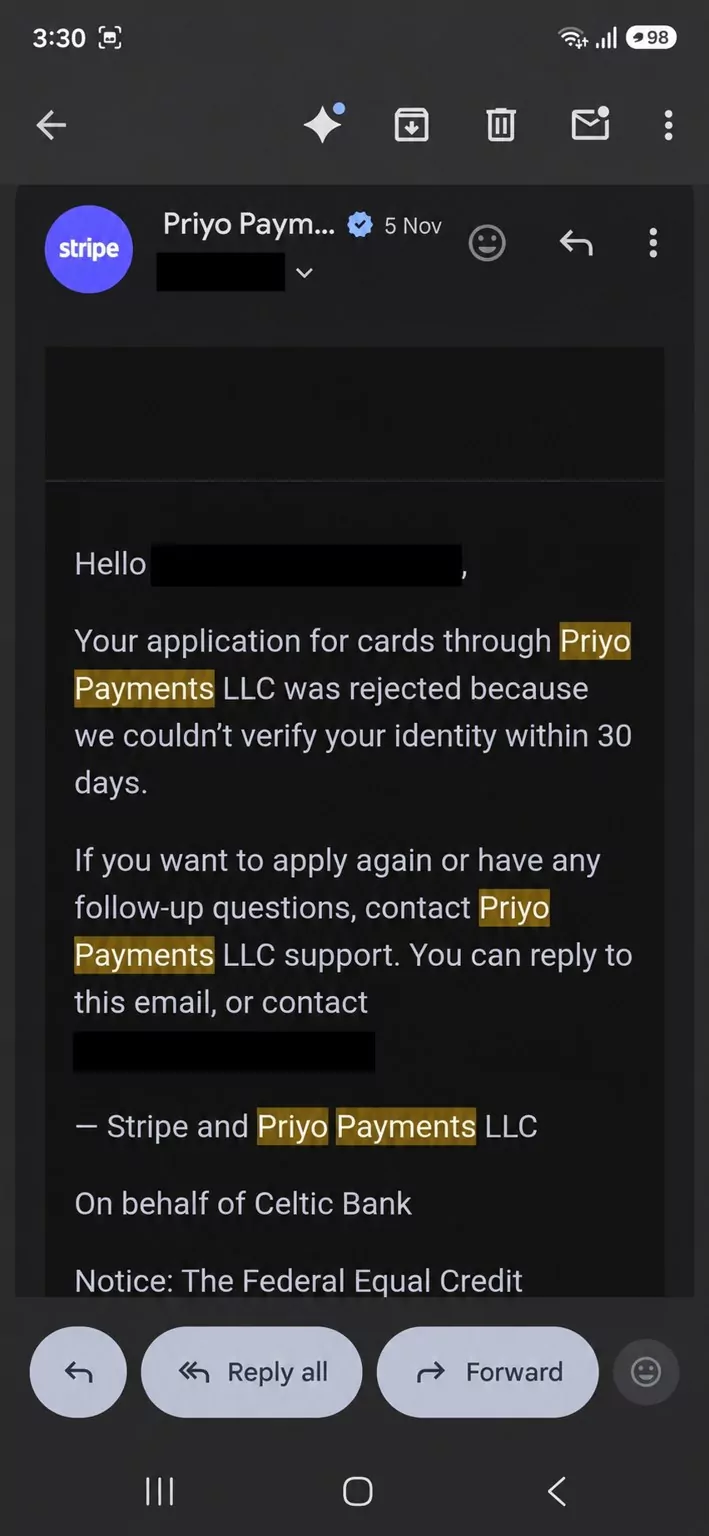
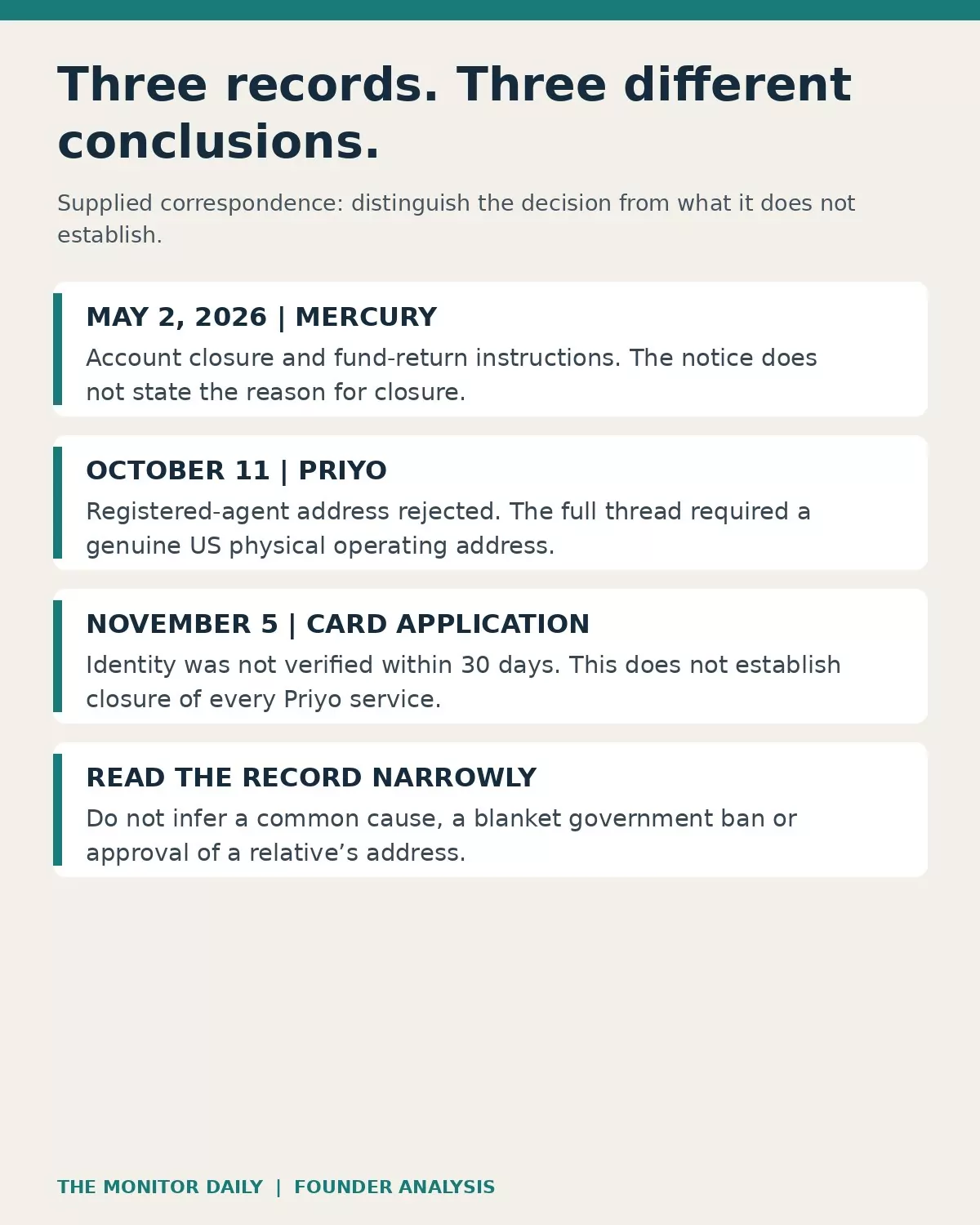
It would be tempting to combine the October address problem and November card decision into one sweeping story. The records do not justify that. They describe different communications and different stated reasons. They do not establish whether the unresolved address caused the card-verification outcome.
They also do not prove that Priyo stopped operating, that every service attached to the company was closed, or that a US government agency issued a blanket ban on businesses like ours. A financial provider’s requirements can be consequential without being a universal statement of law.
For management, the lesson is practical: maintain a separate status for the business account, spend cards, merchant processing and payouts. “The account is not working” is too vague to guide a recovery plan.
Mercury Had Already Shown Why an Exit Route Matters
The earlier Mercury notice confirmed that Editorialge Media LLC’s account had closed. It described returning any remaining funds by physical check. It also referred to closure of the associated IO credit-card account.
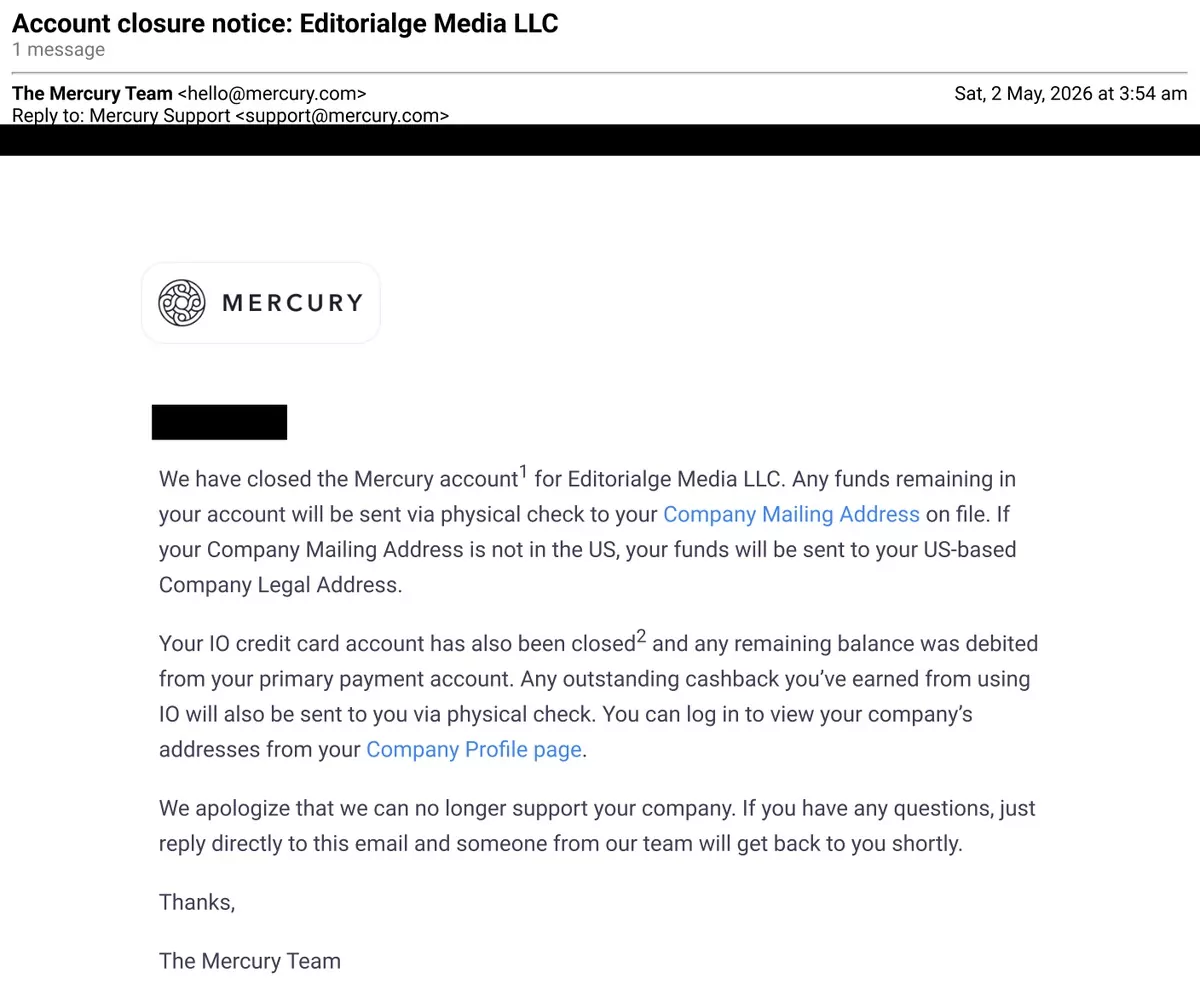
The notice does not give a reason for closure. I cannot responsibly insert one after the fact. Mercury’s current public policy lists Bangladesh among prohibited countries and distinguishes residence from nationality; that establishes an obstacle for relevant applicants now, not the documented cause of this earlier decision.
Nor do the supplied records quantify how much revenue the company lost, whether payroll was delayed, or how long a returned check took to clear. Those would require different evidence. The operating risk is nevertheless clear: a balance and a practical way to use that balance are not interchangeable.
The Monitor Daily’s earlier business bank account closure continuity guide covers the immediate response. The Priyo correspondence adds a subsequent problem: the next application can fail a different eligibility test from the one a founder expected.
Three Questions I Would Settle Before Applying Again
1. Which Entity Is Actually Selling?
If a US LLC signs the contract and issues the invoice, its payment arrangements should reflect that seller. An owner’s personal wallet or another company’s bank account is not automatically an acceptable substitute.
If a Bangladesh operating business will make future sales instead, the change needs to be real: customer terms, invoices, tax treatment, refunds and accounting must follow the new arrangement. That is a business decision to document, not a name to switch silently on a payment form.
2. Which Service Is Missing?
Our card rejection was not itself proof that merchant processing had been refused. Conversely, a processor accepting a customer’s card would not prove that the company had a usable payout destination.
As our payment gateway versus payment processor explainer describes, payment functions are related but distinct. Before choosing a replacement, I would specify whether the business needs client invoice collection, consumer checkout, settlement, international withdrawals or expense payments.
3. What Would Make the Route Usable in Practice?
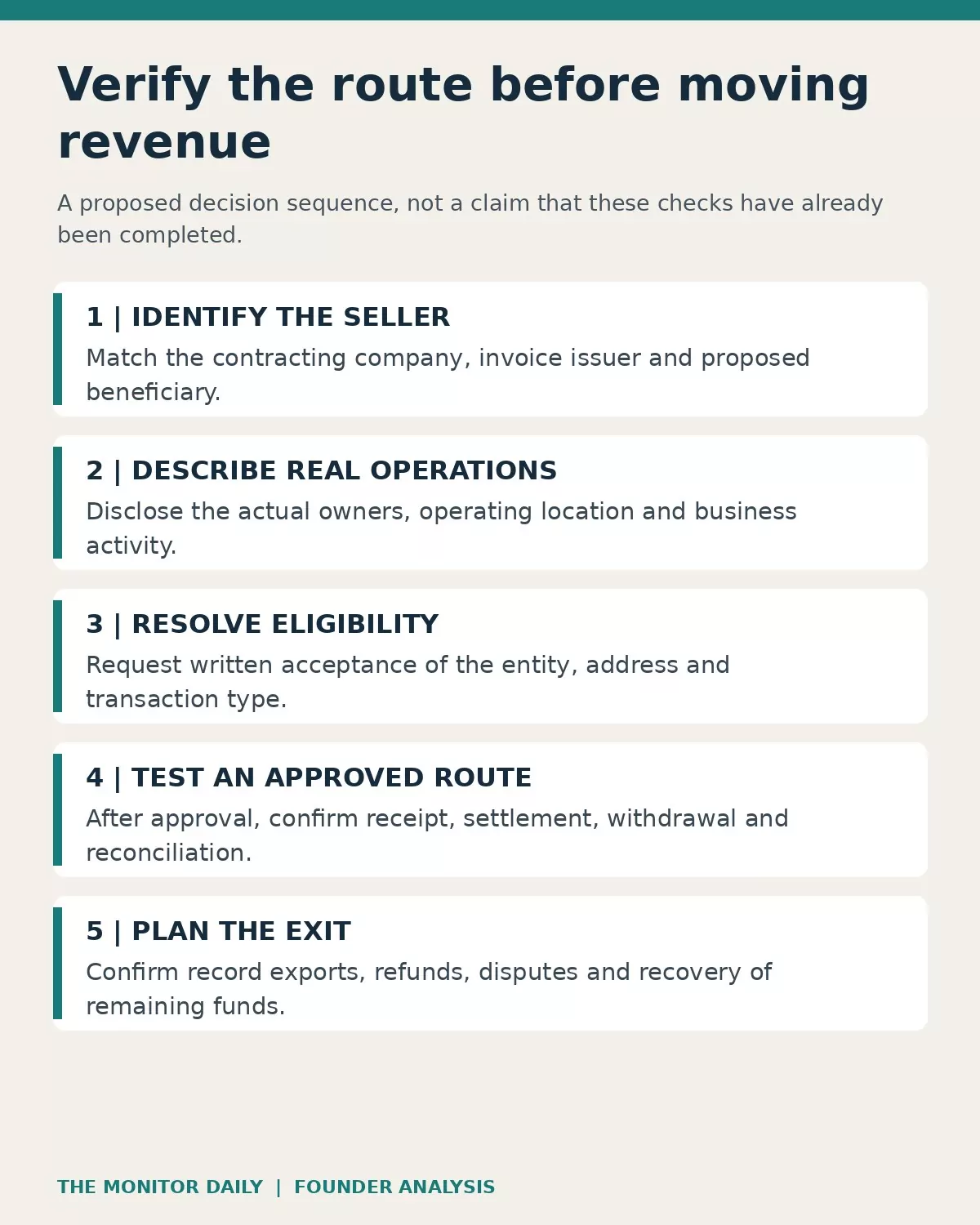
A provider’s written acceptance of the entity, owners, real operating address and transaction type comes first. Then comes a genuine receipt, settlement into the approved beneficiary account, withdrawal and reconciliation.
Only after that sequence would I treat the route as operational. Even a successful first transaction would not guarantee permanent service, but it would establish more than a signup confirmation.
Alternative Routes Need Different Business Decisions
| Business need | Route to investigate | Decision before implementation |
|---|---|---|
| US LLC must remain the seller | A company account and processor that expressly accept the actual ownership and operating footprint. | Confirm the full entity-to-beneficiary arrangement, not just the company’s incorporation country. |
| Business clients buy services | Documented bank transfers or an approved B2B payment service. | Confirm the invoice issuer, payer, beneficiary and receipt documentation. |
| Customers buy eligible software | A merchant-of-record arrangement. | Confirm product eligibility, supplier contracting and the payout destination. |
| A Bangladesh business makes the sale | Approved local acquiring or export-receipt banking channels. | Establish the local merchant relationship and applicable reporting before changing collections. |
This is deliberately a route comparison, not a promise that another logo will solve our case. Payoneer, Paddle, local acquiring and US-company account providers perform different jobs. None should be selected solely because a webpage mentions international customers.
For the same reason, a provider’s personal-account availability should not be treated as approval to receive corporate turnover. And a tax identifier is not a substitute for an acceptable operating arrangement. The IRS describes an ITIN as a federal-tax identifier; it does not establish immigration status or confer a right to a bank account.
There is also a Bangladesh-side review. Bangladesh Bank’s consolidated export-transaction circular addresses service receipts, qualifying payment channels, repatriation and permitted retention. A receiving authorized-dealer bank should identify the provisions applicable to the real seller and transaction. A foreign platform’s acceptance is not the end of that assessment.
The Cost I Would Measure Is the Cost of a Working Route
A low transfer fee is attractive, but it cannot answer whether the money will arrive under the right name, in the right account, when the business needs it.
My comparison would record the same invoice amount, a timestamped exchange-rate quote, processing deductions, intermediary charges, settlement time and the final usable amount. Reserves and refund obligations would be tracked separately from fees. No live price comparison or measured loss is claimed here.
I would also ask what happens if service ends: can the company export its records, recover funds, handle disputes and change payout instructions without relying on an inaccessible account? That exit question belongs in the initial evaluation, not just in the emergency checklist.
What I Want Providers to Explain Earlier
The most useful improvement would be a clear pre-application answer for a clearly described business. Does the provider accept its actual operating country? Is the registered-agent address acceptable for legal correspondence only? Is a US physical office essential? What does “physical” require for this product?
If a founder proposes a relative’s address, support should say what relationship and genuine activity would need to exist, or state that it cannot assess the arrangement. An ambiguous response should not become an invitation for an address seller to promise approval.
Founders have responsibilities too. We should not conceal owners, invent an office, assign a nominal representative or rename receipts to force an application through. Honest disclosure may produce an unwelcome answer. It also tells management whether the proposed financial infrastructure can support the real company.
A Different Way to Judge the US Company
I would now assess a US company by the commercial purpose it serves and the payment structure it can sustain together. Contracts, assets or genuine US activity may justify keeping it. Access to one fintech product, by itself, is a fragile foundation.
Our Priyo experience does not tell every Bangladeshi founder to abandon a US LLC. It shows why the business should not depend on an operating-address claim it cannot substantiate. Where a different seller or structure is necessary, that change deserves legal, tax and accounting work rather than a cosmetic workaround.
The lesson I take from US business address verification is straightforward: company formation is the beginning of an operating arrangement. The arrangement is only useful when the business can explain it truthfully, obtain approval for it, and move money through it.