

A $148 hardware-store charge appears on a print shop’s business card. The receipt shows $112 for shelving brackets for the shop and $36 for the owner’s garden hose. The card statement explains how the owner paid. The receipt and a short note explain why only $112 belongs in the business records.
To document a business expense for US federal tax purposes, keep enough evidence to identify the seller, date, amount, purchase, and business use. Connect those details to the payment and the entry in your books. Travel, meals, and vehicle use can require additional records. A well-documented purchase can still be personal, subject to a deduction limit or treated as an asset.
Build an expense record someone else can follow
Start with the document that best describes what you bought. For a store purchase, that is usually an itemized receipt. For a contractor, it might be an invoice describing the work and the dates covered. If an invoice shows only an amount due, match it to the canceled check, bank transfer, or card transaction showing payment. The IRS guide to supporting business records explains which details several documents can establish together.
Write down the fact a stranger could never learn from the receipt. “Shelving for paper stock, rear workroom” tells a bookkeeper more than “business expense.” If the document already identifies the business and the job clearly, repeating its contents adds little. Put your time into explaining ambiguous purchases and mixed-use charges.
For the print shop example, save the whole receipt against the $148 transaction. Identify the $112 shop portion and route the remaining $36 to the appropriate personal or owner account with your bookkeeper. Assume both amounts already include any sales tax. The two entries now reconcile to the bank, and the bookkeeper can assess the tax treatment of the shelving separately.
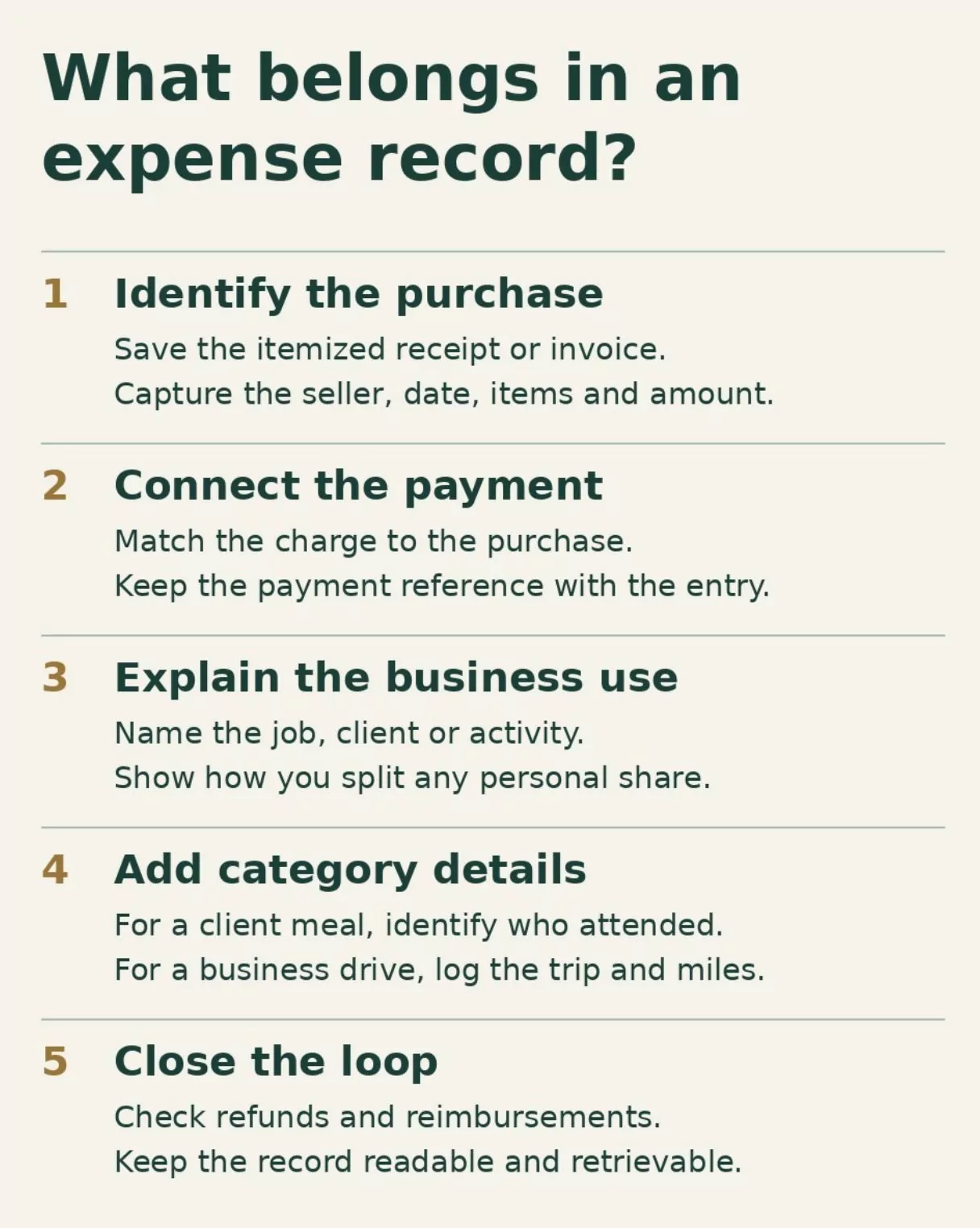
Record the details that depend on the expense
A recurring software invoice may explain itself. A restaurant bill usually leaves out the most important detail for a business meal claim. Capture information that will disappear once the meeting or trip ends.
- Client meal. Keep the itemized bill, payment total including tip, names or identifying details of the people present, their business relationship, and the purpose of the meeting. “Lena Ortiz, buyer for Oak Street Books, reviewed the spring catalog print estimate” explains the connection. Record the actual cost so the preparer can apply any deduction limit.
- Business drive. Log the date, destination, business purpose, and miles for each qualifying trip. Track total annual vehicle mileage as well. A repair receipt identifies a vehicle expense, but it cannot show how many miles were business use. Keep ordinary commuting separate.
- Overnight business trip. Keep travel dates, destination, purpose, and an itemized hotel folio. Split personal nights and extras from the business portion. If the hotel charged a deposit, match it and the final payment to the same folio so the deposit is counted once.
- Equipment. Save the purchase invoice, acquisition cost, date the item was ready and available for business use, and records supporting any business-use percentage. Keep later sale or disposal information with the same asset file. Those facts can matter long after the purchase year.
What the $75 receipt rule actually covers
For expenses covered by the documentary-evidence rules in IRS Publication 463, chapter 5, an expense below $75 generally falls under an exception to the receipt requirement. Lodging is excluded from that particular exception. Exactly $75 does not fall below the threshold. The IRS also provides a separate exception for transportation when a receipt is not readily available.
A $24 cash taxi ride from a hotel to a client’s office illustrates the distinction. Record the fare, date, route, and client visit while you remember them. The receipt exception concerns one form of evidence. You still need to establish the expense and its business purpose.
Recover a missing receipt without guessing
First request a duplicate from the seller. Check the original order email, customer account or hotel booking for an itemized copy. If a duplicate is unavailable, collect what each remaining source can show. A bank record may establish the amount, a delivery email may identify the goods, and a work order may connect those goods to a customer.
For example, if a card statement shows $310 at a hotel, a conference invitation may explain why you traveled. It cannot distinguish room charges from meals or a personal extra night. Request the folio and flag the unsupported part for the tax preparer. If you reconstruct an entry, record when you prepared it and what you relied on. For expenses subject to stricter substantiation, a year-end estimate alone is insufficient.
Make the monthly close catch duplicate expenses
Choose one place for purchase records and give each transaction a reference you can find in the ledger. A spreadsheet row might include the purchase date, seller, gross amount, business share, purpose, payment reference, and receipt filename. A readable scan or electronic invoice is useful only if it stays accessible. Download invoices from vendor portals, back up the files, and periodically open a sample from the backup.
At month-end, trace charges in both directions. Start with the bank statement to find missing receipts. Then start with receipts to find cash purchases and employee-paid expenses that never appeared on the business card. Match a reimbursement to the original purchase before entering it. If an employee bought $48 of packing materials and the company repaid $48, there is one purchase to classify. Finally, link refunds and credits to the original entry so the books reflect what the business ultimately spent.
Set the retention date by record type
The usual federal income-tax retention period is three years for an ordinary return when no exception applies. The period generally runs from filing, with an early return treated as filed on its due date. Using the purchase date as the starting point can lead to premature disposal. The IRS record-retention schedule explains the exceptions, including longer periods for certain omitted income and refund claims.
Keep employment tax records for at least four years after the tax became due or was paid, whichever is later. For property, generally retain the supporting records until the limitation period expires for the year you dispose of it. Before deleting an old folder, check whether an open examination, state requirement, insurer or lender still requires those documents.
Try the one-charge check
Before handing over the books, pick one unfamiliar transaction and ask a colleague to trace it. Can they find what the business bought, explain why it needed it, and reproduce the amount recorded? If they reach the $148 hardware receipt and can identify the $112 shop share without calling the owner, the file has done its job.