

Mailchimp’s proposed sale changes the company’s future owner, but it does not give business customers a new price list or a deadline to move their campaigns. For small firms, the immediate task is to understand how much of their customer outreach depends on the platform—and which future announcements would justify a change.
Intuit announced on November 19 that it had agreed to sell the email marketing business to Milan-based Bending Spoons for approximately $3.68 billion. The companies expect to complete the transaction in early 2027, subject to approvals and other conditions. Our report on the Mailchimp sale covers the announcement.
The customer question goes beyond who owns the software. A marketing platform can hold audiences, templates and campaign history while connecting to a company’s sales records. Changing that arrangement can involve staff time and operational risk as well as a monthly subscription.
What has actually changed?
A sale agreement has been signed; ownership has not yet transferred. Intuit’s transaction filing with the SEC says regulatory clearances and other closing conditions remain. The deal does not require an Intuit shareholder vote and is not conditional on financing.
The filing describes a $3.68 billion cash purchase price, with Intuit separately reinvesting approximately $368 million in newly issued Bending Spoons shares. Those are transaction terms between the companies, not amounts charged to Mailchimp customers.
Mailchimp’s customer notice says the service remains part of Intuit until closing and directs customers to their existing support channels. That is a statement about the transition period. It should not be read as a permanent guarantee about every future feature, subscription or integration.
Why does the buyer matter?
Bending Spoons owns digital businesses including Evernote, Vimeo and WeTransfer. Its published approach to acquisitions involves changes to technology, product development, organizational structure and monetization. Chief executive Luca Ferrari has said the company intends to invest substantially in Mailchimp after closing.
That creates two separate questions: what resources a new owner may put into the product, and how customers will experience the resulting decisions. An investment promise does not answer the second question. Specific plans, service terms and delivery dates matter more than a broad statement of intent.
Business Insider’s reporting on an internal staff memo describes uncertainty among employees and a message that arrangements would remain unchanged before closing. It provides context about the transition, not proof that customer support will deteriorate or that a particular Mailchimp restructuring has been announced.
Does this mean customers will pay more?
The acquisition announcements reviewed for this explainer do not provide a new customer pricing schedule. Neither the purchase price nor the buyer’s general operating model establishes what a particular account will pay after closing.
There is relevant business context. Intuit’s quarterly filing reports Mailchimp revenue of $313 million for the quarter ended October 31, down 1% from a year earlier. It attributes the decline to fewer paying customers and a change in customer mix, partly offset by higher effective prices. That describes an already reported period; it is not evidence of a price increase caused by the proposed sale.
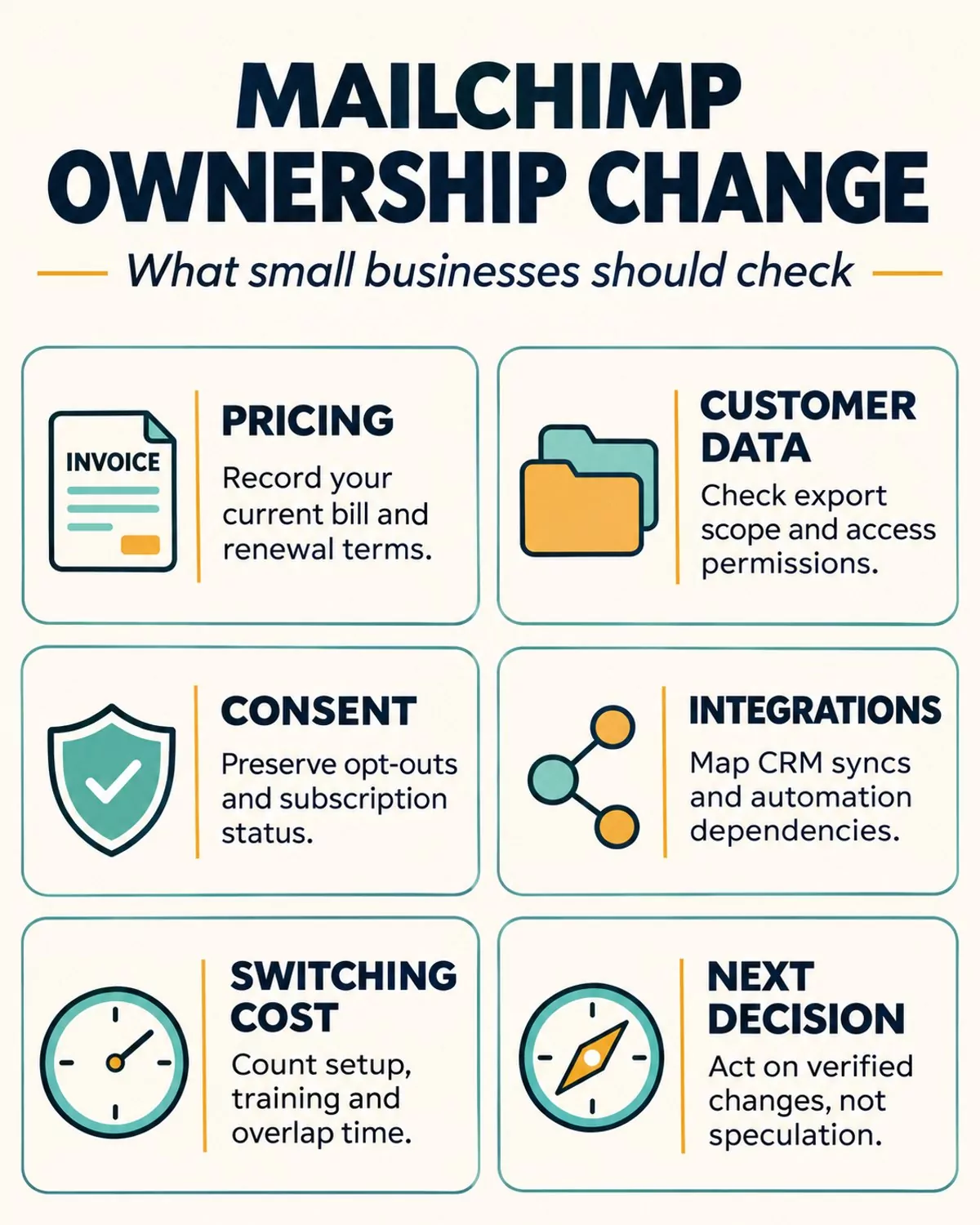
For an operator, the useful baseline is the actual bill and the terms behind it: billing period, contact allowance, send limits, add-ons, discounts and renewal date. Record those now. A later offer can then be compared with the same workload instead of an attractive headline price that buys something different.
Customer data is only part of the switching problem
Mailchimp’s export documentation says an account export can include audiences, templates, email content and reporting data. Audience files distinguish subscribed, unsubscribed, cleaned and non-subscribed contacts. Those distinctions matter: an email address alone does not explain whether it belongs in an active marketing audience.
The documentation also identifies gaps. Billing receipts, deleted audiences and information held only in a separate application are not included. Website, landing-page and advertising content are also excluded from the account export. Mailchimp says email and SMS reports cannot be re-imported.
A downloadable archive therefore should not be confused with a ready-to-run replacement system. Before relying on an export, an authorized administrator should check what it contains, restrict access appropriately and identify what would need separate preservation or rebuilding. These are planning checks, not a claim that a migration has been tested for this article.
Why CRM integrations deserve attention
A business may use its CRM to manage sales opportunities while Mailchimp handles marketing audiences and campaigns. The connection between them can determine which records move, how fields match and where a change in subscription status is recorded.
The sale announcements do not establish that those connections will stop working. The practical response is to map existing dependencies: which connector is used, who administers it, which direction records move and which workflows rely on its output. Our guide to connecting a CRM to email marketing explains the relationship between field mapping, synchronization and opt-out handling.
If a later notice changes an integration or authentication requirement, that map helps the business identify the affected work. Without it, a seemingly small technical change can be difficult to assess because responsibility is spread across sales, marketing and an outside contractor.
When would switching make business sense?
A useful decision compares the cost of staying with the total cost of moving. The latter can include implementation, rebuilding templates and automations, staff training, parallel subscriptions and checking the new workflow. A lower monthly fee does not automatically recover those costs.
Consider a hypothetical firm that could save $40 a month but expects to spend $600 on setup and staff time. Ignoring all other costs, it would take 15 months to recover that initial expense. Add overlap subscriptions or further rebuilding and the payback period lengthens. This is illustrative arithmetic, not a Mailchimp quote or a measured customer result.
Price is only one trigger. A verified change to an essential feature, access requirement or integration may matter more. Conversely, if the service still meets the business’s requirements at an acceptable cost, the ownership announcement alone does not establish a reason to migrate.
What should customers watch next?
The first milestone is completion of the deal. After that, customer-facing announcements about subscriptions, product plans, support and integrations will be more useful than speculation about the buyer’s intentions.
For now, a proportionate response is to document the current arrangement, understand export limits and assign someone to review notices. The decision can then follow a concrete change in cost or capability. Businesses do not need to predict the new owner’s entire strategy to know what their own operations require.