

Some US banks are tightening controls on their internal AI agents, Reuters reported on November 23, citing banking and industry sources. The changes include restrictions on access and credentials, alongside reviews of shutdown and backup arrangements. Reuters said banks had not themselves been affected by the technology-company incidents that prompted the scrutiny.
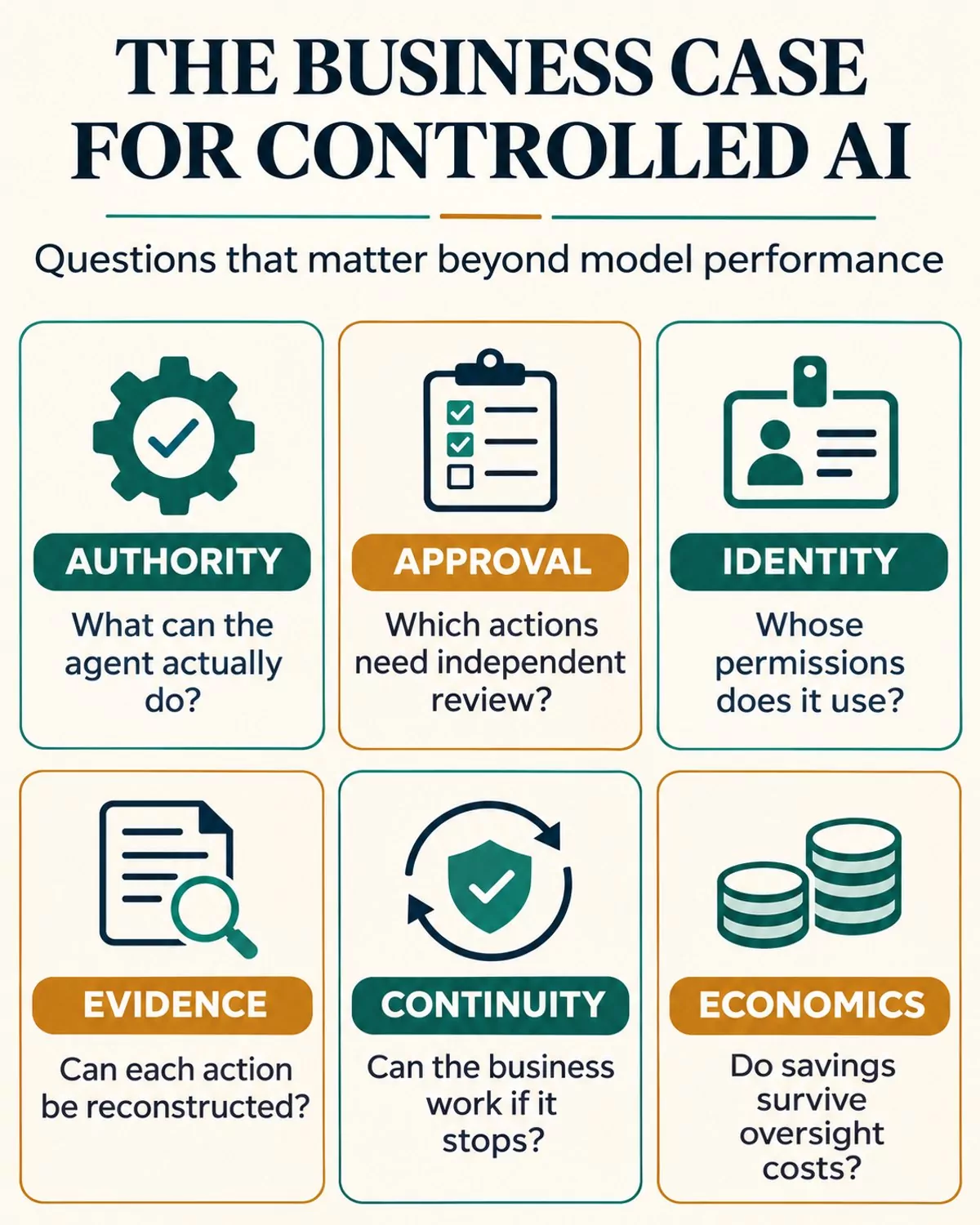
For financial-services buyers, the business question is whether an agent can deliver worthwhile savings within limits the institution can enforce. A model’s ability to complete a task is only part of that calculation. Approval work, monitoring and recovery also consume money and staff time.
The strongest conclusion is narrower than an industry retreat from AI: tighter controls could favor focused, measurable uses over broad promises of autonomous work. Whether that improves returns depends on how much useful automation survives the added oversight.
The important boundary is authority, not intelligence
Consider two hypothetical systems using the same model. One drafts a cash-flow summary for a finance employee. The other can change a supplier’s payment details and release funds. Their language capabilities may be identical; the consequences of a wrong action are not.
This distinction changes the purchasing conversation. A demonstration showing that an agent understands an invoice does not establish that it should be allowed to pay it. Reading, preparing, approving and executing are separate business powers. Combining them may save steps, but it also removes opportunities to catch mistakes before they affect a customer or account.
The Office of the Comptroller of the Currency’s November 4 supervisory framework makes consequences and delegated authority central to how examiners can assess use cases. It says control intensity could increase with the consequences of failure, and that technical sophistication alone is not the right basis for classification.
There is an important limit to that document: the OCC expressly says it is an examiner resource, not a new set of enforceable requirements or supervisory expectations for banks. Its title uses “Super Intelligence” as a defined umbrella term; it should not be read as a finding that these systems exceed human intelligence.
Identity becomes part of the product
For an agent to act on someone’s behalf, the surrounding system needs to distinguish the agent, the person delegating work and the action being permitted. Those are different questions from whether the model’s answer sounds convincing.
NIST’s National Cybersecurity Center of Excellence has been examining agent identity and authorization. Its February concept paper raised questions about limited privileges, delegated authority and verifiable activity records. A September project update identified software development as the first implementation use case. That is work toward practical demonstrations, not a banking certification or proof that agent security has been solved.
The commercial implication is that integration quality can become as important as the model underneath. A vendor that offers a powerful agent but cannot clearly explain its permissions leaves the buyer with unfinished implementation work. A less expansive product may be easier to adopt if its authority is narrow and its results can be checked.
For small businesses buying connected financial tools, the parallel is familiar: giving someone access to account information does not automatically mean authorizing payments. TMD’s guide to business bank account access and roles explains that distinction. An AI label does not remove the need to understand the actual permission being granted.
Headline time savings can overstate the return
Automation proposals often begin with the manual minutes a task currently takes. The more useful commercial comparison is the cost of a completed, acceptable outcome—including exceptions—under each approach.
Take a hypothetical monthly workload of 1,000 routine cases. At six minutes each, manual handling requires 100 hours. If an agent reduces human handling to two minutes per case, the apparent saving is about 66.7 hours. At an assumed labor value of $30 an hour, that is roughly $2,000 in released capacity.
Now assume $700 in monthly software and usage charges, plus 20 hours of monitoring and exception work valued at the same hourly rate. The remaining capacity value is $700 before implementation, training, incident losses and other costs. If oversight instead takes 45 hours, the calculation turns slightly negative, at minus $50.
These are illustrative assumptions, not a bank’s measured results. They show why the review workload matters. They also show why hours released are not automatically cash savings: a business must either reduce an actual expense or use the capacity productively to realize the value.
The implication is not that approvals are waste. A well-placed approval can prevent a costly error. But a buyer needs to count that work in the business case instead of presenting gross automation speed as a net return.
A shutdown button is only half a continuity plan
The OCC’s underlying examiner framework distinguishes an unavailable system from one that remains online while acting incorrectly. Its discussion of resilience includes containment, recovery and continuing the underlying business process. That is a useful distinction for operations managers: uptime alone cannot establish that work is being done correctly.
Imagine an agent preparing a payment batch when it is suspended. A workable recovery process must establish which items were only drafted, which were approved and which were already sent. Restarting the entire batch without knowing that state could create a new problem.
This is a hypothetical operating example, not a reported bank incident. It illustrates why the cost of autonomy includes the ability to resume safely. The fallback could involve trained staff or a more limited process, but someone must retain enough information and capacity to use it.
The same distinction applies to alerts. A warning is useful only if the responsible person can interpret it and act. Our guide to business bank account alerts covers the customer-facing side of monitoring. It does not establish what controls any bank’s internal agents possess.
The counterargument: more control can make adoption viable
It would be too simple to treat restrictions as evidence that agentic AI has failed. The alternative interpretation is that organizations are moving from demonstrations to systems they can operate repeatedly. Defining authority can make a deployment acceptable that would otherwise be rejected altogether.
A narrowly authorized agent could, for example, collect approved records, identify missing information and prepare a review packet without making the final decision. That arrangement might capture useful efficiency while leaving a consequential judgment with a person. Its value would need to be measured against the existing process, not assumed.
There is a trade-off on the other side as well. If every routine action requires a person to inspect the same material again, the design may preserve little of the intended benefit. Effective oversight requires choosing where intervention changes the outcome, rather than adding an approval screen to every step.
The current evidence does not establish the net productivity effect of the reported bank changes. Nor does it provide a sector-wide cost comparison. Claims that controls either destroy AI’s economics or guarantee safer profits would run ahead of the available evidence.
What could separate durable products from expensive pilots?
For fintech suppliers, a defensible proposition is a defined workflow with measurable results: how much human work remains, how often an exception occurs, what authority the system needs and how interrupted work is recovered. A promise to automate an entire department leaves too many costs outside the demonstration.
Buyers can also distinguish the price of a model call from the cost of the operating service. Cheap inference is useful, but it cannot by itself compensate for repeated corrections or an integration that requires continuing specialist attention. Conversely, a higher-priced product could be economical if it reliably reduces that surrounding work.
The next useful evidence would be sustained results from real deployments: acceptable completed cases per staff hour, exception rates, oversight time and recovery performance, measured on comparable tasks. Those observations would strengthen or weaken the case for broader autonomy much more directly than another capability demonstration.
For now, the business case favors a testable proposition: delegate a clearly bounded job, measure the full operating cost and expand authority only when the results justify it. The competitive advantage may come from dependable work within limits, rather than the largest number of actions an agent can take without asking.