
Cross-border payment gateways help businesses accept online payments from customers in other countries, but choosing one involves more than checking whether it accepts international cards. Merchant eligibility, local payment methods, settlement currencies, subscription support and the real cost of conversion can all change the answer.
A SaaS company selling subscriptions may also prefer a merchant of record that handles certain transaction taxes. A physical-goods retailer will usually need a different arrangement. This guide compares 10 payment providers and related merchant-of-record platforms by their likely fit, so you can ask sharper questions before signing a contract.
How We Chose These Cross-Border Payment Gateways
This is a research-based comparison of provider documentation and product information reviewed on November 12, 2026. We did not open merchant accounts, process live transactions or independently benchmark approval rates. The list is organized by use case, not a measured ranking. Features, eligibility, prices and payout terms vary by country, business model, contract and account approval; confirm them directly for your circumstances.
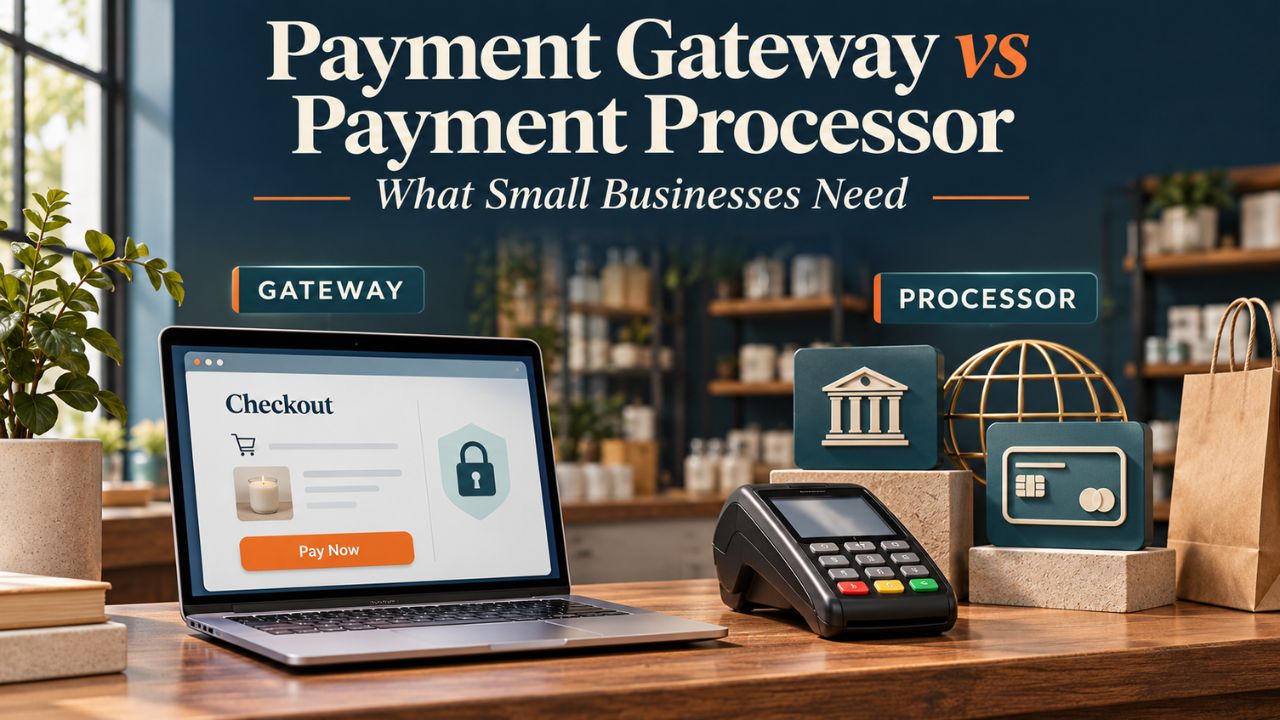
A gateway collects and transmits checkout information, while processing and acquiring move a payment through the relevant networks. Some providers combine these functions. Our explanation of payment gateways versus payment processors covers the distinction. Paddle and Lemon Squeezy are included as merchant-of-record alternatives for digital products, not described as ordinary standalone gateways.
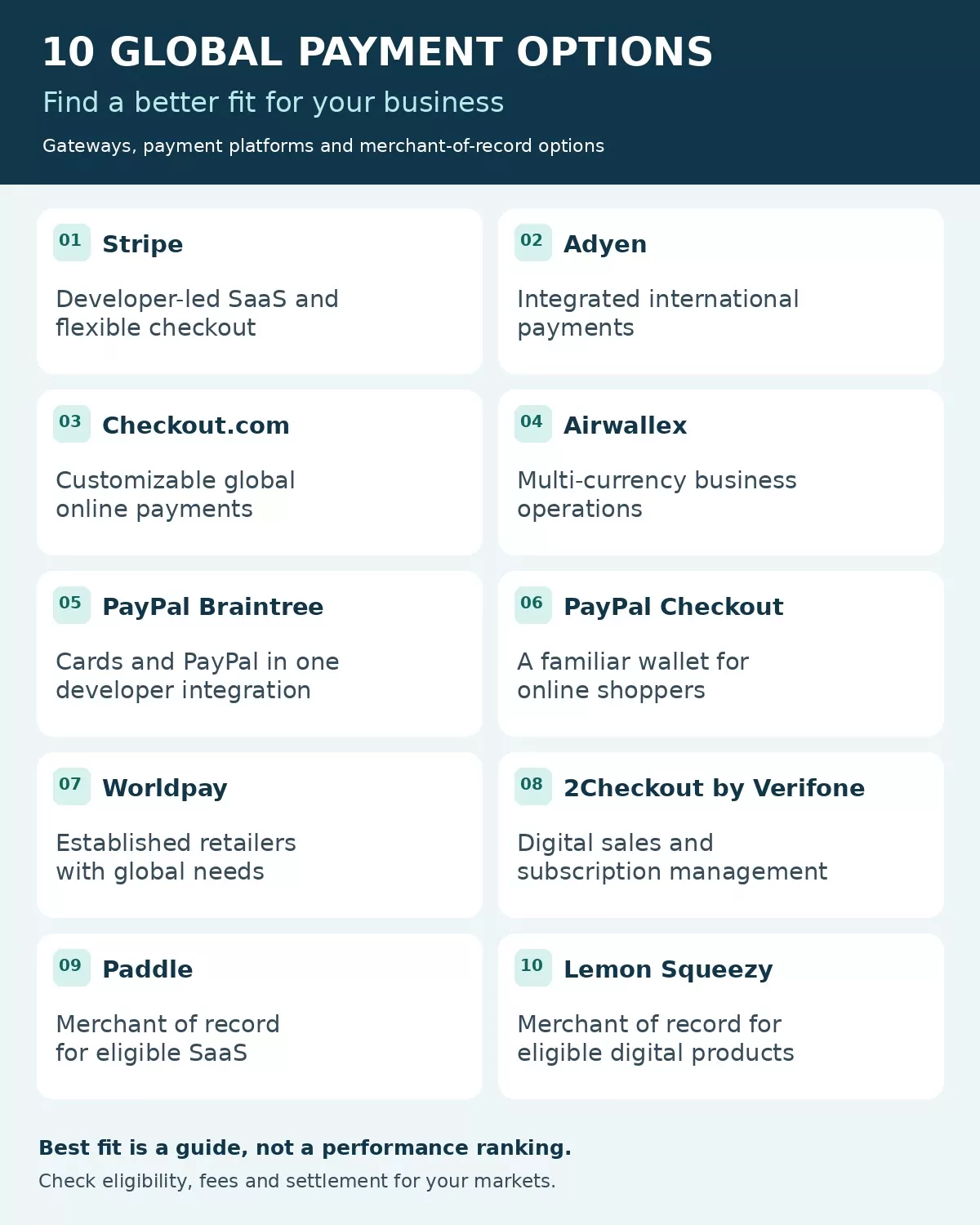
10 Options at a Glance
| Provider | Best fit | Check before choosing |
|---|---|---|
| Stripe | Developer-led SaaS and online checkout | Merchant availability, add-on and international fees |
| Adyen | Businesses needing integrated global acquiring | Contract, volume fit and implementation |
| Checkout.com | Customizable international card and local payments | Eligibility and commercial quote |
| Airwallex | Cross-border collection and multi-currency operations | Settlement and account coverage by market |
| PayPal Braintree | Combining cards and PayPal in a developer integration | Merchant eligibility and method-specific support |
| PayPal Checkout | Adding a recognizable wallet to an online store | Regional pricing and dispute terms |
| Worldpay | Established retailers with international requirements | Product, settlement terms and contract scope |
| 2Checkout by Verifone | International digital sales and subscriptions | Plan, legal seller and eligible products |
| Paddle | SaaS seeking a merchant of record | Product eligibility and tax responsibilities |
| Lemon Squeezy | Digital products and subscription sellers | Supported products and payout eligibility |
1. Stripe — Best for Developer-led SaaS and flexible checkout
Stripe combines payment acceptance with developer tools and separate products for recurring billing and tax-related workflows. It is a practical starting point when a software team wants control over checkout and the way payments connect to its product.
Map the payment methods and recurring-payment behavior you need against the country of your business and customer. A method that works for a one-time purchase may not work the same way for subscriptions. Check cross-border, currency conversion, billing and other applicable charges rather than assuming the domestic card rate is the total.
2. Adyen — Best for Integrated international payments for established businesses
Adyen brings payment processing and acquiring together with a range of payment methods. Its appeal is strongest when a business needs to manage multiple markets and wants a more integrated view of payments across its operation.
Ask for a quote based on your actual sales mix, countries and methods. Confirm integration effort, support arrangements and which services are included; a broad enterprise platform can be more work than a small shop needs.
3. Checkout.com — Best for Customizable online payments across markets
Checkout.com supports online card and local payment methods and offers integrations suited to businesses that want to shape their checkout experience. Teams with their own developers can evaluate it for international expansion and payment operations.
Check whether your legal entity, industry and target markets qualify. Request details on local acquiring, payout currencies, fraud tools and dispute handling in the proposed contract. Do not assume every advertised method is available to every merchant.
4. Airwallex — Best for Payments and multi-currency business operations
Airwallex offers online payment acceptance alongside business accounts and other cross-border financial tools in supported markets. It may be worth examining when collecting customer payments and managing funds in multiple currencies are related priorities.
Receiving money in a currency is not the same as settling it in that currency. Ask which currencies can be held, paid out or converted for your entity, and what fees and bank-account requirements apply in each case.
5. PayPal Braintree — Best for Cards and PayPal through a developer-led integration
Braintree provides an integration for online payments, including PayPal and card capabilities in supported markets. Its recurring billing documentation also describes subscription plans, making it relevant to businesses with predictable repeat charges.
Confirm that Braintree onboards merchants where your company is established and that each payment method supports the countries and billing model you need. Assess developer resources and test failed payments, refunds and recurring-payment changes before migration.
6. PayPal Checkout — Best for Adding a familiar wallet to an existing store
PayPal Checkout is useful to consider when customers already expect a PayPal button. It can complement another payment provider, rather than replacing the entire checkout stack, depending on how a store is configured.
Review country-specific merchant terms, funding methods, currency conversion, disputes and cross-border fees. The buyer-facing PayPal option and Braintree’s developer platform are related offerings, but they are not interchangeable implementation choices.
7. Worldpay — Best for Established retailers with complex international needs
Worldpay offers online payment services for retailers and businesses selling across borders. It is a candidate when payment acceptance is part of a broader operation and the business needs to discuss acquiring and regional coverage with a provider.
The product and commercial arrangement matter. Ask which markets use local processing, which transactions are cross-border, what currencies settle into your bank account and what support is included. Compare contract commitments as well as processing rates.
8. 2Checkout by Verifone — Best for International digital sales and subscription management
2Checkout’s monetization offering combines payments with features for online sales and subscriptions. It is especially relevant to digital businesses looking for an integrated commercial workflow rather than assembling every component separately.
Plans and operating models differ. Ask the provider who is the legal seller for the chosen arrangement, which products and merchants qualify, and which tax, refund and subscription tasks remain yours. Confirm the current contract and fees for your business.
9. Paddle — Best for SaaS companies seeking a merchant of record
Paddle describes itself as a merchant of record for software and digital-product businesses, combining checkout, subscriptions and certain tax and compliance functions. For a small SaaS team, reducing the work involved in transaction-tax administration may be more valuable than minimizing a headline processing rate.
The merchant-of-record model changes the contractual sales relationship and may affect checkout control, reporting and how funds reach you. Verify eligible products, supported seller locations, payout schedules and exactly which tax obligations the agreement covers. It is not a universal solution for physical-goods retailers.
10. Lemon Squeezy — Best for Digital products and subscription sellers
Lemon Squeezy offers checkout and subscription tools using a merchant-of-record model for eligible digital products. It is worth considering for software makers who want a packaged selling experience rather than building every payment and tax workflow themselves.
Check your product category and seller-country eligibility before investing in an integration. Ask how refunds, payouts, fees, customer records and subscriptions are handled, and verify any tax responsibilities that remain with your business. Physical merchandise requires separate eligibility confirmation.

How to Compare the True Cost
Compare proposals using the same transaction mix, not just a published domestic card rate. Include processing and fixed transaction fees, international card charges, currency conversion or exchange-rate spread, local-method costs, refunds, disputes, subscriptions, monthly platform charges and integration work. Our guide to payment gateway fees for small online stores explains why the effective cost can differ from the advertised percentage.
For a simple illustration, suppose a $100 order incurs a $3 processing charge and a separate $2 conversion charge. The payment-related charges total $5, or 5% of the order, before any other applicable costs. This is arithmetic, not a provider quote; actual fees and currency conversion can be calculated on different bases.
Also examine payout timing, reserve requirements and the cost of handling disputes. A cheaper quote can be a poor fit if it does not support your customers’ preferred methods or leaves your team with a reconciliation problem.
Build a Shortlist Around Your Business
Start with the country where your legal entity is registered and the products it sells. Then list your three most important buyer markets, the currencies customers see, the payment methods they use, and the currency in which you need the money deposited. The U.S. International Trade Administration’s guidance on international e-commerce transactions emphasizes choosing payment methods with overseas buyer preferences and payment risk in mind.
For subscriptions, ask about initial authentication, recurring consent, retries, card updates and cancellation. For physical goods, check refunds, partial captures, shipping-related chargebacks and storefront integration. A merchant of record can take on specified transaction responsibilities, but the agreement determines its scope; your business may still have income-tax, reporting and other obligations. Consult a qualified adviser for the jurisdictions involved.
Questions to Ask Before Signing
- Can our legal entity and product category be onboarded, and in which countries can we sell?
- Which payment methods support both our customers’ markets and our exact one-time or recurring use case?
- What are the presentment, settlement and payout currencies, and when is conversion applied?
- What will processing, cross-border, foreign exchange, refunds, disputes and add-ons cost under our expected volume?
- Who is the legal seller, and who calculates, collects and remits applicable transaction taxes?
- What happens to customer payment tokens and subscriptions if we change providers?
- How are fraud checks, reserves, support, outages and reconciliation handled?
Ask each shortlisted provider for written answers and an itemized quote using the same example order values and countries. Test the checkout and reporting in an authorized sandbox where available, including failed payments, refunds and subscription renewal.
Choosing Cross-Border Payment Gateways That Fit
The best cross-border payment gateways for your business depend on where you are established, where buyers live, and how you sell. Stripe, Braintree and other processors can suit teams that want more control; Paddle and Lemon Squeezy offer a different merchant-of-record model for eligible digital products. Retailers with more complex operations may want to compare providers such as Adyen, Worldpay and Checkout.com.
Shortlist two or three options, verify eligibility and tax responsibilities, then compare complete costs and a realistic checkout workflow. Confirm the terms before moving live customer payments.