
Small-business payments entered the 2027 budgeting conversation this week when the Federal Reserve announced new prices for services it provides to banks and credit unions. For an owner, the immediate decision is practical: ask what will change in your own banking agreement, and separate that answer from the Federal Reserve’s wholesale fee schedule. A national pricing announcement is not your company’s next bank statement.
This weekly analysis covers November 10–16, 2026, and was checked on November 17. Its focus is the Federal Reserve’s November 12 announcement and the operational decisions it raises for US businesses. It is a document-based analysis of published central-bank materials, not a bank-product test, a negotiated fee quote or a claim that every payment provider changed its prices this week.
1. What changed in small-business payments this week?
The Federal Reserve Board’s November 12 announcement sets January 1, 2027, pricing for payment services supplied to banks and credit unions. It estimates an average price increase of 1.4% across established, mature services. That is an aggregate estimate for those services, not a required increase in a business customer’s fees.
The Board also announced adjustments to check processing, including changes during low-volume periods. It expressly says the changes do not affect consumers’ and businesses’ ability to pay with or receive checks. That distinction matters: a change behind the banking counter is not an instruction to stop accepting a customer’s check.
| Development | What is established | What a business still needs to establish |
|---|---|---|
| 2027 service pricing | The Fed has announced prices for services supplied to financial institutions | Whether its bank will change the business account’s charges or terms |
| Check-processing adjustments | The Fed is changing parts of its processing operation | Whether the bank will change customer cutoffs, availability or handling |
| Electronic-payment alternatives | Different methods have different operational requirements | Which service is available to this account and to its trading partners |
The news therefore creates a reason to review the payment operation, rather than a reason to replace it immediately. Start with the transactions that are frequent, expensive to handle or difficult to reconcile.
2. The dates and percentages need careful reading
The Board’s detailed Federal Register notice estimates a 5.4% average price increase for Check Services customers. Those customers are financial institutions using the service; the figure is not a forecast for every small business’s check fees.
The notice separately places changes to general weekend operating hours and holiday closures for Check Services in May 2027. It also says the full 2026 FedACH fee schedule will remain unchanged in 2027. These details prevent two misleading shortcuts: treating all operational changes as January events, or presenting the announcement as an across-the-board increase for every payment method.
Our interpretation is that owners should ask for dates and service names alongside any proposed price change. “The Fed raised fees” is not enough detail to reconcile a new charge. A bank may have its own commercial reasons for changing a price; the relevant evidence is the notice and agreement applying to your account.
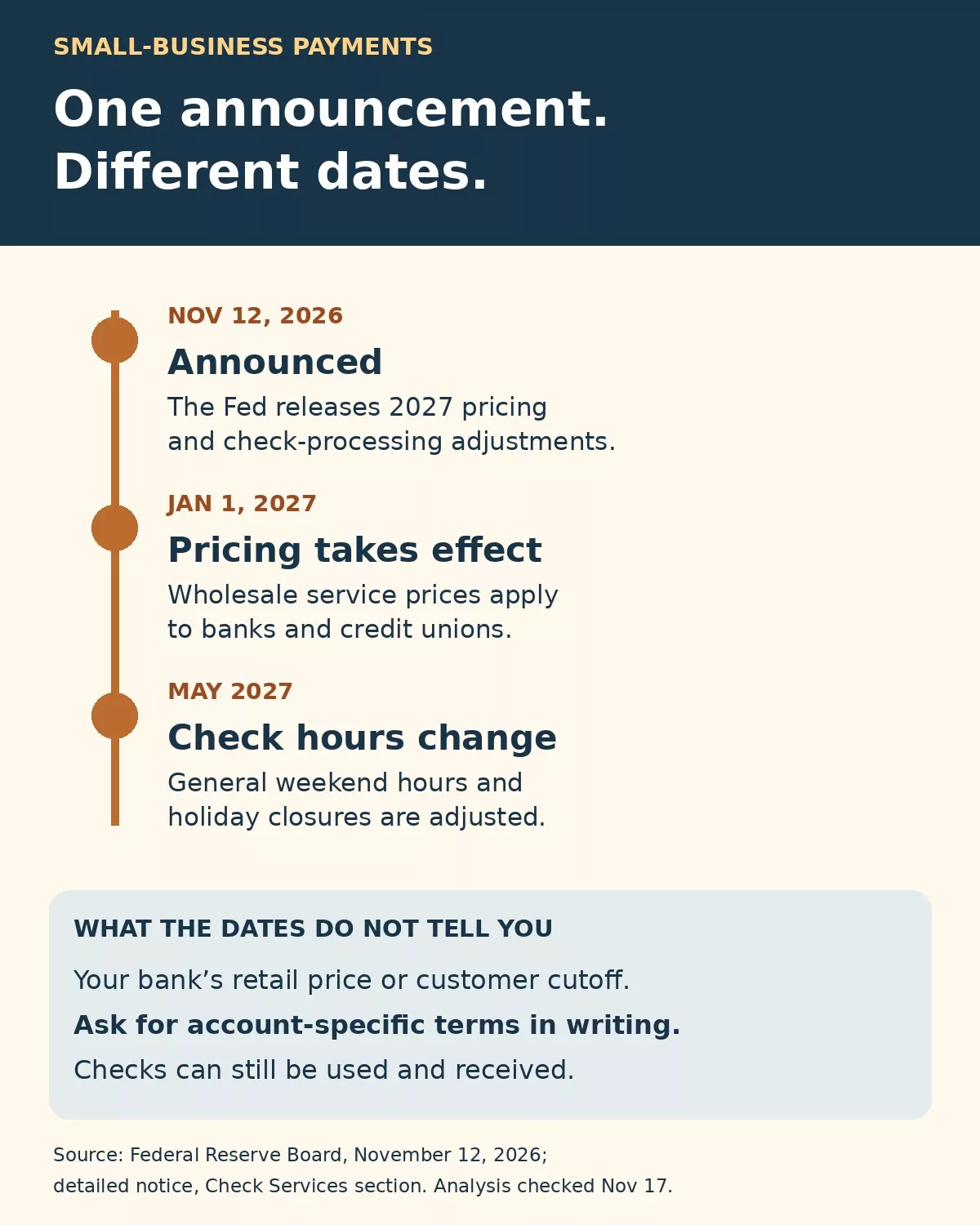
The timeline separates the November news from the 2027 implementation dates. It does not establish a retail account price or a customer deposit cutoff.
3. Wholesale costs and your bill are different layers
Think of the announcement as one input into a bank’s economics. Your bill is the price of the service and account package you actually buy. It may include monthly access, transaction allowances, individual payments, exceptions and other contracted services. Reconstruct that bill before estimating the impact of a headline percentage.
Ask the bank to identify the affected line item, current rate, replacement rate, effective date and any change to an included allowance. If a package price is changing, find out which services it covers. A per-item quote can look attractive while a monthly charge makes it unsuitable for a business with low volume.
Here is a hypothetical calculation, not an actual bank offer. Suppose a business sends 100 supplier payments a month. A proposed plan adds $15 to the monthly fee but reduces a relevant transaction charge by $0.20. At 100 qualifying payments, the reduction is $20 and the net saving is $5 a month. At 40 payments, the reduction is $8 and the same plan costs $7 more.
The break-even volume in that example is 75 payments: $15 divided by $0.20. It assumes that every counted payment qualifies and that no other charges change. Use your own actual volumes and written rates; do not apply this example as a forecast of the Fed announcement.
| Illustrative monthly volume | Saving at $0.20 per qualifying payment | After a $15 extra monthly charge |
|---|---|---|
| 40 | $8 | $7 higher cost |
| 75 | $15 | No net change |
| 100 | $20 | $5 lower cost |
4. A faster transfer is only one part of a better workflow
Earlier context helps explain why changing payment methods is not simply a speed comparison. In a November 4 research brief, Cleveland Fed researchers describe how structured remittance information can help connect a payment to an invoice. They also identify incomplete adoption and integration challenges as barriers to automated processing. That research predates this reporting week; it is background, not a newly announced rule.
For a small company, the practical question is what happens after the money moves. Can the recipient identify the invoice? Can the sender establish that it was paid once? Can the accounting team distinguish a partial payment from a full settlement without searching an email thread?
Consider an illustrative supplier payment covering three invoices and one credit note. A fast transfer that arrives with an unclear reference can still leave an employee doing manual allocation. A useful evaluation follows the reference from invoice approval through payment confirmation to the accounting record. Record any point where somebody must retype an amount or decide which invoice the payment belongs to.
Our ACH versus card payments guide for service-business invoices provides a starting point for comparing those two options. Apply the comparison to your actual transaction values and customer needs rather than assuming one method wins in every situation.
5. Keep control of the payment while changing the method
A payment migration should preserve clear ownership of supplier details and approvals. In the proposed workflow here, a person requesting a change to a supplier’s banking details does not become the sole evidence that the change is valid. Use an established verification process and retain a record of who approved the update.
Keep invoice approval separate from payment status. Marking an invoice “ready” should not make it indistinguishable from one already sent or confirmed. When a system times out, check the recorded payment state before pressing the send button again. This is a suggested control design, not a claim that any particular bank implements it automatically.
The invoice automation mistakes guide explains how fragmented intake and matching problems can lead to duplicate work. For a migration, retain one accountable queue for exceptions, with a named person who resolves uncertainty before a second instruction is created.
Ask the provider to demonstrate its own cancellation, error, investigation and recovery procedures. Do not promise your team that an electronic payment can always be undone. Document the procedure that actually applies to the selected service and the circumstances in which a recovery request may fail.
6. Use the announcement to prepare a focused bank conversation
Take a recent statement, a summary of payment counts and values, and the current fee agreement into the discussion. A short list of actual exceptions is often more useful than a wish list of every payment technology available.
| Question for the bank | Evidence to request |
|---|---|
| Which of our prices or allowances will change? | An account-specific schedule naming old and new terms |
| Which dates apply to us? | Separate dates for pricing, customer cutoffs and operational changes |
| Can our account send and receive the proposed payment type? | A demonstration of the actual account entitlement, limits and recipient requirements |
| What invoice details survive the transfer? | A sample confirmation and export using an illustrative invoice reference |
| What happens after an error or uncertain submission? | The support route, investigation process and applicable recovery terms |
| What is the full cost at our volume? | Monthly charges, included items, transaction rates and relevant exception fees |
Choose one bounded workflow for evaluation, such as recurring payments to established suppliers whose details have already been verified. Agree on the evidence needed before broader use: a correct recipient, clear authorization, useful invoice reference, understandable status and a reconcilable record. Do not use an important real payment as an uncontrolled experiment.
After the discussion, compare the proposed arrangement with the current one over the same period and transaction mix. Record assumptions explicitly. A saving based on a much larger payment volume is not a saving the present business can necessarily realize.
Verdict: make small-business payments easier to explain and reconcile
This week’s change is a clearer 2027 wholesale pricing and processing plan, not evidence that every company’s banking cost has already risen. The past problem—manual work around invoices, approvals and reconciliation—will not disappear simply because a transfer arrives sooner. The present task is to obtain the terms that apply to your own account.
For small-business payments, the useful next step is an account-specific comparison followed by a controlled workflow evaluation. Looking ahead to 2027, keep the January pricing date separate from the May check-processing changes, preserve reliable options for customers and suppliers, and judge any replacement by its total cost and operational result. Modernization is worthwhile when the business can explain where the money went, why it moved and which obligation it settled.