

Nvidia’s independent investigation into whether Chief Executive Jensen Huang was targeted by a foreign intelligence effort is testing the governance of a company whose chips underpin much of the AI industry. The questions extend beyond a personal relationship: what did the company know, how did it protect sensitive information, and can investors and customers evaluate risks while important facts remain unresolved?
Huang acknowledged being unfaithful to his wife and apologized to his family and colleagues. Separately, news reports have described US intelligence suspicions involving a former executive of an Nvidia customer. The existence of those reports does not establish that she committed espionage, that Huang knowingly assisted an intelligence operation, or that Nvidia secrets were compromised.
What has happened—and what remains unproven
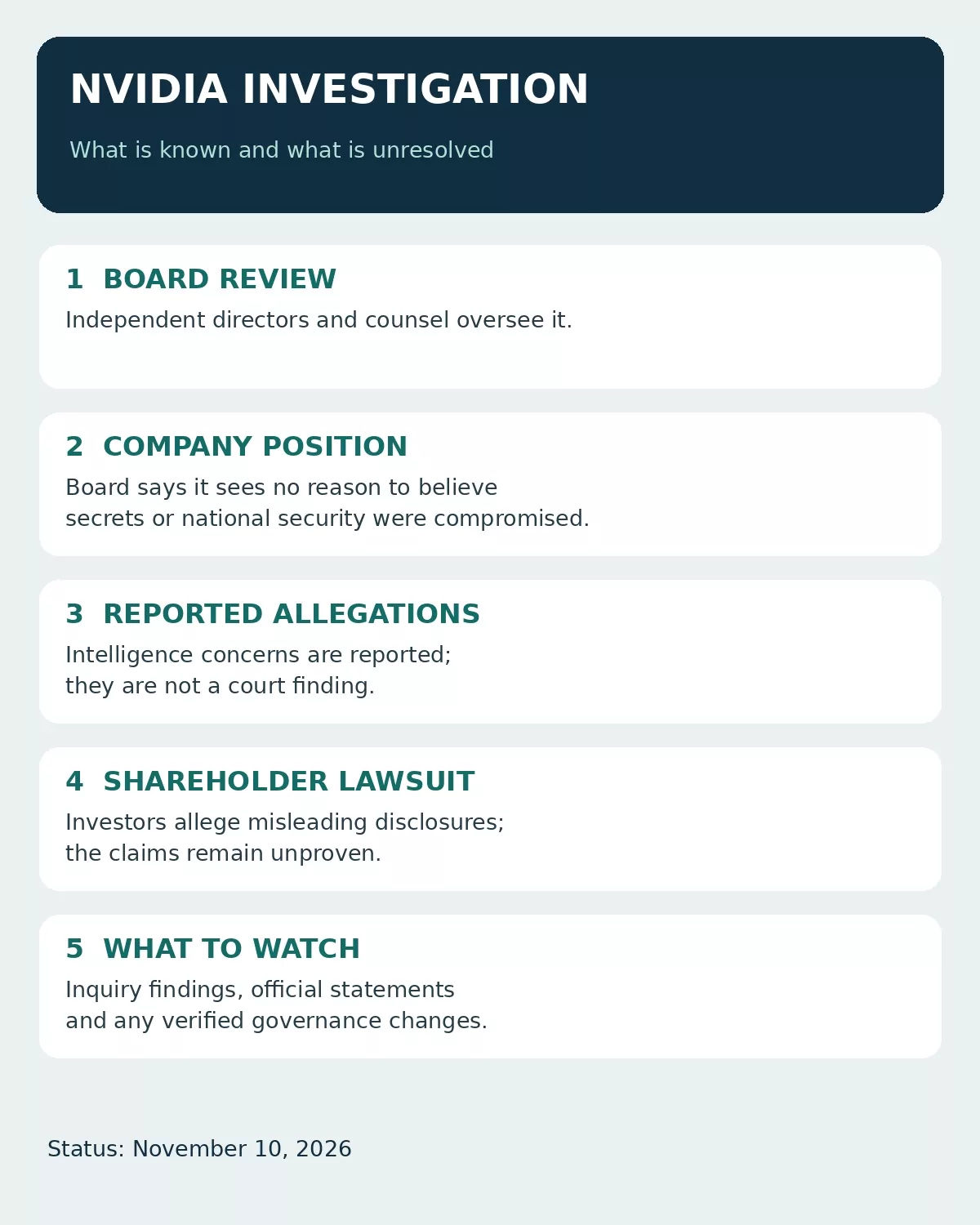
On November 8, Nvidia’s board announced an independent investigation following reports that Huang was the target of a foreign intelligence effort. In its public statement, the board said independent directors and outside counsel would oversee the inquiry. It said it had no reason to believe national security or Nvidia secrets had been compromised, while promising to examine the available information.
That is the board’s present assessment, not a completed investigative finding. The board also expressed confidence in Huang, who said he would cooperate. An independent inquiry could substantiate concerns, narrow them or find no evidence of compromise; the outcome should not be assumed.
The New York Times reported that US authorities suspected Alice Huang, a former executive at Singapore-based cloud company Megaspeed, of gathering intelligence for China. Jensen Huang and Alice Huang are not related. His employee message did not name her, according to reporting by CNA and Business Insider. The alleged intelligence role remains a reported allegation, not a publicly established court finding.
Singapore’s government rejected reporting that its officials had expressed concerns about Alice Huang’s alleged intelligence ties or had investigated those ties. It said investigations involving Megaspeed were ongoing. China has rejected the espionage allegations. Those statements address different questions and do not independently resolve the US allegations.
How the issue reached this point
Nvidia’s transformation from a graphics-chip company into a leading supplier of AI infrastructure made its customer relationships and exports strategically important. Advanced processors and the systems that use them are subject to complex export controls, and their distribution can involve manufacturers, cloud providers and customers in multiple jurisdictions.
On October 29, reporting about a US investigation brought renewed attention to Megaspeed and its former executive. The next day, Jensen Huang defended Nvidia’s dealings with the company as ordinary business, according to CNA’s account of his Bloomberg interview. That response and later reports should be assessed against what investigators ultimately establish about transactions and information flows.
On November 4, three senior US House committee chairs asked Huang to attend a closed-door briefing on the allegations and Nvidia’s procedures for safeguarding information. On November 8, Huang apologized for infidelity and the board announced its review. On November 9, investors filed a proposed shareholder class action alleging misleading disclosures, Reuters reported. The complaint is an allegation by plaintiffs, not a judicial determination; the company had not immediately responded to Reuters’ request for comment.
Why the board’s response matters
A chief executive routinely meets customers and counterparties. The governance question is whether potentially sensitive relationships or transactions were identified, evaluated and escalated through effective controls—not whether every executive meeting is inherently suspicious.
An inquiry that can earn confidence would need a clearly defined scope, access to relevant records, independent counsel and a way to report material findings without compromising legitimate security or privacy interests. Investors can reasonably ask when the board learned of the issues, what controls applied and whether those controls worked. The public does not yet have enough evidence to answer those questions conclusively.
Huang’s acknowledged conduct affected his family, but family members are not responsible for his decisions. Nvidia’s 2026 annual report says two of his adult children work at the company, are not executive officers and do not report directly to him. Their employment alone is not evidence of involvement in the allegations. Scrutiny of corporate governance should not become speculation about private individuals.
The security and export-control questions
There are at least three distinct issues: whether any nonpublic information was obtained, whether any hardware was diverted contrary to applicable rules, and whether corporate processes adequately identified and responded to risks. Evidence supporting one would not automatically prove either of the others.
A company can improve customer due diligence, limit access to sensitive technical material and investigate unusual distribution patterns, but none of those controls can by itself establish what happened in this case. The details of product classification, destinations, licenses, intermediaries and timing matter. Singapore has said it does not implement unilateral foreign export controls, while also saying it does not condone businesses using Singapore to circumvent other countries’ controls. That distinction matters when describing cross-border enforcement.
The board’s statement that it currently sees no reason to believe secrets were compromised deserves weight as the company’s position. It does not eliminate the need for an independent inquiry, and a reported intelligence concern is not proof of a completed breach.
Investors, customers and the wider AI economy
Reuters reported that Nvidia shares fell 4.3% on November 9 as the controversy developed. A one-day move cannot isolate this issue from every other market influence, nor does it predict the company’s future value. The shareholder complaint adds litigation risk, but its claims require evidence and judicial assessment.
For business customers, the practical exposure is different. AI infrastructure buyers need clarity about delivery commitments, support, approved destinations and the reliability of their own suppliers. A prudent response is to map dependencies and review contracts and compliance obligations, rather than assume an imminent disruption. Competitors and cloud providers may face similar scrutiny of customer verification and sensitive-information controls.
For policymakers, this case sits at the intersection of economic competitiveness and national security. More restrictive controls could increase compliance demands or affect access to specific markets; looser controls can raise concerns about enforcement and diversion. Neither outcome follows automatically from an unresolved investigation, and policy decisions will depend on evidence, national interests and the rules in force.
What to watch next
The most consequential developments would be the board’s findings and its explanation of scope; any public statements or filings by relevant authorities; the shareholder litigation’s progression; and any verified changes to Nvidia’s leadership, controls or disclosures. A requested congressional briefing is an oversight step, not evidence of wrongdoing. If officials announce an investigation, its scope and results should be distinguished from any allegation in a lawsuit or press account.
Information is incomplete and the situation can change. Particular care is needed with anonymous-source intelligence reporting: it can identify serious issues for investigation while still leaving underlying documents, methods and conclusions unavailable to the public.
Verdict: A governance test, not a proven security failure
The past explains why Nvidia matters to the AI supply chain and why its cross-border customer relationships attract attention. The present is a period of serious but unresolved allegations, an admitted personal matter, an independent board inquiry and a shareholder lawsuit. None of those facts establishes that classified information or trade secrets were compromised.
The future hinges on evidence and the quality of the response. If the inquiry finds control failures, credible remediation and accountability will matter more than reassurance alone. If it finds no compromise, explaining the basis for that conclusion will still be important. Until then, the soundest judgment is to scrutinize the company’s controls, protect the privacy of uninvolved family members and resist treating suspicion as a verdict.