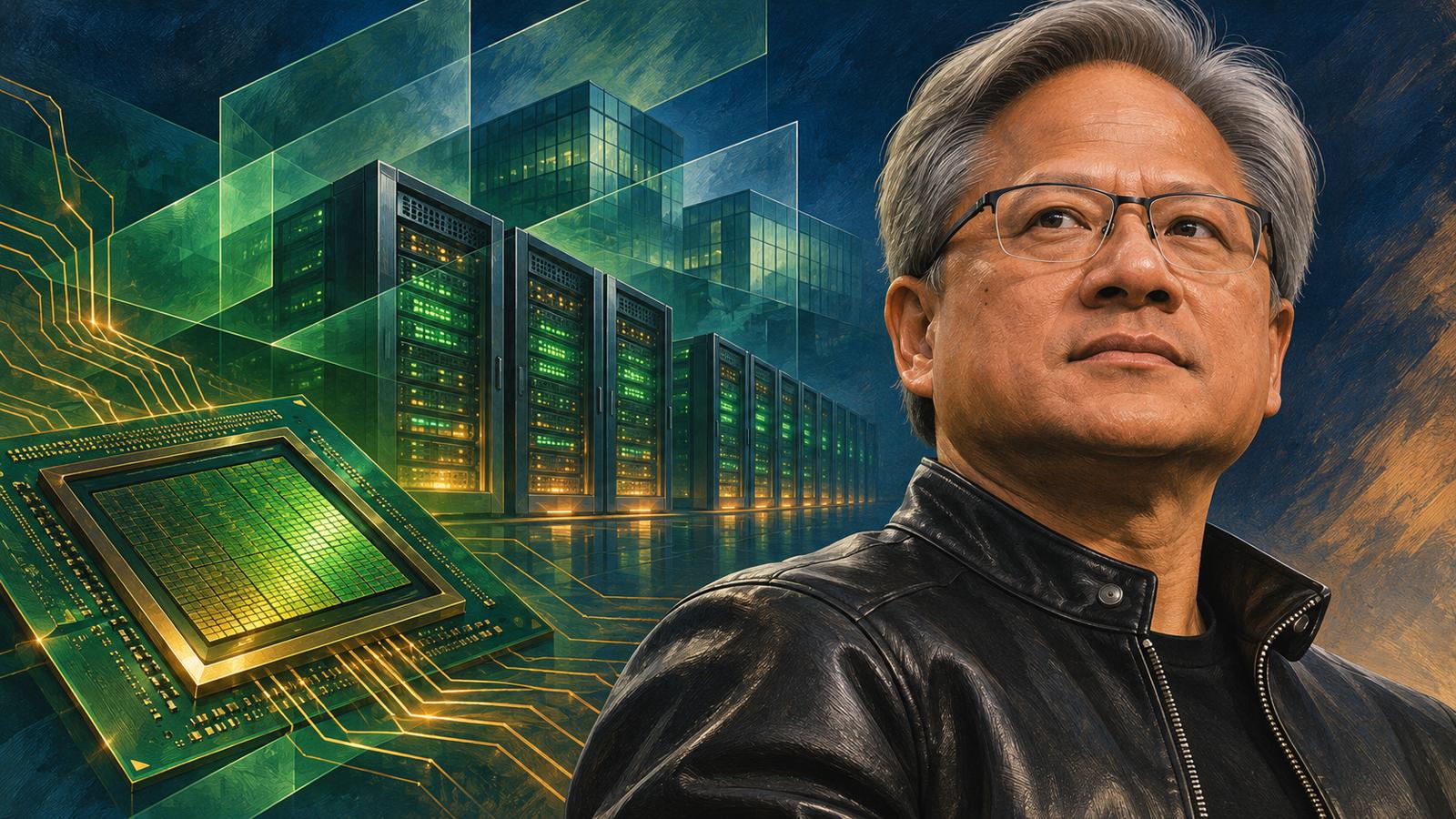
Jensen Huang’s Nvidia comeback offers the AI industry something it values almost as much as faster chips: a familiar decision-maker at a critical supplier. Nvidia’s board restored him as CEO, president and a director on November 22, announcing the reversal on November 23 after receiving input from senior US officials.
US President Donald Trump pushed for his return. Elon Musk publicly supported it. Their involvement makes this a story about concentrated economic power as well as corporate governance. But the business conclusion needs a boundary: restoring Huang may reduce leadership uncertainty; it does not establish that AI chips, cloud computing or business software will become cheaper.
For smaller companies buying AI services, the decisive question is how any improvement at the infrastructure level reaches their invoices—and how much is absorbed elsewhere.
The Nvidia comeback restores leadership, not a clean legal slate
The company’s SEC filing establishes the effective date and restored positions. Colette Kress continues as chief financial officer after serving as interim CEO. Nvidia says Harvey C. Jones remains chairman.
The board said discussions with Huang satisfied it about his candor and ability to lead. It also cited government input in reaching its assessment that reinstatement posed no national-security risk. These are attributed corporate judgments, not an independently published finding that every allegation has been resolved.
Nvidia says its independent investigation will continue, alongside cooperation with government inquiries. It has also announced a National Security and Export Control Committee and a search for a chief compliance officer. The Monitor Daily’s earlier examination of the Nvidia investigation explains why reported intelligence concerns and proven security failures must be kept separate.
The business risk has therefore changed shape. Customers have more clarity about the leadership team, while the company still has to demonstrate that its controls can operate independently of its founder’s influence.
Trump’s intervention links corporate continuity to national strategy
ABC News reported that Trump told CNBC he had spoken directly and indirectly to Nvidia’s board and persuaded it to reinstate Huang. The president described retaining Huang’s technological talent as a national interest and said the administration supplied security assurances sought by directors.
That argument is understandable on its own terms. Disruption at an important computing supplier could affect businesses well beyond the supplier itself. Protecting continuity can be a policy objective without proving that any particular executive is indispensable.
The competing concern is institutional: if political pressure becomes a substitute for a board’s judgment, directors may struggle to impose meaningful conditions on an economically influential founder. Trump’s assertion that Huang had been exonerated also goes further than the company’s statement that its own inquiry continues.
In Reuters’ account of reactions to the decision, Senator Elizabeth Warren demanded answers about both export compliance and the government input behind the reversal. Her criticism is not a finding of wrongdoing. It identifies the accountability question that a successful business recovery would not, by itself, answer.
Public support, strategic interests and political influence are visible. A hidden agreement to deliver cheap chips, preferential treatment or a particular commercial outcome has not been established by the material reviewed for this analysis.
Musk backed Huang—and has a concrete business connection
Forbes reported that Musk signed a petition supporting Huang’s reinstatement and argued that important supplier relationships depended on him personally. After the announcement, Musk wrote on X: “The mistake has been corrected.” Reuters also reported that response.
His advocacy matters, but its evidentiary limits matter too. It establishes public pressure from an influential industry figure. It does not disclose how individual directors weighed that pressure or prove that Musk negotiated the reinstatement.
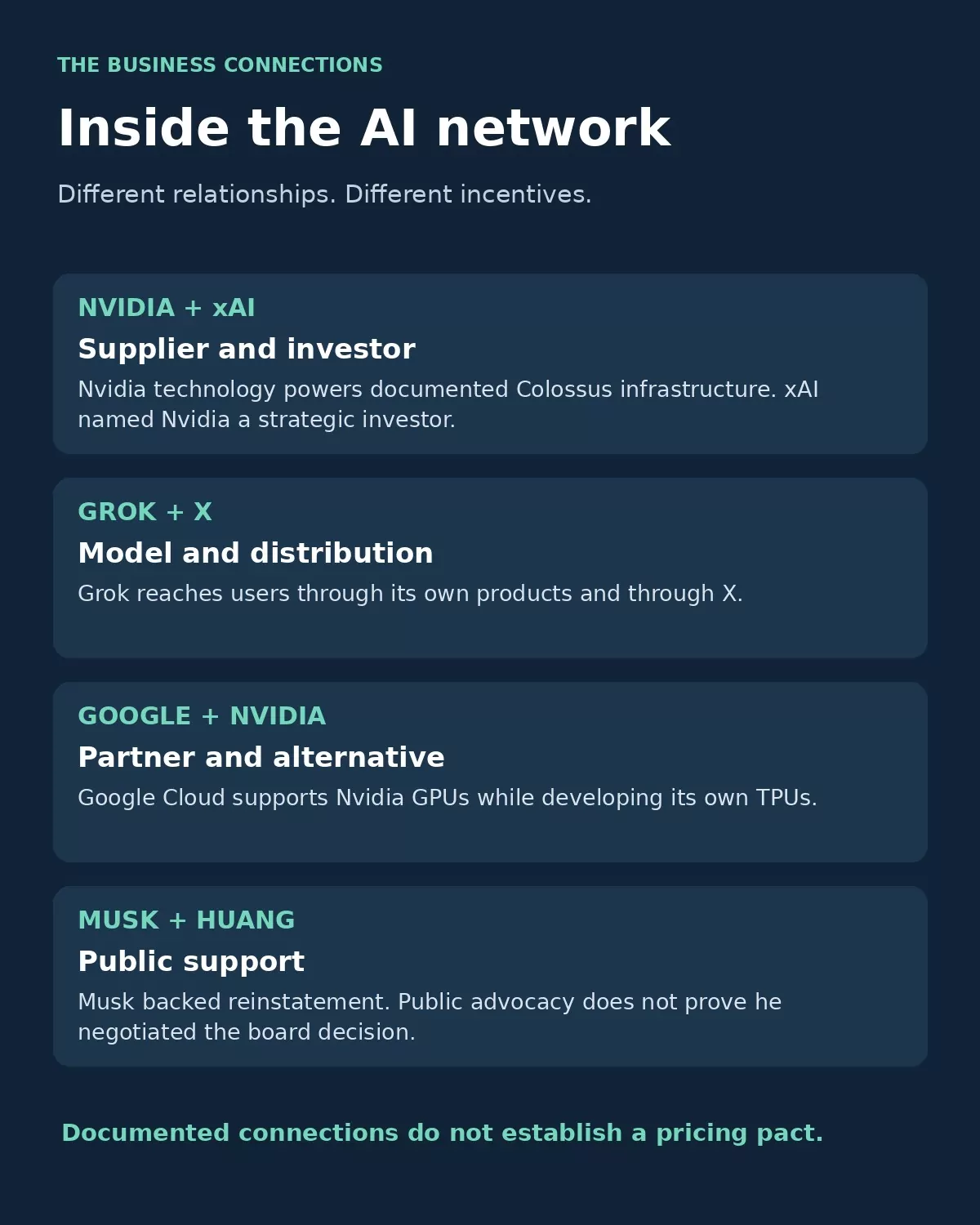
Musk’s connection is more substantial than a social-media endorsement. Nvidia documented in October 2024 that xAI’s Colossus cluster used 100,000 Nvidia Hopper GPUs and its Spectrum-X networking technology to train Grok models. That is a historical infrastructure disclosure, not a claim about today’s complete installed capacity.
In its January 2026 Series E announcement, xAI also identified Nvidia as a strategic investor. The disclosed relationship therefore includes both supplying technology and investing in a customer. Neither fact, alone or together, proves improper coordination.
The commercial incentive is straightforward: an AI developer building around a supplier’s hardware and networking has an interest in dependable deliveries, technical support and product planning. Supporting the person associated with those relationships is consistent with that interest. It does not reveal all of Musk’s private motives.
Where Grok and X fit
The relevant connection runs from computing infrastructure to AI models to distribution. Colossus supports the development of Grok; Grok is offered through its own products and through X. Hardware supply, model capability and audience access are different parts of that chain.
A better or cheaper computing system could improve the economics of developing and serving a model. Whether a customer sees a lower subscription price is a separate decision. Additional capacity could instead be spent on larger models, more features or heavier usage.
Nor does a public post on X establish a procurement contract. The distinction prevents an observable business network from being turned into a story about an undocumented deal.
Google is a partner and an alternative—not evidence of a secret pact
Google’s infrastructure strategy complicates the idea of one unified AI bloc. In a November 16 post updated November 18, Google Cloud described training benchmark submissions using both its own Ironwood tensor processing units, or TPUs, and Nvidia Blackwell-family GPUs.
That disclosure illustrates two relationships at once. Google provides access to Nvidia-based computing while also developing its own accelerator technology. Its benchmark report does not establish universal cost superiority for either platform, and it says nothing about a role in Huang’s reinstatement.
Commercially, supporting multiple architectures can help a cloud provider address different workloads. It can also provide an alternative to dependence on one chip family. For buyers, however, an alternative is useful only if the model, software, engineering capacity and service requirements fit it.
Switching is not simply a matter of choosing a cheaper line on a price list. Porting, validation, staff expertise and operational support can affect the result. Conversely, assuming every AI workload requires the newest Nvidia hardware can overlook viable options.
The reviewed evidence supports a network of overlapping suppliers, customers, investors and competitors. It does not establish a cartel, a pricing agreement or a Google–Musk arrangement to bring Huang back. Those stronger claims would require their own evidence.
Could cheaper chips unlock a broader AI economy?
Yes, lower computing costs could make additional uses economical—but “cheaper chips” can describe several different things. A lower purchase price, more work from the same hardware and a lower cloud bill are not interchangeable outcomes.
A processor can cost more upfront yet complete a workload at lower cost if its usable output rises sufficiently. Equally, a nominally cheaper machine can disappoint if it sits idle, lacks enough memory or requires expensive engineering to run the application.
Google Cloud’s inference guidance emphasizes matching the model and accelerator to the workload. It also discusses techniques such as quantization, which reduces numerical precision to lower memory requirements, while warning that accuracy can suffer. Such techniques can improve economics without any change in a CEO or a chip’s selling price.
That is why the strongest near-term case for Huang’s return concerns execution and coordination, not a promised price cut. The reinstatement announcement does not commit Nvidia to a new low-price chip program. A cheaper-AI revolution remains a possible consequence of efficiency and competition, not a verified term of the comeback.
The savings have to travel through the supply chain
Between a chip and a business user sit servers, facilities, electricity, software and service providers. A reduction in one input can be offset by increases elsewhere. A provider may retain savings as margin, use them to expand capacity or pass some through to customers.
Consider a purely hypothetical AI-enabled service with a $10,000 monthly operating bill. Suppose $2,000 is inference expense and $8,000 covers other costs. A 20% reduction in inference expense saves $400—only 4% of the total, assuming usage and every other cost remain unchanged.
If the provider passes through only half of that saving, its customer-facing reduction would be $200 on an otherwise unchanged $10,000 bill, or 2%. These are illustrative assumptions, not Nvidia prices, observed customer savings or a forecast.
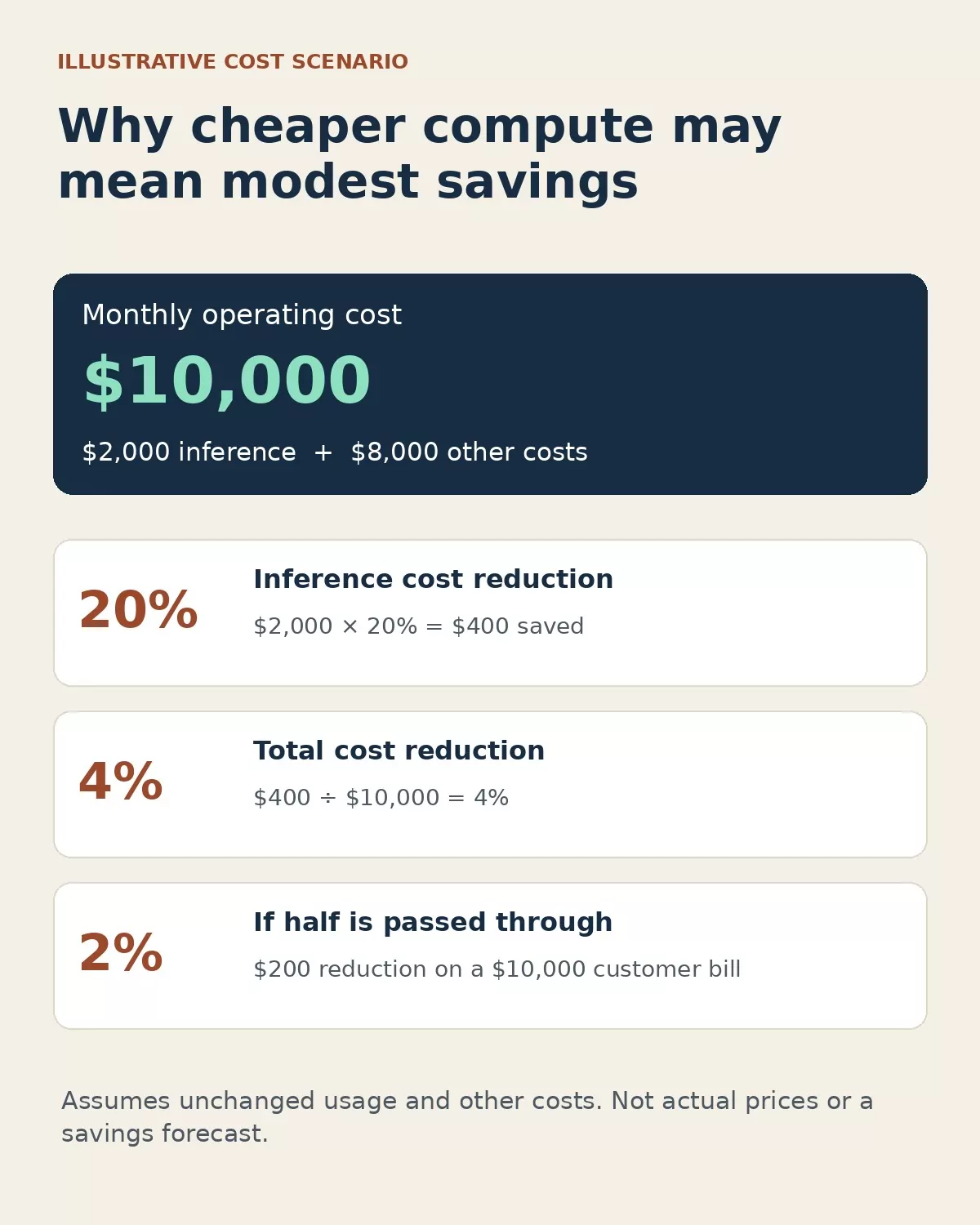
The example explains why an impressive infrastructure improvement need not produce an equally impressive reduction in a small company’s software budget. More importantly, cheaper usage can encourage customers to consume more, so the total bill may rise even as the unit price falls.
China adds a market-access constraint to the cost question
Reuters’ November 23 reporting on Nvidia’s Chinese business described demand for less powerful chips and software even while access to the most advanced processors remained constrained. Its review drew on more than 100 corporate disclosures and procurement records. It also reported uncertainty around some orders after Huang’s departure, without establishing the scale of cancellations.
This makes leadership stability commercially relevant, but not sufficient. A customer’s willingness to buy cannot override the legal conditions governing a sale.
A January 2026 US Bureau of Industry and Security announcement illustrates that separation: it described case-by-case license review for specified advanced chips subject to security requirements. That historical policy is not a complete statement of every rule applying now. Huang’s return is neither an export license nor an amendment to those rules.
If lawful access expands and competition increases, some Chinese developers could gain more deployment options. If restrictions persist, incentives to build around other suppliers could strengthen. Neither scenario can be inferred from Huang’s ancestry or his personal relationships; the relevant evidence concerns actual transactions, policy and technology.
Who captures the gains—and what would change the analysis?
Large infrastructure buyers may benefit first from clearer product planning and commercial coordination. Smaller software firms benefit only if that produces usable capacity, competitive service terms or lower operating costs. The distribution of gains is therefore as important as the headline technological advance.
Concentration can create efficiencies: a supplier and major customer can coordinate complex deployments. It can also create dependence when changing providers is costly. Nvidia’s investment in an AI customer makes it reasonable to scrutinize the commercial terms, but the existence of investment is not proof that demand is artificial or that competitors are excluded.
For business operators, useful evidence would include renewal quotes, actual cost per acceptable completed task, availability guarantees and the cost of moving a workload. TMD’s analysis of AI automation’s full operating economics explains why monitoring, exceptions and recovery can materially change the apparent savings.
The strongest counterargument to a founder-centered interpretation is that engineering organizations, contracts and customer demand can sustain a business without one individual. Huang’s influence may be valuable without being the sole cause of future performance. Evidence of reliable delivery and falling customer costs would support the continuity case; renewed disruption or ineffective oversight would weaken it.
The Nvidia comeback has restored a powerful coordinator to a deeply connected industry. Its broader economic success should be judged by independent governance, lawful supply and measurable customer outcomes. The most revealing next signal is not another endorsement from a billionaire. It is whether businesses can obtain dependable AI services at a lower total cost.