

A stationery shop that takes ten separate $10 card payments can spend $5.90 collecting $100. If one customer buys the same merchandise in a single $100 order, the fee falls to $3.20. The difference is the 30 cents the shop pays each time a customer checks out.
For a US online store comparing payment gateway fees, the first question is what the quote covers. A bundled rate can include the cost of processing the card. A gateway-only quote can leave most of that cost on a separate merchant statement. Take one month of orders and price the same transactions under each offer before deciding which costs less.
What we checked
On November 25, 2026, we reviewed three public pricing details: Stripe’s US domestic online card rate, its treatment of an original fee after a refund, and the billable events in Authorize.net’s gateway fee schedule. The order examples below apply published terms to hypothetical US-dollar purchases. They cover customer-entered card payments at checkout. A store with negotiated pricing should substitute its own rates.
Which part of the payment does the gateway fee cover?
When a customer submits a card payment, the gateway sends the payment information for authorization and returns the response to the checkout. Approval lets the store proceed with the order. Capture, settlement, and the transfer to the store’s bank account are separate steps. An approved order in the store dashboard tells the owner little about when the money will be available to pay a supplier.
A gateway-only agreement can suit a retailer that already has a merchant account. Authorize.net’s published gateway schedule, for example, lists 10 cents per card transaction and 10 cents per settled batch. Its definition of a billable transaction includes charges, declines, voids, and refunds. To calculate the total, add the gateway subscription and the separate merchant-account costs. Counting only completed orders can understate the gateway bill even before processing enters the picture.
A bundled provider gives the merchant one rate for several services. Stripe lists 2.9% plus 30 cents per successful domestic card transaction on its US standard online plan. If a competing quote offers “interchange plus,” ask for both the underlying card costs and the processor’s markup. Federal Reserve researchers explain how interchange fits into the total merchant fee. Adding interchange again to a quote that already includes it would overstate the cost.
What payment gateway fees cost on a single order
Multiply the amount charged at checkout by the quoted percentage, then add the fixed charge. For a $50 payment at 2.9% plus 30 cents, the percentage contributes $1.45, and the fixed charge brings the total to $1.75. That leaves $48.25 before inventory, postage, tax obligations, or other business costs.
| Amount charged | Processing fee | Amount after fee | Effective rate |
|---|---|---|---|
| $10 | $0.59 | $9.41 | 5.90% |
| $50 | $1.75 | $48.25 | 3.50% |
| $100 | $3.20 | $96.80 | 3.20% |
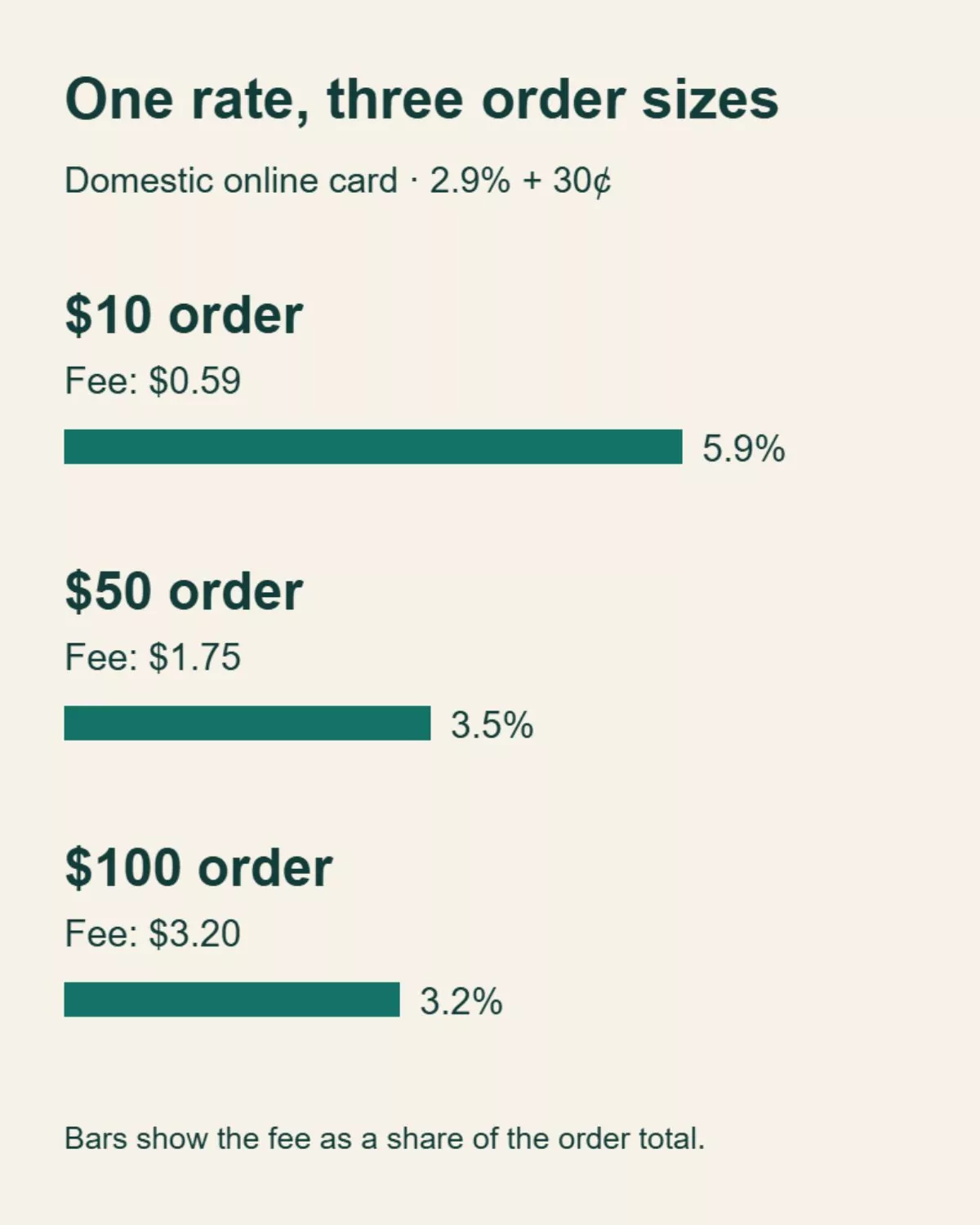
For the stationery shop, turning ten individual purchases into one bundle saves $2.70 in processing. That gives the owner a limit for a bundle discount funded solely by fee savings. A $5 discount would cost more than the shop saves on payments, even if packing one parcel also happens to save postage.
What changes when a customer returns an order?
Suppose the $50 customer receives a full refund. Under Stripe’s standard US card pricing, issuing the refund carries no additional fee, but Stripe keeps the original processing charge. The customer gets $50 back. Across the sale and refund together, the shop is out $1.75 before return shipping or handling. Ten such returns leave $17.50 in original fees. If those fees already appear in the month’s processing total, counting them again as refund fees would double the expense.
Two other questions belong in a quote review. First, where was the card issued, and did the transaction require currency conversion? Stripe lists a 1.5% supplement for international cards and another 1% when conversion is required. A US-dollar price tag alone does not establish the customer’s card origin. Second, what happens if the buyer disputes a charge? Ask the provider to distinguish the contested sale amount from any fee for receiving or challenging the dispute. They affect cash differently.
When does a monthly plan pay for itself?
Consider two hypothetical all-in offers for the same domestic online payments. Offer A charges 2.9% plus 30 cents and has no subscription. Offer B charges 2.6% plus 30 cents and costs $25 a month. Assume identical service, no other fees, and 200 successful $50 orders in the month.
On $10,000 in payments, Offer A costs $290 in percentage fees plus $60 in fixed charges, for a total of $350. Offer B costs $260 plus $60 plus $25, or $345. The lower percentage saves only $5 after the subscription. At $5,000 in sales, the percentage reduction saves $15, leaving Offer B $10 more expensive for that month.
The break-even sales volume is about $8,333.33 per month: divide the $25 subscription by the 0.003 difference between the rates. That shortcut works because the fixed charge is identical. If it differs, multiply the difference in fixed fees by the actual number of transactions as well. A seasonal shop can run the calculation for a quiet month and a holiday month before committing to a year of subscriptions.
Match the quote to one actual payout
Start with a payout ID from the bank-deposit report. Pull the transactions assigned to that payout, even if some orders came in during the previous week. Add captured payments, subtract refunds and fees deducted from that batch, then account for adjustments, such as a reserve held or released. If a monthly gateway fee is billed separately, include it in the monthly cost comparison without subtracting it again from that deposit.
For example, a batch of twenty $50 domestic card payments totals $1,000. At $1.75 each, the fees total $35. One full $50 refund in that same batch would bring the expected deposit to $915, assuming the original fee is retained, fees are deducted at payout, and there are no other adjustments. The $85 difference between sales and cash comprises a $50 refund and $35 in fees. Calling the entire gap a payment fee would send the owner looking for savings in the wrong place.
Keep the gross payment export alongside the fee and payout reports. The IRS explains that the gross amount on Form 1099-K is calculated before adjustments for items such as fees and refunds. A bank deposit and a gross payment total can both be accurate while showing different amounts.
For the next quote, send each provider the same month’s gross card volume, successful payment count, refund count, and international card mix. Ask each to show its calculation and identify any charge billed outside the payout. The resulting dollar figures tell the owner how much a switch could save and whether those savings justify changing checkout.