

Working capital vs cash flow is a difference between a position and a movement: net working capital is current assets minus current liabilities on a specific date; cash flow is money entering and leaving the business over a period. Neither figure, by itself, tells you whether Friday’s payroll can clear.
A hypothetical print shop has $18,000 in net working capital on Monday and a $2,000 payroll funding gap on Friday. Its customers owe it money and its shelves hold saleable paper, but those assets will not become cash before wages are due.
For a US small-business owner or bookkeeper, the distinction comes down to two questions. Working capital tells you how much your current assets exceed your current liabilities on a given date. Cash flow tells you how much money came in and went out over a period. To decide whether you can make Friday’s payroll, you need one more piece of information: how much cash you start with.
Working capital vs cash flow at a glance
This guide uses a simplified print-shop calculation in US dollars, not a reported company case study. The practical observation is that a positive balance-sheet cushion can coexist with an immediate funding gap.
Start with the time label on the report. A balance sheet dated March 31 describes the business at the close of that day. A statement of cash flows for March explains how the cash balance changed during the month. A cash forecast looks ahead and assigns expected receipts and payments to dates. The SEC’s guide to financial statements explains how the historical reports fit together.
| Owner’s question | What to check | How to read it |
|---|---|---|
| How large is our short-term cushion? | Net working capital | Current assets minus current liabilities on the same date. |
| Did cash increase last month? | Net cash flow | Total cash received minus total cash paid during the month. |
| Can we cover Friday’s payments? | Dated cash forecast | Available opening cash plus receipts expected to clear, less payments due through Friday. |
What belongs in the working capital calculation?
Use current assets and current liabilities from the same balance-sheet date. Typical current assets include cash, receivables and inventory. Current liabilities include supplier bills, accrued wages and the portion of borrowing due in the near term. Equipment used to run the business is not inventory merely because it could be sold.
Here, “working capital” means net working capital, including cash. A report labeled “operating working capital” may exclude cash and financing balances. Check its definition before comparing it with this calculation.
A positive total is not a promise that invoices will be collected or stock sold before a bill falls due. Review disputed receivables and slow-moving inventory separately. A larger number caused by unpaid invoices can mean more money is tied up, rather than more money is available.
Where the print shop’s $18,000 is sitting
In this illustrative example, the shop opens Monday with $6,000 in cash, $20,000 in collectible customer invoices and $12,000 in inventory. Its current assets total $38,000. Against those assets, it owes $20,000 in current liabilities, including $8,000 of wages already earned and due Friday. For this simplified example, the payroll funding deadline is also Friday; actual provider deadlines may be earlier. Subtracting $20,000 from $38,000 leaves $18,000 of net working capital.
Only $6,000 is available to spend today. The owner expects a $10,000 customer payment next Monday. Assuming no other cash movements, the shop is $2,000 short on Friday. A forecast that combines both weeks shows $8,000 left after the receipt and payroll. That ending balance hides the day the shop runs short.
| Point in the forecast | Cash movement | Projected cash position |
|---|---|---|
| Opening Monday | Starting cash | $6,000 |
| Friday payroll funding deadline | Pay $8,000 | −$2,000: funding gap |
| Following Monday | Collect $10,000 | $8,000, if the earlier gap has been bridged and any temporary funding repaid |
The negative figure is a warning from the forecast, not an assumption that the bank will permit an overdraft. Without an agreed funding solution, the Friday payment cannot be fully funded as modeled. The illustration excludes financing fees and all other receipts and payments.
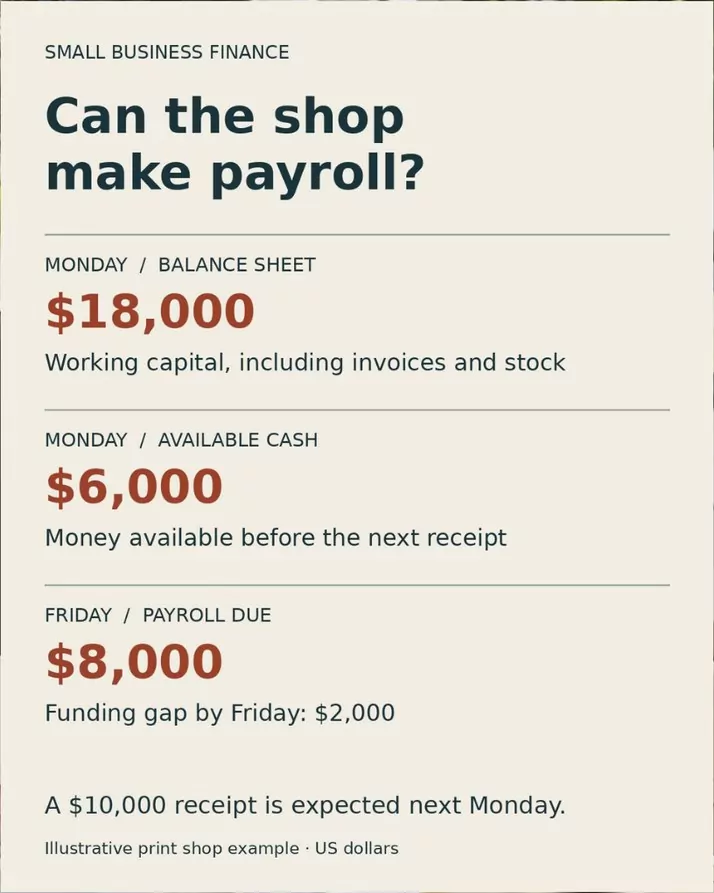
The first call can be specific. If the customer can settle at least $2,000 early and the funds will clear before payroll must be funded, that covers the gap under these assumptions. Until the customer confirms, the owner should keep the shortfall visible and identify another available funding source. The relevant deadline is when the payroll provider takes the money, which may be earlier than payday.
Three transactions that move the numbers differently
Consider each transaction below independently. Assume the invoices and supplier bills are already recorded, the inventory is bought at its recorded cost, and there are no fees.
| Transaction | Cash effect | Net working capital effect |
|---|---|---|
| Collect $5,000 on an invoice | Up $5,000 | Unchanged. Cash rises as receivables fall. |
| Buy $3,000 of paper for cash | Down $3,000 | Unchanged. Inventory rises as cash falls. |
| Pay a $2,000 current supplier bill | Down $2,000 | Unchanged. Cash and current liabilities fall equally. |
The paper purchase explains why a bulk discount can be costly at the wrong time. The balance sheet shows the same working capital immediately after the purchase, but the shop has committed $3,000 that could have covered wages. Before accepting the discount, the owner can put the purchase on its expected payment date and see which later payment becomes difficult.
Does borrowing improve working capital?
It depends on the liability created. Receiving a $5,000 loan that is entirely a current liability increases both cash and current liabilities by $5,000, leaving net working capital unchanged. Cash availability improves immediately, but repayment still needs a place in the forecast. This is arithmetic under the stated assumption, not a recommendation to borrow.
Why profit and a rising bank balance can each mislead
Under accrual accounting, a shop that completes and invoices a profitable job can record revenue before the customer pays. Materials and wages may already have left the bank. When reviewing a profitable month with falling cash, compare the increase in unpaid invoices with the cash spent to fulfill those jobs. An invoice awaiting a corrected purchase order calls for a different response than one a reliable customer routinely pays on day 30.
The reverse is possible, too. Suppose a business receives $15,000 from a loan and uses $4,000 more cash in everyday operations than those operations bring in. With no other cash movements, cash rises $11,000. The loan explains the increase. Separate customer and supplier cash movements from equipment spending and financing. A loan-funded increase in the bank balance does not show that ordinary trading is generating cash.
Iowa State University Extension’s cash-flow analysis guide also distinguishes cash timing from profitability. Although its examples concern farming, the distinction helps explain why a business can buy a long-lived asset, repay loan principal or record depreciation without cash flow and profit moving together.
What to review before committing to the next payment
- Start with available cash. Check the bank statement against your records and account for checks or transfers already committed. If an outgoing payment is already reflected in your opening figure, leave it out of the forecast to avoid counting it twice.
- Give each receipt a realistic clearing date. For a major invoice, check whether the customer accepted the work, approved the invoice, and scheduled payment. Run a second version with the largest uncertain receipt one week late.
- Enter payroll funding, supplier payments, taxes, and debt payments on their expected withdrawal dates. Check the lowest projected balance between today and the next major receipt. A monthly total can conceal a midweek gap.
- Look back at the balance sheet for the cause. Sort invoices by age and identify stock that has stopped selling. If each new order requires a large materials purchase weeks before collection, a deposit or milestone billing arrangement on future orders may shorten that gap.
For the wider picture, use a 13-week cash flow forecast, then add daily detail around tight payment dates. Replace estimates with actual receipts and payments as they clear; move an unpaid invoice to its revised expected date rather than counting it again as a new sale.
Match the response to the cause of the cash gap
| What the records show | Next action to assess | Trade-off to check |
|---|---|---|
| A large invoice is held up by a billing error | Correct the invoice and confirm the customer’s payment date | A promise to pay is not cleared cash |
| A discretionary stock purchase falls before payroll | Model a smaller order or a later purchase | Lost discounts, delivery delays and stockouts |
| Payments come due before a reliable receipt | Discuss revised terms before the deadline | Terms must be agreed; do not assume permission to pay late |
| Routine operations repeatedly consume cash | Review pricing, fulfillment costs, collections and spending with the finance team | Moving a payment only postpones a recurring deficit |
Keep the cost of a proposed fix visible. For example, a hypothetical 2% discount on a $10,000 invoice costs $200 and produces a $9,800 receipt if the customer accepts and pays. Reforecast using $9,800, not $10,000. Whether that trade-off makes sense depends on margin, timing and the alternatives actually available.
Working capital vs cash flow: decide on the date cash is needed
The practical lesson in working capital vs cash flow is to track both the balance-sheet position and the payment calendar. For the print shop, the most useful figure on Monday is the $2,000 it needs by Friday. The $18,000 working capital calculation helps the owner find where money is tied up. The dated forecast identifies how much must arrive and by when. Put both numbers beside the next purchase or payroll decision, and update the forecast when a customer payment actually clears.