

SBA loans explained in practical terms start with what the money will buy. The 7(a) program covers a broad range of eligible business purposes, 504 financing focuses on major fixed assets, and microloans provide smaller amounts through intermediary lenders. Compare the permitted use, financing structure, repayment demands, and application route before comparing advertised rates. None of these programs guarantees approval or removes your business’s obligation to repay.
For a US owner, the useful question is rarely “Which SBA loan is best?” A $30,000 inventory purchase, a business acquisition, and a building project are different financing problems. Put the project on paper first, then ask the appropriate lender or Certified Development Company to confirm its eligibility under the current rules.
SBA loans explained: the differences at a glance
| Program | Typical purpose to discuss | Amount distinction | Application route |
|---|---|---|---|
| 7(a) | Working capital, equipment, eligible acquisitions, real estate, or qualifying refinancing | Program maximum $5 million; specific delivery methods can have lower limits | A participating lender |
| 504 | Eligible buildings, land, and long-term machinery | Generally $5 million in outstanding 504 balances for the borrower and affiliates; specified manufacturing and energy projects can qualify for $5.5 million per project | A CDC working with a senior lender |
| Microloan | Smaller working-capital, inventory, supplies, or equipment needs | Up to $50,000 | An SBA-approved intermediary |
These figures describe program limits, not an offer to your business. For 504, distinguish the SBA-backed financing portion from the total project financing. Existing borrowing, project category, affiliation, and the financing structure can affect the applicable limit. Ask for the calculation for your actual project.
7(a): broader purposes, with a lender making the credit decision
The SBA provides a guarantee to the lender under 7(a); the borrower applies to that lender. The program can accommodate several eligible uses within one request, making it worth discussing when an expansion involves both equipment and working capital. SBA’s 7(a) program guidance describes the permitted purposes and application process.
The guarantee is not a grant. A business must satisfy eligibility and repayment requirements, and the lender must assess the request. Do not assume a program maximum, a preliminary conversation, or a lender match means approval. Obtain the actual proposed structure, fees, conditions, and payment schedule before deciding.
A broad permitted-use list also does not mean every expense in your project qualifies. Itemize what you want to finance and ask the lender to identify any exclusions or separate funding requirement.
504: an asset project with more than one financing component
504 is aimed at major fixed assets rather than ordinary operating cash. The CDC works with a senior lender to assemble the project. It is worth investigating for a qualifying building or long-term equipment purchase; it cannot fund inventory or working capital. Read the SBA’s 504 project guidance before treating the program as a general expansion loan.
The fixed-rate description of 504 should not lead you to assume every component of the project has the same rate or terms. Request a schedule for each financing component and your required contribution. Include interim financing, closing conditions, and the timing of disbursements in the discussion.
The general $5 million limit and the $5.5 million limit for specified projects are different rules. The higher figure is not available to every applicant. Have the CDC confirm the category and existing-balance calculation rather than using a headline maximum as your budget.
Microloans: smaller requests through a different channel
SBA microloans are made through intermediary lenders, with loans up to $50,000. Eligible purposes include inventory, supplies, working capital, furniture, and equipment. They cannot be used to purchase real estate or pay existing debts. The microloan program page explains the intermediary route.
A smaller request still requires a workable repayment plan. Ask the intermediary which documents, security, guarantees, and assistance requirements apply to your circumstances. Compare the amount actually available with the complete purchase budget. A $45,000 equipment quote may not include installation, delivery, or the operating cash needed while staff learn to use it.
Microloans should not be treated as an automatic fallback after another application fails. Explain what caused the financing gap and whether the smaller amount would fund a useful, complete stage of the project.
Separate program fit from affordability
A permitted expense and an affordable payment answer different questions. Build the repayment case from cash available after ordinary obligations, rather than from an optimistic sales target. Consider when customer receipts arrive and whether the project initially increases payroll, rent, or supplier payments before it generates cash.
Use a short-term cash-flow forecast to identify tight weeks. Then extend the analysis across the proposed repayment period with your finance adviser. A short forecast helps with timing; it does not by itself establish long-term borrowing capacity.
For an illustrative operating check, suppose monthly cash receipts are $42,000 and ordinary cash payments are $34,000. A proposed $4,000 debt payment would leave $4,000 before other unmodeled needs. If receipts instead fall to $36,000 with those payments unchanged, the same debt payment produces a $2,000 monthly shortfall. These assumed figures are not a lender underwriting standard, an approval test, or a forecast for a real business.
Use that gap to ask better questions. Could you phase the purchase, reduce the project, increase the cash contribution, or change the timing? Recalculate the effect of each option. More financing can solve an initial purchase gap while creating a recurring repayment problem.
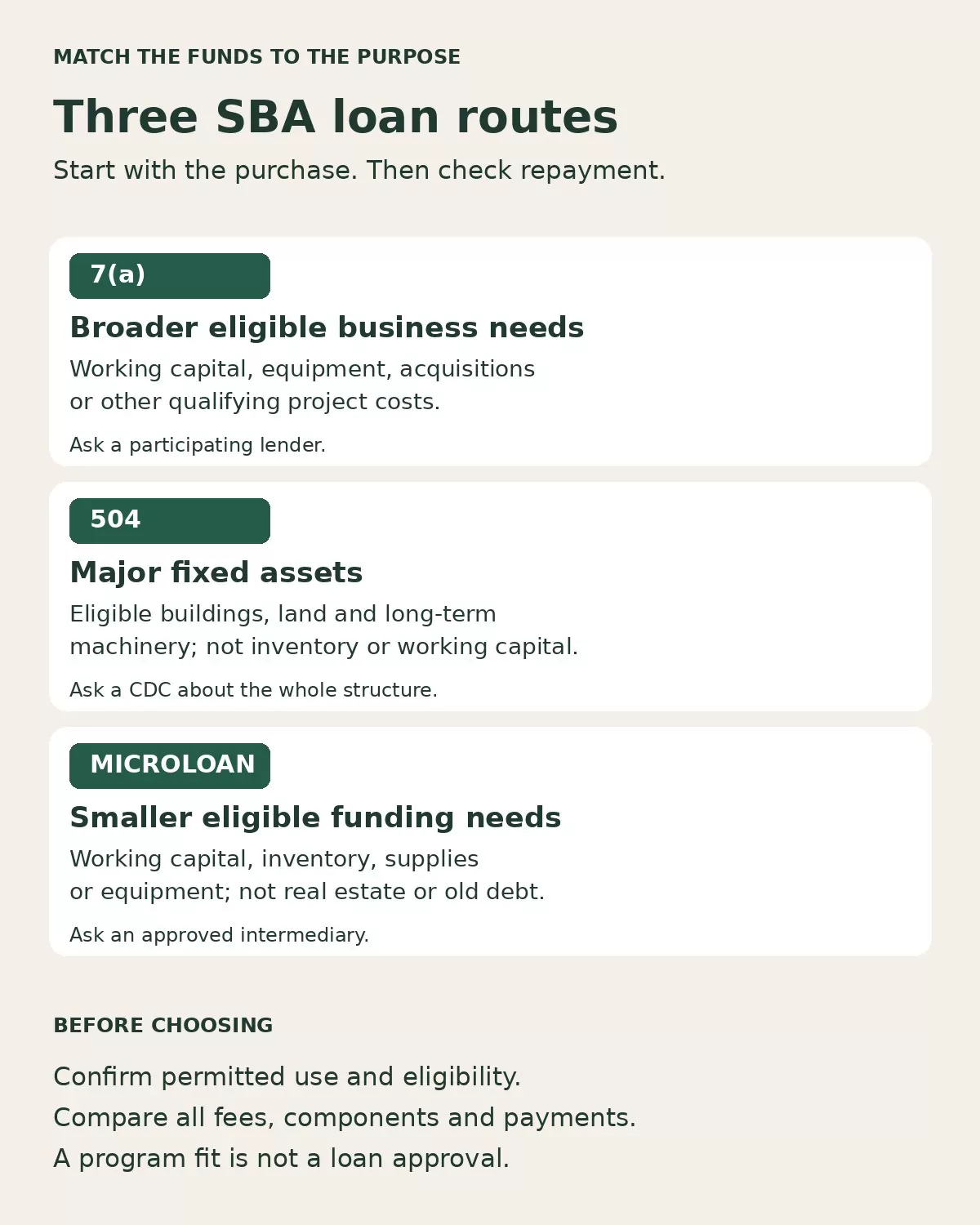
The route identifies whom to approach. It does not establish eligibility, the amount available, or whether the final repayment obligation is affordable.
A decision aid for the first financing conversation
Start with a one-page use-of-funds schedule. Give each line an amount, a quote or assumption, the intended payment date, and the business reason. Separate assets from operating cash and existing debt. This makes it easier to see whether the project belongs in one program or needs a carefully coordinated structure.
- A smaller inventory or equipment request may justify a microloan discussion, provided the expense is eligible and the repayment case works.
- A mixed-purpose request or eligible business purchase may justify a 7(a) discussion with a participating lender.
- A major qualifying fixed-asset project may justify a CDC discussion about 504 and the other financing components.
- A request mainly intended to cover persistent operating losses needs a business-model and cash-flow review before assuming that borrowing fixes it.
These are starting points for questions, not loan recommendations. Multiple programs may warrant investigation for the same project. Compare the actual proposals and constraints rather than selecting solely from the label.
Compare the complete proposal, not just its interest rate
Ask for the amount advanced, cash you must contribute, all charges, payment frequency, maturity, fixed or variable rate terms, any rate-reset mechanism, collateral, guarantees, and conditions before funding. Identify any prepayment provisions and what happens if the project changes. For a multi-part project, get these details for every component.
Put the quotes on a common footing. A lower periodic payment may reflect a longer term rather than a lower total cost. A fee financed into the loan changes the principal you repay. A project that needs bridge funding may face costs before the long-term structure closes. Do not compare one lender’s all-in schedule with another’s headline rate.
Before a business banking meeting, request the lender’s current checklist. Common discussion materials include the ownership structure, financial statements, tax records, existing debt schedule, project quotes, and cash-flow assumptions. Submit only through the lender’s verified process and confirm the exact documents required for your application.
What to confirm before relying on a program comparison
Current eligibility can depend on ownership, business activity, location, size, affiliations, credit, and the proposed use. Ask the lender or CDC to assess the complete facts. This explainer does not establish that a particular applicant meets those requirements.
Program guidance and fees change. The comparison here was checked against SBA pages and the 504 lending regulations on November 24, 2026. It does not quote a universal interest rate, closing time, required down payment, or available loan term. Ask for current written terms and qualified review of the final obligations before committing.
The method is a research-based comparison of program purpose and process, followed by a reasoned decision aid and hypothetical cash calculation. No loan applications, lender offers, or borrower outcomes were tested for this article.
SBA loans explained: choose the next conversation
With SBA loans explained by purpose, the first step becomes clearer: document what the funds will buy, separate the project’s cash needs, and approach the appropriate lender, CDC, or intermediary. Then compare the complete repayment structure against conservative cash assumptions. A program can fit the purchase and still be the wrong obligation for the business; the final decision depends on verified eligibility and actual written terms.