

Your Stripe payout schedule controls when available funds are sent toward your bank; it does not make every successful customer payment spendable immediately. To estimate when you can use the money, separate payment completion, balance availability, payout initiation, and bank receipt. Use the account’s actual expected arrival date and reconcile it with the bank before treating a payout as operating cash.
For a US business owner, this distinction matters when payroll or a supplier bill falls before an expected deposit. A busy sales day can improve the sales report while leaving today’s bank balance unchanged. The useful question is which stage the money has reached, not whether the checkout screen showed success.
This explainer uses current provider documentation and public payment-system guidance checked on November 26, 2026. The decision aid and cash example are illustrative. No merchant account, payout, bank transfer, or customer transaction was tested for this article.
Stripe payout schedule: four checkpoints to separate
| Checkpoint | What to establish | What it does not prove |
|---|---|---|
| Payment completed | The relevant customer payment was confirmed or captured. | The proceeds are already in the bank. |
| Balance available | The provider identifies funds as available for the relevant payout route. | A transfer has been initiated. |
| Payout initiated | A payout record identifies an amount, destination, and expected arrival. | The bank has posted usable cash. |
| Bank receipt matched | The bank entry matches the payout and its usable balance. | The underlying sale can never be refunded or disputed. |
Our explanation of payment authorization versus capture helps distinguish the earlier payment events. For cash planning, retain a separate record for the later payout and bank deposit rather than collapsing the entire journey into “paid.”
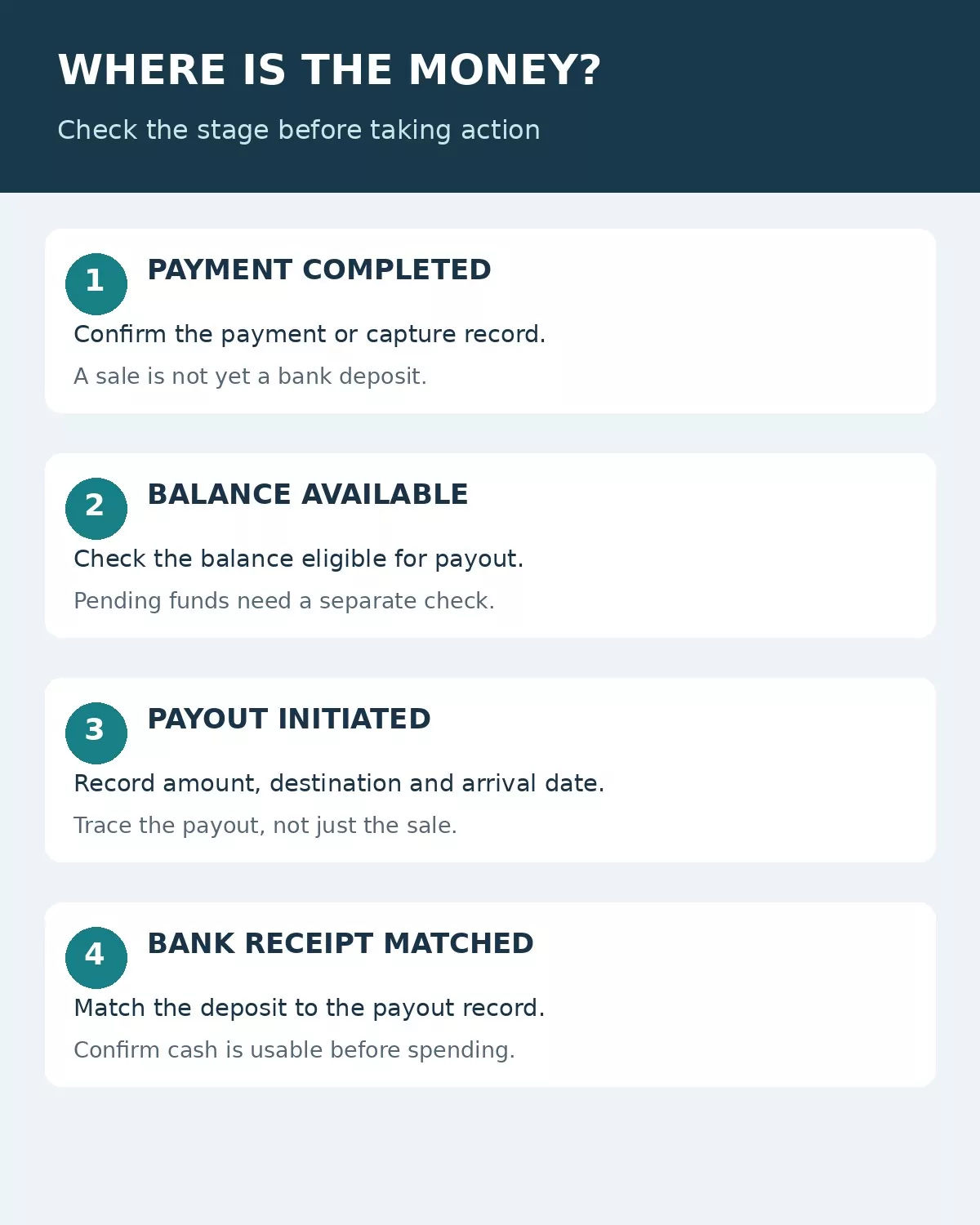
A payment confirmation, an available balance, a payout record, and a bank receipt answer different questions.
Daily, weekly, monthly, and manual describe a cadence
Stripe documents automatic daily, weekly, and monthly schedules, alongside manual payouts, subject to the options available to the account. Daily automatic payouts transfer available funds on business days. Weekly or monthly choices group transfers around selected dates. Manual payouts require an authorized operator or integration to initiate the transfer.
Changing that cadence does not by itself shorten the period before a pending balance becomes available. Nor does selecting manual mean that a payout arrives immediately; Stripe’s schedule help describes a typical manual arrival range of one to four business days. The particular account and payout record should guide your estimate.
Choose a schedule around how the finance team works. A regular automatic cadence may simplify routine reconciliation. Grouped payouts may fit a less frequent review cycle. Manual control creates an additional responsibility: someone must initiate eligible transfers and cover absences. Record that responsibility before relying on the setting.
Do not change a live payout configuration merely to investigate a late deposit. First capture the existing schedule, the affected payout reference, and the expected date. Otherwise, a configuration change can obscure whether the original problem concerned availability, initiation, or bank receipt.
The first payout needs its own cash assumption
Stripe’s general payout overview says an initial payout is typically scheduled to complete within seven to fourteen days after the first successful live payment, with timing affected by country, industry, and risk. This is general guidance, not a promise for every US merchant. Account-specific settlement information and the displayed expected date can differ.
Do not fund a launch-week obligation from an assumed first deposit. Before taking the first payment, identify how the business will cover bills while receipts are still moving through the process. If the account requests verification, have the responsible person resolve it through the authenticated service rather than guessing that another successful sale will remove the requirement.
A third-party platform using Stripe can also have its own payout arrangements and controls. This article addresses the direct merchant planning question; it does not establish the payout rules for every marketplace seller or connected account. Identify which organization actually controls the payout before escalating a missing deposit.
Why the bank date can differ from the sales date
The Federal Reserve’s explanation of ACH processing describes transfers moving between depository institutions through a network and settlement process. That is useful context for understanding why an electronic payment involves several records. It does not establish the route or arrival guarantee for a specific Stripe payout.
For your own records, keep the payment date, payout initiation date, expected arrival date, and actual bank posting date in separate fields. Record the time zone when comparing systems. A difference between two date labels is a reason to inspect the records, not sufficient evidence that money has disappeared.
Plan around the relevant business-day calendar and account notices. A calendar interval crossing a weekend or holiday is not equivalent to the same number of processing days. When a supplier’s deadline is fixed, use a conservative receipt assumption rather than the earliest plausible date.
A practical decision aid for a missing deposit
| What you can confirm | Next useful check | Avoid |
|---|---|---|
| No corresponding payout record | Check balance availability, schedule, and account requirements. | Calling the bank about a transfer that has not been identified. |
| A payout record exists | Record its reference, amount, destination, status, and expected arrival. | Using the original sale date as the transfer date. |
| The expected date has passed | Check account notices and current provider instructions, then trace the specific payout. | Repeatedly changing destinations or requesting another transfer without reconciliation. |
| A matching bank entry exists | Reconcile the deposit with the provider record and confirm usable cash. | Counting the same receipt in both pending payouts and bank cash. |
Stripe’s missing-payout help directs account owners to check account-verification requests when dates keep moving. It also says to contact the bank when a payout has not been received after five business days. Follow the current instructions for the actual status; a failed payout, a verification restriction, and an expected transfer still in progress are different cases.
Prepare one concise support record: payout reference, currency and amount, expected date, bank destination identifier with sensitive digits masked, and the relevant status or error. State which checks you completed. Do not send full account credentials or unnecessary customer data in an ordinary email thread.
Instant Payouts are a separate option
Stripe documents Instant Payouts for eligible accounts and supported destinations, with fees and limits. It says funds typically reach the associated account within thirty minutes, including requests on weekends and holidays. New users are not immediately eligible, and card proceeds and bank-debit proceeds have different availability conditions.
That description is not a fallback guarantee for an urgent bill. Check the amount actually offered, the eligible destination, the displayed charge, and the account’s current limits. Compare the confirmed cost with the business consequence of waiting. If the option is unavailable, do not base a payment commitment on obtaining access in time.
This article does not quote a universal Instant Payout fee or calculate savings from using it. Those conclusions need the account’s actual offer and an explicit cash requirement. Avoid treating a general availability statement as a confirmed quote.
Build a cash plan that can survive a later receipt
Consider a hypothetical business with $4,000 of usable bank cash and $6,500 of bills due before an expected payout. If a $5,000 deposit arrives first, the arithmetic leaves $2,500 after those bills: $4,000 plus $5,000 minus $6,500. If the deposit arrives later, the business faces a $2,500 timing gap when the bills are due.
The sales and the eventual payout can be identical in both cases. The difference is whether the bank cash is available at the required moment. This is illustrative arithmetic, not a forecast, financing recommendation, or test of Stripe’s performance. It excludes other receipts, charges, refunds, and obligations.
Place expected payouts in a cash-flow forecast with their assumptions visible. Keep an alternative case that moves an unconfirmed receipt beyond the bill’s due date. Discuss the gap with the responsible finance person before making commitments; the schedule alone does not resolve it.
Protect bank changes while resolving delays
An unexpected message asking you to “fix” a payout by changing bank details deserves separate verification. Open the service through a known route and use your organization’s authorized change process. The FBI’s business email compromise guidance recommends a secondary channel to verify requests to change account information.
Keep the person investigating a delay distinct from any approval required to change the payout destination. Record the reason, approval, and verified destination under your own controls. A request that appears urgent should not remove an existing approval requirement.
Use the Stripe payout schedule as one part of the answer
The Stripe payout schedule helps explain when available funds are sent, but the usable-cash decision needs the payout record and the bank receipt as well. Identify the last confirmed checkpoint, follow the matching recovery path, and update the cash plan when the evidence changes. That produces a more reliable operating decision than assuming that every successful sale will fund the next bill.