
Net 30 payment terms give a customer 30 days to pay under an agreed starting point, commonly the invoice date. For a small business, offering that time is a credit decision: you deliver the work or goods before collecting the money. The right question is whether the customer, margin and cash reserve justify that exposure—not whether “net 30” looks professional on an invoice.
This explainer is for US business owners deciding whether to extend payment terms to other businesses. It uses published guidance reviewed on November 18, 2026, with illustrative calculations and a proposed operating workflow. The examples are not observed customer results, and no software or credit-reporting service was tested for this article.
1. What net 30 payment terms actually mean
In ordinary invoicing, “net” refers to the full amount due after any applicable adjustments, while “30” describes the payment period. It does not mean the customer pays 30% now, and it is different from dividing an invoice into installments. Unless you have agreed otherwise, do not interpret the label as a promise to make several partial payments.
The starting event must be clear. Some agreements measure the period from the invoice date; others use invoice receipt, delivery or another agreed event. Those are different commitments. A customer’s accounts-payable team may also require a purchase-order number, acceptance record or supplier registration before an invoice can be processed.
Put the actual due date on the invoice as well as the term. For example, if the agreement says 30 calendar days after an invoice dated November 18, 2026, the calculated due date is December 18, 2026. This is an illustrative date calculation, not a rule overriding a contract. Specify how weekends, holidays and any grace period are handled rather than expecting the label to answer every question.
A customer’s monthly payment run does not automatically explain what the seller agreed to accept. Resolve any mismatch before taking the order. Otherwise, the buyer may regard the invoice as ready for its next run while the seller regards it as overdue.
2. Agree on terms before supplying the work
Payment timing is not something to improvise after delivery. Cornell’s publication of UCC Section 2-310 illustrates why: its model rules for sales of goods address payment timing when the parties have not agreed otherwise, including a receipt-based default and a separate provision concerning shipment on credit. It does not establish a universal net-30 default for every US transaction.
That model text is not a substitute for the governing state’s enacted law or the rules applying to a particular service contract. For a significant arrangement, have the actual agreement reviewed for its jurisdiction and transaction type. Do not treat a template invoice as proof that all proposed conditions have been accepted.
Record the legal customer name, the event starting the clock, the due-date calculation and the permitted payment methods. Also establish who can approve the order, where the invoice must be sent, and how a genuine dispute will be handled. A sales contact and the person responsible for paying may be different people.
Our guide to writing an invoice covers the information a customer needs to identify the transaction. Clear terms still need a usable invoice: the right entity, correct amount, required reference and an accessible way to pay.
3. Compare payment structures by the risk you carry
Net 30 is one option, not a standard every customer must receive. Match the structure to when you spend money, when the customer can verify delivery, and how much unpaid work you can carry at once.
| Structure | When it may fit | Main trade-off |
|---|---|---|
| Payment before work begins | Small orders or work with substantial upfront expense | The customer must commit cash before seeing the completed result |
| Deposit plus balance | Custom work requiring materials or reserved capacity | The deposit may cover only part of your costs; the remaining balance still creates exposure |
| Milestone payments | Long projects with verifiable stages | Unclear acceptance criteria can delay billing or create disputes |
| Shorter net period | A buyer can process invoices promptly and the seller needs quicker collection | Terms that the buyer cannot operationally meet are likely to produce friction |
| Net 30 | A reviewed customer needs a processing window and the seller can fund the gap | You carry the cost and nonpayment risk while waiting |
For example, a custom fabricator buying job-specific materials may prefer a deposit even for a reliable customer. A service provider with low incremental costs might consider a small credit limit for a repeat client. These are illustrative judgments; customer size or brand recognition alone does not establish payment reliability.
4. Calculate the cash gap before offering credit
A profitable invoice can still create a cash shortage. Revenue, margin and cash available today answer different questions. Estimate the money leaving your business before the payment arrives, and repeat the calculation across overlapping orders.
Consider this hypothetical job: the invoice is $5,000, cash costs incurred before collection are $3,000, and the customer pays in full on the agreed date. Ignoring other expenses and taxes, the job has a $2,000 contribution after those specified cash costs. But you still need to fund the $3,000 before collection.
| Illustrative arrangement | Cash received before collection of the balance | Job costs paid before that collection | Unfunded job-cost gap |
|---|---|---|---|
| Full $5,000 invoice on net 30 | $0 | $3,000 | $3,000 |
| $2,000 deposit, $3,000 balance on net 30 | $2,000 | $3,000 | $1,000 |
| Three overlapping jobs without deposits | $0 | $9,000 | $9,000 |
| Three overlapping jobs with $2,000 deposits each | $6,000 | $9,000 | $3,000 |
This simplified model assumes the deposits arrive before the stated costs are paid. It excludes overhead, taxes, payment fees and financing costs. It also measures the cash-cost gap, not the full amount you could lose if a customer never pays. Keep both figures visible.
Next, test a late-payment scenario. If the customer pays 15 days after the agreed deadline, which payroll, supplier or operating payments fall into that additional interval? Use dated cash movements rather than assuming that a month’s average balance will cover every week.
The SBA’s archived discussion of net 30 and cash flow explains the relationship between paying suppliers and collecting from customers. Its practical suggestions include deposits, prompt invoicing, follow-up and a credit-approval process. Published in 2016, it is background guidance rather than a current price quotation or a legal rule.
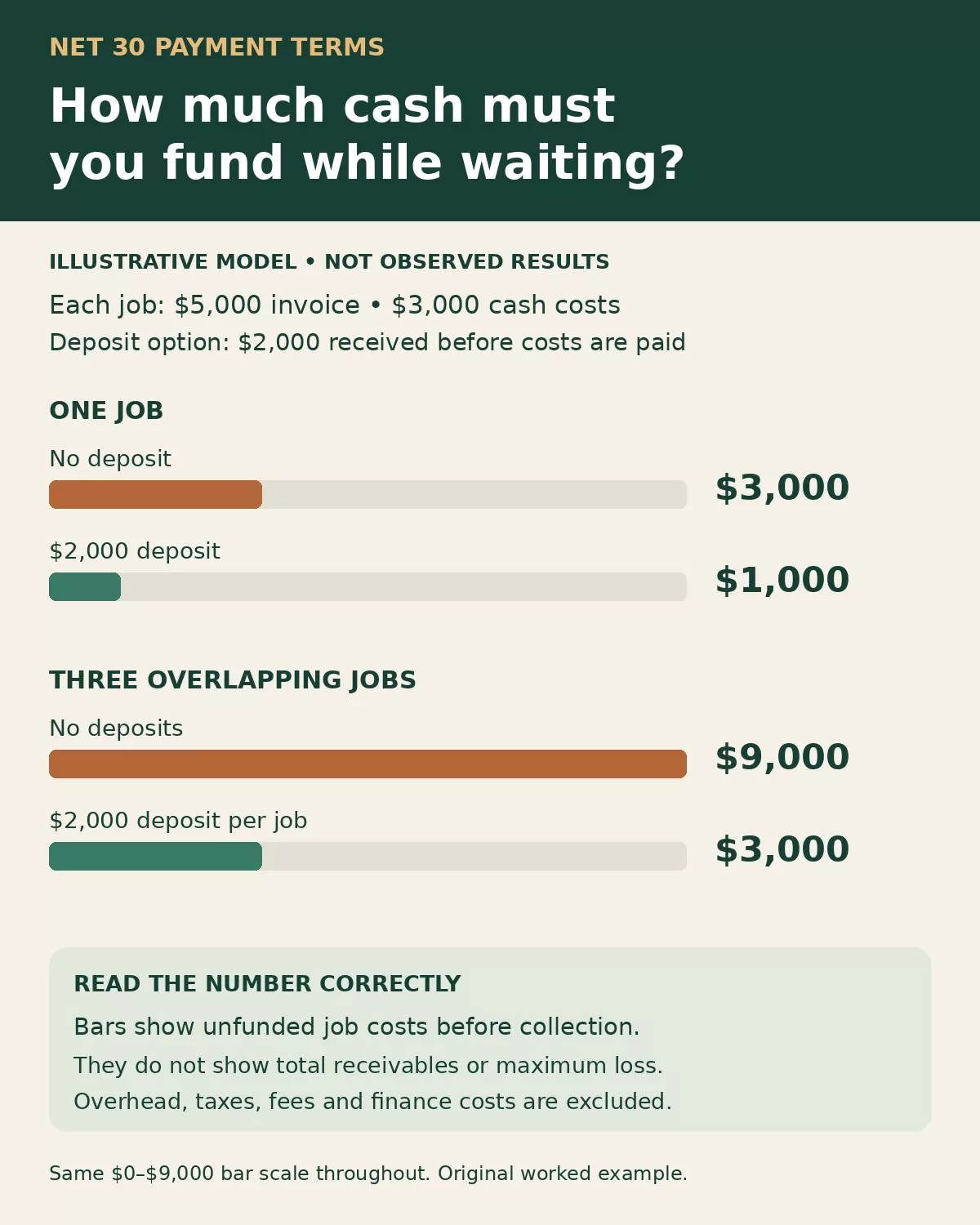
On the same scale, the chart shows how overlapping jobs multiply the cash required before collection. A deposit reduces that funding gap; it does not eliminate the unpaid balance or establish a customer’s ability to pay.
5. Decide which customer receives which limit
A payment period says when an invoice is due. A credit limit says how much unpaid exposure you will accept. You need both. A customer can have no overdue invoices and still owe more than you can comfortably fund.
In a proposed internal policy, an owner might approve a maximum open balance of $6,000 for a particular customer. If $5,000 is already unpaid, a new $4,000 order would take the total to $9,000. A rule checking only whether the existing invoice is overdue would miss that exposure.
Before accepting the second order, decide whether to require payment, obtain a deposit, reduce the order or approve a documented exception. The $6,000 limit here is illustrative; it is not a recommended limit for every business.
| Question | If the answer is uncertain | Possible response |
|---|---|---|
| Is the correct customer entity and payment contact established? | You may be billing the wrong party or sending invoices into an unmonitored queue | Resolve onboarding before extending terms |
| Is there a credible basis for expecting payment? | The sales opportunity is being treated as evidence of credit quality | Review suitable business references, records or other authorized evidence |
| Can you fund the expected and delayed cash gaps? | Routine bills depend on the buyer paying exactly on time | Consider a deposit, milestones or a smaller limit |
| Can staff see total unpaid exposure before accepting more work? | Several modest invoices could accumulate unnoticed | Create a shared balance and exception process |
Assign an accountable approver and a review date. Sales staff need a clear route for an exception rather than an informal promise that someone in finance will sort it out later. Record the reason for each exception and the maximum additional exposure it permits.
6. Understand early-payment discounts and late charges
“2/10 net 30” commonly offers a 2% discount if the qualifying payment is made within 10 days, with the full amount due within 30 days. Define the starting date and eligibility in the agreement. On an illustrative $5,000 invoice, the discount is $100 and the discounted payment is $4,900.
You are giving up $100 of revenue to encourage earlier collection in that example. Whether that is worthwhile depends on the cash benefit, margin and actual customer behavior. It is not free financing, and offering a discount does not guarantee that the buyer will use it.
Late charges require a separate review of the agreement and applicable law. Do not assume that writing a percentage on an overdue invoice makes it enforceable, or that one rate is valid for every state, customer and transaction. Establish any lawful charge and its calculation before relying on it as part of the arrangement.
Keep a contractual late charge separate from your operating response to a missed payment. Contacting the customer, investigating an invoice dispute and deciding whether to accept additional orders are distinct decisions. A growing fee balance does not solve the immediate cash shortage.
7. Build a small, reliable invoicing routine
When the agreed billing event happens, issue the invoice promptly through the customer’s required channel. Retain a submission record and check that the customer has the information needed to process it. Do not silently replace the original due date when resending a copy.
Use a shared record containing the invoice date, contractual starting event, due date, original amount, credit notes, payments received and remaining balance. Add a responsible person and the next action. Keep “invoice submitted,” “approved by customer” and “payment received” as separate states.
A proposed reminder sequence could include a brief pre-due check, a notice after the deadline, and a documented conversation when the expected payment does not arrive. Timing should match the agreement and relationship. Pause automatic reminders when they would repeat an inaccurate balance or ignore a genuine dispute.
Our overdue-invoice tracking guide explains how to maintain a collection queue. Use it alongside the original credit decision: collecting an old invoice and deciding whether to fund another order are related tasks, but one should not happen invisibly inside the other.
8. Review whether the arrangement is working
After a defined review period, compare agreed due dates with actual receipt dates. Track unresolved disputes, time spent chasing payment and balances above the approved limit. A customer who pays consistently after the deadline may require a different operating assumption from one who pays as agreed.
Look for causes before changing the terms. Missing purchase-order details may call for better order intake. Repeated invoice corrections may require a billing fix. A buyer refusing the agreed timetable may require renegotiation or a different credit decision.
Do not count more invoiced sales as proof that net 30 improved the business. Check what was collected, what remains exposed and whether the arrangement displaced more reliable work. A manageable customer relationship should be understandable to someone other than the person who originally approved it.
Final Thoughts: offer net 30 payment terms with a clear limit
Net 30 payment terms can fit a reviewed customer and a business that can fund the wait. They are a weaker choice when the agreement is vague, the buyer’s payment process is unresolved or each new order requires cash that you do not have available.
Start with a defined due-date rule, calculate the cash gap, set a customer-level exposure limit and assign the follow-up. If the numbers do not work, negotiate a deposit, milestones or shorter terms before delivery. The aim is a payment arrangement that supports the sale while keeping the next payroll and supplier bill fundable.