

A profit and loss statement for small business shows the income and expenses reported for a period and the profit or loss left after them. Read it from revenue through the main cost groups, then compare the result with a genuinely comparable period. Before acting, confirm the accounting basis and whether the books are complete. The bottom line alone cannot tell you how much cash is available to spend.
The most useful reading ends with a specific question: did the business earn less from each sale, spend more supporting operations, or simply report a different mix of transactions? Those explanations lead to different actions. Cutting advertising will not fix an invoice posted to the wrong month.
This is a research-based explainer using US government educational guidance checked on November 27, 2026. The worked figures are hypothetical and independently calculated; they are not a company’s results or an accounting-software test.
Start with the report settings
Read the business name, reporting dates, currency, and accounting basis before the amounts. A report for November 1–15 cannot be compared directly with a full October report. A year-to-date total also answers a different question from a single month’s performance.
Check whether the report covers the whole business or a selected location, department, or project. Keep a copy of those filters with the review. Otherwise, a missing branch can look like a sudden loss of sales.
Cash and accrual reporting can recognize transactions at different times. IRS Publication 583 describes cash-method income as generally reported when received, while accrual-method income is generally reported when earned; expense recognition also depends on the method and applicable rules. For a management comparison, establish which basis each report uses. This is not an instruction to select or change a tax accounting method.
Ask the person responsible for the books whether bank reconciliation, supplier bills, payroll entries, and period-end adjustments are finished. A report exported before those tasks are complete may be useful as a provisional view, but its apparent precision does not make it final. Our explanation of bank statements and accounting ledgers shows why bank activity and book entries require reconciliation.
Read a profit and loss statement for small business in layers
Start with net revenue: the sales amount after relevant returns, discounts, or allowances. Check the report’s labels rather than assuming every business presents those adjustments on separate lines.
Next locate cost of sales, often called cost of goods sold. Subtracting it from net revenue gives gross profit. Then inspect operating expenses and the operating result. Interest, other items, and any income-tax expense shown can take the report toward its final profit or loss. The SEC’s financial-statement guide explains this progression and the different jobs performed by income, balance-sheet, and cash-flow reports.
Use the subtotals as stopping points. If gross profit is disappointing, investigate the sales and direct-cost detail before looking for savings in office subscriptions. If gross profit holds up but operating profit falls, the next useful detail is the expense group below gross profit.
Classification matters. A cost moved from operating expenses into cost of sales can change gross profit without changing the final profit. Before interpreting a movement as better or worse performance, ask whether the same categories and treatment were used in both periods.
A worked example: higher sales, lower profit
Suppose a hypothetical business produces the following two completed, comparable monthly reports in US dollars. Cost classifications are unchanged. Operating expenses include all operating charges assumed for this example. There is no other income or expense beyond the interest shown; income taxes are deliberately excluded.
| Report line | Month A | Month B |
|---|---|---|
| Net revenue | $48,000 | $54,000 |
| Cost of sales | $22,000 | $28,000 |
| Gross profit | $26,000 | $26,000 |
| Operating expenses | $19,000 | $21,000 |
| Operating profit | $7,000 | $5,000 |
| Interest expense | $600 | $800 |
| Profit before income taxes | $6,400 | $4,200 |
Revenue rose by $6,000, or 12.5%. Cost of sales rose by the same dollar amount, leaving gross profit unchanged. The additional $2,000 of operating expenses and $200 of interest then reduced profit before income taxes by $2,200. The report is profitable in both periods, but the larger sales total did not produce a larger profit.
Gross profit divided by net revenue gives the gross profit margin used here. Month A is $26,000 divided by $48,000, about 54.2%; Month B is $26,000 divided by $54,000, about 48.1%. Those percentages describe this example, not an industry benchmark or a target every business should meet.
The numbers identify where to investigate. They do not establish why it happened. Lower prices, a different product mix, higher input costs, or a classification issue would require transaction-level evidence. Request the detail behind cost of sales and the changed expense accounts before choosing an explanation.
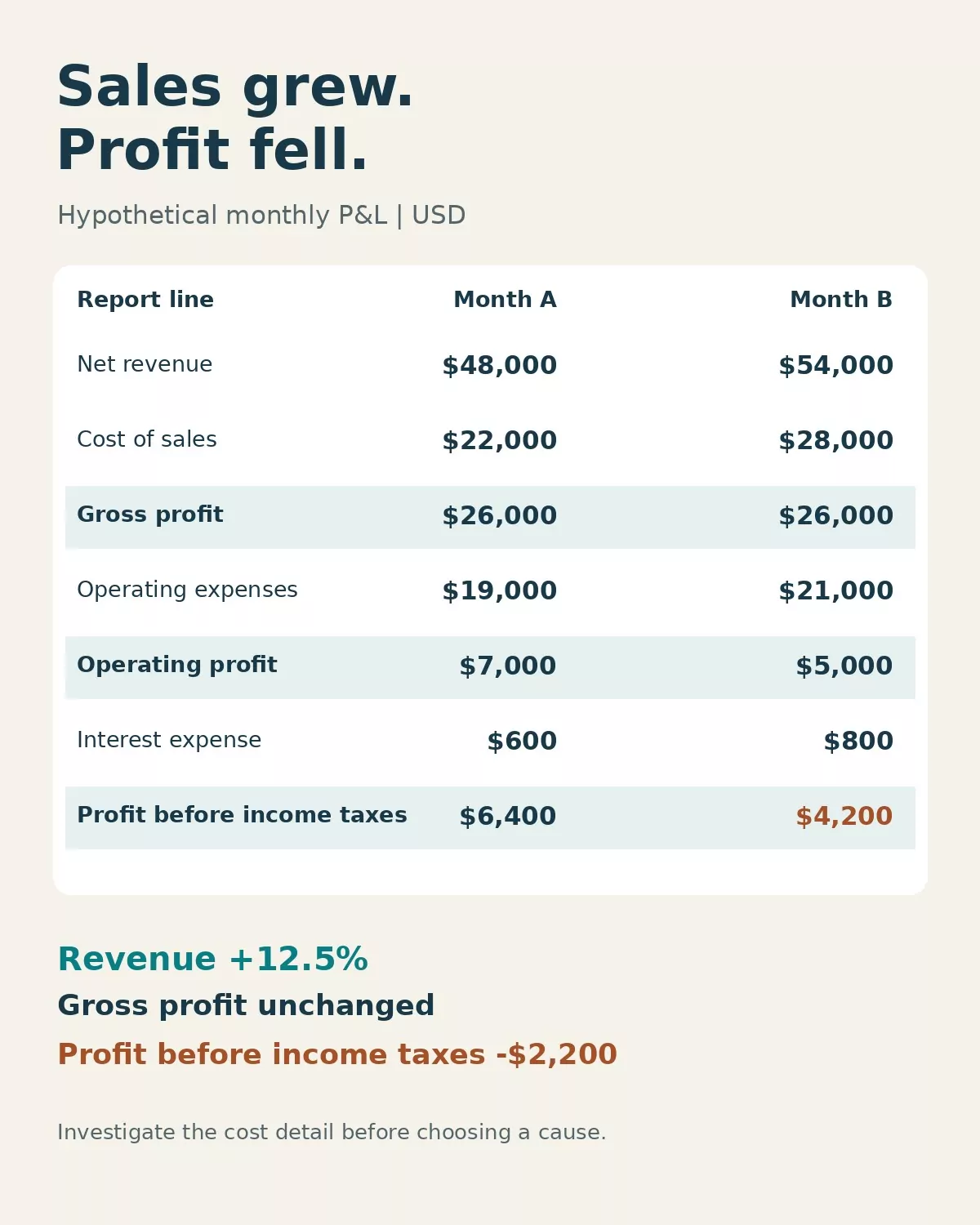
The $6,000 increase in revenue is absorbed by the same increase in cost of sales. Higher operating expenses and interest then reduce the remaining profit before income taxes.
Turn a variance into a checkable question
Compare both dollars and percentages. A large account can create a meaningful dollar movement from a small percentage change. A tiny account can show an alarming percentage change while having little effect on the result. When the earlier amount is zero, report the dollar change rather than presenting an undefined growth percentage.
| What changed? | Useful next record | Question to resolve |
|---|---|---|
| Revenue is different | Sales detail, returns, and posting dates | Was the change in activity, price, timing, or report scope? |
| Gross margin fell | Cost-of-sales detail and category mapping | Did the economics change, or did the classification? |
| Operating expenses rose | Supplier bills, payroll detail, and contracts | Is the movement recurring, one-time, missing earlier, or incorrect? |
| Profit and bank cash tell different stories | Cash-flow report, balance sheet, and reconciliations | Which receipts, payments, or noncash items explain the difference? |
This is a proposed review path, not a diagnosis. Give each material unexplained movement to someone who can inspect the underlying record. Record the explanation, supporting document, and next action so the same question does not return unanswered at the next review.
For seasonal activity, consider the same period in the previous year alongside the immediately preceding period. Explain changes in scope or opening days. A comparison should make the business easier to understand, not create a flattering growth percentage.
Profit is different from available bank cash
An accrual-based sale can be recorded before the customer pays. Depreciation can reduce reported profit without a matching cash payment in that period. Borrowing and repayment of loan principal also affect cash through financing activity. These are reasons to read the P&L with the other statements rather than trying to make its final number equal the bank balance.
Trace actual cash movements in the cash-flow report and verify the relevant balances. For upcoming payroll or supplier commitments, use a cash-flow forecast with expected receipt and payment dates. A historical profit figure does not confirm that an unpaid customer invoice will arrive before next week’s bill.
Likewise, this example’s $4,200 is profit before income taxes, not a calculated tax bill or an amount approved for an owner withdrawal. The entity’s reporting and tax position need their own review. Preserve the label when sharing the result.
Make the next review easier to trust
Keep the report version, filters, and supporting explanations together. The IRS’s business recordkeeping guidance connects reliable records with preparing financial statements and monitoring a business. If a line looks wrong, trace the source document and have the responsible person correct the books; do not edit only the exported presentation to make the result look cleaner.
A useful review note can be short: “Cost of sales increased $6,000; gross profit stayed at $26,000; the purchasing lead will reconcile supplier and sales detail before the pricing discussion.” That is an illustrative handoff, not a claim that higher supplier prices caused the change.
Use the profit and loss statement for small business to locate the question, the supporting record to test the explanation, and the cash view to assess payment timing. Finish with a documented action or an explicitly unresolved item, rather than treating a positive bottom line as permission to spend.