
To get your first 100 customers without paid ads, start with a buyer you can reach directly and an offer they can pay for today. Sell it yourself, help those customers get the result they bought, and track how each sale happened. Once the same type of customer starts buying for the same reason, look for referrals, partners, or search traffic that can bring you more people with that problem.
The first sale can come from a friend. The more revealing sale comes when a buyer who owes you no favor pays the ordinary price and uses what they bought. Start with people you can reach, then see whether the offer holds up outside that circle.
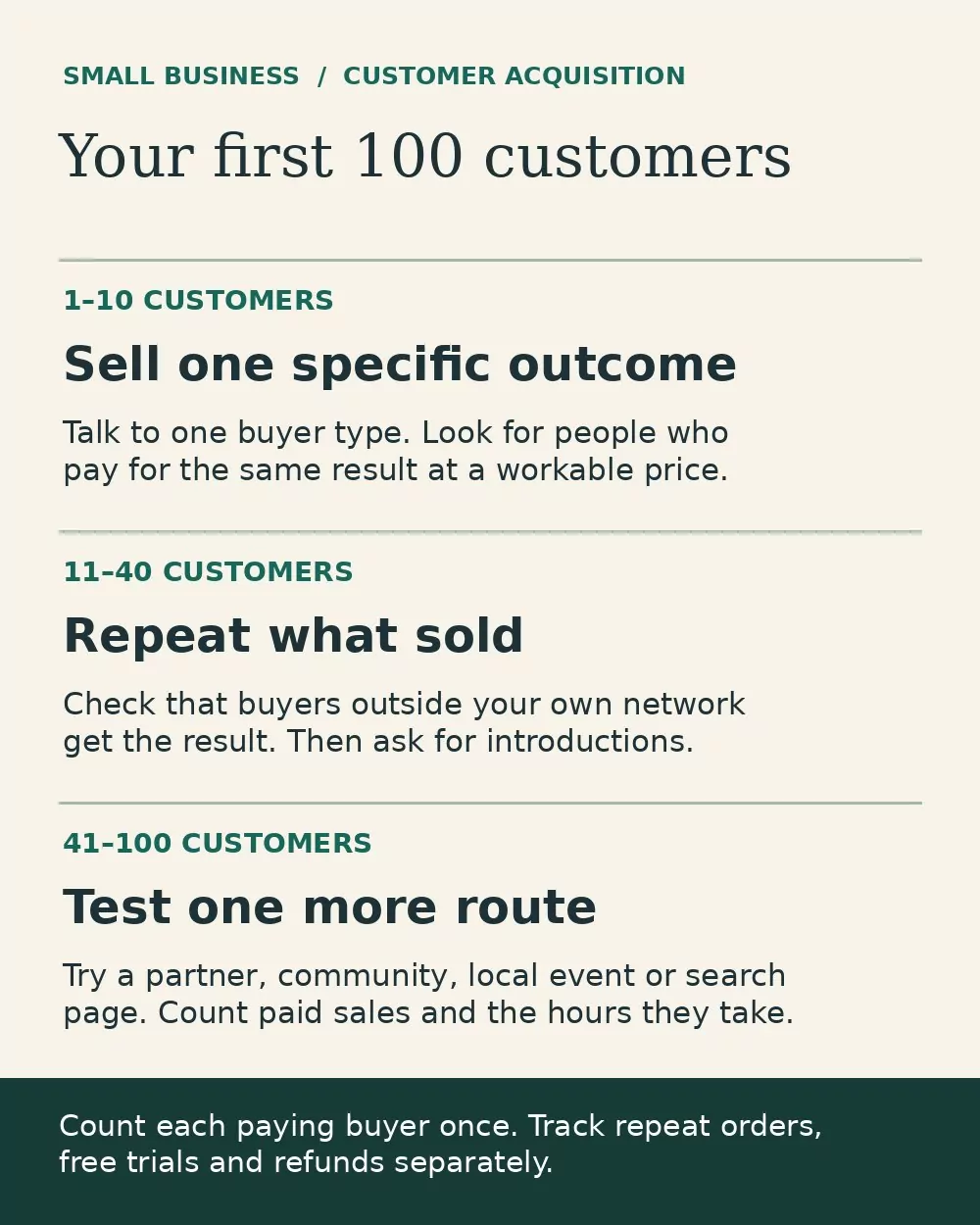
How to get your first 100 customers without paid ads in three stages
Count a customer when a distinct person or business makes a qualifying purchase. For B2B software, one company buying 12 seats normally counts as one customer. For a shop, a buyer making a second purchase is still one customer. Track free trials, waitlist signups, and refunds in separate columns. For this plan, exclude fully refunded first orders from the milestone tally and record them so you can investigate why they happened. For preorders, track paid orders and fulfilled orders separately.
The milestones below give you a reason to change what you do as you learn. Treat the ranges as planning checkpoints.
| Stage | What to do | What to check before expanding |
|---|---|---|
| Customers 1–10 | Speak directly to one type of buyer and offer a specific paid outcome. | Several buyers can describe the same problem and pay for a similar offer. |
| Customers 11–40 | Repeat the best route, improve onboarding, and ask satisfied buyers for introductions. | Buyers outside your immediate network purchase at workable prices and get what they came for. |
| Customers 41–100 | Build one more route through a partner, a relevant community, or content for people already looking for a solution. | You can trace sales to the route and support the new customers with the time and margin you have. |
Customers 1–10. Find the problem people are already paying to solve
Pick a narrow buyer and name the event that makes the problem urgent. “Small businesses that need help with reports” leaves you guessing. “Agency owners who spend the first Monday of every month assembling client reports” tells you whom to approach, when to ask, and what service might earn a first payment.
Ask prospects how they handled the problem the last time it came up. Who did the work? What tools did they use? Did anyone approve a budget? If the problem sounds frustrating but always falls below other priorities, keep looking. If the buyer can show you a spreadsheet, an overdue task, or an existing bill for a workaround, you have something concrete to discuss. For help choosing interview questions, the SBA’s market research guide outlines ways to research demand directly with buyers.
For a service or B2B product, offer a paid pilot with a scope the buyer can understand. For example, a reporting service could offer to produce one monthly client report from three agreed data sources for a fixed fee. Agree on the delivery date, who supplies access, and what the buyer will receive. A short engagement can reveal whether the customer values the output enough to pay again and how much effort you spend producing it.
Reach out through relevant introductions or one-to-one messages. Say why you chose that buyer, describe the offer, and make the next step easy. An introduction request can be specific enough for the other person to forward.
I’m looking to meet agency owners who still build monthly client reports by hand. I’m offering a fixed-price pilot to produce one report from their existing data. If someone comes to mind, would you ask whether they’d welcome an introduction?
Ask permission before someone shares contact details. If you use commercial email, check the rules that apply to your recipients and respect opt-outs. In the US, the FTC’s commercial email guidance covers business-to-business messages too.
For a local or consumer business, put the product in front of customers in a place where they can try or buy it. A small bakery might arrange a tasting with a neighborhood café and take orders for pickup. An online seller might invite a small group from an existing audience to try a new product and track paid purchases separately from samples. In an interview with Entrepreneur, Kosterina founder Katina Mountanos described getting early olive oil buyers through friends and family, then seeing reorders and referrals reach beyond that group. The practical signal was what customers did after trying it.
Customers 11–40. Find what made the first buyers say yes
Look back at the first sales. Write down what prompted each purchase, who made the decision, the price they paid, and what they used first. You may find that six people bought for one narrow use while the other four paid for unrelated custom work. Build the next offer around the use that repeated. Keep a clear scope so you can tell whether the underlying offer sells at the price you need.
Make new customers successful before asking them to send more people your way. For subscription software, define the first useful action, such as sending a live invoice or publishing a report. For a service, confirm that the agreed deliverable was accepted. For a consumer product, watch for returns, repeat orders where relevant, and what buyers tell you after delivery. Compare customers over the same period after purchase so last week’s buyers have a fair chance to act.
Ask for an introduction once the result is clear. Give the customer a description of who would benefit and permission to decline.
I’m glad the monthly report is ready to send. Do you know another agency owner who still assembles these by hand? If so, would you be comfortable forwarding the pilot details?
A simple CRM follow-up workflow can remind you when a buyer agreed to reconnect. Record introductions that turn into conversations and conversations that turn into paid orders. A few customers who bring you business can be more useful to study than dozens who give you a high satisfaction score. Before turning on a referral discount, try a straightforward ask. If you introduce a reward later, include that cost when judging the channel.
Customers 41–100. Add a channel that reaches the same buyers
Keep the route that is already working. When you have capacity to test another one, choose it based on where your buyers already seek help. A partner can help when the customer already pays someone to handle a related problem. A community can help when buyers ask questions there. Search content can help when buyers use recognizable phrases to look for a solution. Test one route long enough to see whether it produces qualified opportunities and purchases.
| Route | A first test | What to measure |
|---|---|---|
| Partner introductions | Ask an adjacent business to introduce you to a few customers who have the problem you solve. Give the partner a short explanation they can forward. | Introductions that led to qualified conversations, paid orders, and delivery work you can support. |
| Customer communities | Answer a question you know well. If the rules allow it, share a relevant example or invite people who ask for help to contact you. | Conversations with people in your target market and the purchases that follow. |
| Search content | Turn a recurring buying question into a worked example, a comparison, or a pricing page with a clear next step. | Qualified inquiries and paid orders from that page after it has had time to be found. |
| Local discovery | Run a small demo or tasting with an established local business that serves the same buyers. Give attendees a clear way to order. | Unique paying buyers and repeat orders where the product lends itself to repeat purchases. |
A reporting service could partner with a consultant who sets up agency analytics. The consultant handles the setup. The reporting service takes over the monthly work once the client has working data. Agree on who owns the handoff and what each side will promise the customer before making introductions. If the customer needs a service the partner already sells, find a different partner or a different referral scenario.
If buyers keep asking whether their existing spreadsheet can handle the job, publish a walkthrough showing when it can and where teams tend to run into more work. Include the price and scope of your service where they help a reader decide. A well-matched page gives a prospect something to use before contacting you and a concrete reason to reach out if the work is still a problem.
Track where people stop before you increase volume
Keep a simple sheet with the date, buyer type, source, offer, next step, outcome, first payment, and notes on any refund or lost sale. Use the same unit for each row and count each new customer once. Ask buyers how they first heard about you. If you move the sheet into a CRM, use a consistent source field so you can group buyers by how they found you. If a partner made the introduction and an article helped close the sale, record the partner as the source and note the article as an assist. You can then compare channels without counting the sale twice.
Suppose 120 well-matched prospects produce 24 replies, 12 completed conversations, and four paying customers. That’s four customers from 120 initial contacts, or about 3.3% in this example. The numbers give you places to look. With 12 replies that led to no conversation, read those replies and check the next step you offered. With eight completed conversations that didn’t turn into a sale, review urgency, price, and who could approve the purchase. A channel with four paid sales is still a small sample.
Time matters as much as the cash cost of a channel. If four new customers take 20 hours of research, outreach, and demos, that’s five acquisition hours per customer. Track onboarding separately. A $49 sale that needs five hours of selling and another two hours of setup would be hard to repeat unless later purchases or renewals support it. Record referral fees, samples, and event expenses too. You can run without paid ads and still spend real money acquiring customers.
What to do over the next four weeks
- In week one, choose one buyer type and one problem. Speak to a few people who recently dealt with it, then write a price and defined outcome for the first offer.
- In week two, ask for introductions, send a manageable batch of relevant messages, or put the offer in front of buyers at a small event. Follow up with interested buyers and record which ones pay, decline, or need more time.
- In week three, onboard the customers you earned. Check whether they get the first useful result, record objections and refunds, and ask for introductions where the work has gone well.
- In week four, compare paid sales and the hours each route took. If buyers paid, got a result, and resembled each other, repeat the strongest route. If offers went out and stalled, fix what held buyers back before pursuing more leads.
Use weeks as review points. A business customer may need several weeks to approve a purchase. A market stall can collect payments in a day and need longer to see whether buyers return. Decide how long your offer takes to buy and use before reaching a verdict on the channel.
If you want to get your first 100 customers without paid ads, use the milestone to answer a question you’ll face well before customer 100. Can you name the buyer, explain why they paid, and show how you’ll reach the next one at a cost the business can support? Each sale that helps you answer that question makes the next batch easier to plan.